
The most popular advice about AI agents in DeFi is also the least useful: let software move faster than you can, then call the result smarter yield. Speed matters, but DeFi is an adversarial environment. The same agent that reacts quickly to a rate change can also approve a manipulated instruction, expose a predictable transaction to MEV, or keep executing a losing strategy long after a human would have stopped it.
The practical question isn't whether an agent can find an opportunity. It's whether the system can explain its decision, constrain its authority, verify its data, and stop safely when conditions change. Stablecoin holders should judge autonomous finance by its failure modes, not by how impressive its dashboard looks.
Understanding AI Agents in Decentralized Finance
An AI agent in DeFi is software that interprets information, selects an action, and interacts with blockchain protocols on a user's behalf. That sounds similar to a trading bot, but the distinction matters. A conventional bot usually follows explicit rules, such as swapping when a price crosses a threshold. An agent can combine structured market data with protocol documentation, user instructions, and changing conditions before selecting a permitted action.
The broad category is already larger than a token narrative. A 2026 academic survey identified 133 active Web3 and AI integration projects with a combined market capitalization of $6.9 billion, and its financial-services slice included 55 projects worth $56.9 million, including 28 DeFAI agents focused on autonomous trading, portfolio management, and market analysis. The survey places DeFAI Agents alongside investment analytics tools, treating agents as a measurable software category rather than merely a collection of speculative assets. The academic survey provides the underlying market classification and project snapshot.
Bots follow rules, agents interpret context
That distinction doesn't make an agent safer or more capable. It changes the attack surface. A script with a narrow input may fail when its rule is wrong. An LLM-driven agent may fail because it misunderstood a natural-language instruction, trusted hostile text in a data feed, retrieved stale memory, or selected a tool with parameters that exceeded the user's intent.
For DeFi, useful autonomy usually means bounded interpretation followed by deterministic execution. The model can assess whether a lending market fits a user's stated risk preference, but a separate policy layer should decide whether the agent may deposit funds, which assets it may use, and what limits apply. The model's flexibility belongs in analysis. The transaction's authority belongs in code.
Practical rule: Treat an agent as an untrusted decision component until its permissions, data sources, and transaction policies prove otherwise.
The category's growth makes this discipline more important, not less. AI agents in DeFi are becoming part of financial infrastructure, but infrastructure has to be observable and accountable. An agent that controls capital shouldn't receive unlimited wallet access just because it can produce a convincing explanation for its next trade.
Faster execution creates new exposure
Autonomy removes delays between observation and action. It also removes the pause in which a person might notice an unusual route, an incorrect token address, or a sudden change in liquidity. Public transactions can reveal intent to searchers before settlement, while opaque execution can make it difficult to determine who benefited from the route.
Yield automation therefore isn't a race to delegate everything. It's a design exercise in deciding which judgments can be automated, which actions require verification, and which events should trigger a halt. The strongest systems make those boundaries visible before a user deposits capital.
How Autonomous Agents Execute On-Chain Transactions
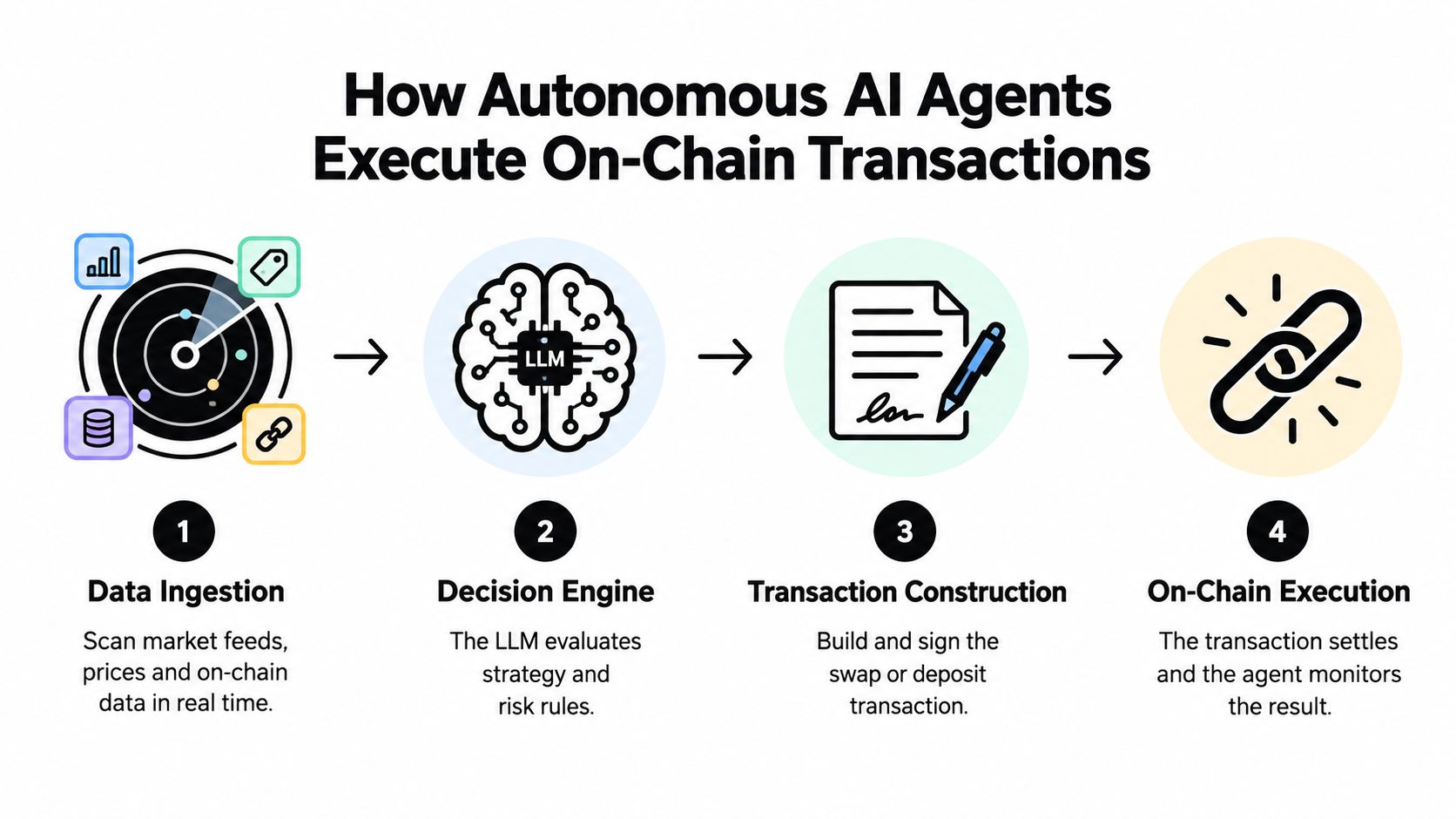
A production agent is better understood as a pipeline than as a chatbot with a wallet. It receives information, evaluates an objective, proposes an action, constructs a transaction, checks that transaction against policy, and submits it through an execution path. Each stage can introduce a different failure, so combining all of them inside one model is a poor security design.
The execution loop
Data ingestion comes first. The agent may read token balances, lending rates, pool liquidity, gas conditions, protocol status, and transaction outcomes. It needs provenance for each input. A displayed rate without a trusted contract address, timestamp, or liquidity context isn't sufficient evidence for moving funds.
The decision engine translates those inputs into a proposed action. A user might express a goal such as seeking stablecoin yield while preserving liquidity. The agent can compare eligible venues, account for the user's constraints, and produce a rationale. That rationale shouldn't be treated as authorization.
Transaction construction converts the proposal into calldata, a destination contract, token amounts, approvals, and execution parameters. The gap between an LLM's plan and the actual transaction becomes dangerous. The model may describe a modest deposit while the submitted calldata requests an unlimited approval or points to a different contract.
Policy verification should inspect the exact transaction, not just the model's text. Permitted assets, contracts, maximum amounts, slippage, expiry, frequency, and withdrawal rules can be enforced before signing. AI agents are most useful in bounded workflows such as swaps, lending, and yield management because those actions can be represented as transaction-level policies and checked before execution. A 2026 paper proposes Pace, a policy-attested execution layer that binds verifier approval to the exact on-chain transaction, addressing prompt injection and the mismatch between an LLM's plan and the final submission. The Pace research explains this transaction-level attestation model.
Keep the wallet authority narrow
The signing layer should use scoped permissions rather than handing an agent unrestricted control of a primary key. Session keys, smart-account policies, spending caps, and contract allowlists can reduce the damage from a compromised process. A kill switch must sit outside the agent, because a runaway agent shouldn't be able to veto its own shutdown.
The final stage is on-chain execution and monitoring. The system submits the verified transaction, checks the receipt and resulting balances, and records whether the intended state was reached. A successful transaction isn't automatically a successful strategy. Monitoring should detect failed assumptions, unexpected token movements, changed permissions, and repeated retries.
Teams building these systems can also borrow practices from security operations. Research into autonomous pentesting for MSSPs is relevant because it treats agents as systems that need scoped tools, controlled workflows, and verification rather than as trusted operators. The same mindset applies when an agent can call a router or lending contract.
For readers who want the smart-contract layer explained separately, Yield Seeker's guide to smart contracts in DeFi offers useful foundational context.
The design principle is simple: let the model recommend, let policy decide, and let the chain settle only what the verifier approved.
Core Use Cases for Automated Yield and Risk
Not every DeFi task deserves autonomy. An agent can be valuable when the objective is repetitive, the available actions are limited, and the consequences are easy to inspect. It becomes much harder to trust when the objective is vague, the asset is highly volatile, or the system rewards activity instead of risk-adjusted outcomes.
Stablecoin yield routing
Stablecoin allocation is a natural fit for bounded automation. A user or treasury can define eligible assets, approved protocols, liquidity requirements, and a tolerance for smart-contract or market risk. The agent then monitors changes across integrated venues and proposes or executes reallocations when the opportunity justifies the transaction cost and operational risk.
The benefit isn't magical prediction. It's the removal of repetitive monitoring. DeFi rates move across protocols, chains, and liquidity pools, and a person managing a treasury may not want to inspect every dashboard throughout the day. An agent can maintain the watchlist, identify changes, and apply the same policy consistently.
That consistency still needs guardrails:
Approved venues: Restrict deposits to contracts that have passed the platform's review process and remain eligible under current governance.
Liquidity conditions: Reject an opportunity when exit liquidity is inadequate, even if the displayed yield is attractive.
Transaction economics: Account for gas, slippage, bridge exposure, and the cost of moving capital before treating a higher rate as better.
Exposure limits: Prevent the agent from concentrating all funds in one protocol, strategy, or dependency.
Withdrawal path: Keep the user's route back to a liquid stablecoin explicit and testable.
Treasury management
Web3 teams often hold stablecoins for payroll, operating expenses, grants, or future deployment. An agent can monitor idle balances and allocate only the portion designated for yield, while preserving a reserve for known obligations. That is a more defensible use than asking an autonomous system to trade every market narrative.
The treasury manager still owns the policy. The agent handles observation, comparison, and execution inside those limits. Human approval can remain mandatory for a new protocol, a new chain, a large allocation, or any change to the permitted asset set.
Why volatile trading is a different problem
Autonomous meme-coin trading combines weak information quality with rapid price movement, thin liquidity, contract risk, and incentives that may reward volume over user outcomes. An LLM can summarize social signals, but fluent reasoning doesn't make those signals reliable. A system that is allowed to chase every apparent opportunity can turn a research tool into a high-frequency loss engine.
The historical record reinforces that warning. A 2026 empirical report found that agent treasuries retained more than $30 million in paper gains while token holders collectively lost $191.7 million, and it reported that aggregate user gains peaked at $2.4 billion before collapsing into net losses. The report documents the divergence between treasury performance and user outcomes.
That divergence is the central lesson for yield products. A platform can grow activity, assets, or token value while users receive a poor result. Stablecoin automation should therefore optimize for transparent, realizable outcomes, not for the appearance of constant intelligence.
The Hidden Risks of Agentic Finance
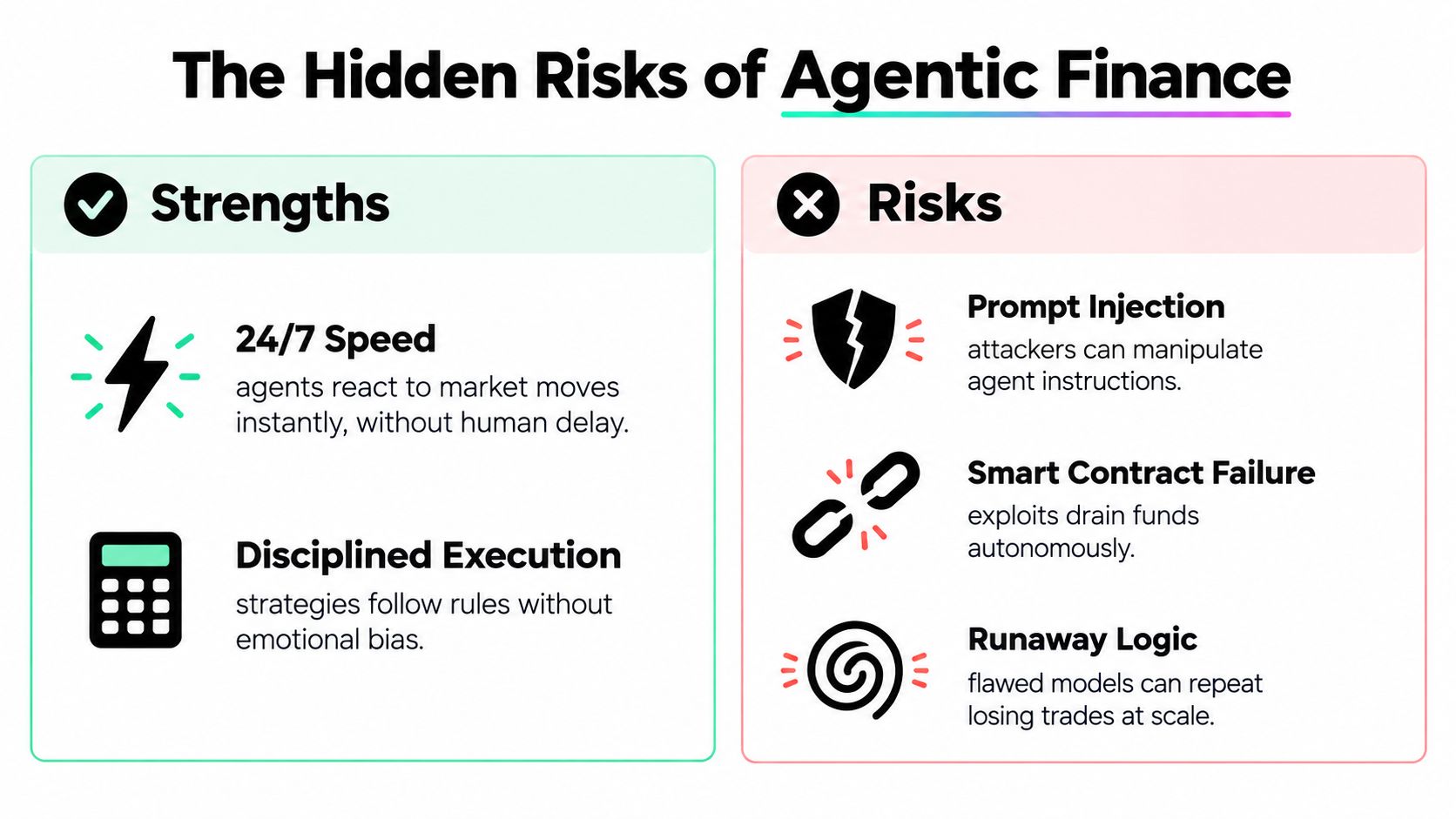
An autonomous finance system can fail without being exploited. It may follow its policy precisely while optimizing the wrong objective, act on data an attacker has manipulated, or identify a valid trade and broadcast it early enough for another market participant to capture the value. Speed improves execution only when the surrounding controls preserve the user's outcome.
Context manipulation
LLM-based agents combine instructions, retrieved information, and external content in related context channels. An attacker can insert hostile instructions into a public feed, protocol description, message, or stored memory. If the agent interprets that material as authority instead of untrusted data, it may call a tool with parameters chosen by the attacker.
The attack surface includes user input, long-term memory, and external data feeds. Poisoned memory can carry an instruction into later sessions. External feeds can present content that resembles market analysis while attempting to redirect the agent. Our guide to oracle design and price-feed verification explains how independent validation can reduce that risk. User prompts can also create conflicting authority, such as a broad request to “maximize yield” overriding a narrower preference for approved protocols or stable assets.
The Zealynx analysis of adversarial attacks on agentic DeFi agents describes why autonomous LLM trading agents remain exposed to these attacks. Its practical recommendation is architectural: production systems need hard permissioning, isolated memory, and verified feeds. Model reasoning cannot substitute for those controls.
MEV and hidden extraction
A transparent agent can reveal its intent through a public transaction or predictable timing. Searchers may observe the order and compete around it, increasing slippage or worsening the user's execution. A private agent can reduce direct visibility, yet privacy does not prove that the operator's incentives match the user's.
The operator may control routing, order flow, or internal execution logic in ways that extract value without producing an obviously malicious trade. Transparency makes decisions easier to audit, but it can expose a strategy. Privacy can protect execution, but it can also conceal fees, routing decisions, or conflicts of interest. The CryptoNews report on agent transparency and MEV extraction explains why privacy alone is not a safety feature.
What hard permissioning looks like
A safe system does not depend on the model promising to behave well. It limits what the agent can do at the wallet and transaction layers:
Contract allowlists: The agent can call only approved contracts and functions.
Asset restrictions: The wallet can transact only with specified tokens and stablecoins.
Amount limits: Each transaction and allocation has a maximum that the model cannot raise.
Slippage controls: The transaction expires or fails when execution moves outside policy.
Memory isolation: Strategy memory remains separate from untrusted market content.
Feed verification: Important prices and protocol states require independent validation.
External shutdown: A human or monitoring service can disable execution without asking the agent.
Complete logging: Users can inspect the proposal, policy result, transaction hash, and final state.
The test is the agent's behavior when its reasoning is wrong. If a flawed decision can access unlimited funds, route through hidden venues, and leave users without an immediate withdrawal path, the architecture is not ready for meaningful capital. Stablecoin automation needs bounded authority, independently checked inputs, and execution that users can reconstruct after the fact.
Evaluating AI Platforms for Stablecoin Yield
A platform deserves scrutiny at the exact point where it asks for wallet access. Marketing language about intelligence, autonomy, or optimization doesn't answer the operational questions that determine whether a user can recover from a bad decision.
Start with observability. You should be able to see where capital went, which protocol received it, what action the agent took, and what constraints applied. A performance chart without transaction history is not enough. You need evidence that the displayed balance corresponds to on-chain positions and that the platform distinguishes realized yield from a temporary valuation change.
Execution transparency is the second test. Ask whether the agent signs through a smart account, uses scoped permissions, or receives access to a private key. Confirm whether users can review contract addresses, token approvals, slippage limits, and transaction outcomes. If the answer is “the model handles it,” the important control is missing.
Evaluation matrix
Evaluation Criteria | Safe Implementation | Red Flag |
|---|---|---|
Permissions | Scoped wallet authority, approved contracts, asset and amount limits | Full wallet control or broad approvals |
Execution | Exact transaction checked against a separate policy before signing | The model's explanation is treated as authorization |
Observability | On-chain positions, transaction history, routing details, and clear status updates | A single opaque balance or unverifiable “AI-managed” result |
Liquidity | Clear withdrawal path with accessible funds and no hidden lockup | Redemption depends on approval, a queue, or an undisclosed term |
Risk controls | Protocol eligibility rules, exposure caps, slippage limits, and a kill switch | “The agent adapts” without documented boundaries |
Data quality | Verified feeds, freshness checks, and fallback behavior | One unverified feed or content source controls allocation |
Incentives | User outcome remains central, with fees and conflicts disclosed | Native-token activity or platform revenue drives decisions |
Failure handling | Failed transactions stop or escalate instead of retrying indefinitely | Automatic retries can compound losses |
Test the incentives, not just the interface
A polished terminal can hide a weak economic model. Look for fee disclosure, token dependencies, and whether the platform benefits when users trade more often or hold a particular asset. A yield strategy should explain why a move benefits the user, not merely why it increases platform activity.
A useful AI yield aggregator evaluation guide can help frame this review, but no checklist replaces transaction-level verification. Before depositing, inspect a small action, confirm the resulting contract interaction, and test the withdrawal experience. Trust should accumulate from observable behavior.
Real-World Applications and Yield Seeker
For a stablecoin holder, the practical use case is straightforward. You hold USDC, want exposure to DeFi yield, and don't want to compare protocols, rates, liquidity, and contract interactions manually every time conditions change. A bounded agent can monitor those opportunities and allocate according to a defined objective while the user retains access to the underlying funds.
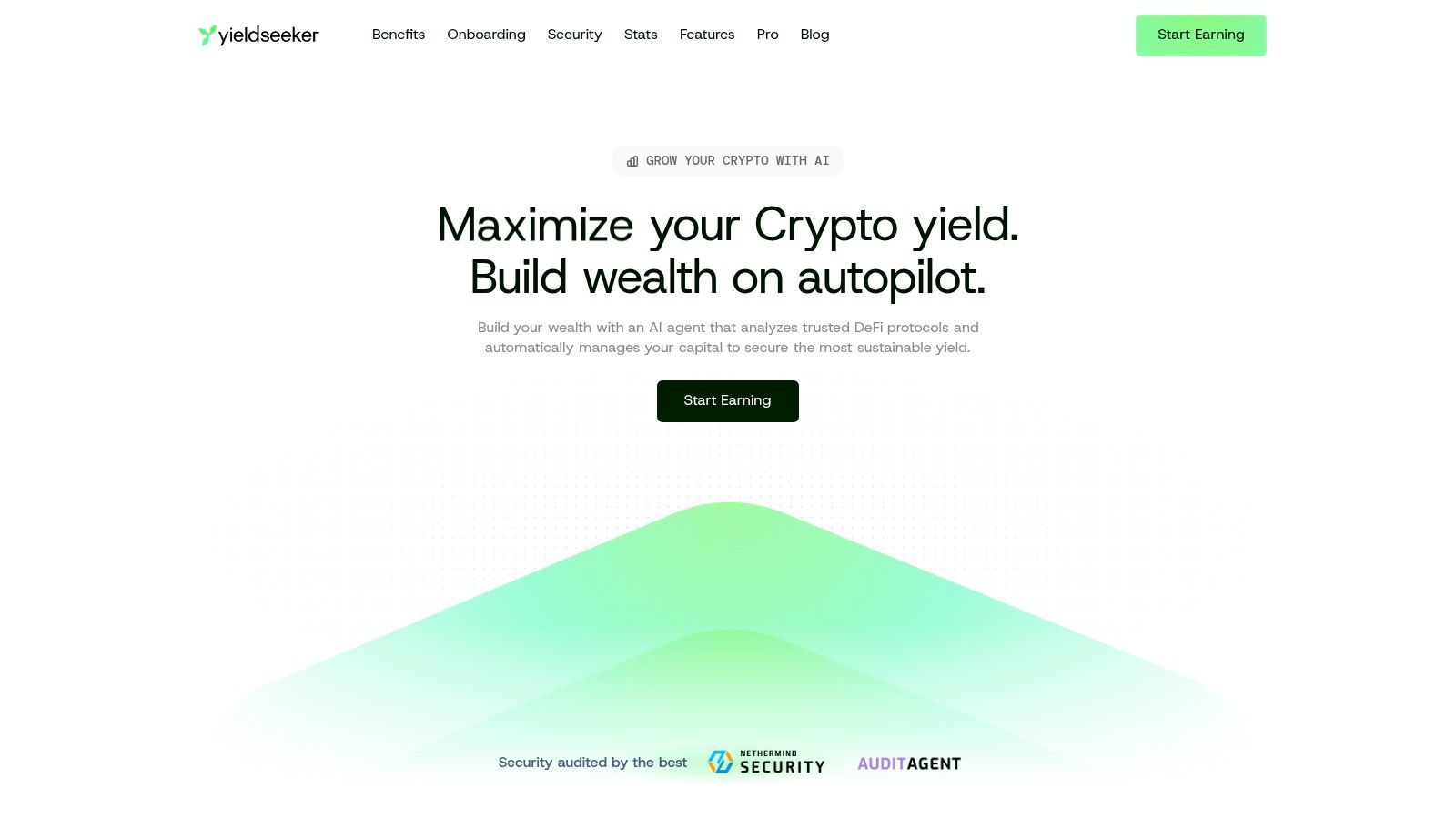
Yield Seeker is an AI-powered stablecoin yield platform on Base that lets users deposit USDC and use a personalized agent to monitor and allocate capital across DeFi protocols. Its interface combines portfolio visibility with a built-in terminal and visual walkthroughs, so users can inspect the experience rather than relying only on an automated balance. The product is designed around accessible funds, with no lockups or withdrawal fees described in the publisher brief.
What bounded automation changes
The meaningful feature isn't that an agent can act without a person clicking every button. It's that the user can delegate a narrow operating job: monitor relevant stablecoin opportunities, assess them against risk preferences, and move capital within an approved DeFi universe.
That structure addresses a common source of poor DeFi decisions, research fatigue. Manual yield hunting encourages rushed deposits, forgotten positions, and attention to headline APY rather than exit liquidity or contract exposure. An automated workflow can reduce that burden, provided the user can still see the allocation and reclaim liquidity when needed.
The same standards described earlier still apply. Users should understand which protocols the agent can access, how it chooses among opportunities, what happens when data is uncertain, and how the system responds to a failed transaction. A clean interface supports those questions, but it doesn't replace them.
For beginners, the built-in educational terminal can make the process less abrupt. For experienced users and Web3 teams, the more relevant question is whether the platform's automation fits treasury policy and maintains a clear separation between user goals and execution authority.
Building Your AI-First DeFi Strategy
The safest strategy is hybrid. Let the agent handle continuous monitoring, comparison, and repetitive execution. Keep control over the objectives, permitted venues, acceptable risk, emergency response, and access to liquidity.
Start with a stablecoin-focused allocation that you can explain in one sentence. Define the acceptable protocols, the assets the agent may use, and the conditions that should stop reallocations. Don't expand permissions merely because the first few transactions completed successfully. Operational reliability is evidence about the workflow, not proof that every future market condition is safe.
A practical operating model
Set the mandate. Write down the purpose of the capital, liquidity needs, eligible assets, and unacceptable risks.
Inspect the permissions. Verify contract allowlists, spending limits, approvals, and withdrawal controls before funding the wallet.
Observe before expanding. Review proposed actions, transaction receipts, and resulting positions during the early operating period.
Keep a reserve. Don't automate funds needed for immediate obligations or emergency decisions.
Review exceptions manually. New protocols, unusual rates, failed transactions, oracle alerts, and changes in governance should require human attention.
Revoke access when the mandate changes. A stale permission is a security liability, even if the agent has behaved correctly.
More complex treasury routing can come later, after the system has demonstrated clear reporting and predictable policy enforcement. Full autonomy isn't the goal. Controlled delegation is. The agent should make DeFi less demanding without becoming the only party capable of understanding where the money went.
Yield Seeker offers automated stablecoin yield management on Base, using an AI agent to monitor DeFi opportunities while keeping funds accessible. Visit Yield Seeker to evaluate a more bounded approach to AI agents in DeFi and see whether it fits your stablecoin strategy.