
Most readers looking for automated business examples are stuck in the same spot. They want passive income, but they also know most “set it and forget it” advice falls apart the moment markets move, fees spike, or a protocol changes its incentives. In Web3, bad automation doesn't just waste time. It can leak yield, increase risk, and leave capital parked in the wrong place.
The better model is intelligent automation. That means software handles repetitive execution, while rules, alerts, and review loops keep the system aligned with your goals. That distinction matters. More than 66% of organizations worldwide have implemented automated business processes in at least one area, and the BPA market is projected to reach $23.9 billion by 2029. Automation is no longer niche. It's standard operating infrastructure.
Web3 pushes that idea further because capital, settlement, and logic can all live on-chain. Smart contracts can rebalance positions, auto-compound rewards, react to oracle data, and route funds without waiting on operations teams. AI adds another layer by ranking opportunities, filtering noise, and helping operators avoid purely mechanical decisions.
But there's a catch. Most “automated” systems still need oversight. One analysis argues that 80% of automated systems require continuous monitoring and 65% of businesses fail to automate successfully without regular performance tracking. That matches what builders see in practice. Good automation replaces clicks. It doesn't replace judgment.
Here are 10 automated business examples built around that reality, with a focus on DeFi-native models that can scale.
1. AI-Powered Automated Yield Aggregation
This is one of the strongest Web3-native business models because it solves a real user problem. Stablecoin holders want yield, but they don't want to monitor fragmented protocols, compare changing rates, and move funds manually every time conditions shift.
An AI-powered yield aggregator accepts deposits, evaluates opportunities across lending venues and vaults, then reallocates capital according to a ruleset. In practice, that often means stablecoins moving among strategies tied to products like Yearn Finance vaults, Aave supply markets, Balancer pools, or chain-specific opportunities. The business earns through management logic, distribution, or platform fees, while the user gets a cleaner experience.
What makes it work
The edge isn't “AI” by itself. The edge is disciplined automation around protocol selection, risk limits, and explainability. A useful example is this breakdown of an AI yield aggregator, which shows the model as a live capital allocation system rather than a dashboard with marketing copy.
I'd build this with three layers:
Strategy layer: rank protocols by net yield, liquidity profile, smart contract risk, and sustainability
Execution layer: rebalance only when the expected improvement justifies fees and slippage
Oversight layer: log every decision so humans can review why capital moved
Practical rule: If the system can't explain why it changed allocations, don't trust it with real treasury size.
Security matters more here than in simpler automated business examples because the platform touches user funds, protocol approvals, and transaction routing. Teams building these systems should think seriously about AI-driven security for modern applications, especially when agents have authority to trigger on-chain actions.
What doesn't work is blind auto-rotation into whatever pool shows the highest headline yield. That's how users get trapped in unsustainable incentives.
2. DeFi Protocol Yield Farming Automation
Some automation models don't need AI at all. They just need clean execution. Yield farming automation falls into that category.
At the simplest level, this business deposits assets into protocols such as Aave, Compound, Morpho, or liquid staking products like Lido, then automates the ugly operational work. It claims rewards, handles approvals, redeposits proceeds, and keeps compounding without asking the user to babysit the position every few days.

Manual compounding is often inefficient. Chainlink's review of DeFi yield automation explains that automated vaults reduce the cost of repeated user actions by batching transactions, and it notes examples where centralized automated vaults compound rewards for stablecoin pools averaging 20% to 30% APY. The underlying logic is simple. If every user has to claim, swap, and redeposit individually, fees and friction eat into returns.
Where operators get tripped up
The business model works when operators optimize for net outcomes, not gross yield screenshots.
Check fee drag first: gas, performance fees, and routing costs can turn a strong strategy into a mediocre one
Watch governance changes: reward emissions and collateral rules can shift quickly
Keep the UX plain: if users need a tutorial to understand deposits and withdrawals, adoption slows
The best version of this model feels boring. That's a compliment. Boring automation keeps users in strategies they understand and lets the compounding happen in the background.
3. Algorithmic Stablecoin Yield Optimization
Capital efficiency starts to matter more than raw APY. Instead of chasing directional bets, an automated engine looks for stablecoin-specific inefficiencies across DEXs, lending venues, and liquidity pools.
A practical version monitors USDC, USDT, and DAI routes, checks whether swap spreads exceed fees, and executes when the edge is real. It can also route idle stablecoins into higher-yield stablecoin venues while maintaining a mostly stable value profile. For operators serving busy professionals or treasury managers, that's often more attractive than volatile token strategies.
Why this model is attractive
Stablecoin users usually don't want surprise exposure. They want cash-like positioning with better utilization. A good algorithmic engine can provide that by combining routing logic, spread thresholds, and reserve rules.
For a closer look at the mechanics, this algorithmic stablecoin overview is the kind of architecture worth studying. The useful parts are the threshold logic and the insistence on only executing when the spread clears all-in costs.
Automated stablecoin strategies work best when they reject most possible trades. Selectivity is the product.
What doesn't work is building around tiny, noisy edges and pretending they'll scale. The system needs deep enough liquidity, disciplined transaction timing, and a hard minimum return threshold. Otherwise the bot is active but not profitable, which is a common failure mode in automated business examples that look elegant on paper.
4. Automated Portfolio Rebalancing Engines
Rebalancing isn't flashy, but it's one of the cleanest automation businesses you can build. The premise is straightforward. Users define target allocations across assets or strategies, and the engine restores those weights when drift moves outside preset bands.
That can apply to a personal stablecoin portfolio, a multi-protocol treasury, or a DeFi-native index product. Balancer and Index Coop show the broad design pattern. The operator doesn't need to predict markets perfectly. They need reliable rules for when and how to trade back into balance.

The business case
This model sells discipline. That's valuable because many users know their target allocation, but they still don't execute consistently when markets move. A rebalancing engine turns policy into automatic action.
One useful implementation path is an AI-assisted allocation system paired with a rules engine like the one discussed in this yield rebalancing engine write-up. The key is to separate recommendation from execution. Let the model suggest changes, but keep guardrails around turnover, slippage, and concentration.
Use drift bands: constant rebalancing can create fee churn
Limit complexity early: two or three sleeves beat eight underfunded micro-allocations
Review allocations on a schedule: the engine can trade automatically, but strategy assumptions still need human review
What doesn't work is over-optimizing every tiny portfolio movement. The whole point is disciplined maintenance, not hyperactivity.
5. Smart Contract Automation with Oracle-Triggered Actions
This is the model that feels the most “on-chain native.” A smart contract holds the business logic, and oracle inputs determine when actions fire. If a yield threshold drops, a collateral ratio weakens, or a market condition changes, the system executes a pre-approved response.
MakerDAO liquidation logic helped normalize this pattern. Aave's risk systems and AMM mechanics on platforms like Uniswap push the same idea further. For business builders, oracle-triggered workflows are useful because they remove the need for a human operator to sit in front of the screen waiting for conditions to change.
Where this becomes a real business
You can package this as infrastructure for vaults, treasury tools, liquidation protection systems, or AI-guided execution layers. The value comes from reliability and policy enforcement.
A solid build usually includes:
Multiple oracle inputs: one feed shouldn't control the full decision path
Circuit breakers: pause conditions matter when prices or feeds go wrong
Clear trigger documentation: users need to know what the contract will do before they deposit
I've seen teams underestimate the product work here. The smart contract logic is only half the job. The other half is making sure users understand the trigger conditions well enough to trust them.
Builder's note: If the action path isn't legible to a non-developer, users will assume the contract can do more than it actually can.
What doesn't work is trying to automate every branch of a complex discretionary strategy. Oracle-triggered systems perform best when the conditions are narrow, testable, and easy to audit.
6. Treasury Management and Liquidity Automation
Friday afternoon is when treasury mistakes show up. Payroll is due, a market dips, one multisig signer is offline, and too much capital is parked in the wrong place. Good treasury automation prevents that situation by assigning every dollar a role before stress hits.
For a DAO, creator collective, or Web3 startup, idle stablecoins are not just unused capital. They are operating funds, reserves, and strategic liquidity sitting in the same wallet unless someone builds rules around them. The practical model is to route balances into separate sleeves with different liquidity and risk constraints, then automate movement between them based on runway targets, payment schedules, and reserve thresholds.
I'd structure it like this:
Operating cash: funds for payroll, grants, and near-term expenses, held in highly liquid positions
Reserve capital: low-volatility stablecoin allocations with clear withdrawal paths
Productive idle balances: controlled exposure to conservative on-chain yield strategies with caps and exit rules
The business value here is discipline. Treasury systems can auto-sweep excess balances, maintain a minimum cash buffer, queue recurring vendor payments, and flag when a strategy allocation drifts past policy. That matters more than headline APY. Treasury money needs predictable access first.
Off-chain finance still matters here. Teams often pair on-chain treasury logic with bookkeeping controls, approval flows, and vendor operations such as accounts payable management. The strongest setups connect wallet activity to finance reporting so contributors can see where capital sits, what can be withdrawn today, and which funds are committed.
A common failure mode is treating treasury automation like an always-on yield farm. That usually ends with mismatched liquidity, messy accounting, or governance friction when someone needs cash fast. Treasury automation works when policy is boring, explicit, and easy to audit.
7. Yield-as-a-Service Platform Model
If you don't want to build a consumer product, build the rails. Yield-as-a-Service packages automated strategy logic into APIs, SDKs, embeds, or white-label workflows that wallets, fintech apps, and Web3 products can offer to their own users.
This model is attractive because distribution partners already have the users. They need infrastructure that can power deposits, allocation, yield tracking, and withdrawals without forcing them to become DeFi strategy shops. Lido's staking integrations and Yearn-style vault abstractions are useful reference points for how this category grows.
Why it scales well
The economics can be cleaner than direct-to-consumer products because the partner owns the customer relationship. Your job is to make integration easy, reporting accurate, and strategy behavior predictable.
The most profitable automated business models in the broader automation market include subscription-based services, digital product marketplaces, and online marketplaces. Yield-as-a-Service borrows the same logic. Package the complexity once, then let many partners distribute it.
A strong YaaS product usually needs:
Simple integration surfaces: deposit, redeem, performance, and risk endpoints
Partner reporting: clear yield history, allocations, and user-level records
Operational support: migration help, incident communication, and documentation
What doesn't work is overbuilding the protocol layer while neglecting partner experience. In this model, docs, support, and reliability are part of the product.
8. Risk-Managed Automated Lending Protocols
Automated lending is one of the oldest DeFi business models, but the best versions aren't just supply-and-borrow markets. They're systems that actively manage position health.
A stronger product watches collateral levels, borrow costs, refinancing opportunities, and liquidation zones. If rates change or collateral weakens, the system can nudge the user, restructure the position, or execute predefined protection logic. That moves the product from passive infrastructure into actual business automation.
The higher-end version
Galaxy's research on on-chain yield points to delta-neutral managed strategies that earn from net interest rate spreads. In one example, a user deposits stablecoins as collateral, borrows a volatile asset like ETH, immediately sells it for more stablecoins, and keeps the position delta-neutral so returns come from the spread rather than price exposure. The same research highlights stablecoin concentrated liquidity pools that maintained 20% to 30% APY over multi-year periods when automated with tight ranges.
That kind of design shows where lending automation gets interesting. The business isn't just “lend assets.” It's “manage a capital-efficient structure users would struggle to run manually.”
Maintain buffers: users always need distance from liquidation thresholds
Keep emergency liquidity: protection fails if repayment capital isn't available
Explain mechanics clearly: automated borrowing products can look safer than they are
What doesn't work is marketing high-debt lending as passive income without teaching users how the unwind path works.
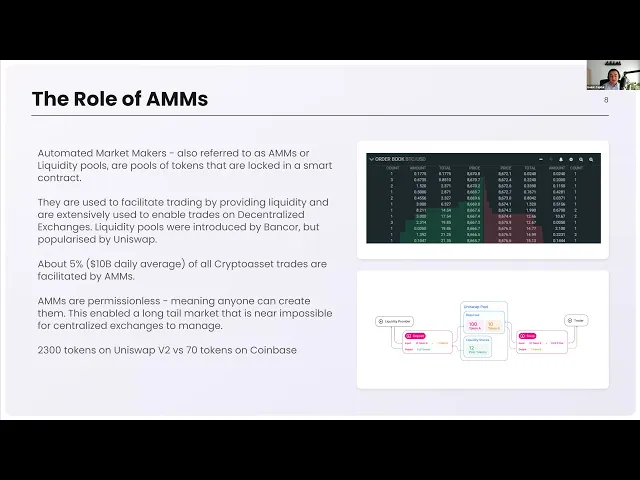
9. Automated Market Maker Liquidity Provision
Providing liquidity on AMMs used to be closer to passive indexing. Concentrated liquidity changed that. Now, many positions need active range management, fee harvesting, and repositioning to stay productive.
That complexity creates a real automation business. The platform can accept deposits, place capital into selected pools, manage range width, claim fees, and reposition when the market moves. Uniswap V3 management tools, Gamma-style active strategies, Curve stablecoin optimization, and Balancer liquidity systems all point to versions of this model.
A stablecoin-first approach is usually the cleanest entry point because price behavior is easier to reason about than volatile token pairs.

Where the edge actually comes from
The edge comes from range selection and maintenance. Chainlink's explanation of automated vaults points out that compounding and concentrated positioning can be encoded into smart contract workflows, which reduces repeated manual intervention and keeps capital deployed more efficiently. In plain English, someone has to do the fiddly work. Your business can be the someone.
Start with correlated pairs: stablecoin pools are easier to manage than volatile pairs
Treat fee income as variable: don't assume recent fees will persist
Backtest with ugly periods: trending markets expose weak range logic
For a quick visual on how automated liquidity strategies are discussed in practice, this walkthrough is useful:
What doesn't work is calling LP automation passive and ignoring impermanent loss, out-of-range positions, or the cost of frequent repositioning.
10. AI-Driven Risk Management and Portfolio Monitoring
This is the automation layer I trust most because it doesn't need to touch every trade to be valuable. AI-driven monitoring can watch protocol health, liquidity conditions, concentration risk, collateral status, and behavioral anomalies, then raise alerts or recommend changes before a human would normally react.
For operators managing multiple wallets, treasury sleeves, or client accounts, this becomes the command center. It can rank risk, surface outliers, and help decide when to de-risk or rotate exposure. That's especially useful in DeFi, where opportunities are fragmented and warning signs show up across governance forums, utilization levels, pool behavior, and on-chain flows.
What good monitoring looks like
I'd rather use AI for prioritization than for total autonomy here. Let the model triage what deserves attention, then either route approved actions into automation or send a human an alert with context.
A practical system should answer questions like these:
Which positions are becoming fragile?
Which protocols changed assumptions that mattered to my strategy?
Which alerts were noise, and which ones were useful?
Many teams often overestimate “autopilot.” As noted earlier, oversight remains essential. AI can compress the review burden, but it can't remove accountability. The best monitoring businesses don't pretend to replace operators. They help operators stay ahead of risk without living inside ten dashboards.
10-Item Automated Finance Feature Comparison
Approach | 🔄 Implementation complexity | Resource requirements | ⭐📊 Expected outcomes | Ideal use cases | ⚡ Key advantages |
|---|---|---|---|---|---|
AI-Powered Automated Yield Aggregation | High, ML models, orchestration, continuous tuning | Large: ML engineers, real-time data, execution infra, capital | ⭐⭐⭐⭐, Adaptive, high time-sensitive yield capture; variable in stress events | Diversified stablecoin investors, platforms needing automated optimization | 24/7 optimization, scalable allocations, reduced manual monitoring |
DeFi Protocol Yield Farming Automation | Medium, protocol integrations and batched operations | Moderate: smart‑contract ops, gas optimization, monitoring | ⭐⭐⭐, Reliable compound returns; performance depends on protocol health | Retail users, small deposits, passive income seekers | Automated compounding, simple UX, gas-saving batching |
Algorithmic Stablecoin Yield Optimization | Medium‑High, low‑latency monitoring and fast execution | High: HFT-style infra, MEV mitigation, gas management | ⭐⭐⭐, Stable, low‑volatility yields; limited upside as competition grows | Stablecoin-focused investors seeking low correlation | Maintains price stability, efficient for small capital, predictable returns |
Automated Portfolio Rebalancing Engines | Medium, allocation logic and execution scheduling | Moderate: portfolio tracking, execution, tax logic | ⭐⭐⭐, Maintains target risk profile and discipline over time | Multi-asset investors, robo-advisors, index strategies | Enforces allocation discipline, reduces emotional trading, scalable |
Smart Contract Automation with Oracle-Triggered Actions | High, secure oracle integration and on-chain logic | Large: oracle providers, audits, smart‑contract engineering | ⭐⭐⭐, Deterministic on-chain execution; depends on oracle integrity | Protocol-level automation, liquidation triggers, decentralized apps | Trust-minimized execution, transparent and auditable automation |
Treasury Management and Liquidity Automation | Medium‑High, governance workflows and reporting | Moderate‑Large: multi-protocol integrations, multi-sig, compliance | ⭐⭐⭐, Optimizes idle treasury yield while preserving reserves | DAOs, Web3 teams, creators managing community funds | Maximizes treasury returns, improves transparency, reduces overhead |
Yield-as-a-Service (YaaS) Platform Model | Medium, API and partner integration complexity | Moderate: API platform, partner support, SLAs | ⭐⭐, Broad distribution and recurring revenue; margin varies | Wallets, platforms seeking white‑label yield offerings | Accelerates go‑to‑market, reduces infra duplication, partner scaling |
Risk-Managed Automated Lending Protocols | High, collateral automation and refinancing logic | Large: oracle feeds, liquidation engines, monitoring | ⭐⭐⭐, Fewer liquidations and optimized borrowing costs; protocol-dependent | Borrowers using leverage, institutions managing debt positions | Prevents costly liquidations, dynamic rate optimization, real-time protection |
AMM Liquidity Provision Automation | Medium‑High, range management and fee optimization | Moderate: pool management, liquidity analytics, rebalancers | ⭐⭐⭐, Fee capture and capital efficiency; exposed to impermanent loss | LPs seeking passive fee income, experienced DeFi liquidity providers | Captures trading fees, optimizes concentrated liquidity, passive market making |
AI-Driven Risk Management & Portfolio Monitoring | High, advanced ML, anomaly detection, continual retraining | Large: historical data, ML team, alerting infra | ⭐⭐⭐⭐, Early risk detection and reduced tail losses; improves with data | Platforms and investors prioritizing safety at scale | Proactive alerts, scalable risk scoring, data-driven decision support |
Your Next Step in Automated Business
A founder starts with a simple auto-compounder for stablecoins. Six months later, the product has a policy engine, fallback routes, vault limits, oracle checks, and a support queue full of edge cases. That arc is common in Web3 automation. The hard part is rarely writing the first script. The hard part is building a system that can keep allocating capital under stress without confusing users or creating hidden risk.
The strongest automated business models in this space share one trait. They turn judgment into rules before they turn rules into code. That matters more in DeFi than in standard SaaS automation because execution, custody, and settlement often happen in the same system. A weak assumption can move real money into the wrong venue in seconds.
Start with the model that fits how you operate. Solo operators and small teams usually do better with a narrow system such as stablecoin yield rotation, portfolio rebalancing, or a constrained lending strategy with fixed risk limits. Teams with deeper engineering depth can justify oracle-triggered execution, treasury routing, or a Yield-as-a-Service stack that sells infrastructure instead of yield exposure alone.
Trade-offs decide whether the business holds up.
Simple automation is easier to audit, explain, and support. It also leaves fewer ways to adapt when spreads compress or incentives disappear. More complex systems can improve capital efficiency, but they increase the burden on monitoring, incident response, and access control. AI helps most at the decision layer, ranking opportunities, flagging anomalies, and suggesting reallocations. It should not replace clear policy, human override paths, or user-visible rules.
I have seen solid strategies fail for boring reasons. Permissions were too broad. Rebalance thresholds were poorly chosen. Teams automated around incomplete data and treated temporary yield spikes like durable signals. In practice, durable automated businesses come from tighter scope, better guardrails, and slower expansion.
That is the right next step for this category. Pick one narrow use case. Define position limits, exit conditions, and failure handling. Run it through live market changes before adding another strategy or another chain.
If you want a practical starting point, tools like Yield Seeker fit that first phase well. It gives stablecoin holders a way to use AI-assisted yield automation without manually tracking every protocol themselves. The appeal is not maximum complexity. The appeal is a system simple enough to evaluate, monitor, and stop if conditions change.
The next win is not a giant autonomous finance machine. It is one automated system that earns trust, survives volatility, and gives you a clear base to build on.