

Picture this: your crypto is out there, working for you 24/7, sniffing out the best returns across the market—all while you sleep. That’s the magic behind automated DeFi strategies. They use smart technology to manage your investments so you don't have to.
How Automated Strategies Put Your Crypto to Work
In the wild west of decentralized finance (DeFi), the best places to earn yield can change in a heartbeat. Trying to keep up manually, hopping from one protocol to another to chase the best rates, is a full-time job. It’s exhausting, and frankly, not practical for most of us.
This is where automated strategies step in. Think of them as your own personal fund manager, one that never sleeps and is always hunting for the next big opportunity. Instead of you staring at charts, rebalancing your portfolio, or moving funds around to snag a better interest rate, a smart system does all the heavy lifting.
This isn't just for the crypto-obsessed. It’s for anyone who wants to earn some passive income without getting bogged down in the day-to-day grind of research and endless transactions.
The Headache of Manual DeFi
If you've ever tried to manage your own DeFi positions, you know the pain. It usually involves:
Constant Monitoring: Your eyes are glued to the screen, tracking APYs across a dozen different lending platforms and liquidity pools.
Sky-High Gas Fees: Every time you manually move your funds, you're hit with transaction costs that can quickly eat away at your profits.
Tough Calls: Knowing exactly when to harvest rewards, rebalance a position, or pull out of a farm is more of an art than a science. It takes real expertise.
All this complexity is a massive roadblock, especially if you have a day job or are just dipping your toes into DeFi. It’s like trying to navigate a foreign city without Google Maps—you might get there eventually, but it’s going to be a stressful and inefficient trip.
Automated DeFi strategies aren't just about making life easier. They're about opening up sophisticated financial tools to everyone, not just the big hedge funds. By taking the constant manual work out of the equation, these systems let anyone get in on advanced yield generation.
The Automated Fix
Platforms that offer automated strategies cut through all that noise. You just deposit an asset—say, some USDC—and the tech takes it from there. An intelligent system, typically a mix of smart contracts and AI agents, gets to work analyzing the market for you. It automatically puts your funds into the most promising opportunities it can find, all while keeping risk in check.
This means your capital is always working as hard as possible, compounding your returns while you get on with your life. It’s the closest thing we have to a true “set it and forget it” model for earning yield, turning the dream of passive income in DeFi into a real, achievable thing for everyday people.
Diving Into Common Automated Stablecoin Strategies
Not all automated DeFi strategies are built the same, especially when your main goal is to protect and grow your stablecoin pile. If you're holding stables, you’re probably looking for steady, predictable returns—not moonshot gambles. Automation just makes getting those returns a whole lot easier.
Think of these strategies less like financial products and more like different jobs you can assign to your capital. Some jobs are simple and safe, like earning a steady paycheck. Others are more complex and require quick thinking to grab opportunities as they pop up.
Let's break down the most common roles your automated stablecoins can play.
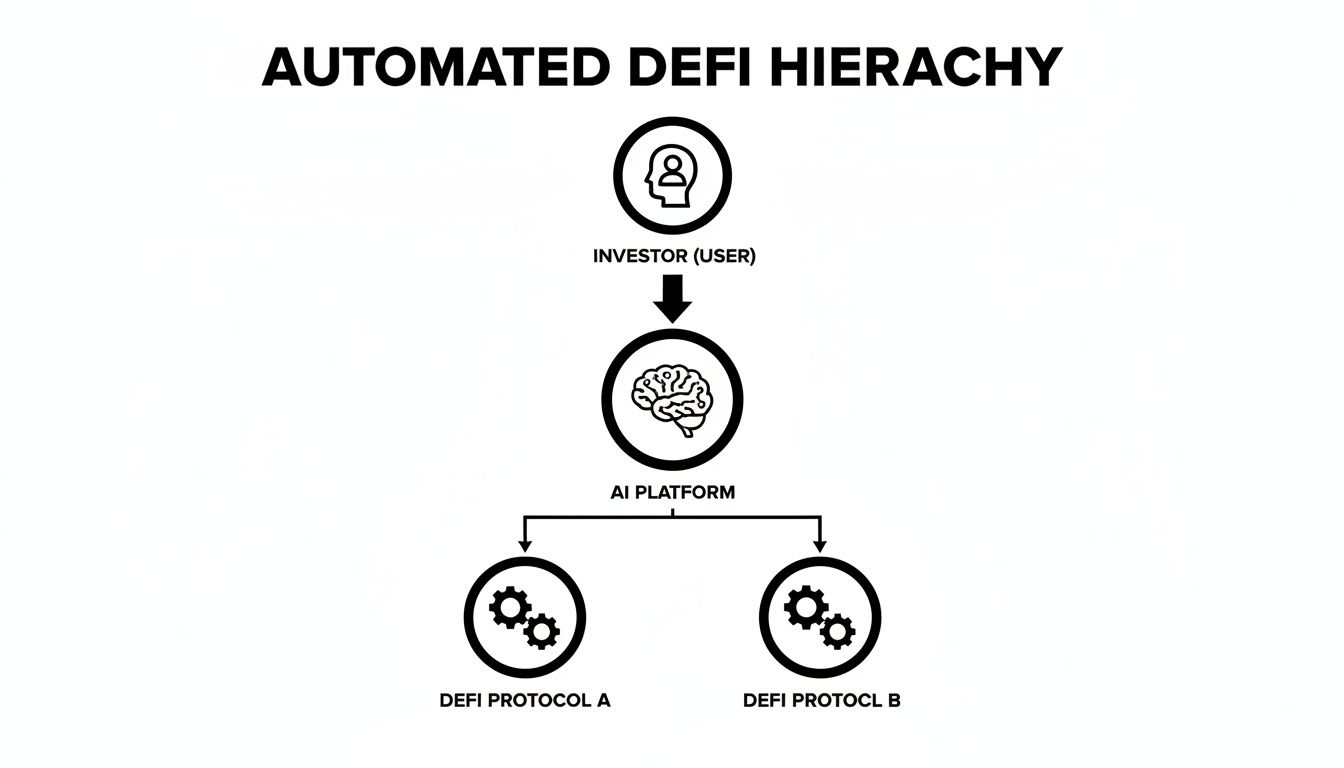
This is where the magic of automation really shines: a single, simple interface can plug you into a whole universe of complex financial tools, saving you the headache of managing each one by yourself.
Automated Yield Farming and Lending
This is the bread and butter of automated DeFi. At its heart, this strategy is all about lending your stablecoins to decentralized protocols or adding them to liquidity pools to earn interest and rewards. Simple, effective, and a great starting point.
Lending Automation: Picture a super-smart savings account that’s constantly hunting for the best interest rate across dozens of digital "banks" (lending protocols like Aave or Compound). An automated strategy does just that—it continuously scans the rates and shuffles your funds to the most profitable spot, making sure you’re always earning the max yield without lifting a finger.
Yield Farming Automation: This kicks things up a notch. The system doesn't just lend your assets; it also automatically claims the reward tokens (like CRV or COMP) you earn from the protocol. It then sells those tokens and plows the profits right back into your principal, creating a powerful compounding snowball.
This approach is popular because it sticks to established, blue-chip DeFi protocols, making it a relatively conservative way to earn interest on stablecoins.
Comparing Automated Stablecoin Strategies
To get a clearer picture, let's put these strategies side-by-side. Each has its own mechanics, potential returns, and, of course, risks.
Strategy Type | How It Works | Typical APY Range | Primary Risk Factor |
|---|---|---|---|
Yield Farming | Lends stablecoins to pools, auto-compounds rewards. | 3% - 15% | Smart Contract Bugs |
Lending Automation | Moves funds between protocols for the best lending rate. | 2% - 10% | Counterparty Risk |
LP Rebalancing | Adjusts liquidity ranges on DEXs to maximize fees. | 5% - 25%+ | Impermanent Loss |
Vaults/Strategies | Executes complex, pre-set strategies across multiple protocols. | 5% - 30%+ | Strategy Complexity |
Algorithmic Strategies | AI-driven agents adapt to market data in real-time. | Varies Widely | Model Risk |
Harvest Bots | Automates the claiming and selling of farming rewards. | N/A (utility) | Oracle Manipulation |
This table isn't exhaustive, but it gives you a good feel for the trade-offs involved. Higher potential APY often comes with more complex risks you need to be comfortable with.
Dynamic Liquidity Provision
Providing liquidity to decentralized exchanges (DEXs) is a fundamental part of DeFi. But doing it well is a real challenge, especially on platforms with "concentrated liquidity" where you have to set a specific price range for your assets. Get it wrong, and you earn nothing.
An automated liquidity provider (LP) strategy works like a professional market maker. It constantly analyzes trading volume and volatility to shift your liquidity's price range dynamically. When the market moves, the bot repositions your funds to make sure they stay in the game, earning trading fees. Trying to do this manually is a recipe for high gas fees and a lot of screen time.
The Main Idea: Automated liquidity management is all about one thing—earning the most fees while dodging the bullet of impermanent loss. By keeping your capital where the action is, the system aims to crush a lazy "set-and-forget" LP position.
Vaults and Algorithmic Strategies
Vaults are a more sophisticated flavor of automated DeFi strategies. A vault is basically a smart contract that pools everyone's funds together and runs a complex, pre-programmed strategy. These can be as simple as auto-compounding a yield farm or as intricate as multi-step operations that hop between several different protocols.
Algorithmic strategies, often supercharged by AI, take this idea even further. They don't just mindlessly follow a script; they actually adapt to what's happening in the market right now. For example, an AI agent might pull capital from a lending protocol and throw it into a liquidity pool if it spots a sudden spike in trading fees, grabbing a short-term opportunity a human would almost certainly miss. That adaptability is what makes them so potent in DeFi's chaotic environment.
The Technology Driving DeFi Automation
Every automated DeFi strategy runs on a powerful stack of technology working together behind the scenes. This isn't some black box or a single magic algorithm; it's a combination of different tools, each playing a specific, vital role. Once you understand this tech backbone, the idea of your crypto managing itself becomes a lot less mysterious.
At the very foundation of it all are smart contracts. The best way to think of them is like indestructible, digital vending machines. They're just self-executing programs where the rules of an agreement are written directly into the code. Once they're live on a blockchain, they run exactly as programmed, with no chance of downtime, censorship, or meddling from a third party. They are both the rulebook and the referee, all in one.
But a rulebook needs a trigger. A smart contract can’t see what’s happening in the outside world on its own. That's where bots and AI agents come into the picture.

Smart Contracts: The Unbreakable Rulebook
A smart contract for a lending strategy might have a simple rule coded into it, like: "If the interest rate on Protocol A drops below 5%, move the funds to Protocol B." The catch is, the contract itself has no idea what the interest rate is. It needs an external signal to tell it when to execute that command.
These contracts are the absolute core of DeFi. They're what guarantees that once you deposit your funds into a strategy, the pre-defined rules are followed to the letter, no questions asked. Their transparent and unchangeable nature provides the trustless foundation for all automated DeFi strategies.
Bots: The Diligent Workers
This is where off-chain bots come in. Think of them as diligent workers who monitor market data 24/7 and trigger those smart contracts when the time is right. These are just scripts that are constantly scanning for specific conditions—an interest rate change, a new yield farming opportunity, or the need to rebalance a portfolio. When a condition is met, the bot pings the smart contract with a transaction, basically telling it, "Okay, it's time to act."
Monitoring: They watch for changes in APYs, asset prices, and gas fees across dozens of protocols at once.
Executing: They trigger smart contracts to perform actions like harvesting rewards or shifting liquidity to a better pool.
Repetitive Tasks: They handle the high-frequency, boring tasks that would be completely impossible for a human to keep up with.
Bots are incredibly reliable and fast, but they usually operate on simple "if this, then that" logic. For more complex decisions, you need a more advanced supervisor.
AI Agents: The Intelligent Supervisors
Artificial intelligence is what takes DeFi automation to a whole other level. Unlike a simple bot, an AI agent can analyze massive datasets, spot complex patterns, and make predictive decisions. It effectively acts as the strategist, deciding which rules the bots should be following in the first place. You can see how critical this is when leading DeFi aggregators like 1inch hire for roles focused on data science for DeFi automation.
AI integration is a game-changer for yield optimization. The DeFi platform market is on track to hit $51.22 billion in 2026 and is projected to grow to $78.49 billion by 2030. Machine learning helps protocols spot market patterns, automate fund allocation, and seriously upgrade their risk assessment.
This analytical firepower lets an AI uncover yield opportunities that are invisible to both humans and simpler bots. By learning from historical data and real-time market action, it can dynamically adjust strategies to squeeze out the best possible returns while keeping risk in check. For a deeper look at this, you might find our guide on how machine learning is used in trading algorithms interesting.
It’s this intelligent layer that really makes modern DeFi automation a true "set it and forget it" solution.
Navigating the Risks in Automated DeFi
While automated DeFi strategies can be a fantastic way to earn passive income, it's critical to remember that high yields never come without risk. The promise of hands-off returns is incredibly tempting, but we're dealing with complex tech in a notoriously volatile market. Getting a handle on these potential pitfalls is the first step to making smart, informed decisions with your capital.
The goal here isn't to scare you off. It's to give you a clear-eyed view of the landscape. Think of it like driving a car—you can manage the risks by understanding how the engine works, checking your tire pressure, and following the rules of the road. In DeFi, that means knowing where the weak points are and how to protect yourself.

Smart Contract and Protocol Risk
Code is the foundation of every single automated strategy. Smart contracts are just programs that follow pre-set rules, but what happens if those rules have a bug or a loophole? That’s smart contract risk—the potential for someone to exploit a flaw in the code. A single vulnerability could allow a hacker to drain a protocol's funds, leading to a total loss for everyone involved.
But it goes deeper than that. You also have protocol risk. Even if a strategy's own smart contract is perfect, it almost certainly plugs into other DeFi protocols like Aave or Curve. If one of those underlying protocols gets hacked or fails, it can trigger a disastrous domino effect that hits the automated strategy relying on it.
To keep yourself safe, you need to:
Prioritize Audited Platforms: Only put your money into platforms and strategies that have gone through extensive security audits from reputable firms. No excuses.
Check the Track Record: Stick with protocols that have been running securely for a good amount of time. A long, boring, uneventful history is exactly what you want to see.
Understand Protocol Dependencies: Figure out which underlying protocols a strategy is built on. Spreading your investments across strategies that use different DeFi "money legos" can seriously reduce your exposure if one of them breaks.
Market and Liquidity Risks
Not all dangers are technical. The crypto market’s volatility is legendary, and these wild swings create market risk. For anyone holding stablecoins, the biggest fear is a de-pegging event, where a stablecoin loses its $1.00 peg. No automated strategy can save you from this kind of fundamental asset failure.
Another classic hazard is impermanent loss, a tricky concept that affects anyone providing liquidity to a decentralized exchange. If the prices of the assets in a liquidity pool drift too far apart, your position could end up being worth less than if you'd just held those assets in your wallet.
Liquidity risk is the other big one to watch. If a market panic causes liquidity to evaporate from a pool, an automated strategy might get stuck, unable to exit a position without taking a massive hit from slippage. This is how paper gains turn into very real losses, very quickly.
For a deeper dive into managing these kinds of threats, check out our guide on the best practices for DeFi risk management. Getting your head around these concepts is absolutely essential for navigating automated DeFi safely and protecting your funds from nasty surprises.
Getting Started with an AI-Powered DeFi Platform
Getting your hands dirty with automated DeFi might sound like a headache, but the new wave of platforms is designed to be surprisingly simple. The best ones cut through the complexity, letting you deploy some pretty advanced strategies without needing to be a coding wizard. The whole point is to lower the barrier to entry, so you can chase your financial goals instead of getting stuck on the tech.
When you're ready to jump in, look for platforms that clearly put the user first. A clean, intuitive interface isn't just nice to have; it's a must. You should be able to see your balance, track how you're doing, and understand what your money is up to with just a quick glance. That kind of transparency is key for building trust.
What to Look For in a DeFi Automation Platform
Before you put any real money on the table, it’s smart to vet a platform against a few non-negotiables. These are the features that really separate the top-tier services from the rest of the pack.
Support for Low-Fee Blockchains: High gas fees can absolutely chew through your returns. Platforms built on efficient networks like Base or Solana can run strategies that involve frequent, small transactions without bleeding you dry on fees.
Transparent Performance Reporting: You need the real story on how your investment is performing, warts and all. Look for platforms that give you the nitty-gritty details on realized yield, fees, and how a strategy has performed over time.
No Lockups or Withdrawal Fees: It's your money, and you should be able to get to it. The best platforms give you total liquidity, meaning you can deposit and withdraw your funds whenever you want, no questions asked and no penalties.
That last point about flexibility is a big deal. It means you’re always in the driver's seat and can pull your funds if the market goes sideways or if you just need the cash.
Your First Steps with AI-Driven Automation
Getting started is usually as easy as a few clicks. On a platform like Yield Seeker, the process is pretty standard: you create an account, connect your crypto wallet, and maybe deposit a small test amount of a stablecoin like USDC. After that, the platform's AI agent gets to work, deploying your capital for you.
The real magic of automated DeFi strategies is their knack for navigating the mess of fragmented liquidity and grabbing opportunities as they appear. With weekly trading volume on decentralized exchanges (DEXs) recently hovering around $86 billion, the market is a whirlwind of activity. AI agents can dynamically route funds across thousands of liquidity pools to make swaps and farm yield with minimal slippage—something no human could ever keep up with. You can read more about how automated market makers are fueling this volume.
Once you've made a deposit, you can sit back and watch as the AI starts allocating your funds across different, pre-vetted DeFi protocols. It’s constantly watching the market, hunting for the best risk-adjusted yield and moving your capital around as new opportunities pop up. This hands-off approach makes powerful financial tools accessible to everyone, from busy professionals to people just dipping their toes into DeFi. It proves you don't have to be a full-time degen to earn like one.
Got Questions About Automated DeFi? We've Got Answers.
Jumping into any new corner of finance brings up a ton of questions, and automated DeFi is no different. Let's tackle some of the most common ones I hear, so you can get your head around the space and move forward with a bit more confidence.
Are Automated DeFi Strategies Safe for Beginners?
Look, no investment is ever 100% risk-free, but automated strategies can be a much gentler starting point for beginners than jumping straight into manual trading. Why? Because they take two of the biggest tripwires out of the equation: emotional decisions and simple human error. Instead of panic-selling during market FUD or FOMO-ing into a sketchy farm, the strategy just does what it was programmed to do.
That said, you can't forget about the technical risks. Smart contract bugs are a real thing. The best way to sidestep this is to stick with reputable, well-audited platforms that live and breathe security. The good ones are designed to hide all that complexity behind a clean interface, giving you a curated, more risk-aware path into DeFi.
"One of the best things about a solid automated platform is that it cuts down on the unforced errors. It's the circuit breaker that stops you from that late-night, high-gas 'ape' into a risky farm you'll regret in the morning. It guides you toward a more systematic, sustainable way of earning."
How Much Can I Realistically Earn with Stablecoins?
Yields in DeFi are always in flux, changing with the market's mood. But for most automated DeFi strategies dealing with stablecoins, a realistic APY to aim for is somewhere between 5% and 20%. If you see a platform promising wild, guaranteed high returns, your alarm bells should be ringing—those often come with massive, often hidden, risks.
The real magic of an AI-driven platform is its ability to nimbly shift your funds around, catching the best yields as they pop up and moving on before they dry up. The goal isn't to hit a 1000% moonshot; it's to consistently beat what you'd get from a high-yield savings account in traditional finance, without taking on heart-stopping risk. That adaptability is what makes automation so powerful.
Do I Need a Lot of Money to Get Started?
Not at all. This is one of the best things about modern DeFi, especially on low-cost blockchains. Accessibility is the name of the game. Many platforms will let you get started with a tiny amount—sometimes as little as $10.
This low barrier to entry is a complete game-changer. It means you can take the platform for a test drive, see how the automation actually works, and get comfortable with the whole process before you even think about putting in more serious cash. It opens the door to sophisticated yield opportunities that used to be walled off for everyone but the big players.
We're seeing this play out across the market with the rise of decentralized exchanges (DEXs) fueled by these accessible strategies. In fact, some analysts are forecasting that DEXs could handle up to 50% of all crypto trading volume by the end of 2026. That's a huge leap from their 21% peak in late 2025, and it's all thanks to how automated market makers have made trading permissionless and efficient for everyone. You can dive deeper into these DeFi trends on DL News.
Can I Withdraw My Funds at Any Time?
This is a make-or-break question, and the answer really depends on the platform. The sign of a trustworthy, user-first service is liquidity. The best automated platforms do not have lockup periods or hit you with crazy withdrawal fees. Your funds should be your funds, accessible whenever you need them.
Always, always check a platform's withdrawal policy before you deposit a single cent. Keeping full control and access to your assets is a core principle of self-custody and should be a non-negotiable for any service you use.
Ready to put your stablecoins to work without the headache of managing them 24/7? At Yield Seeker, our AI-powered platform does the heavy lifting. Just deposit as little as $10 USDC on the Base chain and let your personalized AI Agent hunt down and manage the best risk-aware yields across DeFi. Get started today at https://yieldseeker.xyz.