
You're probably already doing one of these jobs manually without calling it a job. Checking DeFi rates across tabs. Moving stablecoins after APYs shift. Claiming rewards, swapping them, redepositing them, then wondering whether the extra yield even covered the gas. In Web3, “work” often looks like clicking through dashboards and trying not to miss the small window where a strategy still makes sense.
That's why automated jobs examples in finance matter more than the old factory-floor story. The biggest automation wave for many crypto users isn't a robot replacing a worker. It's software replacing repetitive judgment-light tasks that used to eat hours every week. That distinction matters. Contractbook argues that automation usually strips out repetitive, low-value busywork rather than eliminating entire roles, while work that depends on judgment, creativity, empathy, and accountability tends to stay human-led, as discussed in Contractbook's analysis of what automation is really changing.
In DeFi, that pattern is obvious. You still decide your risk tolerance, liquidity needs, and whether you trust a protocol category at all. But the machine can monitor, sort, route, rebalance, and compound much faster than you can.
That's the shift this guide focuses on. Not assembly lines. Code.
If you want the broader builder view of what shipping practical automation can look like, this piece on how to ship a full-stack app is worth a read.
1. Automated Yield Farming Across Multiple DeFi Protocols
Open three DeFi tabs before breakfast and the job shows up fast. Rates shift, reward tokens pile up, gas changes the math, and a strategy that looked good yesterday can slip by lunch. Automated yield farming exists to handle that maintenance loop with rules instead of constant attention.
A good system does more than chase the highest APY on a dashboard. It monitors approved venues, moves capital only when the net return still makes sense after fees, claims rewards, converts them when needed, and compounds back into the position. Chainlink's explanation of DeFi yield automation describes this well: autonomous smart contracts can harvest, reinvest, and compound without manual intervention.
Yield Seeker fits this category with a practical retail entry point. Users can deposit from as little as $10 USDC on Base, keep funds accessible, and avoid lockups or withdrawal fees, as described in Yield Seeker's automated stablecoin yield product overview. That setup matters because a lot of DeFi users want help with execution, not a black box that traps capital.
What the software is actually doing
The automated job here is operational. It replaces repetitive portfolio maintenance across fragmented protocols.
Track live yield conditions across venues: The agent watches multiple lending or yield sources instead of relying on one interface.
Reallocate only when the move is worth it: Better systems account for gas, slippage, and timing before shifting capital.
Keep rewards from sitting idle: Claimed incentives can be swapped into the base asset and redeployed so compounding stays active.
Apply the same rule set every time: That consistency matters more than people expect. Manual yield farming often breaks down because the process is tedious, not because the strategy is hard.
The gain is not just higher yield. It is fewer low-value decisions.
That said, automation does not remove inherent risks. Users still carry smart contract exposure, protocol-level failure risk, liquidity constraints, and changing yield conditions. An agent improves execution discipline. It does not make a weak venue safe or turn temporary incentives into durable returns.
This is also a good place to be realistic about AI in Web3. The useful part is not “AI picks magic yields.” The useful part is software handling monitoring, routing, and compounding faster than a person can, while the user still sets boundaries on assets, chains, and risk. If you want a related example of how automated systems capture short-lived pricing opportunities, this breakdown of crypto arbitrage automation strategies covers the execution side well.
The broader lesson shows up outside DeFi too. Good automation works best when rules are clear, edge cases are known, and humans keep control over risk limits. That same pattern appears in Resolut's guide for credit risk, even though the domain is different.
2. Automated Stablecoin Arbitrage Execution
Some automated jobs examples are glamorous on paper and less attractive in production. Stablecoin arbitrage sits in that category. The pitch is simple: detect a price difference between stablecoin pairs or chains, execute fast, capture the spread, reconcile balances, repeat.
The operational reality is harsher. Spreads tighten quickly, bridge timing matters, and small mistakes erase the edge.

Where automation helps and where it doesn't
A solid arbitrage bot handles monitoring and execution better than any person can. It can watch multiple venues continuously, route around poor liquidity, and settle positions without waiting for you to wake up in the right time zone.
But this is also one of the easiest places to overestimate automation. If the system doesn't model fees, bridge delays, and slippage correctly, it's not doing arbitrage. It's doing expensive movement.
What works:
Fast spread detection: Constant monitoring beats manual scanning.
Consistent execution rules: Bots don't hesitate when thresholds hit.
Cross-chain coordination: Good systems treat balances and bridges as part of one inventory problem.
What doesn't:
Tiny balances on fee-heavy routes: The transaction path can consume the entire opportunity.
Thin liquidity venues: A quoted spread can disappear on execution.
Loose monitoring: If nobody reviews exceptions, failed settlements pile up.
Britannica notes that automated yield farming aggregators already give users predefined strategies and dashboards for real-time monitoring of balances, current yields, and rewards, and that many platforms automate reinvestment to reduce the lag between reward accrual and redeployment in its overview of cryptocurrency yield farming automation. Arbitrage needs the same mindset, but with stricter execution discipline.
For a strategy-specific view, see Yield Seeker's breakdown of crypto arbitrage.
3. Automated Treasury Management for Web3 Teams
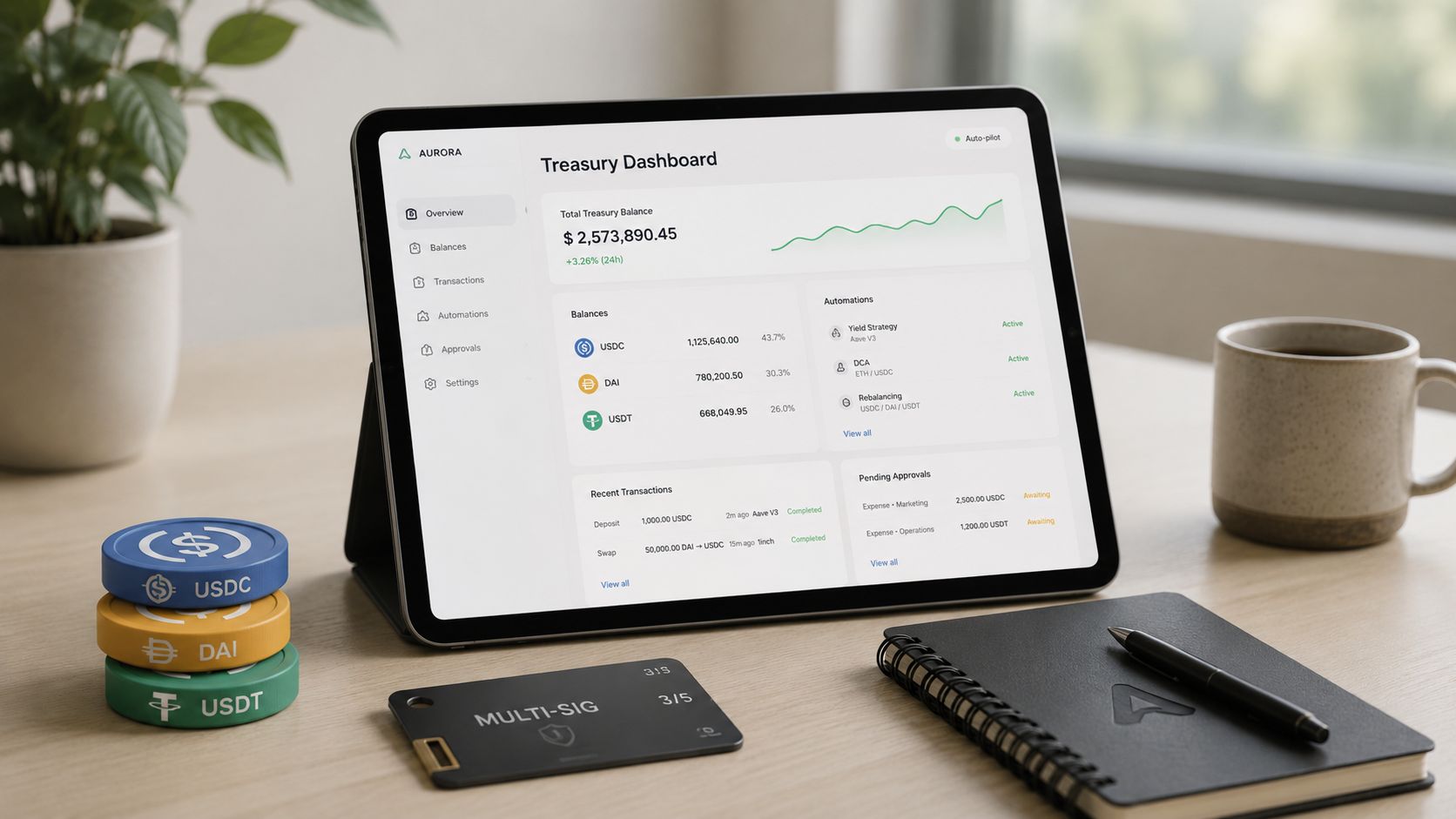
Most DAOs and crypto-native teams don't need a full treasury department. They need the work done. That's why treasury automation is one of the most practical automated jobs examples in Web3.
A team receives fees or revenue in volatile assets, converts part of it into stablecoins, keeps operating runway available, and puts idle balances somewhere productive. Traditionally, a founder, ops lead, or finance person ends up doing this manually between everything else.
Why teams automate this early
The first benefit isn't yield. It's discipline. An automated treasury setup can convert incoming assets into stablecoins, maintain reporting visibility, and rebalance around expected cash needs so the team isn't improvising every week.
That matters because automation rarely wipes out the finance role entirely. It changes the role. The system handles recurring mechanics. Humans still set policies, approval thresholds, and exposure limits.
Teams that automate treasury operations usually get two wins at once. Less idle capital and fewer ad hoc decisions.
Governance matters more than people expect. If your multisig policy is messy or nobody agrees on reserve thresholds, automation only makes the confusion faster. Good treasury systems need clear permissions, clear objectives, and a record of why funds moved.
I also wouldn't run treasury automation without human review on denomination strategy. Converting some revenue into stablecoins is an operational choice. Deciding how much to keep liquid versus deployed is still a leadership decision. If you think about treasury work through a risk lens rather than a pure yield lens, Resolut's piece on credit risk analysis using machine learning is a useful adjacent read.
4. Automated Liquidity Pool Rebalancing
Liquidity provision can look passive from the outside. It usually isn't. Anyone who has managed concentrated liquidity knows there's a real maintenance job hiding underneath the interface.
That job includes checking pool ranges, collecting fees, deciding whether to redeploy, and adjusting capital when the pool drifts out of an efficient zone. Automation is well suited to this because the work is repetitive, timing-sensitive, and rules-based.
Best fit for stable pairs
This works best when you're dealing with stablecoin pools or closely correlated assets. In those cases, the software can monitor position ratios, harvest fees, and rebalance more rationally than a distracted human can.
For active LPs, the benefit isn't just convenience. It's consistency. You stop neglecting small but important maintenance steps.
A strong rebalancer usually does three things well:
Track pool state continuously: It sees when your position is no longer where you want it.
Collect and redeploy fees: Idle fees are dead capital until someone moves them.
Manage multiple pools together: This matters if you're splitting capital across venues instead of treating each LP position in isolation.
The downside is that automation doesn't erase structural LP risks. It won't protect you from every form of divergence or from poor pool selection. It also won't make frequent on-chain adjustments free.
Rebalancing software is a maintenance worker, not a magician. It improves position upkeep. It doesn't fix a bad market setup.
For users who already understand AMM mechanics and want the maintenance layer automated, Yield Seeker explains its yield rebalancing engine in more depth.
5. Automated Dollar-Cost Averaging Into Yield-Bearing Stablecoins
This is one of the few automated jobs that's useful for beginners and boring in the best way. A system takes a fixed amount of stablecoins on a recurring schedule and deploys it into a yield-bearing position immediately.
That “immediately” matters. Idle cash sitting in a wallet earns nothing while you wait for the perfect moment that usually never comes.

Good automation for people with jobs outside crypto
For salaried users, creators, and founders who convert income into stablecoins over time, this setup replaces a simple but easy-to-ignore job: consistent deployment. You choose the schedule and the size. The software handles the repetition.
What I like about this style of automation is that it reduces decision fatigue more than it chases some complex edge. It's not trying to outsmart the market every hour. It's trying to stop cash from sitting unused because the owner got busy.
Useful strengths:
Regular deployment: A weekly or monthly cadence is easier to maintain than manual deposits.
Instant productive use of capital: Deposits start participating in yield as soon as they land.
Cleaner behavior: Users stop trying to time every small move.
Weak spots:
Fee drag on small recurring transactions: This matters more on expensive chains.
No sensitivity to temporary spikes in opportunity: The system follows the schedule, not the moment.
Dependency on consistent cash flow: If income timing is irregular, schedules need adjustment.
This is one of the most approachable automated jobs examples because it doesn't require a trader's mindset. It replaces hesitation with a routine.
6. Automated Risk-Adjusted Portfolio Allocation
A wallet holds USDC, ETH, a liquid staking token, and a few yield positions spread across protocols. Markets shift, incentives change, and one governance proposal can alter the risk of a position overnight. Keeping that mix aligned with a real risk tolerance is a recurring job, and it is a good candidate for automation.
In DeFi, portfolio allocation is less about picking a single winner and more about ranking imperfect options. An automated system can monitor lending rates, protocol exposure, collateral quality, token volatility, and concentration risk far faster than any individual user checking dashboards by hand. That matters if the goal is to keep capital productive without drifting into positions that no longer fit the mandate.
The useful version of this job is not blind rebalancing. It is rules-based allocation with clear constraints. For example, a user might cap smart contract exposure to newer protocols, keep a minimum share in liquid stablecoin positions, and only allow higher-volatility assets to occupy a defined slice of the portfolio. Tools like Yield Seeker are interesting because they can keep evaluating those constraints in the background while conditions move.
The trade-off is straightforward. Risk scores are only as good as the inputs behind them. Software can assess known signals such as audit history, governance concentration, liquidity depth, and strategy complexity. It cannot reliably foresee exploits, social consensus breaks, or panic that hits an entire category at once.
That is why I trust this automation most when it explains why money moved.
Best use case: Users, DAOs, and small Web3 teams that want allocation rules matched to a specific risk profile.
Biggest benefit: Less manual comparison across protocols and faster reaction when the portfolio drifts outside its limits.
Main caution: A portfolio can look conservative on paper and still carry hidden correlation or smart contract risk.
Used well, this replaces ongoing portfolio maintenance, not judgment. The system does the monitoring and adjustment work. The owner still decides what “acceptable risk” means.
7. Automated Stablecoin Swap Optimization
This job used to belong to the power user with too many tabs open. Compare one DEX against another. Check an aggregator. Estimate slippage. Guess whether gas makes the route pointless. Then execute and hope the path still holds.
Swap optimizers turn that manual routing work into software. They compare venues, evaluate execution paths, and aim to complete the trade at the best available combination of price and cost.
A small edge that compounds through repetition
On a single swap, the savings may feel minor. Over repeated treasury moves, reinvestments, or stablecoin rotations, better routing adds up. That's the practical case for automation here.
The hidden value is also psychological. Users stop wasting attention on low-level comparison tasks that software is better at doing.
Most DeFi users don't need a better opinion on routing. They need a system that checks more routes than they ever will.
The trade-offs are real. Routing logic can be opaque, and some paths increase exposure to MEV or unfamiliar intermediary contracts. For small transactions, optimization can also be marginal. If the amount is tiny, overthinking route perfection isn't productive.
I'd use this automation heavily for repeated operational flows, especially if you're moving stablecoins often. I'd care less about it for one-off, low-value swaps.
8. Automated Dividend Reinvestment for Yield Tokens
Compounding sounds simple until you try to do it consistently across protocols. Claim rewards. Convert them if needed. Re-enter the strategy. Repeat often enough to matter, but not so often that fees eat the advantage.
That repetitive loop is almost a perfect software job. It's predictable, mechanical, and easy to neglect manually.
The practical compounding job
Automated reinvestment systems handle reward collection and redeployment without waiting for the user to remember. In DeFi, that means less idle reward accumulation and less fragmentation across positions.
This works especially well when rewards are small but frequent. Humans tend to delay redeployment because the task feels too minor. Software doesn't care.
Where it shines:
Long-term passive strategies: Reinvestment keeps the strategy active without manual touchpoints.
Multi-position accounts: The more rewards sources you have, the better automation fits.
Users who forget to claim: This is more common than often acknowledged.
Where it gets messy:
Tax reporting: More reinvestment events can mean more records to reconcile.
Small balances: Gas can overpower the value of frequent redeployments.
Near-term withdrawals: Compounding may be pointless if capital is about to come out.
This category is less about finding new opportunity and more about reducing waste inside an existing strategy. That makes it one of the highest-utility automated jobs examples for passive users.
9. Automated Tax-Loss Harvesting for Crypto Holdings
Tax-loss harvesting is one of the few jobs on this list where the automation can be smart but still highly jurisdiction-sensitive. The system scans positions for unrealized losses, identifies opportunities to realize them, and can re-enter similar exposure depending on the applicable rules.
In pure stablecoin portfolios, this isn't usually the star of the show. Stable balances don't create many obvious harvesting opportunities. But once a portfolio includes volatile governance tokens, LP tokens, or emissions-heavy positions, the workload grows fast.
Strong software, heavy human context
The software part is straightforward enough. Track lots, detect losses, propose actions, document them. The hard part is compliance context. Different jurisdictions treat crypto taxation differently, and the rules around substantially identical exposure are not something I'd leave to vague product copy.
What makes this useful:
Continuous monitoring: It catches windows a human investor often misses.
Documentation support: Good logs matter as much as the trade itself.
Re-entry logic: Keeping portfolio exposure while realizing losses is the whole point.
What makes it dangerous:
Rule ambiguity: Tax handling isn't uniform.
Operational complexity: More automation can create more accounting work if the records aren't clean.
False confidence: “Automated” doesn't mean “approved by your tax authority.”
I like this as an assistive layer, not a fully hands-off promise. The job can be automated. Responsibility can't.
10. Automated Stablecoin Allocation Across Multiple Chains
A wallet holds USDC on Ethereum, idle cash on Base, and a yield position on Polygon that no longer justifies the bridge and gas costs. Someone has to decide whether to move capital, wait, or leave it alone. In practice, that job turns into constant monitoring of APYs, bridge routes, settlement delays, chain-specific risks, and transfer costs.
For stablecoin holders operating across Ethereum, Base, Polygon, Arbitrum, and similar networks, manual allocation breaks down fast. The work is repetitive, but the decisions are not trivial. Good automation handles the repetition while applying rules that keep capital from chasing every temporary rate spike.
When multi-chain automation earns its keep
The useful systems treat chain allocation as a return-versus-risk problem, not a routing problem. They check whether a higher yield survives bridge fees, slippage, gas, withdrawal delays, and smart contract risk. They also account for a simple operational truth. Capital in transit is not earning, and sometimes it is not fully under your control either.
That filter matters. A 20 basis point improvement can disappear the moment a bridge fee changes or exits get crowded. On smaller balances, the move often makes no sense at all.
Discipline is the value. An automated allocator can set minimum yield spreads, approved bridge lists, destination limits, and cooldown periods between moves. That keeps the system from overtrading and helps avoid one of the more common mistakes in DeFi automation. Treating every cross-chain difference as an opportunity.
Good chain allocation software answers a harder question than “Where is yield highest?” It answers “Where should this capital actually live after costs, access, and risk?”
This is one of the clearer automated jobs examples in Web3 because it mirrors a real operations function. Monitor venues, compare net outcomes, move funds under defined rules, and keep logs. Humans still set policy. The software handles the cross-chain maintenance that would otherwise eat hours every week.
Automated DeFi Jobs: Top 10 Comparison
A useful comparison table should help with one decision: which automated job is worth running for your capital, team, or product. In DeFi, the difference is not just yield. It is setup time, monitoring burden, gas sensitivity, execution speed, and how much policy a human still needs to define.
The table below compares the 10 jobs in this article through a Web3 lens. It focuses on the work AI agents and automation systems like Yield Seeker can take off your plate, while leaving risk limits, treasury policy, and protocol selection in human hands.
Solution | 🔄 Implementation Complexity | ⚡ Resource Requirements | ⭐📊 Expected Outcomes | 💡 Ideal Use Cases | 📊 Key Advantages |
|---|---|---|---|---|---|
Automated Yield Farming Across Multiple DeFi Protocols | 🔄 Medium to High: cross-protocol integrations, position tracking, and rebalance logic | ⚡ Moderate: stablecoin capital, wallet access, gas budgeting, and monitoring | ⭐ More consistent yield capture when rules are set well. Results still depend on protocol risk and fee drag | 💡 Retail users seeking passive stablecoin yield, operators managing small to mid-sized balances | 📊 Reduces manual hopping between protocols, captures rate differences, and batches routine actions |
Automated Stablecoin Arbitrage Execution | 🔄 High: low-latency execution, route selection, and settlement handling | ⚡ High: fast infrastructure, available liquidity, capital buffers, and constant monitoring | ⭐ Can produce steady small gains, but only when spreads survive fees, slippage, and timing risk | 💡 Arbitrage desks, bot operators, and advanced traders pairing it with broader yield strategies | 📊 Runs around the clock, captures short-lived spreads, and does not depend on market direction |
Automated Treasury Management for Web3 Teams | 🔄 Medium: policy rules, multi-sig flows, reporting, and reserve management | ⚡ Moderate: revenue inflows, accounting discipline, dashboards, and review processes | ⭐ Better capital deployment, cleaner reporting, and less manual treasury work | 💡 DAOs, protocols, and Web3 teams managing operational runway and on-chain reserves | 📊 Automates allocation workflows, improves visibility, and keeps idle capital from sitting untouched |
Automated Liquidity Pool Rebalancing | 🔄 Medium to High: AMM mechanics, concentrated liquidity management, and threshold-based re-entry logic | ⚡ Moderate: LP capital, gas for updates, analytics, and active monitoring | ⭐ Better fee capture and capital efficiency when ranges are set properly. Returns can fall fast in choppy conditions | 💡 LPs in stablecoin and correlated-asset pools seeking active position management | 📊 Maintains target ranges, reduces manual repositioning, and improves fee capture in active pools |
Automated Dollar-Cost Averaging (DCA) into Yield-Bearing Stablecoins | 🔄 Low: scheduled contributions and simple allocation rules | ⚡ Low: recurring deposits, wallet funding, and basic automation setup | ⭐ Gradual position building with yield earned during the hold period | 💡 Salaried investors, beginners, and long-term savers who want stablecoin exposure without constant decisions | 📊 Removes timing pressure, keeps deposits working immediately, and is easy to maintain |
Automated Risk-Adjusted Portfolio Allocation | 🔄 High: portfolio scoring, protocol monitoring, and rule-based reallocations | ⚡ Moderate to High: data feeds, risk models, and reliable position tracking | ⭐ More controlled exposure across protocols, with returns shaped by the limits the user sets | 💡 Users who want DeFi exposure without managing every vault, pool, and lending venue by hand | 📊 Adjusts allocation to changing risk conditions, reduces concentration, and enforces discipline |
Automated Stablecoin Swap Optimization | 🔄 Medium: routing across DEXs, aggregators, and settlement paths | ⚡ Low to Moderate: router integrations, gas, and quote monitoring | ⭐ Lower slippage and better execution on frequent or larger swaps | 💡 Traders, treasury operators, and users rebalancing capital often | 📊 Cuts avoidable execution costs, improves fill quality, and handles background route selection automatically |
Automated Dividend Reinvestment (DRIP) for Yield Tokens | 🔄 Low to Medium: reward collection, threshold rules, and reinvest scheduling | ⚡ Low: active yield positions and gas for reinvestment | ⭐ Stronger compounding over time, especially when reward claims would otherwise sit idle | 💡 Long-term holders and passive income users collecting rewards from yield-bearing tokens | 📊 Keeps rewards productive, reduces forgotten claims, and compounds without manual intervention |
Automated Tax-Loss Harvesting for Crypto Holdings | 🔄 High: tax-lot tracking, jurisdiction-aware logic, and re-entry rules | ⚡ Moderate: recordkeeping, tax tooling, and portfolio visibility | ⭐ Can improve after-tax outcomes when losses are available and local rules allow the strategy | 💡 Active traders and larger holders managing taxable crypto portfolios | 📊 Captures losses systematically, preserves portfolio intent, and reduces manual tax prep work |
Automated Stablecoin Allocation Across Multiple Chains | 🔄 High: bridge handling, chain-specific allocation logic, and transfer timing | ⚡ High: bridge access, gas on multiple networks, security reviews, and active monitoring | ⭐ Broader access to yield sources and lower single-chain concentration, if net returns justify the moves | 💡 Advanced users and larger capital holders optimizing stablecoin deployment across ecosystems | 📊 Spreads chain risk, widens the opportunity set, and keeps cross-chain allocation rule-based |
A few patterns stand out.
The easiest jobs to automate are repetitive and rules-based: DCA, DRIP, and swap optimization. The harder jobs involve timing, settlement risk, and policy decisions across protocols or chains: arbitrage, portfolio allocation, and treasury management. That trade-off matters because the highest headline return is often attached to the highest operational burden.
For builders, DeFi automation manifests as real digital labor. These systems are not generic bots clicking buttons. They monitor rates, route capital, claim rewards, rebalance positions, and document what happened on-chain. That is why automated jobs examples in Web3 deserve their own category. The work is financial, continuous, and tightly linked to live market conditions.
The Future of Work Is Automated, Not Absent
A Web3 operator checks six dashboards before breakfast, compares lending rates across three chains, claims rewards, swaps into a different stablecoin, and updates a treasury sheet that is already out of date by noon. That is a job. It is also the kind of job software handles better.
In DeFi, automation shifts execution work away from humans and leaves policy, risk limits, and approval rules with the human owner. The automated jobs in this article show the pattern clearly. Agents can monitor yield spreads, route capital, harvest rewards, rebalance liquidity, and keep records of what happened on-chain. The user still sets the rules that matter, including acceptable drawdown, liquidity needs, protocol exclusions, wallet permissions, and when to hold cash instead of chasing yield.
That division of labor is the useful way to read automation in Web3.
The common mistake is treating DeFi agents like generic bots. They are closer to always-on financial operators. They watch volatile markets, react to changing pool conditions, and execute within constraints that a person defines up front. Good automation reduces missed opportunities and cuts the amount of manual dashboard work. Bad automation adds hidden risk, brittle logic, and false confidence.
The ethical line matters too. A system can execute transactions faster than any human. It cannot carry final responsibility for treasury policy, counterparty selection, or loss tolerance. That is why the best DeFi automation tools automate labor while keeping the user in control of permissions, visibility, and withdrawal access. The human remains accountable for the mandate.
That distinction matters even more for teams. In many Web3 companies, treasury work sits with a founder, finance lead, or ops manager who is already handling payroll, vendor payments, and runway planning. Automating yield monitoring and reallocation removes repetitive work from that role, but it does not remove the need for review, controls, and a clear investment policy.
The practical takeaway is simple. In crypto, automated jobs do not erase work. They replace low-value manual execution with software that runs continuously, then hand the judgment calls back to the person who owns the capital.
If you want DeFi automation that feels practical instead of theatrical, Yield Seeker is worth trying. It gives stablecoin holders an AI-powered way to monitor opportunities, allocate capital across protocols in real time, and keep funds accessible without manually juggling dashboards, reward claims, and rebalancing decisions every week.