

Tax season gets ugly fast when your money has lived in five wallets, three exchanges, two lending protocols, and one bridge you barely remember using in February. You open a CSV, then another. Cost basis looks wrong. Staking rewards are mixed with swaps. A wallet-to-wallet transfer shows up like taxable income. By the time you reach line-item review, the main problem is obvious. The return isn't hard because taxes are mysterious. It's hard because the data is fragmented.
That's why automated tax returns matter, especially if you hold digital assets or manage a treasury that touches DeFi. Good automation can pull records together, classify routine activity, and remove a lot of spreadsheet labor. Bad automation can turn messy source data into polished nonsense.
The useful way to think about this is simple. Automation is a calculation engine, not a substitute for judgment. For clean, standard situations, it can be excellent. For crypto, DeFi, wrapped assets, liquidity pools, cross-chain transfers, and treasury activity, it needs supervision from someone who understands what happened on-chain.
Moving Beyond the Spreadsheet Nightmare
A lot of investors still treat tax prep like a once-a-year cleanup project. That works if your activity is simple and contained in one brokerage account. It breaks when your financial life spans centralized exchanges, self-custody wallets, staking platforms, and on-chain protocols that don't package your history into a neat year-end statement.
Crypto makes the problem worse because transaction labels rarely tell the whole story. A token movement might be a trade, a bridge, collateral movement, a liquidity deposit, a reward claim, or just you moving funds between your own wallets. In a spreadsheet, those events often look similar until you trace them manually.
Why automation has become the default
The market is moving in this direction because manual prep doesn't scale. The global automated tax software market is projected to grow from $18,654.2 million in 2024 to $33,882.2 million by 2031, and over 74% of enterprises and 62% of individuals are expected to shift toward automated tax solutions by 2025, according to automated tax software market projections and adoption data.
That doesn't mean every automated workflow is good. It means more people have realized that hand-built tax files are fragile. One broken formula or one misread export can ripple across the entire return.
Practical rule: If you need to explain your tax process as “I combine exports from everywhere and hope the categories line up,” you're already a candidate for automation.
What automation solves and what it doesn't
At its best, automation handles the repetitive layer:
Data collection: Pulling records from exchanges, wallets, and accounting systems
Normalization: Converting different file formats into one usable ledger
Classification: Sorting transfers, income, disposals, and fees
Calculation: Applying tax logic consistently across a large transaction set
What it doesn't solve by itself is interpretation. DeFi still produces edge cases that software can misread. A rebasing token, LP withdrawal, or smart contract interaction may need a human to confirm intent.
That trade-off matters for investors and treasuries alike. The goal isn't to avoid touching the return. The goal is to spend your time reviewing the handful of entries that matter instead of rebuilding a ledger from scratch.
How Tax Automation Actually Works
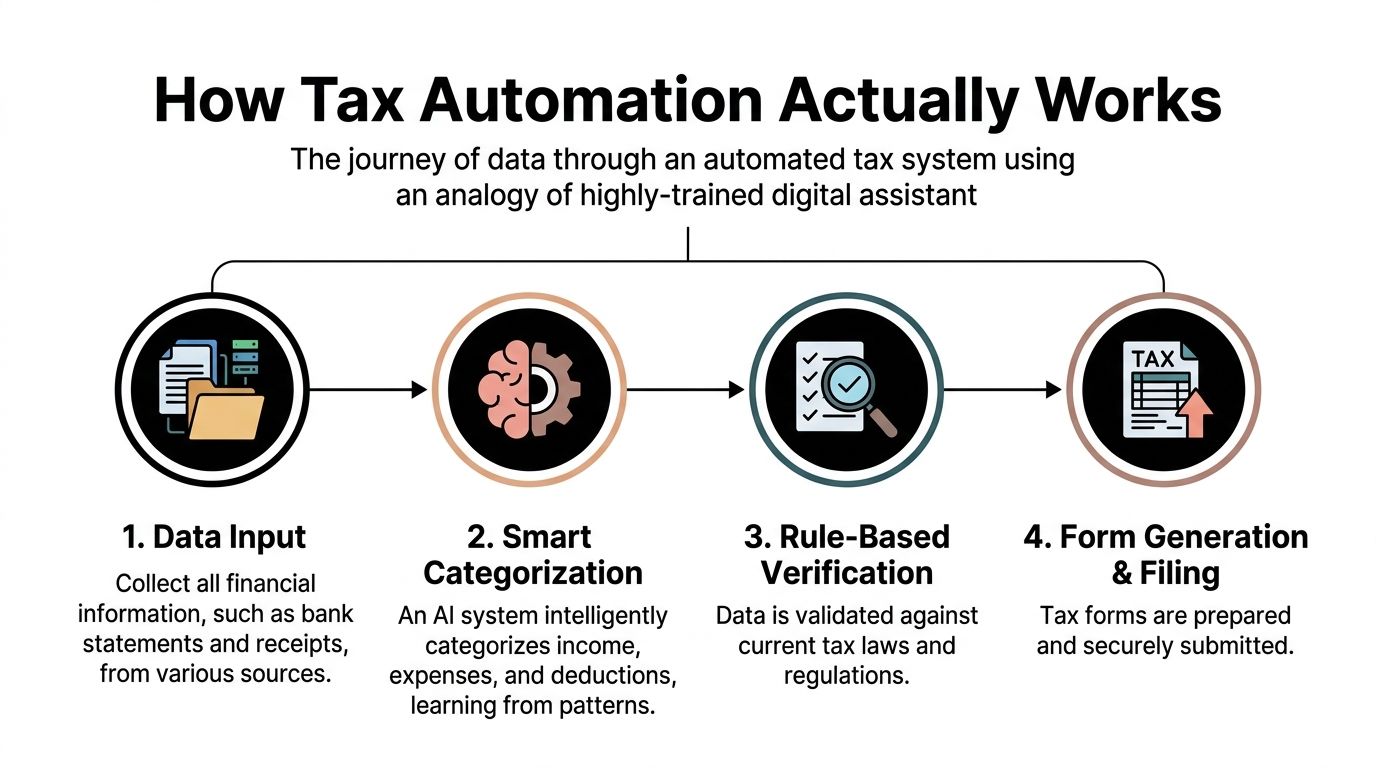
Think of tax software as a digital assistant that's fast at reading records but literal about what it sees. It doesn't “understand” your portfolio the way a trader or controller does. It ingests data, applies rules, and produces outputs based on the information you gave it.
For standard returns, AI-powered systems demonstrate 97.3% accuracy compared with 94.1% for human preparers, and for simple filings with a standard deduction, AI accuracy reaches 99.1%, based on findings in this analysis of AI tax preparation accuracy. That's why automation works so well on routine tax work. The machine doesn't get tired, skip a box, or transpose numbers.
The four moving parts
Most automated tax returns follow the same core sequence.
Data ingestion
The platform connects through APIs, CSV uploads, or direct document imports. In crypto, that often means exchange API keys, wallet addresses, and transaction exports. In traditional finance, it means brokerage statements, bank activity, and tax forms.Transaction classification
The software maps events into categories like buy, sell, transfer, interest, staking reward, expense, or income. This is the step people casually call “AI,” but in practice it's usually a mix of rules, pattern matching, and model-assisted labeling.Rule application
Once events are categorized, the software applies tax treatment. It calculates gains, losses, income recognition, and holding periods. If the category is wrong, the calculation can still be perfectly wrong.Output generation
The final product may be a finished return, a package for your CPA, or a set of tax reports for review and filing.
Why crypto needs a closer review
Traditional brokerage data is usually structured. DeFi data often isn't. A simple token swap is manageable. A multi-step strategy involving a bridge, deposit into a vault, reward token emissions, and later redemption is harder because one economic action may appear on-chain as several separate events.
A good platform should let you inspect that logic, not hide it. If you're comparing options, this crypto tax software comparison is a useful starting point because the biggest difference between tools isn't the dashboard. It's how they handle edge cases.
Here's a simple test. If a platform can't clearly show why it labeled an on-chain transaction as income instead of transfer, you're not looking at automation. You're looking at a black box.
A quick visual walkthrough helps if you haven't seen the process in action:
Good automation compresses the boring work. It doesn't remove your responsibility to check how unusual transactions were interpreted.
The Real Benefits and Hidden Limitations
People oversell automated tax returns in two ways. First, they describe them like autopilot. Second, they lump tax software together with general AI chat tools. Those are different things, and confusing them creates avoidable risk.

The upside is real. Automation cuts repetitive data entry, standardizes calculations, and gives investors a single place to review activity that would otherwise be scattered across exports and wallet explorers. For teams, it also creates process discipline. Instead of asking who updated which spreadsheet tab, everyone works from one reconciled ledger.
What works well
A few areas consistently benefit from automation:
Area | Where automation helps |
|---|---|
Routine calculations | Repeats tax logic consistently across large data sets |
Consolidation | Pulls data from multiple sources into one workflow |
Review readiness | Flags missing fields, duplicates, and inconsistent labels |
Documentation | Produces reports you can keep with your records |
For a treasury team, that consistency matters even more than speed. You need a review trail. You need repeatability. And you need a system that someone else can understand if the person who built last year's spreadsheet is gone.
Where people get burned
The weak point isn't usually the math. It's the inputs and the assumptions. In crypto, software can misread internal transfers, fail to match wrapped and unwrapped assets cleanly, or treat contract interactions as taxable events without enough context.
That gets riskier when people use chatbots as tax authority. Over-reliance on AI without manual verification can increase audit vulnerability, and complex tax questions may receive outdated or inaccurate guidance up to 50% of the time, according to this report on AI tax guidance accuracy and audit risk. That's the exact opposite of what you want when handling DeFi, international activity, or novel token mechanics.
If a chatbot gives you a clean answer to a messy DeFi transaction, treat that as the start of your review, not the end of it.
The same principle shows up outside crypto. Investors who deal with pass-through entities, property structures, or pooled investments still need to understand how tax character flows through the return. For example, this overview of powerful syndication tax benefits is useful because it shows how attractive tax outcomes can depend on structure, timing, and classification. Software can process those records, but it can't decide whether the underlying characterization is right for your facts.
The practical limitation
Automation is strongest when the economic event is obvious from the data. It's weaker when the software must infer intent.
That means these cases deserve human review:
Wallet transfers that look like disposals
Liquidity pool deposits and withdrawals
Staking, restaking, and reward claims
Bridges and cross-chain swaps
Token migrations, rebases, and wraps
Anything involving manual journal entries
The rule is old but still accurate: garbage in, garbage out. Tax software doesn't rescue bad records. It organizes them faster.
Preparing Your Data for Automation
Most tax problems show up before you ever press “calculate.” They start when records are incomplete, duplicated, or disconnected from each other. If you want automated tax returns to work, you need a clean transaction map first.

Automated systems can pre-populate 42% to 48% of all individual tax returns in the U.S. using existing information returns and prior-year data, which highlights how much complete records reduce manual work, according to this National Bureau of Economic Research paper on pre-populated returns. The lesson for crypto is straightforward. The better your source data, the more useful automation becomes.
What clean data looks like
Clean data doesn't mean perfect data. It means every meaningful movement has a source, a destination, a timestamp, and enough context to classify it correctly.
For most investors, that means gathering:
Exchange records: API connections where possible, CSV exports when needed
Wallet histories: Public wallet addresses for every chain you used
Bank and brokerage statements: Especially if fiat on-ramps or off-ramps matter
Tax documents: 1099s, year-end summaries, and any prior working papers
Notes on unusual transactions: Token migrations, airdrops, recoveries, exploits, or treasury reclassifications
Crypto records that usually get missed
The common blind spots are predictable. People remember Coinbase or Kraken. They forget the wallet they used once for a bridge. They export spot trades but miss staking subaccounts. They include one side of a transfer and not the other.
Reviewing your history in a portfolio tracker before tax prep usually saves time because it exposes missing wallets and strange balances early. A tool focused on portfolio tracking for digital assets can help you identify data gaps before they become filing problems.
Checklist: Before importing anything, write down every exchange, wallet, chain, and protocol you touched during the year. Memory is unreliable. Old email confirmations and wallet activity are better.
A better prep habit
Don't wait until year-end to assemble records. Create a simple ledger of exceptions during the year. You don't need a long memo. A sentence is often enough.
Examples:
“Moved USDC from Exchange A to self-custody. Not a sale.”
“Deposited ETH into liquid staking protocol. Receipt token issued.”
“Bridge transaction split into burn on one chain and mint on another.”
“Treasury wallet paid vendor in stablecoins.”
Those notes matter because automated systems are good at reading transactions, not intentions. If you capture intention while it's fresh, review becomes much faster later.
A Practical Workflow for Investors and Treasuries
The best automated tax workflow looks less like one giant filing event and more like a controlled reconciliation process. Whether you're an individual investor or part of a treasury team, the sequence is broadly the same. The difference is usually the number of accounts, reviewers, and approval steps.

A workable process starts with source control. You connect exchanges, import wallets, bring in fiat records, and lock down a single version of the ledger for review. Then the software classifies activity and produces draft outputs.
The stage that matters most
Many users get lazy at this stage. They see a neat dashboard and assume the hard part is done. It isn't.
The critical stage is review and reconciliation:
Check transfers: Confirm wallet-to-wallet movements weren't treated as sales or income
Inspect income labels: Review staking, yield, referral, and reward categories
Spot unmatched transactions: These often signal missing wallets, failed imports, or chain-specific gaps
Review high-value events first: Start where mistakes hurt most
Document overrides: If you reclassify a transaction, note why
AI-driven tax agents now use real-time processing and dynamic risk assessment, which can reduce compliance remediation costs by 30% to 40% for firms and cut certain withholding tax calculation errors by up to 90%, according to this Tax Adviser analysis of automation in tax reporting and withholding. That's valuable, but the hidden point is even more important. These systems work best when humans focus on the exceptions instead of rebuilding routine calculations by hand.
How the workflow plays out in practice
An individual investor might run this process in one sitting over a weekend. A treasury team may spread it across accounting, operations, and outside tax review.
A practical sequence looks like this:
Select a tool that supports your actual activity
If you use DeFi, make sure the platform handles wallets, on-chain imports, and custom labeling. Don't choose based on homepage copy.Connect every source before reviewing anything
Partial imports create fake problems. Missing one wallet can make every transfer around it look taxable.Reconcile drafts against economic reality
Ask a simple question for each odd item: what happened here? Not what the software says. What happened.Generate reports and preserve support
Keep exports, reconciliation notes, and copies of source files. If you later need to defend a treatment, these records matter.File only after exception review is complete
Filing a polished report that you haven't reviewed is worse than filing late with a correct one.
For investors, automation shortens the path to a usable draft. For treasuries, it creates a repeatable review system that other people can audit and inherit.
Choosing Tools and Maintaining Compliance
The right software isn't the one with the most aggressive AI marketing. It's the one that fits your transaction reality and makes review easy. For crypto users, that means broad exchange coverage, wallet support, on-chain visibility, and a clear way to handle custom classifications when the default label is wrong.
What to look for
A strong tool should offer:
Crypto and DeFi support: Wallet imports, exchange integrations, and visibility into on-chain activity
Security controls: Two-factor authentication, sensible permissions, and clear handling of sensitive financial data
Auditability: A clean transaction log, visible classifications, and exportable support files
Override flexibility: The ability to fix edge cases without breaking the rest of the ledger
Stable workflow design: Easy review for you, your accountant, or your finance team
If you're comparing platforms for ongoing oversight, this guide to crypto compliance software is a practical reference because compliance isn't just about filing. It's about keeping records in shape all year.
Compliance is a habit, not a button
The long-term edge comes from operating discipline. Save reports. Keep source exports. Record exceptions when they happen. Reconcile wallets periodically instead of only at year-end. If your activity crosses into entity reporting, contractor payments, or specialized filing obligations, use niche resources where they fit. For example, teams dealing with payer reporting may find this guide for Church Extension Funds on 1099s useful as a reminder that reporting workflows often depend on entity type and payment context, not just software settings.
The main point is simple. Automated tax returns are a co-pilot, not an autopilot. They handle scale well. They handle ambiguity poorly unless you step in. If you treat the software as a fast assistant and keep human oversight in the loop, you realize the full benefit of automation without sleepwalking into preventable mistakes.
If you're putting stablecoins to work in DeFi and want a simpler way to manage yield opportunities without juggling protocols by hand, Yield Seeker is worth a look. It helps users automate stablecoin yield strategies with an AI-assisted workflow while keeping funds accessible and the experience easy to monitor.