

The popular advice is simple: automate everything you can, then let AI optimize the rest. That advice is incomplete. In production, the difficult part of automated treasury management isn't generating another forecast or connecting another wallet. It's deciding what the system may do without permission, what requires approval, and how people regain control when market conditions invalidate the model.
Treasury automation now sits on mature infrastructure. PwC's 2025 Global Treasury Survey reports that 74% of respondents are expanding or actively using AI in treasury, while 94% already operate a dedicated treasury management system. The next advantage won't come from adding autonomy for its own sake. It will come from building a system that moves quickly while preserving policy, evidence, and accountability.
Why More Automation Is Not the Real Goal
More automation can reduce repetitive work, but it can also make mistakes faster and harder to diagnose. A forecast that refreshes continuously is useful. An allocation engine that moves capital across protocols without a clear approval boundary is a different proposition entirely.
The right question isn't, “How much of treasury can we automate?” It's, “Which decisions can run automatically without weakening the controls that make those decisions acceptable?” That distinction matters in both corporate finance and DeFi, where a flawed payment rule, stale balance, or compromised integration can turn an operational error into an irreversible transaction.
Treasury teams still prioritize foundational plumbing. Commentary from DBS on AI and corporate treasury highlights the continuing importance of eliminating spreadsheets and integrating ERP, TMS, and banking systems. That priority reveals a practical reality: many organizations aren't blocked by a lack of intelligent models. They're blocked by fragmented data, inconsistent policies, and unclear ownership when an automated action fails.
Operational rule: An automated decision is production-ready only when someone can explain why it happened, which policy allowed it, what data triggered it, and how to reverse or contain the outcome.
Control comes before autonomy
A treasury platform should separate observation, recommendation, approval, and execution. These aren't interchangeable stages.
A system may automatically collect balances and classify transactions. It may recommend a liquidity transfer or compare DeFi yields. It may execute a pre-approved action inside strict limits. Each step demands a different level of human involvement and evidence. Forecasting can often tolerate model uncertainty because a person still decides. Autonomous execution can't rely on the same assumption.
Approval thresholds should reflect both amount and risk. A routine movement between approved accounts might follow a standing policy. A new counterparty, unfamiliar protocol, or unusual transaction path should create an exception, even if the expected yield looks attractive.
Trust is the real performance metric
Teams often measure automation through speed, task reduction, or forecast accuracy. Those metrics matter, but they don't show whether operators trust the system enough to leave it running during stress.
A stronger review asks:
Policy coverage: Which actions have explicit rules, and which rely on informal judgment?
Auditability: Can the team reconstruct the complete decision path after settlement?
Exception quality: Does the system surface meaningful anomalies, or bury operators in alerts?
Containment: Can the team pause execution without disabling data collection and monitoring?
Accountability: Is a named person responsible for every strategy and approval class?
A useful introduction to the broader discipline is this guide to what treasury management involves. Automated treasury management should extend that discipline, not replace it with a collection of disconnected bots.
The best architecture therefore starts with clean feeds, reconciled balances, and explicit policies. Intelligence comes afterward. Feature count is a poor substitute for control design.
Core Components of Automated Treasury Systems
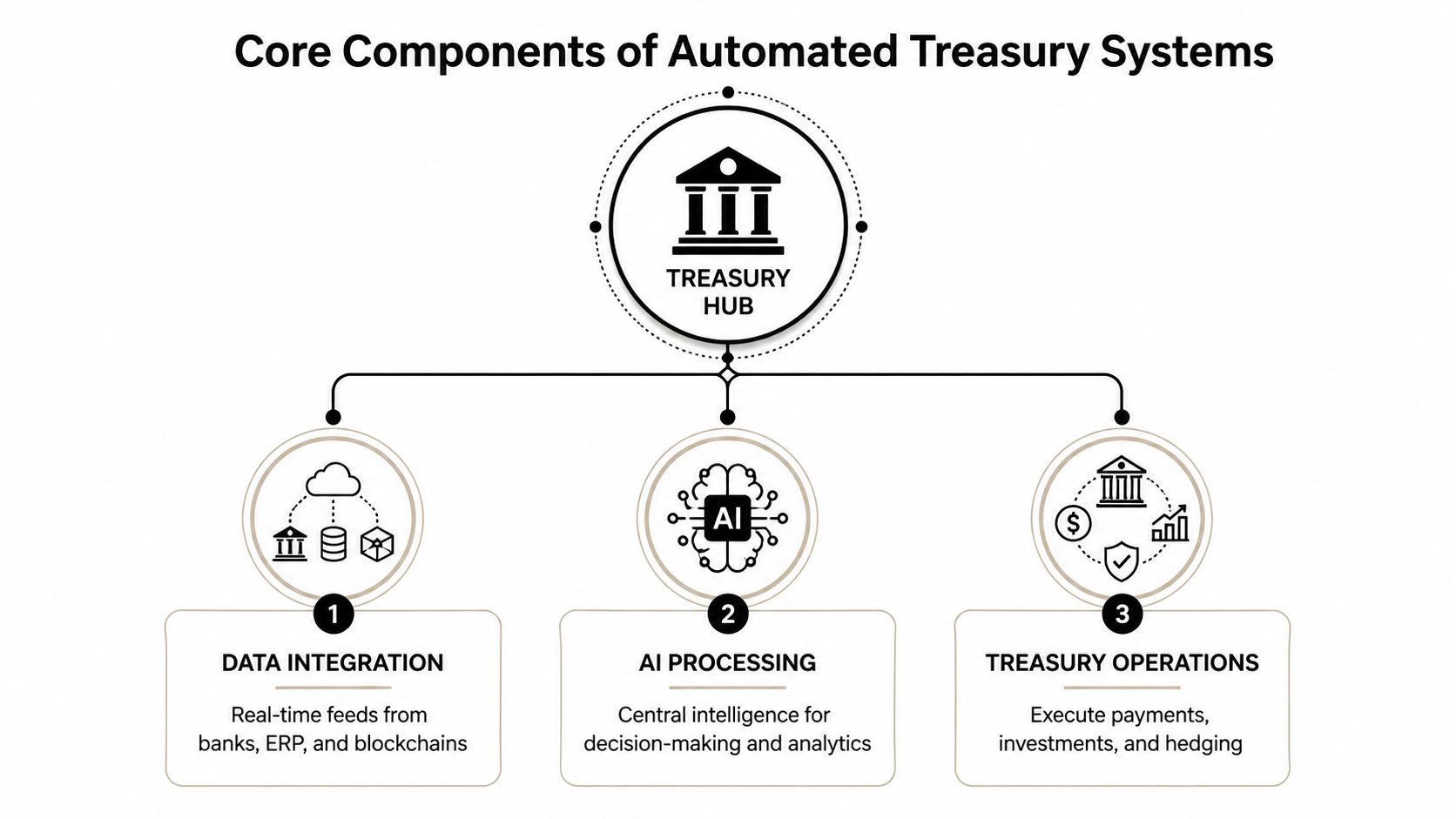
A practical system has three layers: data integration, decision intelligence, and treasury operations. The layers should be connected, but they shouldn't have identical permissions. Data systems can observe broadly, models can recommend selectively, and execution systems should act only within enforceable boundaries.
Data integration creates the forecasting loop
The data layer combines bank feeds, ERP records, AP obligations, AR receipts, internal ledgers, and on-chain balances. Each source has different timing and semantics, so normalization matters as much as connectivity. A payment appearing in an ERP queue shouldn't be counted as settled cash, while an on-chain transfer shouldn't be treated as available until the relevant confirmation and reconciliation rules are satisfied.
API connectivity turns this from batch reporting into a continuous loop. PwC reports that 65% of organizations plan to expand API use in the coming years, supporting more direct exchange between banks, ERPs, and treasury systems through the 2025 Global Treasury Survey. For a crypto-native treasury, the equivalent feeds include wallet events, protocol positions, oracle data, bridge exposure, and pending transactions.
A rolling forecast works only if those events update the model consistently. Teams building or reviewing a forecast process can use this cash flow forecasting 2026 guide to clarify the relationship between source data, forecast horizons, and variance analysis.
Intelligence should recommend before it executes
The AI layer identifies patterns, estimates liquidity needs, detects anomalies, and ranks possible actions. It can compare a stablecoin vault with a reserve account, evaluate expected liquidity, and flag that a seemingly attractive strategy creates unwanted concentration.
The execution layer is separate. It handles payment initiation, internal sweeps, investment instructions, hedging, or DeFi rebalancing. That separation prevents a model output from becoming an irreversible transaction by default.
Traditional treasury teams may begin with automated statement ingestion, reconciliation, and cash positioning. Deloitte reports that 78% of corporates use technology to assist with treasury accounting, 64% use it for cash management, and 50% use it for cash flow forecasting in its treasury survey, while many also expect more automation in those areas through its treasury technology report. Crypto teams often start with wallet monitoring and exposure reporting, then add governed allocation.
That progression works because each phase produces operational evidence before the next permission is granted.
AI Agents and Smart Contracts in Treasury Workflows
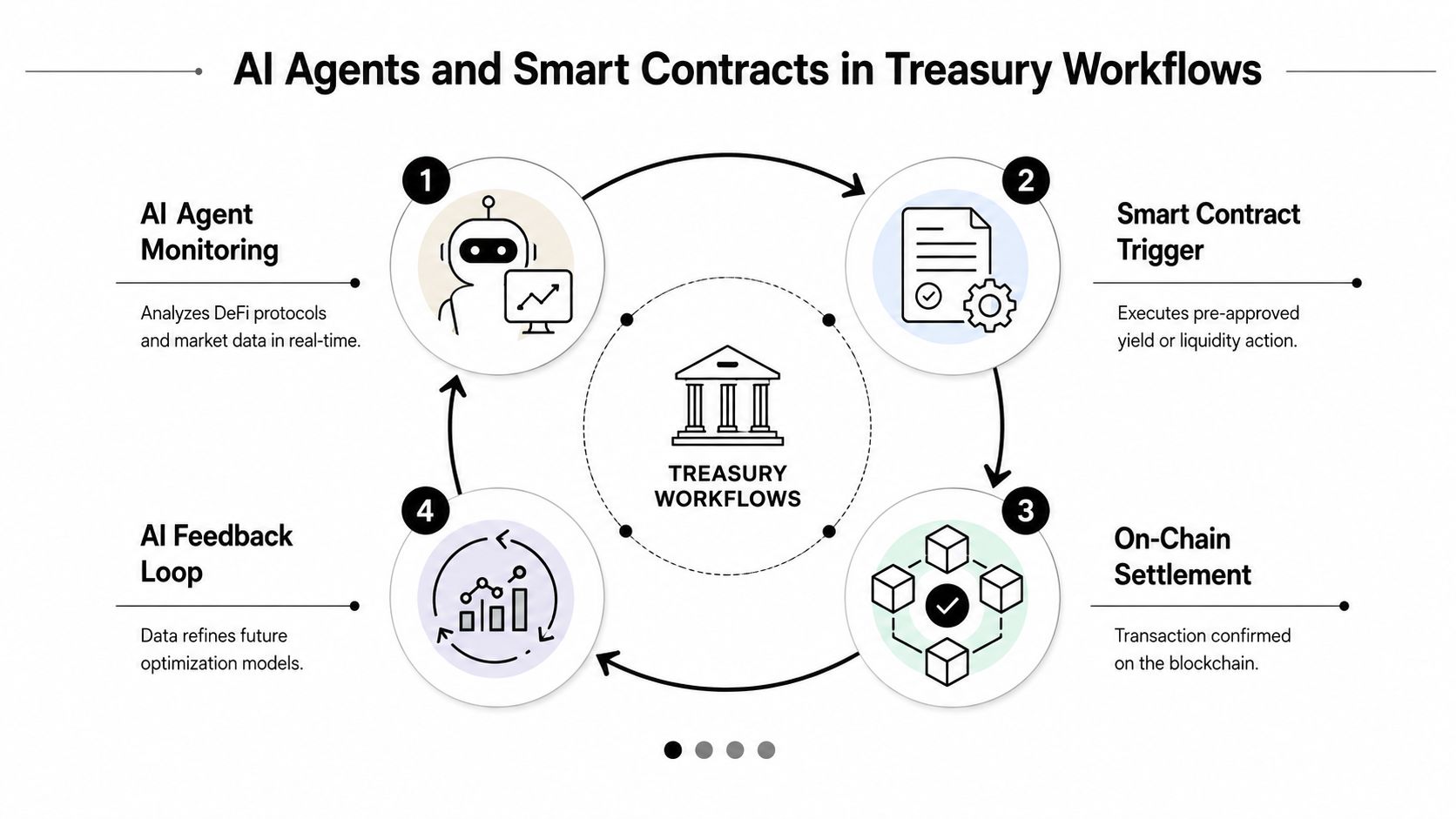
AI agents and smart contracts solve different problems. The agent interprets changing information. The contract enforces what the treasury is willing to permit. Combining them without separating those responsibilities creates a system that can be fast, opaque, and difficult to stop.
A useful architecture begins with the agent observing approved data sources. It evaluates protocol liquidity, utilization, counterparty exposure, expected yield, and the treasury's upcoming obligations. It then proposes an action, such as moving a defined portion of idle USDC into an approved vault or returning capital to a liquid reserve.
The smart contract receives only structured instructions that match an existing policy. It can enforce a protocol allowlist, exposure ceiling, minimum liquidity reserve, withdrawal permissions, and transaction expiry. If the instruction violates a rule, the contract rejects it regardless of the agent's confidence.
The division of labor matters
The agent shouldn't hold unrestricted signing authority. It should produce a decision record containing the observed inputs, selected strategy, expected effect, confidence or uncertainty indicators, and policy reference. A separate executor or multisig process can validate that record before settlement.
This design also makes model replacement safer. The treasury can change its agent, data provider, or optimization logic without rewriting the custody layer. The contract remains the final policy boundary.
For a deeper look at agent behavior in crypto systems, see AI agents in crypto. The same principle applies to treasury operations: autonomy is safer when the agent proposes and the settlement layer constrains.
A feedback loop should record what happened after execution. Did the withdrawal complete? Did the realized yield match the expected outcome? Did slippage, gas, or liquidity conditions alter the result? Those observations can improve future recommendations, but they shouldn't change the policy itself without oversight.
Yield optimization is a constrained problem
An agent that selects the highest displayed yield is not managing treasury risk. It's ranking one variable. A treasury strategy must weigh safety, liquidity, concentration, operational complexity, and return together.
In volatile DeFi markets, the optimal action may be to accept lower yield in exchange for immediate access to reserves. A strategy may also keep capital split across approved venues even when concentration appears efficient. The correct decision depends on the treasury's liabilities and risk mandate, not on a generic yield leaderboard.
The video below can help teams visualize how automated treasury workflows connect monitoring, execution, and settlement.
A human operator should still be able to pause a strategy, revoke permissions, and force a return to a reserve path. Smart contracts provide transparency and enforcement, but they don't remove the need for incident ownership.
Implementation Roadmap for Crypto Treasury Automation
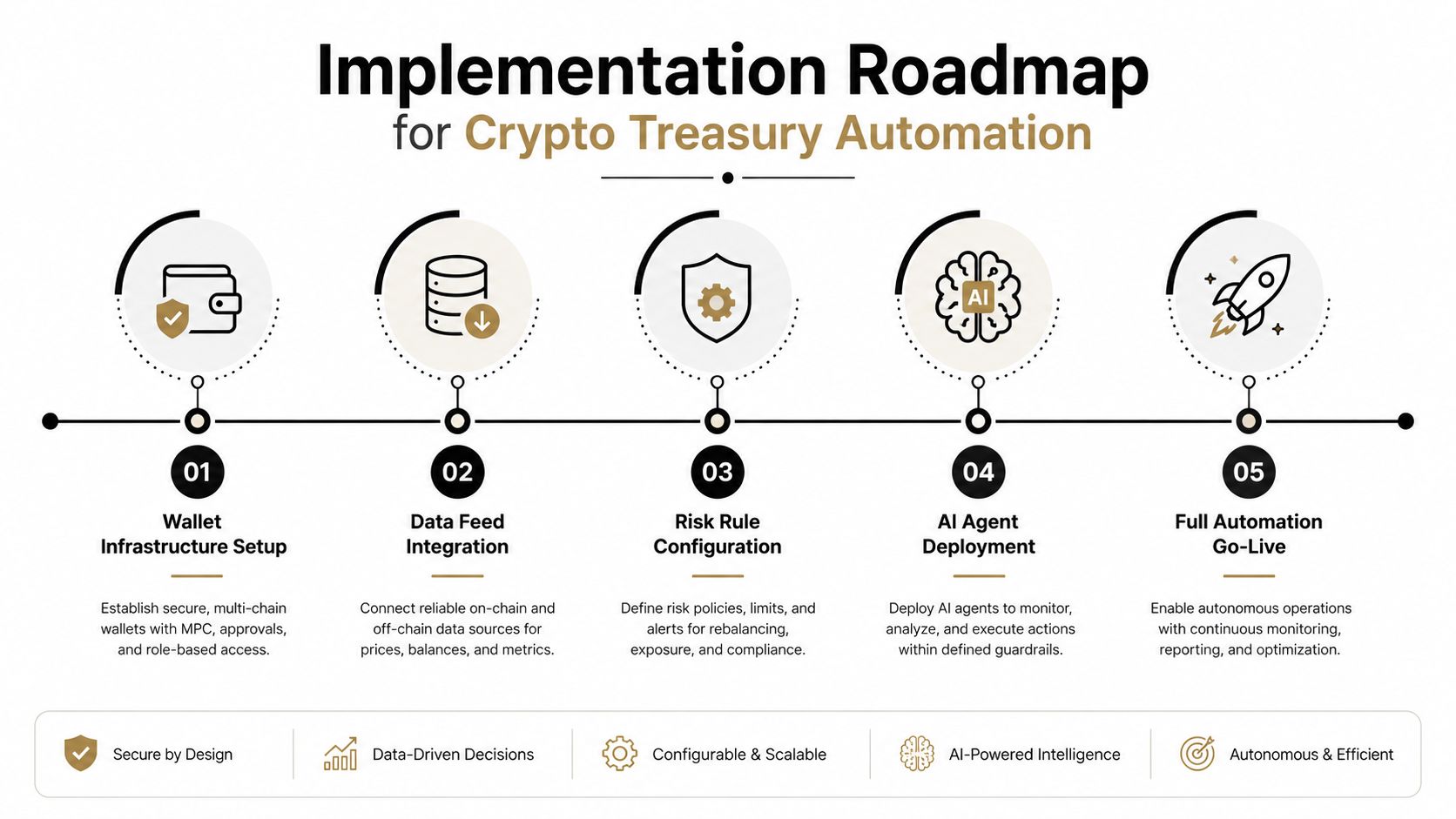
Crypto treasury automation should be introduced as a permissions program, not a software installation. Each stage should answer one question: what does the system know, what may it recommend, and what may it execute?
Establish custody and operating boundaries
Start with wallet infrastructure, signer roles, and recovery procedures. Use segregated wallets for operating liquidity, strategy capital, and long-term reserves. A multisig should control meaningful treasury permissions, while automated contracts should receive only the authority required for their defined actions.
Write the policy before deploying the agent. Specify approved assets, acceptable protocols, exposure limits, minimum liquid reserves, transaction routes, and conditions that require a human decision. Include emergency actions such as pausing a contract, revoking an approval, and moving funds to a safe destination.
Protocol due diligence should cover contract upgradeability, oracle dependencies, withdrawal mechanics, admin privileges, liquidity conditions, and historical incidents. A high displayed return doesn't compensate for an exposure the treasury can't explain.
Build observability before optimization
Connect wallet activity, balances, protocol positions, transaction status, and treasury liabilities into one monitoring view. Reconcile the view against source systems before allowing any automated movement. If the dashboard is wrong, an agent will make confident decisions from bad information.
Run the system in observation mode first. Let it calculate forecasts and produce allocation recommendations without signing transactions. Compare recommendations with actual cash needs and review false alerts, missing events, stale data, and unexpected protocol states.
Market-specific risks deserve separate review. Teams assessing stablecoin proposals should understand the concerns raised in this analysis of the Hyperliquid warning, especially where governance, collateral, and liquidity assumptions interact.
Expand permissions gradually
A controlled rollout can follow this sequence:
Read-only monitoring: Collect balances, positions, obligations, and protocol data. Test data freshness and reconciliation.
Human-approved recommendations: Let the agent propose transfers and rebalances, but require an operator to approve every action.
Bounded execution: Permit automatic actions only for approved assets, destinations, and exposure ranges. Log every instruction and settlement result.
Exception-driven operations: Allow routine actions to proceed automatically while routing new protocols, unusual sizes, failed transactions, and policy conflicts to people.
Stress validation: Simulate oracle outages, delayed withdrawals, stale feeds, abnormal prices, failed transactions, and compromised integrations before expanding scope.
Every stage needs a rollback path. Define who can pause execution, where capital goes when a strategy stops, and how the team communicates during an incident. Don't treat a successful test transaction as proof that the production system is safe.
Risk Management and Control Frameworks
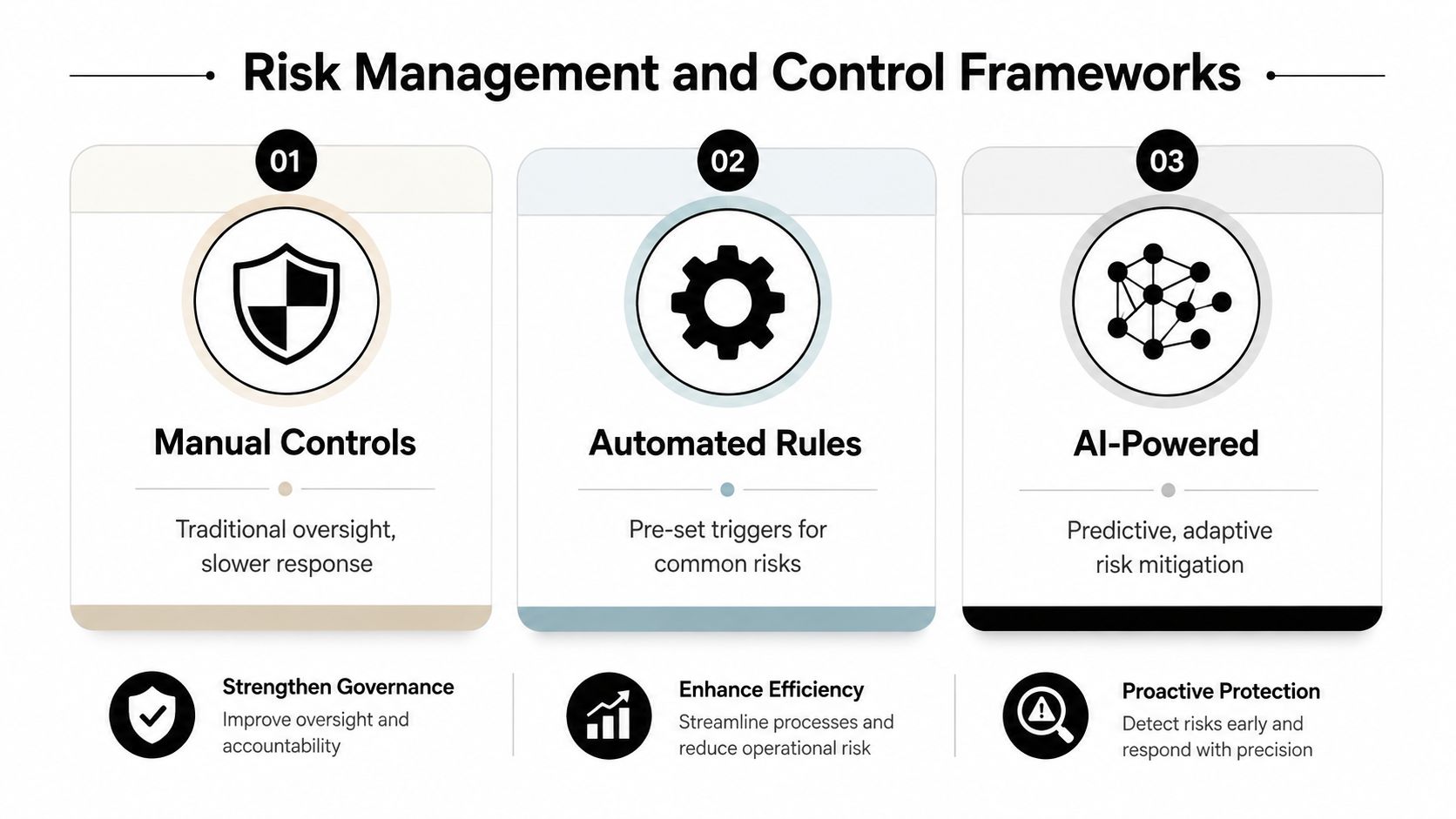
Manual controls, rule-based automation, and AI-powered controls each have a place. The mistake is treating them as competing replacements rather than layers with different strengths.
Approach | Strength | Weakness | Appropriate use |
|---|---|---|---|
Manual controls | Contextual judgment and clear accountability | Slow response and inconsistent execution | New strategies, unusual events, and high-impact approvals |
Automated rules | Predictable enforcement and repeatability | Limited ability to interpret novel conditions | Known transaction patterns and hard policy boundaries |
AI-powered controls | Pattern detection and adaptive recommendations | Model uncertainty and explainability challenges | Monitoring, prioritization, and scenario analysis |
Hard limits should stay hard
Use smart contracts and deterministic policy engines for rules that must never be bypassed. Examples include maximum protocol exposure, minimum reserve levels, approved destination addresses, and required signer combinations.
Use automated alerts for conditions that need judgment. A sudden change in liquidity, an unusual withdrawal queue, or a mismatch between expected and realized yield may not justify an automatic liquidation. It should create a clear, prioritized review.
Human approval remains appropriate for new counterparties, policy changes, material reallocations, and actions that could impair payroll, settlement, or other obligations. Speed matters, but the fastest unsafe transaction is still a failure.
Design for containment, not perfection
A resilient control framework assumes that data can be delayed, models can be wrong, and contracts can behave unexpectedly. Circuit breakers should pause affected strategies without taking down the entire treasury. Alerting should distinguish between a failed data feed, a breached exposure limit, and a genuine market event.
A practical review of automated risk assessment tools can help teams compare monitoring capabilities, but the selection criteria should come from the treasury policy. Tools don't define acceptable risk. The organization does.
For teams reviewing broader operational controls, this framework for stopping financial leaks in 2026 offers useful context for connecting process failures, authorization, and financial loss.
Incident principle: Pause first, preserve evidence second, investigate third, and only then restore automated execution.
Smaller treasuries may use a single multisig, strict allowlists, and manual approval for anything outside routine flows. Larger or more complex operations need role separation, independent monitoring, formal change management, and tested recovery procedures. The right design depends on exposure and consequence, not on whether the treasury calls itself traditional or crypto-native.
KPIs and Performance Monitoring
A treasury dashboard should guide four decisions: continue, pause, investigate, or change policy. Its design must expose concentration and liquidity risk instead of rewarding attractive returns alone. In production, the dashboard is also the operator's control surface when an agent proposes autonomous execution.
Forecast accuracy belongs in the KPI set, with definitions fixed across reporting periods. The previously cited Stealth Agents industry summary reports median 30-day forecast accuracy rising from 71% without AI to 92% with AI, and 7-day accuracy rising from 83% to 96%. It also reports an 18% average reduction in idle cash buffers. Treat these figures as reference points, not targets. Data quality, treasury complexity, and forecast definitions vary.
KPI | Manual baseline | With AI automation | Improvement |
|---|---|---|---|
30-day cash forecast accuracy | 71% | 92% | 21 percentage points |
7-day cash forecast accuracy | 83% | 96% | 13 percentage points |
Idle cash buffer | Baseline | Reduced by 18% on average | 18% reduction |
The table repeats benchmarks from the previously cited industry summary.
Measure control quality alongside returns
Yield measures outcome, but control metrics show whether the system remains governable:
Forecast variance: Compare predictions with realized cash movements and classify each material deviation.
Exception rate: Track actions sent to human review, separating useful exceptions from alert noise.
Policy violations: Record rejected instructions, attempted limit breaches, and unauthorized destinations.
Execution quality: Compare approved actions with settled outcomes, including failed transactions and unexpected costs.
Liquidity availability: Monitor capital accessible under normal and stressed conditions.
Decision latency: Measure the time required for human review after an automated pause.
The dashboard should preserve the evidence behind every recommendation. Show the data timestamp, policy version, proposed action, affected exposure, approval identity, and settlement status in one audit trail. Without that context, operators cannot determine whether a poor result came from stale data, a policy change, execution failure, or market movement.
Set thresholds for combinations of signals, not isolated metrics. A yield increase paired with higher concentration or slower withdrawals should trigger review. An agent that produces strong returns while generating more exceptions is shifting risk into operations, not improving treasury performance. The governance test is whether a human can reconstruct the decision and stop the next action before settlement.
Real-World Scenarios and Market Adaptation
Stablecoin treasury automation faces three recurring regimes. Yields compress, liquidity thins, or the rules around a strategy change. A resilient system doesn't respond to all three with the same instruction.
When yields compress across approved protocols, the agent should compare the opportunity cost of moving funds with transaction costs, liquidity, concentration, and reserve requirements. If no destination clears the treasury's policy threshold, the correct action may be to hold liquid stablecoins rather than chase a marginal return.
During a liquidity shock, the system should prioritize obligations and access. Smart contract limits can prevent new allocations, while a circuit breaker pauses rebalancing until price feeds, withdrawal conditions, and available liquidity pass review. The human operator decides whether the event is temporary, structural, or evidence that a protocol no longer belongs on the allowlist.
Regulatory or governance changes create a different problem. The strategy may remain technically profitable while becoming unacceptable under the treasury's mandate. The agent can identify affected positions and prepare an exit plan, but policy owners should approve the change in exposure and document the reasoning.
The useful test isn't whether the system acts without people. It's whether people can understand and govern its behavior when conditions fall outside the training data. Yield Seeker offers an example of a product approach in which an AI agent monitors supported vaults, evaluates yield and portfolio risk, and reallocates deposited stablecoin capital when appropriate. For treasury teams, the relevant question is how those actions fit into their own wallet permissions, reserve policy, and approval process.
If you're evaluating automated treasury management for stablecoins or DeFi reserves, visit Yield Seeker to see how an AI-powered agent can monitor supported opportunities and manage allocations while keeping the strategy visible to the user. Use it as a practical reference point when designing your own balance between automation, liquidity, and control.