
You're staring at five browser tabs, each showing a different stablecoin lending rate. One protocol offers the highest APY, another has deeper liquidity, a third looks safer, and the fourth just changed its rate. Meanwhile, network activity is rising, and the cost of moving funds keeps changing. By the time you finish comparing the options, the opportunity you were chasing may already be gone.
That situation has a direct parallel in cloud engineering. Web requests don't choose individual servers by hand. A routing layer watches backend conditions and sends each request toward a suitable target. Automatic load balancing applies the same basic logic to infrastructure, and increasingly to DeFi capital allocation: monitor live conditions, choose a destination, route the capital, and adjust when the environment changes.
Why Manual DeFi Allocation Breaks at Scale
Manual allocation works when your portfolio is small, your strategy changes infrequently, and you can tolerate checking rates occasionally. It becomes much harder when you're tracking several chains, protocols, vaults, risk profiles, and withdrawal conditions at once.
A stablecoin holder might begin with a simple plan: deposit into the lending market showing the best rate. Then utilization changes, liquidity thins, gas becomes more expensive, or the protocol pauses a market. The user has to notice the change, calculate whether moving is worthwhile, approve a transaction, wait for execution, and check that the new deposit arrived correctly.
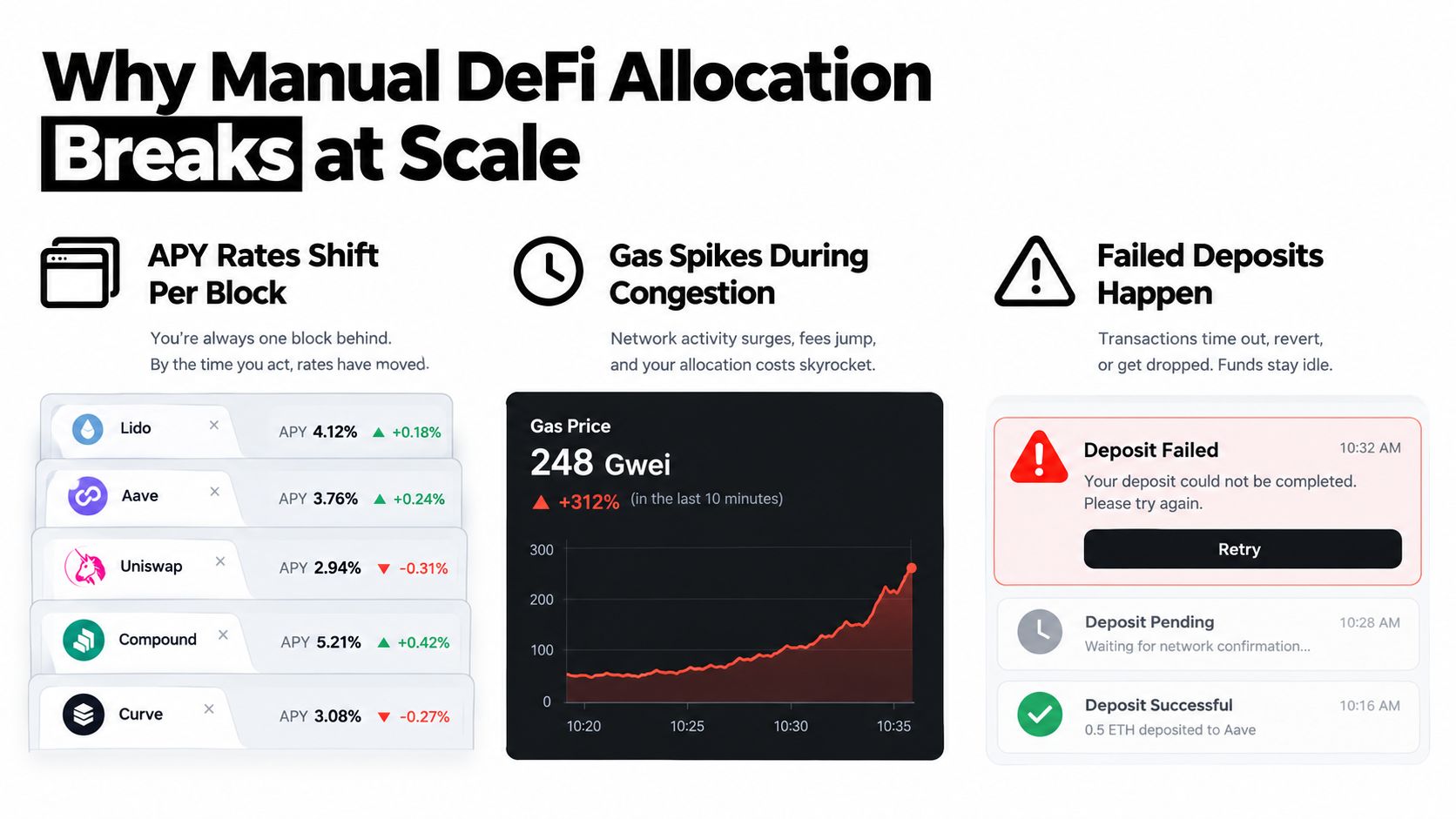
The problem is coordination, not intelligence
Even an experienced DeFi user can struggle with the number of decisions involved:
Monitoring fatigue: Rates, utilization, liquidity, and protocol status can change while you're doing something else.
Slow reactions: A weekly review may miss several meaningful allocation changes.
Execution friction: Approvals, swaps, deposits, and withdrawals create multiple points of failure.
Rebalancing cost: A move only makes sense after accounting for gas, slippage, and any protocol fees.
Concentration risk: Users often leave funds in one familiar venue because comparing alternatives takes too much time.
This is why fragmented DeFi markets create an operational problem, as discussed in how to navigate fragmented DeFi. The issue isn't that users lack basic knowledge. The issue is that human attention doesn't scale as the number of live inputs grows.
Practical rule: A higher headline rate isn't automatically a better destination. The relevant question is whether the additional yield survives execution costs, liquidity constraints, and the risk of the venue.
Automatic load balancing introduces a separate decision layer between the depositor and the available yield sources. Instead of asking the user to inspect every venue, that layer can compare conditions and assign capital according to defined rules. Manual allocation still has a place for deliberate research and larger strategic decisions, but it becomes inefficient when every small market change requires the same attention.
What Automatic Load Balancing Actually Means
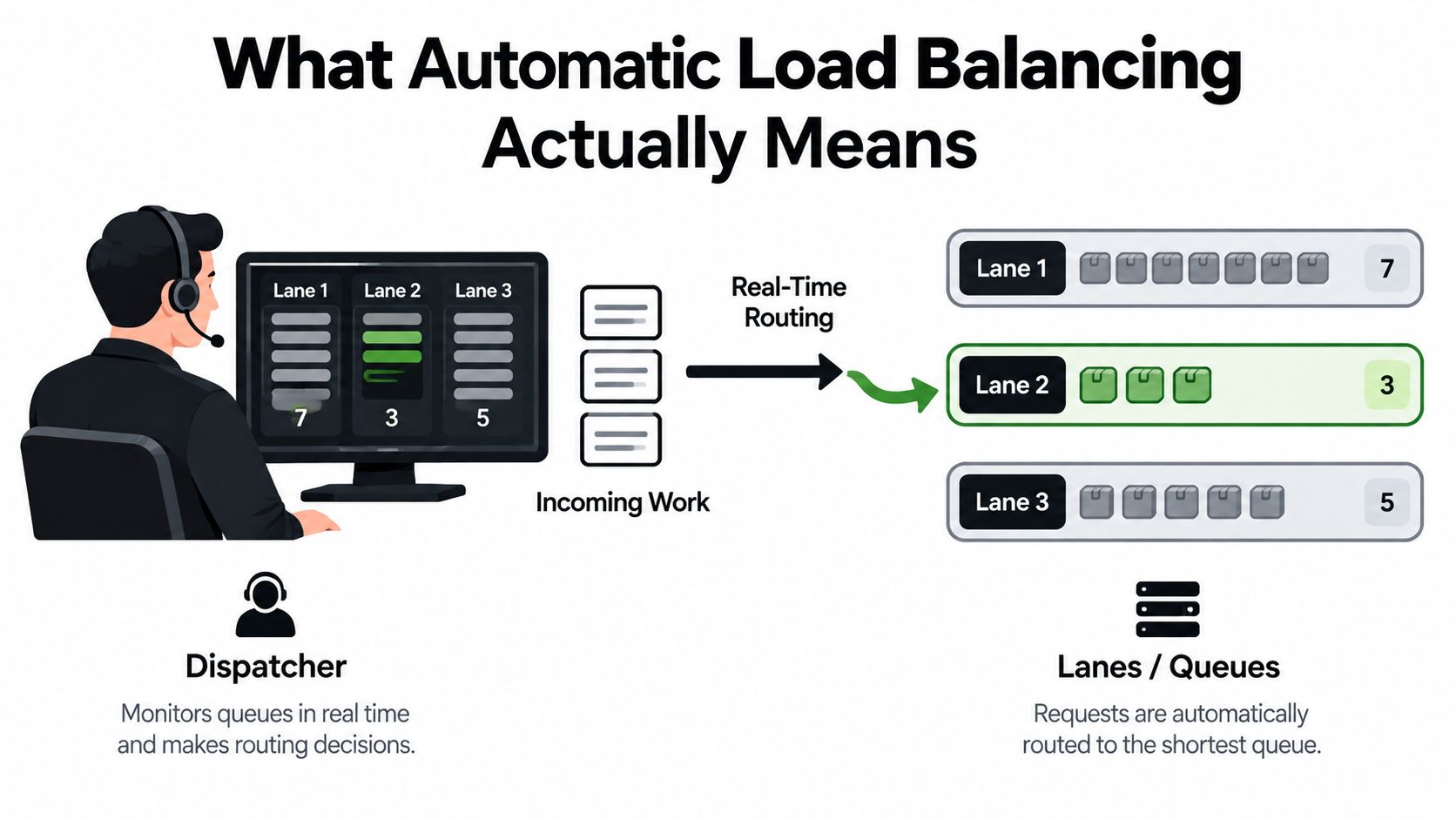
Think of a dispatcher standing in front of three checkout lanes. The dispatcher sees the queue length and directs each arriving shopper toward a lane that can serve them efficiently. Shoppers don't need to inspect every cashier or calculate the queue speed themselves.
In cloud infrastructure, a load balancer sits between clients and backend servers. It selects a target for each request, distributes work across a pool, checks whether targets are healthy, and helps prevent one server from absorbing more traffic than it can handle. The client sees one virtual endpoint rather than a list of individual machines. F5's explanation of load-balancing mechanics describes how the balancer can rewrite traffic destinations on the inbound path and return-path addressing while preserving the connection.
The same pattern maps cleanly to DeFi
The analogy becomes useful when the objects are translated directly:
Traffic system | DeFi allocation system |
|---|---|
Dispatcher | Allocation engine or agent |
Backend servers | Lending markets, vaults, or protocols |
Incoming requests | Stablecoin deposits |
Server health | Protocol status and smart-contract conditions |
Response time | Transaction and withdrawal experience |
Capacity | Available liquidity |
Routing policy | Allocation and risk rules |
A DeFi allocator may evaluate APY, utilization, liquidity depth, gas cost, and protocol risk before deciding where funds should go. The goal isn't to split deposits evenly. It's to direct capital toward suitable destinations while respecting constraints such as diversification, liquidity, and user preferences.
Automatic load balancing is also not a one-time distribution. It operates as a loop:
Monitor relevant conditions.
Score available destinations.
Decide how much capital each destination should receive.
Route deposits, withdrawals, or rebalances.
Repeat as conditions change.
That distinction separates load balancing from auto-compounding. Auto-compounding reinvests rewards within one strategy or protocol. Automatic load balancing compares multiple destinations and can change the portfolio's weights.
This is the same general idea whether the assets are HTTP requests moving between servers or stablecoins moving between yield sources. The dispatcher makes routing decisions so the end user doesn't have to manage every underlying destination.
A short visual explanation of request distribution can help cement the analogy:
The Core Benefits and Why They Matter for Yield
A stablecoin allocator faces the same basic problem as a busy cloud service. Deposits can arrive while one venue becomes crowded, another offers better liquidity, and a third develops a risk signal. Automatic load balancing addresses this mismatch by directing work toward suitable capacity. AWS describes Elastic Load Balancing as a managed service that distributes incoming traffic across multiple targets, monitors target health, and adjusts capacity as traffic changes in its load-balancing documentation.
That model gives DeFi allocation four practical benefits.
Availability becomes exposure management
A cloud balancer can stop sending new requests to an unhealthy server. A DeFi allocator can apply the same logic by limiting or reducing exposure to a venue whose conditions worsen. This does not remove smart-contract, oracle, or market risk. It reduces the chance that one protocol becomes the portfolio's only destination.
Diversification still needs care. Several related protocols may share exposure to the same asset, oracle, bridge, or market dependency. More destinations do not automatically create independent protection.
Throughput becomes access to more opportunities
A cache-aware balancing technique used in Google's web search backend produced a double-digit percentage increase in throughput, according to researchers who documented the system in the VLDB research paper. The paper also describes how datacenter operators may over-provision resources by up to 30% because load imbalance and tail latency leave capacity unused. Both findings point to the same principle: routing based on workload conditions can use available capacity more effectively than treating every destination alike.
For stablecoins, that does not mean chasing the highest APY. It means comparing venues through a broader score that can include liquidity, utilization, transaction cost, and risk.
Faster reaction reduces opportunity latency
Manual rebalancing depends on someone noticing a change, assessing it, and submitting a transaction. An automated allocator can evaluate signals continuously and act according to defined thresholds or policies. The shorter response time may help a portfolio react before an attractive opportunity fades or a venue becomes less suitable.
Execution still has limits. Transaction confirmation, available liquidity, gas costs, and safety controls determine whether a proposed rebalance can complete.
Scaling becomes a capital-routing problem
As deposits grow, allocating them well becomes less about selecting one destination and more about distributing weight across suitable pools. Idle capital and crowded venues can both reduce the result. A routing system shifts exposure while respecting limits, instead of sending every new deposit to the same pool.
Benefit | In cloud load balancing | In DeFi capital allocation |
|---|---|---|
Availability | Routes work away from unhealthy targets | Reduces dependence on weakening venues |
Throughput | Uses backend capacity more efficiently | Compares multiple sources instead of relying on one |
Lower latency | Responds to changing server conditions | Reacts to yield and liquidity changes sooner |
Elastic scaling | Absorbs demand by distributing requests | Spreads deposits and withdrawals across suitable pools |
For the user, the result is less dashboard maintenance, fewer manual decisions, and a more consistent process. Routing can make capital management easier, but it cannot make an unsafe destination acceptable. Limits, diversification rules, and risk checks still determine how the system behaves when conditions change.
From Round-Robin to AI-Driven Routing
Not every load-balancing algorithm makes the same decision. Some follow fixed rules. Others inspect live conditions. The most advanced systems attempt to anticipate what will happen next.
Static rules are predictable but limited
Round-robin routing sends requests to servers in a repeating sequence. Its DeFi equivalent is splitting deposits evenly across selected pools, regardless of changing APY or utilization. This is easy to understand and audit, but it assumes the destinations remain similarly suitable.
Weighted round-robin adds preference. A stronger server receives more requests, just as a DeFi allocator might assign a larger share to a venue with deeper liquidity or a preferred risk profile. The weights still change only when the operator updates them.
Least-connections routing looks at active demand rather than following a fixed sequence. In DeFi terms, an analogous system might reduce new allocations to a crowded market and favor a venue with more available capacity.
Dynamic routing responds to live state
Dynamic balancers use signals such as server health, response time, queue depth, and resource availability. The DeFi translation is a live score built from APY, utilization, liquidity, gas, and risk indicators. This approach can react to conditions that a static allocation misses, but it needs reliable data and careful thresholds.
The distinction matters because a market with an attractive rate may also have limited exit liquidity or high execution costs. A dynamic allocator can include those factors instead of treating APY as the only signal.
Predictive systems act before congestion
AI-assisted routing adds historical patterns, anomaly detection, or reinforcement learning to the decision process. Rather than waiting for a server to become overloaded, a predictive balancer may shift requests when it detects an approaching demand spike. In DeFi, the equivalent could be preparing for expected liquidity changes, yield compression, or a developing risk signal.
Research in a simulated Nginx and AWS environment found that a reinforcement-learning balancer outperformed classic methods during burst-load and failure scenarios. The reported results included up to 30% higher throughput and 20% lower latency with PPO, while another adaptive approach increased throughput from roughly 85 to 115 requests per second to 120 to 150 requests per second and reduced latency from about 95 to 120 milliseconds to 65 to 95 milliseconds, as reported in the SciELO study.
Generation | How it works | Reaction speed | DeFi capital equivalent |
|---|---|---|---|
Round-robin | Assigns destinations in sequence | Fixed | Splits deposits evenly |
Weighted routing | Favors destinations with assigned weights | Rule-based | Gives preferred pools larger allocations |
Dynamic routing | Uses live capacity and health signals | Responsive | Adjusts for APY, utilization, liquidity, and cost |
Predictive routing | Anticipates changes using models and patterns | Proactive | Moves capital ahead of expected yield or risk shifts |
Static logic can be the right choice when the environment is stable and simplicity matters most. Dynamic logic fits fragmented markets with changing conditions. Predictive logic can add value when the data is rich, but it also introduces model risk and operational complexity. The decision framework behind algorithmic yield routing is useful because the objective isn't to use the fanciest algorithm. It's to use enough intelligence to improve routing without losing control.
How AI Agents Like Yield Seeker Apply the Same Logic
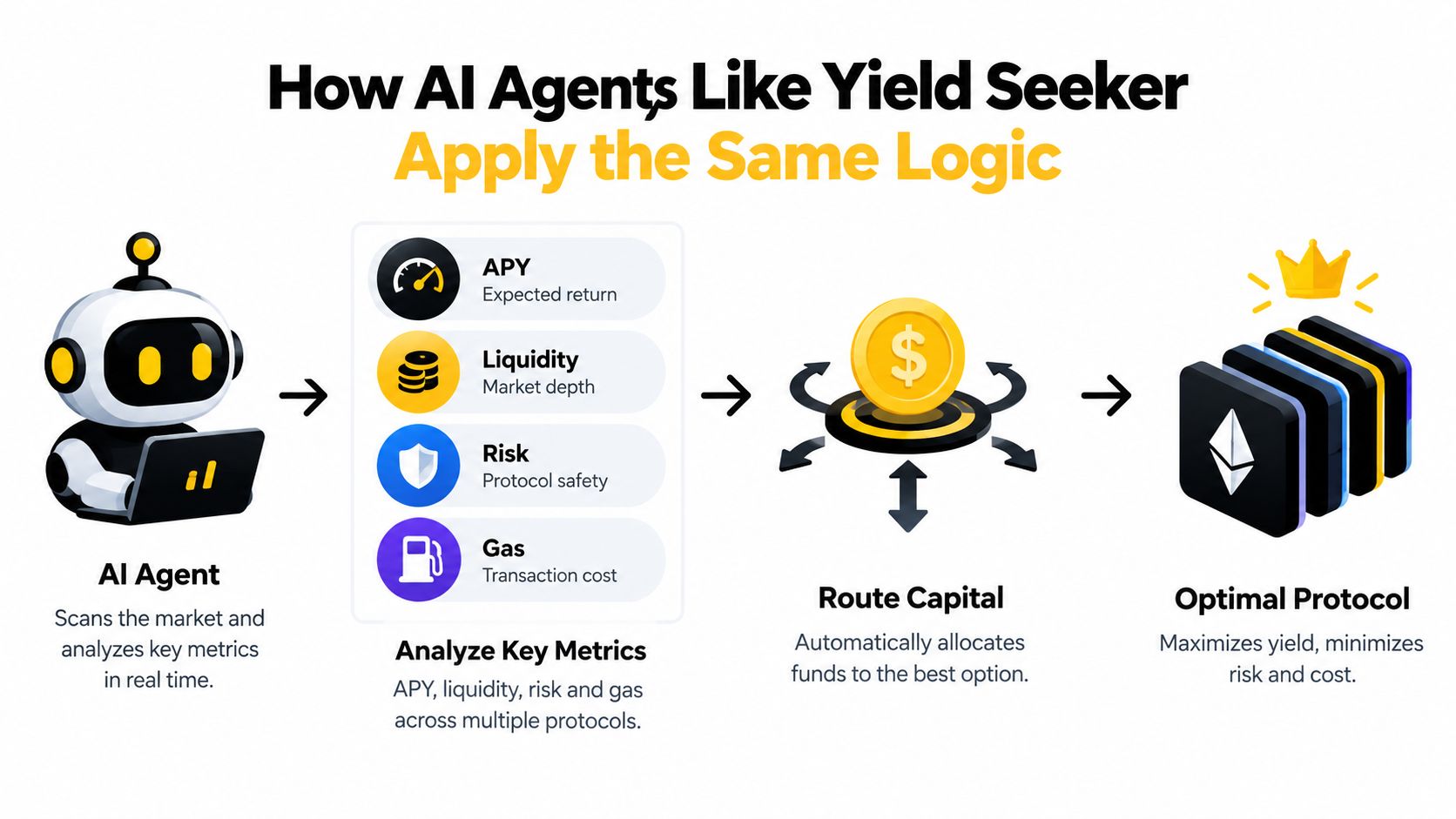
An AI agent managing stablecoin allocation acts like an intelligent dispatcher. It doesn't inspect only one rate. It watches a set of conditions that influence whether a destination can accept capital, generate yield, and support a safe exit.
The infrastructure comparison is direct:
Server latency maps to transaction and withdrawal responsiveness.
CPU and queue load map to protocol utilization and available capacity.
Health checks map to contract status, oracle behavior, and venue availability.
Routing weights map to portfolio allocation percentages.
Failover rules map to reducing or stopping allocations when conditions deteriorate.
The agent's operating loop can be expressed plainly: monitor, score, allocate, rebalance, repeat. It ingests signals, evaluates eligible venues, assigns weights, and executes changes when the expected benefit justifies the cost and risk.
Why the agent matters
A passive aggregator may rebalance on a schedule. A manual user may open a dashboard once a week. An agent can maintain a more continuous feedback loop, subject to its data quality, execution policy, and safety limits.
Yield Seeker is one implementation of this pattern. Its AI agent operates on Base, monitors stablecoin opportunities across DeFi protocols, and can reallocate according to real-time conditions and user risk preferences. Users evaluating the broader design space can also explore choosing an AI agent framework to understand how agent architecture, tools, and decision loops differ.
The important insight is that the agent doesn't replace the depositor's judgment. It automates the repetitive routing work after the user chooses the asset, network, constraints, and acceptable risk. A well-designed system should make its signals and actions understandable enough for the user to inspect.
That's why AI agents in crypto are better understood as execution and monitoring systems, not magic yield machines. They can reduce the burden of comparing fragmented venues, but the quality of the result still depends on the destinations the agent is allowed to use and the rules that govern its behavior.
Honest Risks and Common Misconceptions
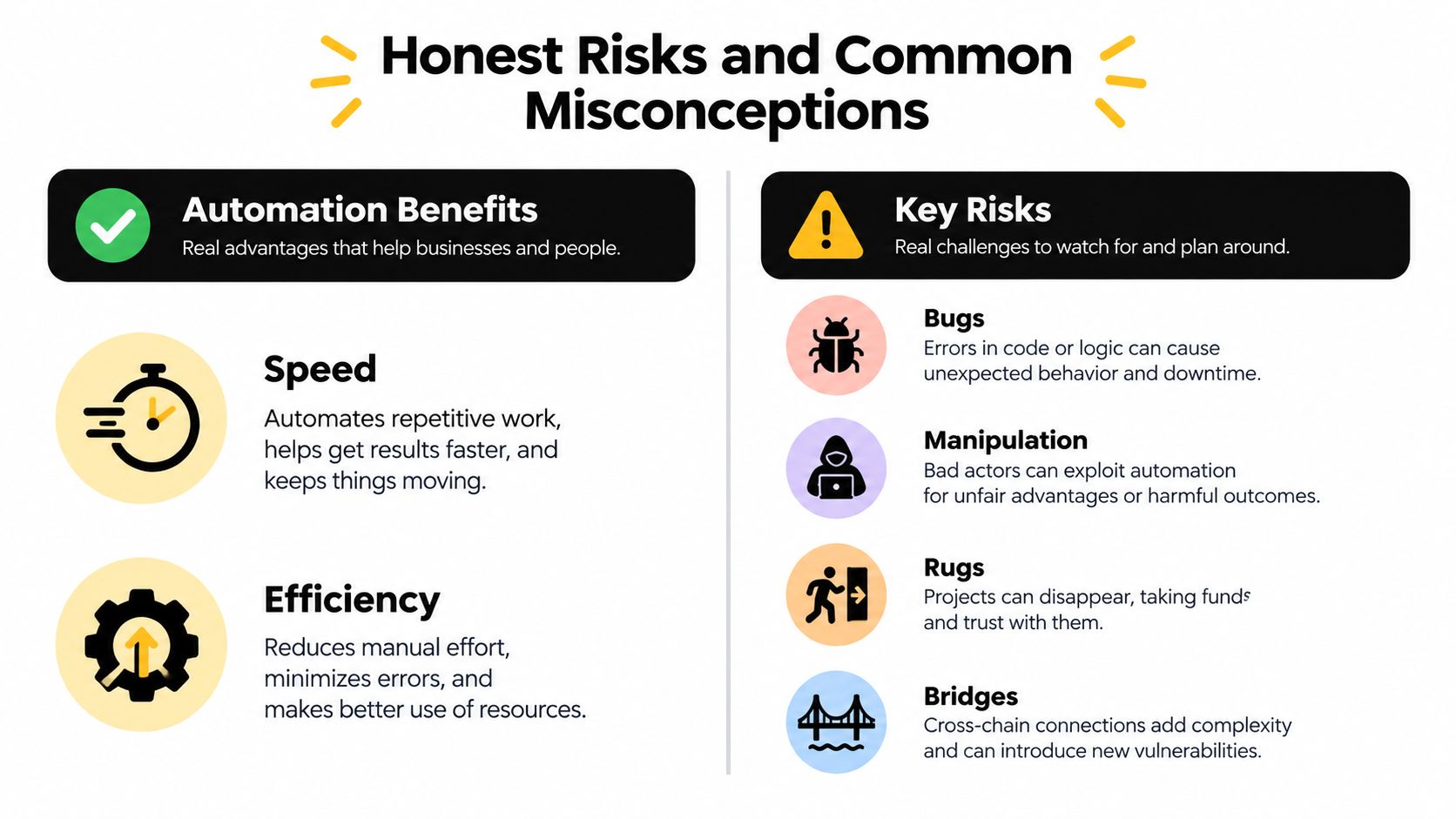
Automation improves the routing process. It doesn't make the underlying venues trustworthy by default.
A load balancer can detect that a backend is slow, but it can't repair vulnerable application code. In DeFi, an allocator may identify changes in APY, liquidity, or protocol status, but it can't guarantee that a smart contract is safe or that an oracle will remain accurate.
The yield can disappear through costs
A headline rate is only one input. Rebalancing gas, bridge fees, swaps, and slippage can reduce realized returns. If the allocator moves too frequently, the strategy may spend more on execution than it gains from the improved destination.
The same principle applies to small deposits. A theoretically attractive move may be uneconomic when transaction costs consume too much of the expected improvement. A responsible allocator needs a minimum-benefit threshold before it acts.
Automation creates its own failure modes
Smart-contract bugs, oracle manipulation, rug pulls, and bridge exploits can overwhelm a routing strategy. An agent can also make poor decisions if its data is stale, its scoring model overweights a misleading signal, or its execution logic behaves badly during an unusual market event.
Recent research on AI-driven load balancing emphasizes the need for continuous telemetry, retraining, and careful warm-up because cold starts and instability can produce unsafe decisions, as discussed in this research review. The DeFi equivalent is ongoing monitoring, conservative launch conditions, and a clear response when the model loses confidence.
Automation should reduce repetitive work, not remove accountability.
Three assumptions to reject
“Automation guarantees higher yield.” It can improve consistency and reaction speed, but no routing method guarantees a superior outcome.
“Diversification removes risk.” Multiple venues can still share dependencies or fail during the same market event.
“The system is free because it is automatic.” Execution, management, and performance costs still affect net results.
Centralization deserves attention too. If one allocator controls a meaningful amount of liquidity, its decisions can affect the venues it routes toward. Users should understand custody, permissions, emergency controls, and whether they can withdraw without waiting for discretionary intervention.
Calibrated trust is the right objective. Automation can make allocation faster and less tiring, but users still need venue research, sensible position sizing, and a plan for abnormal conditions.
A Practical Checklist for Choosing an Automated Allocator
Treat an automated allocator like production infrastructure. Before depositing, ask how it observes conditions, makes routing decisions, handles failures, reports costs, and lets you exit.
Start with control and visibility
Who controls the contract and permissions? Look for clearly documented ownership, upgrade authority, administrative roles, and emergency controls. A red flag is an unexplained ability to move funds or change strategy rules without transparent limits.
Can you verify the yield sources on-chain? An acceptable answer identifies the protocols, contracts, assets, and allocation paths. Be cautious when a dashboard shows a rate without explaining where the capital is deployed.
What triggers a rebalance? The system should describe whether it reacts to APY changes, utilization, liquidity, risk events, gas conditions, or defined thresholds. “The AI decides” isn't enough. You need to know what signals enter the decision.
How often can the logic execute? Continuous monitoring doesn't mean continuous transactions. Ask how the allocator separates observation from execution and how it prevents unnecessary churn.
Test the economics and failure response
What happens when a target pauses or shows signs of exploitation? A resilient design should have health checks, allocation limits, and a route to reduce exposure or hold funds safely. A red flag is a strategy that assumes every venue remains available.
How are fees calculated? Ask for the full cost model, including management charges, performance fees, withdrawal costs, swaps, and network execution. Compare expected benefit against total cost rather than comparing headline APYs.
Are historical results verifiable? Look for transaction history, allocation records, methodology, and a distinction between gross and net performance. Historical results can't predict future returns, but unverifiable results provide little basis for evaluation.
Can small deposits move efficiently? Check whether gas and slippage are included in routing decisions. A strategy that works for large positions may make poor trades for smaller balances if fixed execution costs dominate.
Inspect the exit path
Withdrawal conditions matter as much as deposit mechanics. Confirm whether funds remain accessible, whether a protocol has liquidity constraints, and whether the allocator can unwind positions without a discretionary approval process.
A useful way to organize the review is through familiar infrastructure principles:
Infrastructure question | DeFi allocator question |
|---|---|
Latency | How quickly can it detect and act on a change? |
Failover | What happens when a venue becomes unavailable? |
Observability | Can you inspect balances, decisions, and transactions? |
Cost control | Does the expected improvement justify execution costs? |
Capacity | Can the system handle deposits and withdrawals without concentration? |
Access | Can you exit under ordinary and stressed conditions? |
Run these checks before depositing, then revisit them quarterly or after a major contract, strategy, or governance change. An allocator that was acceptable under one set of assumptions may become unsuitable if its permissions, venues, fees, or risk policy changes.
Yield Seeker's Base-routed stablecoin allocator is one example to evaluate against this framework. It is designed to monitor and allocate stablecoin capital across DeFi opportunities while keeping users' balances and earnings visible through its interface. The product overview states that users can deposit USDC on Base, access capital without lockups or withdrawal fees, and use an AI agent to manage allocation, but you should still review the current terms and risks before committing funds.
Yield Seeker offers an AI-powered way to route stablecoin capital across DeFi protocols on Base, using live conditions and user preferences to guide allocation and rebalancing. If you want to spend less time comparing fragmented yield markets while keeping access to your funds, visit Yield Seeker and review how its allocator works before depositing.