
In 2026, mainstream stablecoin DeFi yields generally sit in the 2% to 6% APY range, while Yield Seeker reports roughly 3% to 14% APY depending on agent settings and market conditions. The strongest choice depends on whether you prioritize automation, liquidity, simplicity, capital efficiency, fixed-rate exposure, or diversification, so no single protocol deserves an unconditional best-yield label.
The popular advice is to sort DeFi platforms by the biggest number on the screen. That approach misses the part that determines whether the return is usable: rates change with borrowing demand, funding conditions, incentives, governance, liquidity competition, and the risk of the underlying asset. In 2024, one industry summary estimated users earned about $10 billion in DeFi yields, while another research note placed fees earned by liquidity providers above $6 billion, but those totals don't turn a temporary APY into a dependable one. The market summary documenting these figures also describes stablecoin APRs moving from below 2% in late 2022 to brief 15% spikes in the first quarter of 2024 before settling around 5% to 6% on a seven-day moving average.
I rank the following opportunities by use case and risk-adjusted appeal. The comparison considers yield potential, liquidity, transparency, implementation complexity, security signals, fees, lockups, automation, and sustainability. APYs are expected returns, not promises. Risk grades are qualitative, the scope covers the named chain and protocol deployments, and live rates, fees, liquidity, and withdrawal conditions should be checked before every deposit.
1. Yield Seeker
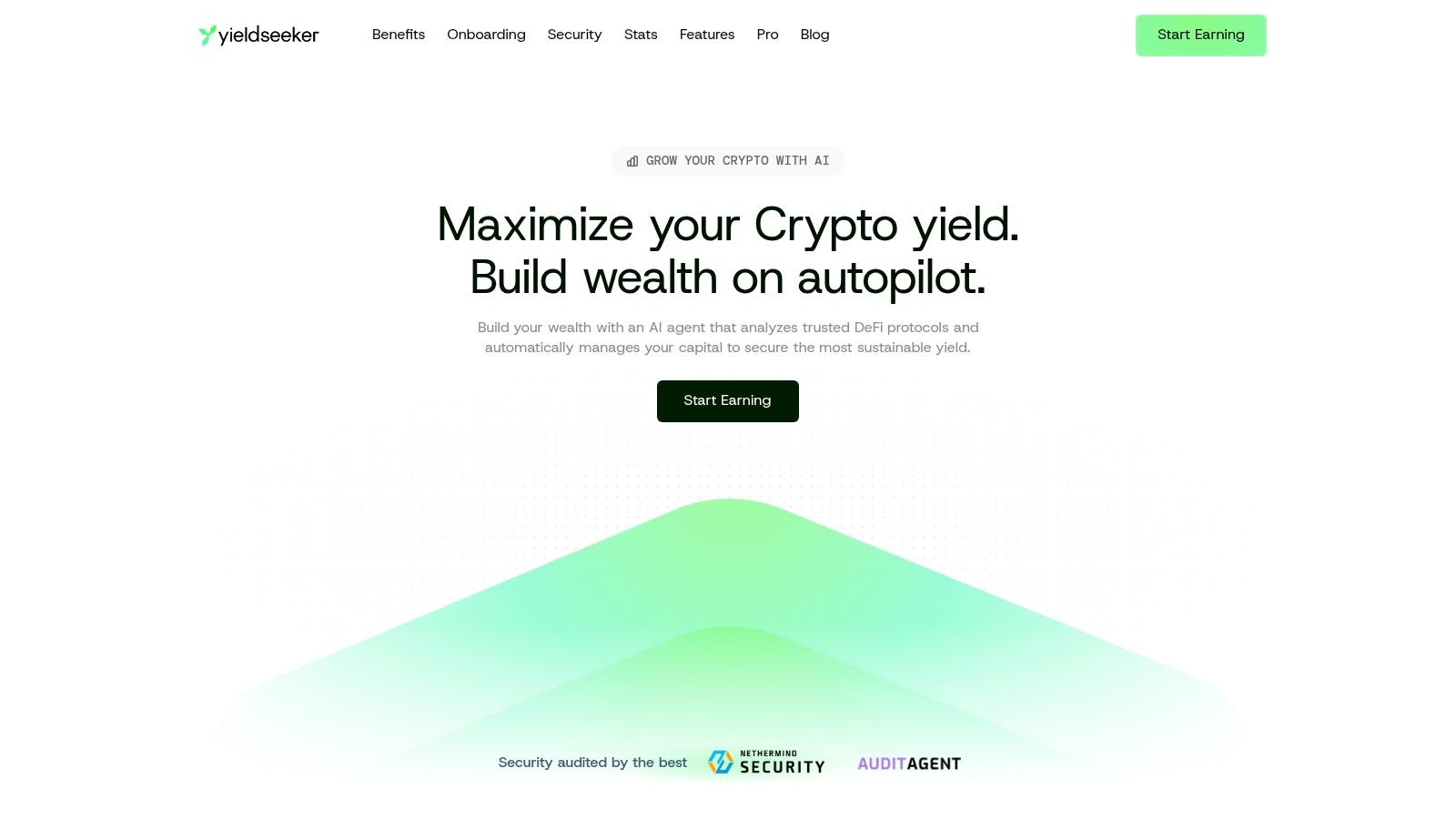
Yield Seeker is the strongest fit for a hands-off stablecoin holder who wants DeFi allocation without manually comparing lending markets and vault dashboards. Its AI Agent monitors and allocates capital across curated DeFi vaults on Base, while the non-custodial structure keeps control with the user. The platform supports deposits from $10 USDC, and its website reports roughly 3% to 14% APY depending on agent settings and market conditions. Those figures come from Yield Seeker's product site, so treat them as indicative ranges rather than guaranteed outcomes.
The practical advantage is orchestration. After depositing USDC, you assign a personalized agent that can monitor opportunities, route transactions, and rebalance according to a selected risk profile. A dashboard shows balances and earnings, while the terminal, visual walkthroughs, and activity logs make the agent's actions easier to inspect. Funds remain accessible, with no lockups or withdrawal fees stated in the product brief.
Why it ranks first for automation
Yield Seeker's appeal isn't a potentially higher displayed rate. It reduces the research burden of tracking fragmented opportunities and gives beginners a guided route into stablecoin yield while still offering experienced users visibility into strategy activity. The Basic tier is free to start, and the Pro tier is listed at $29 per month, with early-bird pricing available for qualifying users, according to the product information.
Security signals include references to audits by Nethermind, continuous automated analysis from AuditAgent, and user-fund isolation through Coinbase Trusted Execution Environment. Those safeguards can improve transparency and operational confidence, but they don't eliminate smart-contract, stablecoin, strategy, or Base-chain risk.
Practical rule: Automation removes repetitive decisions, not investment risk. Review the active strategy, underlying venues, withdrawal path, and current rate before increasing capital.
Yield Seeker is less suitable for someone who needs broad multichain coverage, direct control over every lending market, or exposure beyond its current stablecoin-focused Base experience. For that audience, a direct protocol may offer better granularity. For time-constrained investors, treasury operators, and beginners, its risk-aware automation is the clearest value proposition in this list.
2. Aave v3
Aave v3 remains the most straightforward choice for users who want direct access to variable-rate lending with visible reserves, supply rates, and borrowing conditions. You supply assets such as USDC or DAI to a lending market, borrowers pay interest, and suppliers receive a variable portion of that market's economics. Aave operates across networks including Base, Ethereum, Arbitrum, and Optimism, so users can choose between liquidity environments rather than relying on one deployment. Visit the Aave application to inspect live reserve conditions.
The main strength is control. You decide which asset to supply, which chain to use, and when to enter or exit, subject to available liquidity, supply caps, and any governance or guardian action affecting the reserve. The interface exposes rate changes in real time, which makes it easier to distinguish a current market condition from a long-term expectation.
The best use case for direct lending
Aave suits active lenders who want a transparent base layer and don't need an automated allocator. Its model is easier to reason about than a strategy vault because the immediate source of return is lending demand in the selected reserve. However, that simplicity doesn't make the yield fixed. If borrowers repay or demand weakens, supplier rates can fall, which is why this guide to DeFi lending is useful before committing capital.
Aave's maturity, open-source code, documentation, governance process, and continuing security work are meaningful signals, but they aren't a guarantee against losses. Smart-contract vulnerabilities, oracle issues, stablecoin failures, and governance decisions remain relevant. Supplying collateral doesn't create liquidation exposure in the same way borrowing does, but users still face the risk that withdrawals become constrained if a market's available liquidity is limited.
A high-quality Aave position starts with the reserve, not the protocol name. Check the specific asset, chain, utilization, liquidity, caps, and current supply rate.
Aave ranks highly for flexible lending and transparency, but below automated platforms for users who don't want to monitor rates. Its variable return is a feature for active users and a maintenance obligation for passive ones.
3. Spark Protocol
Spark is designed for users who want a simpler route to Maker-governed savings exposure through DAI. Its sDAI tokenized wrapper represents DAI deposited into the DAI Savings Rate mechanism, allowing holders to maintain an on-chain, transferable position rather than interacting with the savings contract manually. The Spark Protocol interface presents that experience as a savings and lending product.
The appeal is conceptual clarity. Instead of selecting among many lending reserves, a user obtains exposure to a defined Maker savings primitive whose rate can change through governance. sDAI can be held as a token and redeemed through supported routes, with access to DAI, USDS, or USDC depending on the route used. There are no lockups noted in the supplied product description, but practical liquidity still depends on the route, market depth, and transaction costs at the time of exit.
Where simplicity meets conversion risk
Spark fits a DAI holder who wants a set-and-forget position and understands that the DSR is variable. A USDC holder must first swap into DAI, creating an extra conversion step with possible slippage and network fees. That makes Spark less convenient than a native USDC lending market for someone whose accounting, liquidity, or treasury operations are denominated in USDC.
The return source also deserves attention. A governance-adjusted savings rate isn't the same as a contractual fixed return. Maker governance can change the DSR, and the position inherits DAI's stablecoin and protocol risks. Documentation and audits around the wrapper improve inspectability, but they don't remove the possibility of a depeg, a smart-contract problem, or an unfavorable governance decision.
Spark is best when you want one clearly defined savings primitive. It isn't automatically best when switching stablecoins adds friction or when you need a rate that won't change.
Spark earns its place for simplicity and direct Maker exposure. It isn't the highest-control option, and it may not be the most efficient route for every stablecoin holder.
4. Morpho
Morpho appeals to users who care about capital efficiency and market-level risk isolation more than broad, pooled convenience. Morpho Blue creates isolated lending markets with one collateral asset and one loan asset, alongside explicit parameters such as the loan-to-value limit, oracle, and interest-rate model. Suppliers earn lending yield in the market they select, while curated vaults can package several decisions into a more accessible strategy. The Morpho platform provides documentation, market information, and tools for evaluating those structures.
The architecture changes the question from “How safe is the entire lending pool?” to “What are the risks of this specific market?” That can make exposures easier to isolate, but it also places more responsibility on the user. A market with thin liquidity, a questionable oracle, or an unsuitable curator can be riskier than its displayed rate suggests.
Capital efficiency has a cost
Morpho may offer tighter spreads than a legacy pooled model because its markets use more explicit and focused parameters. That potential advantage doesn't mean every market will be attractive. Liquidity can fragment across many deployments, and vault users add curator, allocation, and governance risk on top of the underlying contracts.
Its security posture includes audits, extensive risk documentation, and a bug bounty. Those are useful signals to compare, not substitutes for reading the market configuration. Before supplying, inspect the collateral, loan asset, oracle source, liquidation threshold, available liquidity, and curator rules if a vault is involved.
A useful way to understand the difference is through this explanation of yield optimization protocols. Optimization can improve capital use, but every additional decision layer needs a clear failure analysis.
Morpho is the strongest pick here for experienced users who want isolated markets and are willing to evaluate them individually. It ranks below Aave for users who value a simpler, more standardized lending experience.
5. Yearn Finance
Yearn Finance is for users who want vault-level automation rather than direct reserve management. You deposit into a Yearn v3 vault, and the vault can allocate capital across one or more strategies, harvest returns, and compound according to its design. The Yearn Finance application displays vault information, supported assets, and fee details so users can compare the strategy rather than only the headline APY.
This structure saves time. A user doesn't need to manually claim rewards or move funds every time a strategy changes, although the user still needs to understand what the vault is doing. Yearn's v3 architecture uses ERC-4626-style vaults, supports single- and multi-strategy configurations, and has deployments across networks such as Ethereum, Base, and Arbitrum.
Hands-off does not mean risk-free
The key limitation is hidden complexity. A vault can depend on several underlying venues, tokens, or liquidity conditions, so its risk surface may be wider than a simple supply position. Performance fees reduce net returns, and the quoted APY can change when the underlying strategies' opportunities change. Vault-specific fees should be checked in the interface rather than assumed from a general platform description.
Audits, an established community, and an active security process provide useful confidence signals. They don't protect against every strategy failure, stablecoin event, liquidity shock, or integration problem. The right comparison is net return after fees against the number of protocol layers and the ease of exiting.
For readers who want a broader framework for these structures, this overview of vault finance in crypto explains why automated allocation can be helpful and why the vault itself must be treated as an additional risk layer.
Yearn ranks well for automated compounding across established strategies. It isn't ideal for users who want every position to remain immediately legible at the individual reserve level.
6. Pendle Finance
Pendle is the most specialized opportunity on the list because it separates an asset's principal from its future yield. A yield-bearing asset can be divided into a principal token, or PT, and a yield token, or YT. Buying PT can create a fixed-rate style position through a discount to maturity, while holding YT provides exposure to the variable yield generated before that maturity. Explore the mechanics and live markets through the Pendle Finance app.
That design gives users a clearer interest-rate view than ordinary lending. A treasury seeking predictable exposure may prefer PT, while an experienced trader who expects future yield to rise may choose YT. Liquidity providers can also earn trading fees and incentives in PT and YT pools, but that introduces another exposure to market activity and pricing.
Precision requires more homework
Pendle's advantage is control over the timing and direction of yield exposure. Its weakness is that the position is harder to manage. Maturities matter, secondary liquidity varies by market, and selling before maturity can produce an unfavorable price. The yield-bearing asset underneath the PT or YT can also suffer its own smart-contract, stablecoin, or depeg event.
A displayed fixed rate isn't equivalent to a risk-free return. It reflects the market price of the principal token, the maturity date, the underlying asset, and the ability to hold the position through settlement. YT can be especially sensitive because its value depends on future yield rather than principal alone.
Pendle is therefore best for advanced users, fixed-rate strategists, and people with a specific view on future borrowing or staking returns. It shouldn't be the default recommendation for a beginner who wants liquid stablecoin income. The protocol's documentation can explain the mechanics, but users still need to model exit pricing and maturity before buying.
7. Beefy Finance
Beefy Finance suits users who want multichain auto-compounding and are comfortable reviewing vault-specific risk. The platform offers vaults built around lending receipts, liquidity-pool positions, and reward strategies. After deposit, the vault automates harvesting and reinvestment, which can improve the practical outcome compared with manually claiming and redeploying rewards. The Beefy Finance platform publishes vault information and security materials for users to review.
Its breadth is both the attraction and the problem. A large menu of chains and vault types lets users diversify implementation, but the options aren't interchangeable. A stablecoin lending vault has a different risk profile from an automated market-maker position, especially if the latter carries impermanent loss or relies on volatile reward tokens.
Review the vault, not just the brand
Beefy provides a public Safety Score, a documented SAFU approach, an audits repository, and an ongoing bug bounty. Those tools make comparison easier, but a score can't replace reading the underlying protocol, chain, asset pair, and withdrawal conditions. Beefy adds another smart-contract layer, so users inherit risks from both the vault and the protocols it calls.
The right question is whether compounding creates enough practical value to justify that extra layer. For a small position, transaction automation and reinvestment may be convenient. For a larger position, users should calculate the net result after vault fees, swaps, gas assumptions, reward-token volatility, and any exit slippage.
Beefy ranks seventh because its multichain reach is useful but makes due diligence especially important. It's a strong tool for experienced users who understand that “auto-compound” describes an operation, not a safety grade.
Top 7 DeFi Yield Comparison
Product | 🔄 Implementation Complexity | ⚡ Liquidity & Minimums | 📊 Expected Outcomes | 💡 Ideal Use Cases | ⭐ Key Advantages |
|---|---|---|---|---|---|
Yield Seeker | Low user complexity, AI agent automates allocations and monitoring | Very low min ($10 USDC); funds liquid, no lockups or withdrawal fees | Reported ~3–14% APY (variable; strategy & market dependent) | Beginners and busy investors wanting hands‑off stablecoin yield | AI-driven automation, strong audits/TEE isolation, transparent logs |
Aave v3 | Moderate, direct interaction with lending markets; requires understanding supply/borrow mechanics | Deep liquidity; no lockups; minimal deposit amounts per asset | Variable interest rates reflecting market demand; transparent real‑time rates | Flexible lending/supplying and overcollateralized borrowing across chains | High liquidity, mature protocol, clear live rates and governance |
Spark (sDAI / DSR) | Low, wrapper provides set‑and‑forget DSR exposure but requires DAI (or swap) | On‑demand liquidity; redeemable routes to stablecoins; swap slippage possible | Exposure to Maker DSR (variable, governance‑driven), generally conservative | Simple DAI savings exposure for conservative yield preservation | Direct access to DSR, transparent wrapper, redeemable anytime |
Morpho (Blue + Optimizer) | Higher, market‑level params and curator choices require understanding | Liquidity varies by isolated market; some markets can be thin | Potentially higher supplier yields via capital efficiency; outcome market‑dependent | Users chasing optimized lending yields with market‑level control | Capital‑efficient markets, risk isolation, extensive audits/bug bounty |
Yearn Finance (v3 Vaults) | Low–Moderate, deposit to vaults; strategies automated but strategy risk exists | Varies by vault; generally liquid; performance fees apply (vault‑specific) | Automated compounding; variable APYs after fees depending on strategies | Hands‑off yield aggregation and cross‑chain allocation seekers | Automated strategy selection, transparent vault fees, wide integrations |
Pendle Finance | High, requires understanding PT/YT mechanics, maturities and market pricing | Liquidity depends on market/maturity; exits can be illiquid or discounted | Enables fixed‑rate or speculative yield exposure; can amplify returns or risk | Users targeting fixed‑rate yield locking or interest‑rate speculation | Fine‑grained interest control via yield tokenization (PT/YT) |
Beefy Finance | Low, deposit into auto‑compounding vaults; review Safety Scores recommended | Varies by vault; auto‑compounding improves net APY but adds an extra contract layer | Auto‑compounding often increases net APY; results vary by vault and strategy | Hands‑off compounding for LPs and reward‑based strategies across chains | Turnkey auto‑compounding, broad vault menu, public Safety Scores |
Choose the Yield You Can Keep Monitoring
Start with the asset and chain, not the APY. A USDC holder on Base has a different decision from a DAI holder seeking Maker exposure or an ETH holder looking for staking-related income. Once the asset is clear, confirm whether the quoted return is variable lending income, trading fees, a fixed-rate market price, token incentives, or a mixture of sources.
Then inspect the layers beneath the number. Identify the collateral, stablecoin issuer or design, oracle, liquidation process, governance controls, vault curator, and external protocols involved. A higher rate may reflect stronger borrowing demand, but it may also depend on emissions, thin liquidity, a temporary funding-rate distortion, or a newer structure with less operating history.
Liquidity deserves its own check. Look at the available exit route, not just the deposit button. Confirm whether withdrawals are immediate, whether a maturity applies, whether the market can absorb your position, and whether swapping back to your preferred stablecoin creates slippage. Account for network fees, vault performance fees, swap costs, and any subscription cost before comparing net returns.
The wider market context supports caution. DeFi TVL passed $100 billion on March 5, 2024, reaching $101.36 billion, after previously exceeding that threshold on May 11, 2022, according to the historical DeFi TVL record. The same source records a peak near $177.5 billion in November 2021 and roughly $74.7 billion by August 2026. Scale can improve liquidity and maturity, but competition can also compress fee-based returns.
Stablecoin adoption is deepening the liquidity base, with active stablecoin addresses rising from 19.6 million to 30 million year over year, a 53% increase, according to the stablecoin adoption report. That growth doesn't guarantee attractive rates. Another analysis says more than half of Ethereum stablecoin deposits earned under 3% APY, while Aave's thirty-day average yield on USDC and USDT was around 2%, as reported in this stablecoin yield analysis.
Use a simple operating routine:
Record the observation: Save the APY, source, chain, asset, and date when you assess a position.
Separate return sources: Mark base lending yield, fees, incentives, and any fixed-rate discount separately.
Review exit conditions: Check liquidity, maturity, redemption routes, and swap costs before depositing.
Size for failure: Limit exposure according to smart-contract, stablecoin, oracle, governance, and strategy risk.
Revisit deliberately: Rates and market conditions change, so schedule reviews rather than assuming the original APY persists.
The seven options serve different purposes. Yield Seeker handles automated Base stablecoin management. Aave provides flexible direct lending. Spark offers simple DSR exposure. Morpho focuses on isolated, capital-efficient markets. Yearn automates vault allocation. Pendle enables fixed- or variable-rate positioning. Beefy delivers multichain compounding.
The best DeFi yield isn't the largest number you can find. It's the opportunity whose mechanics, liquidity, fees, and risk you understand well enough to keep monitoring.
Yield Seeker offers an AI-powered way to automate stablecoin allocation across curated DeFi opportunities on Base, with deposits from $10 USDC and accessible funds without lockups or withdrawal fees. If you want to compare automated management with the direct protocols covered here, visit Yield Seeker and review how its personalized AI Agent approaches risk-aware yield.