
If you've ever earned interest in a savings account or received dividends from a stock, you already get the basic idea behind crypto passive returns. It's simply a way to make your digital assets work for you and earn income, rather than just letting them sit idle in a wallet.
This isn't about the thrill of day trading or perfectly timing the market. Instead, it's about putting your crypto to work within the decentralized finance (DeFi) ecosystem to generate a consistent yield.
How Crypto Passive Returns Actually Work
Think about the cash you might have stashed away. It's safe, sure, but it's not growing. The same goes for crypto just sitting in a wallet. DeFi provides a whole new world of opportunities to put that capital to work, turning it from a static holding into a productive asset.
At its heart, earning passive returns in crypto means you're providing a service that a network or protocol needs. You're getting paid for your contribution. You could be lending your assets, helping secure a network, or providing the fuel for decentralized trading, and the yield you get back is your reward for doing so.
Putting Your Digital Assets to Work
Imagine a global, automated financial system that never sleeps and operates without banks. For this system to run, it needs capital. That's where you and your assets come in.
You can fill a few crucial roles:
Providing Security: Many blockchains operate on a Proof-of-Stake model. By "staking" your assets, you help validate transactions and keep the entire network secure. You're rewarded for helping maintain the blockchain's integrity.
Supplying Liquidity: For people to trade tokens on decentralized exchanges, there needs to be a ready supply of those tokens available. By adding your assets to these pools, you become a liquidity provider and earn a small fee from every single trade that happens.
Offering Loans: DeFi lending platforms are like peer-to-peer banks. They connect borrowers directly with lenders like you. You supply the crypto, borrowers pay interest, and you earn that interest.
This entire ecosystem is built on smart contracts—basically, self-executing code that lays out all the rules upfront and runs automatically. It’s all transparent. If you want to get a better handle on the foundational tech that makes this possible, understanding blockchain technology is a great starting point.
From Complex Concept to Simple Analogy
Let's break it down with some familiar ideas. Staking your crypto is a bit like earning dividends from a stock—you're rewarded for being a long-term supporter of the project. Lending your crypto is almost exactly like putting money into a high-yield savings account where a bank pays you for using your cash.
The big difference? DeFi cuts out the middleman. This often leads to much more attractive yields than you'd find in traditional finance. The return you earn is usually shown as an Annual Percentage Yield (APY), and it directly reflects how much demand there is for your capital in that particular corner of the crypto world.
If you're new to the term, taking a moment to understand what APY is in crypto is a smart move. It's the key metric you'll use to compare different opportunities and figure out which strategies are right for you.
Exploring the Core Ways to Earn Yield
Alright, so you get the idea that your crypto doesn't have to just sit there. The next logical step is figuring out how to put it to work. There are a handful of core strategies for generating these passive returns, and each one is a different tool for a different job.
The basic principle is always the same: you provide something of value to a decentralized protocol—security, capital, liquidity—and you get paid for it. It's a simple give-and-take.
This is the fundamental loop: you deposit your assets, they become productive capital within DeFi, and you earn yield in return.
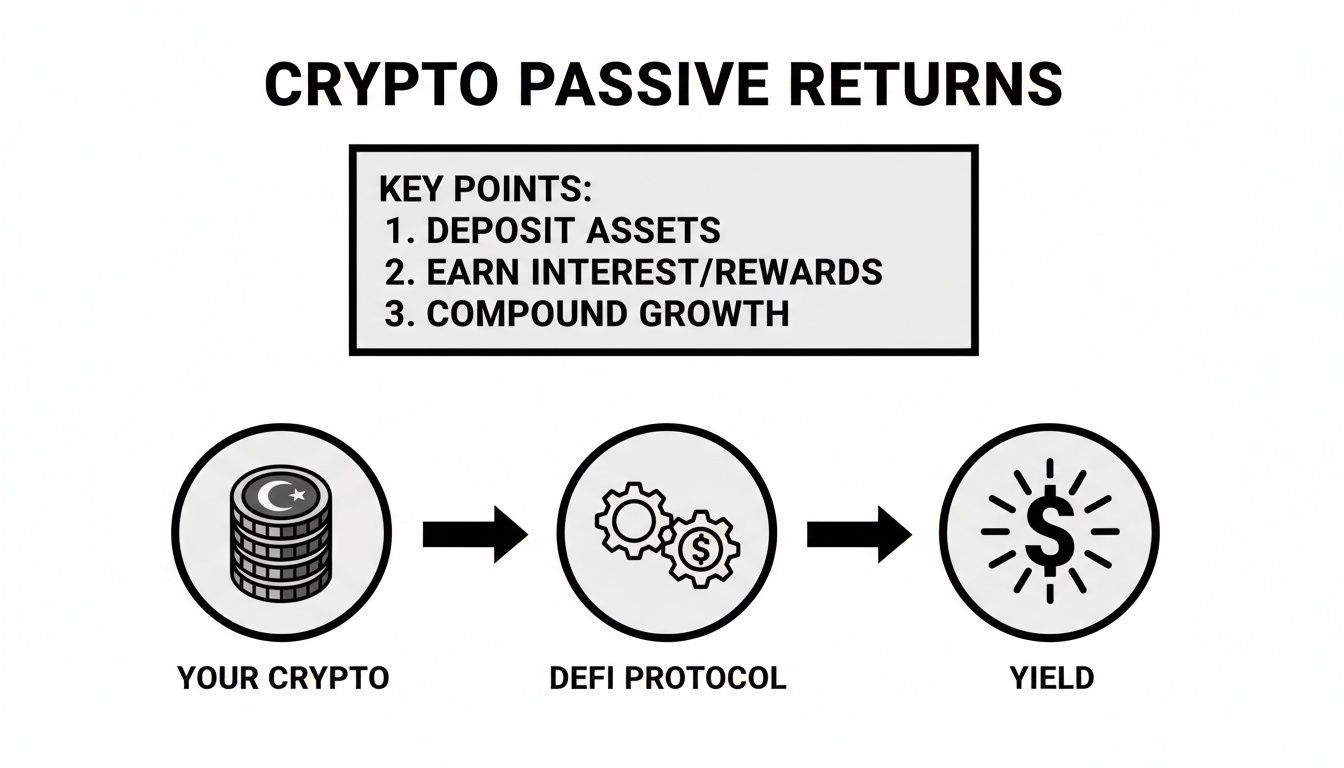
Now, let's break down the most common ways you'll see this play out in the wild.
H3: Staking Your Assets for Network Security
Staking is probably the most straightforward way to earn. You're essentially locking up your cryptocurrency to help secure and validate transactions on a Proof-of-Stake (PoS) blockchain like Ethereum.
Think of it like earning dividends on a stock. By holding shares, you're showing long-term belief in a company and get a cut of the profits. With staking, you're "holding" your tokens to support the network's health and getting rewarded for that commitment. It’s a vital function that keeps these networks running.
H3: Crypto Lending: Becoming the Bank
With crypto lending, you can lend out your assets to borrowers through a decentralized protocol. You just deposit your crypto into a lending pool, and others can borrow from it, paying interest that flows directly back to you.
You're basically playing the role of the bank. In the old world, a bank takes deposits and lends them out, pocketing the difference. DeFi cuts out the middleman; smart contracts handle everything, letting you capture a huge slice of the interest paid by borrowers. This is an incredibly popular strategy, especially with stablecoins.
And the demand is huge. In the last year alone, stablecoins processed an eye-watering $9 trillion in adjusted transaction volume—that's more than five times what PayPal handles. All that activity creates massive demand for stablecoin lending, which in turn fuels some very attractive yields for lenders. You can dig into the data behind this trend in the latest State of Crypto report.
H3: Providing Liquidity for Decentralized Trading
Decentralized exchanges (DEXs) need a ready supply of different tokens so people can trade them instantly. By depositing a pair of assets (say, ETH and USDC) into what’s called a liquidity pool, you become a liquidity provider (LP).
Your reward? You earn a tiny percentage of the trading fees every single time someone swaps between the two tokens you supplied. The more people trade, the more fees you rake in.
It’s a bit like running a currency exchange booth at an airport. You keep both dollars and euros on hand, and you make a small commission every time a traveler swaps one for the other.
H3: Yield Farming: Chasing the Best Returns
Yield farming is a more hands-on, advanced game. It’s all about actively moving your assets between different DeFi protocols and liquidity pools to constantly hunt down the highest possible returns. Serious yield farmers might even use leverage—like borrowing assets from one protocol to supply to another—to boost their earnings.
This is like being a savvy saver who’s constantly shifting money between banks to catch the best promotional high-yield savings rates. It takes more effort and a much deeper understanding of the market, but the potential rewards can be significantly higher. To see how this works in practice, check out our guide on how to earn passive income with crypto.
H3: Comparing Your Options
So, which path is right for you? It really boils down to your appetite for risk, how much you know, and how much time you want to spend managing your funds.
To make things clearer, here’s a quick side-by-side look at the main strategies.
Comparing Crypto Passive Income Strategies
Strategy | Real-World Analogy | Typical APY Range | Primary Risk Factor | Best For |
|---|---|---|---|---|
Staking | Earning stock dividends | 3-10% | Token Price Volatility | Long-term holders looking for steady, lower-risk returns. |
Lending | Being the bank | 5-20% | Counterparty & Protocol Risk | Investors seeking predictable yields, especially with stablecoins. |
Liquidity Providing | Currency exchange booth | 10-50%+ | Impermanent Loss | Users comfortable with market volatility and asset price changes. |
Yield Farming | Chasing promotional rates | 20-100%+ | Smart Contract Bugs & High Complexity | Advanced users willing to take on higher risk for higher rewards. |
Each strategy has its place. Staking is great for a set-and-forget approach, while yield farming is for the active DeFi power user. The key is finding the one that aligns with your own financial goals and comfort level.
Understanding the Real Risks of DeFi Yield
Chasing those eye-popping crypto passive returns can be thrilling, but it's crucial to understand that those high yields don't just appear out of thin air. They're compensation for taking on a unique set of risks you won't find in traditional finance. Knowing what you're up against isn't about scaring you off—it's about equipping you to protect your funds and make smarter moves.
There's a golden rule in this space: high yields almost always mean higher risk. Forgetting this is probably the fastest way to get wrecked in DeFi. A good grasp of general principles of risk management is a massive advantage for anyone stepping into this arena.
Let's unpack the most common risks you'll need to keep on your radar.

Smart Contract Risk: The Vending Machine Bug
Every single DeFi protocol runs on smart contracts—they're just bits of code that execute actions automatically. When you deposit your crypto, you're placing your trust in that code to perform perfectly, without any hidden bugs or backdoors.
Think of it like a vending machine. You slot your money in, press a button, and you expect your drink. But what if there's a flaw in its programming? It might just eat your money, or worse, a clever hacker figures out a trick to make it spit out every single drink for free. A smart contract vulnerability is exactly that—a bug that can be exploited to drain the protocol of all its funds.
DeFi has lost billions of dollars to smart contract exploits. This is precisely why you should stick to protocols that have undergone multiple, reputable security audits. An audit is like hiring a team of experts to meticulously inspect that vending machine's code, trying to find any flaws before someone else does.
Impermanent Loss: The Hidden Cost of Liquidity
When you become a liquidity provider on a decentralized exchange (DEX), you deposit a pair of assets, say ETH and USDC. The catch is, if the prices of those two assets drift apart, the total value of your position could end up being less than if you had just held onto the ETH and USDC in your wallet. That difference is what we call impermanent loss (IL).
It’s a tricky name because the "loss" only becomes real, or permanent, when you actually pull your funds out. It’s better to think of it as an opportunity cost. You earn trading fees for providing liquidity, but sometimes those fees aren't enough to make up for the value you lost from the price divergence. This risk is especially potent in pools with two highly volatile assets.
Protocol and Counterparty Risk
Not all risks are buried in code. Sometimes, the danger is more about the project itself or the people you're dealing with.
Protocol Risk: This is the straightforward risk that the project you've put money into just... fails. The team might give up, its economic model might fall apart, or it just never gains any real traction. It's no different from investing in a startup that could go belly-up, taking your capital down with it.
Counterparty Risk: In crypto lending, this is the risk of a borrower not paying back their loan. Most DeFi platforms try to solve this with over-collateralization (you have to post more collateral than you borrow), but a massive market crash can trigger a domino effect of liquidations, sometimes leaving the protocol with bad debt.
Stablecoin Peg Risk: When "Stable" Isn't Stable
Stablecoins are the foundation of countless passive income strategies because they're designed to maintain a steady value, usually 1-to-1 with the U.S. dollar. The key word there is designed. That peg is never a guarantee.
Peg risk is the very real danger that a stablecoin loses its tie to its target value. This can happen for a bunch of reasons—the collateral backing it isn't sufficient, a panic causes a "bank run," or its stabilizing algorithm has a fatal flaw. The spectacular collapses of algorithmic stablecoins in the past are a brutal reminder that not all stablecoins are built the same. This is exactly why strategies often favor fully-backed, audited stablecoins like USDC.
Your Framework for Vetting Yield Opportunities
Navigating the world of crypto passive returns is about more than just chasing the highest APY you can find. A disciplined, repeatable approach to due diligence is what separates sustainable income from catastrophic losses. Think of this framework as your pre-flight checklist before you commit a single dollar to any protocol.
Jumping into a shiny new opportunity without doing your homework is like buying a car without checking its service history. That flashy exterior—or a juicy yield—can hide some serious problems under the hood. A systematic process helps you filter out the junk and spot the legitimate, long-term plays.
Analyze Protocol Security and Audits
First things first, and this one is non-negotiable: you have to verify a protocol's security. Smart contract risk is always lurking in DeFi, so your initial focus must be on how well a project is set up to protect user funds from getting drained.
Start by looking for security audits from reputable third-party firms. An audit is basically an ethical hacker doing a deep dive into a protocol's code to find holes before the bad guys do. Don't just check a box that says "audited." You need to dig a little deeper.
Reputable Auditors: Look for well-known names like Trail of Bits, OpenZeppelin, or CertiK. An audit from some no-name firm doesn't carry nearly the same weight.
Multiple Audits: The best projects get audited multiple times, especially after any major code changes. It shows they're consistently putting security first.
Resolved Issues: Check the actual audit reports—they're almost always public. See what issues were flagged and, more importantly, confirm that the team actually fixed them.
A clean audit history doesn't guarantee a project is bulletproof, but it's a huge green flag. It shows the team is professional and committed to security, which is the bare minimum for any crypto passive returns strategy.
Evaluate the Team and Community Health
Behind every single protocol is a team of developers and a community of users. The quality and engagement of these two groups are powerful clues about a project's chances of sticking around for the long haul.
First, look into the team. Are the founders public, with a real name and face attached to the project? Do they have a solid track record in the crypto space? While anonymous teams can sometimes build great things, a public-facing team adds a crucial layer of accountability. A quick search should tell you about their past work and contributions.
Next, get a feel for the community's health. A vibrant, engaged community is one of the strongest signs of a healthy project. Here’s what to look for:
Active Communication: Hop into their Discord or Telegram. Is the team regularly sharing updates and answering questions from users, or is it a ghost town?
Constructive Discussion: Is the conversation all about "wen moon?" or are people actually discussing the product, its features, and its strategy? The latter suggests a more mature user base that's in it for more than just a quick pump.
Understand the Project Tokenomics
Tokenomics is just a fancy word for the economic model of a protocol's native token—how it's created, distributed, and what it's used for. Getting a handle on this is critical for figuring out if the yield you're being offered is actually sustainable. A broken model can cause a token's value to spiral to zero, taking your returns with it.
You have to ask yourself: where is this yield really coming from? Is it generated from real, productive activity, like fees from lending or trading? Or is it just funded by printing a boatload of new tokens out of thin air, creating massive inflation?
A yield that comes from real protocol revenue is infinitely more sustainable than one that relies on endless token emissions. This single distinction is one of the most important things to understand when hunting for reliable crypto passive returns.
Automating Your Yield with AI-Powered Tools
Let’s be honest: manually chasing the best passive returns in crypto can feel like a full-time job. It’s a constant grind of researching new protocols, analyzing risks, and jumping between different platforms to execute trades. This whole process is a huge barrier for most people, but thankfully, AI-powered automation is changing the game.
Think about having an expert analyst working for you 24/7. This analyst never sleeps and can crunch thousands of data points every single second. That’s the core idea behind AI-driven yield platforms. They scan countless protocols in real-time—a feat no human could ever match—to find the absolute best risk-adjusted yield for your capital.
These tools do all the heavy lifting. They don't just spot opportunities; they can run entire strategies for you, moving funds to capture the highest returns while keeping a close eye on risk. This is the next step in earning passive crypto income, making the whole thing more efficient, accessible, and a whole lot safer.

Why Automation Is a Game Changer
The most obvious benefit is simple: you get your time back. Instead of losing hours each week staring at dashboards, an automated system does the work for you. But the perks go way beyond just convenience.
AI systems bring a level of sophistication that's tough to replicate on your own. They can execute complex strategies involving multiple steps or protocols, all while constantly scanning for red flags like weird smart contract activity or a sudden drop in liquidity. This keeps your capital safer by reacting to market shifts faster than any person ever could.
Best of all, automation flattens the steep learning curve of DeFi. You no longer need to be a protocol wizard to get in on advanced yield strategies. The platform handles all the technical stuff, letting you tap into high-level opportunities without having to become a degen yield farmer yourself.
The Power of AI in Risk Management
One of the biggest wins with AI is its ability to manage risk with cold, hard data—and at scale. While you might check a protocol’s audit history and team reputation, an AI can do that and so much more, nonstop.
Here’s how AI steps up the risk assessment game:
Real-Time Monitoring: AI agents watch on-chain data around the clock, looking for strange transaction patterns, smart contract bugs, or liquidity drains that could signal trouble.
Quantitative Scoring: Instead of going with a gut feeling, these systems assign hard risk scores to protocols based on dozens of metrics, from code audits and developer activity to insurance coverage.
Automated Diversification: A core rule of risk management is not putting all your eggs in one basket. An AI yield aggregator can automatically spread your capital across multiple vetted protocols, so if one fails, it doesn’t take you down with it. You can learn more about how an AI yield aggregator works to minimize risk.
By handing off these intensive tasks to an AI, you shift from a reactive to a proactive approach to security. The system is built to spot and sidestep risks before they blow up—a level of diligence that's nearly impossible to maintain on your own.
This kind of automation can deliver some pretty impressive results. For instance, during strong market cycles, some automated strategies have generated 50-200% annual returns. To put that in context, starting with just $25,000 at a steady 60% annual return could grow to $100,000 in three years and a mind-blowing $400,000 in six. All without you losing sleep over charts.
Choosing the Right Automation Platform
As these tools become more popular, picking the right one is key. Not all automation platforms are built the same. When you're looking around, focus on platforms that are transparent, give you control, and take security seriously.
Look for tools like Yield Seeker that show you exactly where your funds are and what strategies are in play. You should always be able to pull your funds out whenever you want, without any weird lockups or penalties. At the end of the day, automation should make your life simpler and your returns safer—not add another layer of complexity or risk.
A Few Common Questions
Diving into crypto passive income always brings up a few questions. That's a good thing—this space is complex, and being curious is your best defense for protecting your money. Here are some of the most common questions we get, with straight-up, practical answers.
The goal here is to clear up any confusion, lock in the core ideas, and give you the confidence to get started the right way.
How Much Can I Realistically Earn?
This is the million-dollar question, and the honest answer is: it varies wildly. Your potential earnings are a direct result of the strategy you choose, the assets you're using, and what the market is doing at any given moment. There's no one-size-fits-all number.
A better way to think about it is in tiers of risk:
Lower-Risk Strategies: A common starting point is lending out stablecoins like USDC on massive, battle-tested platforms like Aave or Compound. In this zone, you might see an Annual Percentage Yield (APY) in the 5-15% range. The returns are more grounded because you're taking on much less risk, especially from price swings.
Higher-Risk Strategies: This is where you see the crazy numbers. Yield farming on a brand new, unproven protocol might advertise an APY of 100% or more. Just know that those eye-popping figures aren't free money. They're direct compensation for shouldering huge risks, like smart contract bugs or the project's token value collapsing overnight.
For most people starting out, aiming for a sustainable 5-20% APY is a smart, realistic goal. This is achievable by sticking to carefully vetted protocols or using automated platforms that put risk management first. And always remember the golden rule: if a yield seems too good to be true, it absolutely is.
Is This Actually "Passive" Income?
The income stream itself is passive, but the work required to generate and maintain it? Not so much. It's a huge misconception that you can just "set it and forget it."
The reality is that earning yield the right way involves a ton of ongoing work. You need to be researching protocols, assessing risks, and constantly monitoring your positions. Is the APY changing? Has a new security concern popped up? This "active management" can quickly turn into a part-time job that demands real expertise.
This is exactly where automation is changing the game. AI-powered platforms are built to do all that heavy lifting for you. They handle the research, the risk analysis, and the day-to-day capital movements behind the scenes, turning what was a very hands-on job into something genuinely passive for you. You just deposit your funds, and the system gets to work.
What’s the Safest Way to Get Started?
If you're brand new to this, the absolute safest first step is a strategy that cuts out as many risks as possible. That means focusing on stable assets and platforms with a long, proven track record.
The most common path for beginners is lending blue-chip stablecoins—especially USDC—on large, thoroughly audited DeFi protocols. By using a stablecoin, you immediately sidestep the wild price volatility of assets like Bitcoin or Ethereum. And by sticking to protocols that have been around for years managing billions of dollars, you're leaning on their established security.
An even simpler, and arguably safer, route for newcomers is to use a trusted automated yield platform. These services give you a few key advantages right out of the gate:
Built-in Vetting: They've already done the hard work of researching and vetting different protocols for you.
Automatic Diversification: Your funds are often spread across multiple strategies, so you're not over-exposed to a single point of failure.
Simplified Experience: They manage all the technical stuff, from connecting wallets to interacting with smart contracts.
No matter which path you take, the non-negotiable rule for beginners is to start small. Never, ever put in more than you're okay with losing, particularly while you're still learning the ropes. This lets you get real, hands-on experience without putting serious capital on the line. As you get more comfortable and knowledgeable, you can gradually increase your position.
Ready to put your stablecoins to work without the constant research and risk monitoring? Yield Seeker uses a personalized AI Agent to find and manage the best risk-aware yields in DeFi for you, automatically. Start earning smarter at Yield Seeker.