
The most popular advice in crypto yield comparison is also the worst one: chase the highest APY and sort out the details later. That works until the yield disappears, the pool gets crowded, the peg wobbles, or the exit gets ugly. A smarter comparison starts by asking a harsher question, what is this yield really paying me for, and what could take it back?
Comparison lens | What you're really checking | Good sign | Warning sign |
|---|---|---|---|
Nominal yield | What the rate is made of | Clear base interest with visible inputs | Big number with opaque incentives |
Risk channels | What can break the return | Simple custody and limited moving parts | Smart-contract, issuer, or platform complexity |
Liquidity stress | Whether you can exit cleanly | Fast withdrawals, deep liquidity | Lockups, queues, or chain dependencies |
Opportunity cost | What else that capital could earn | Yield that clearly beats a benchmark after risk | A flashy APY that barely compensates for extra risk |
The right frame is not “what pays most today.” It's “what survives stress, preserves access, and still looks good after fees, slippage, and failure modes.”
Why the Highest APY Is Usually the Wrong Answer
The highest displayed APY is often the loudest warning sign in the room. In crypto yield comparison, the big number usually hides borrowing demand, token emissions, thin liquidity, or platform risk that can unwind fast. If you're comparing stablecoin yields, the core question is whether the premium is durable or just compensation for taking on a mess.
A useful historical anchor is simple. A BIS analysis reported that in January 2025, average DeFi lending rates for stablecoins including USDT and USDC were about 400 basis points, or 4 percentage points, above the US federal funds rate. That spread proves meaningful premium exists, but it also proves you should compare against a real benchmark, not against a random APY screenshot. This guide on APY versus yield is a good companion if you want to keep the language straight.
Stop ranking yields as if they were identical products
They're not identical at all. A rate boosted by borrowing demand is different from a rate boosted by temporary incentives, and both are different from a rate that comes from a clean lending market with decent liquidity. If the yield is variable, incentive-heavy, or close to pool capacity, the number is fragile by design.
Practical rule: treat the top APY as a candidate for extra scrutiny, not as the default winner.
The four-layer frame solves that. You compare nominal yield, then strip out the risk channels, then test liquidity under stress, then measure opportunity cost against a conventional benchmark. That's a much better way to sort stablecoin yield than staring at the biggest percentage and hoping the market stays polite.
A Four-Layer Framework for Comparing Crypto Yields
The cleanest way to compare yields is to stack the decision in layers. If you try to judge an opportunity from the APY alone, you miss the reason the yield exists and the way it can vanish. The right order is what pays, what can break, how you exit, and what else the capital could have done.

Layer one is nominal yield, not the whole story
Start with the visible number, but don't stop there. Ask whether the return is base lending interest, token incentives, or a temporary promotion. A dashboard that shows 4.25% APY on USDC may sound straightforward, but the number only means something if you know whether it's variable, what drives it, and how quickly it can change. The historical comparison from the BIS makes the point clear, this is a spread you should evaluate against a benchmark, not against another shiny APY. The BIS comparison note is useful because it puts stablecoin yield beside both the federal funds rate and bank deposit rates.
Layer two is the risk decomposition
Now isolate the failure modes. Smart-contract risk, oracle risk, custody risk, issuer risk, and platform risk are not the same thing, and you should not bundle them into one vague “DeFi risk” bucket. The clearer the structure, the less likely you are to confuse a high rate with a good trade.
For teams that want to systematize this work, SEO Agent is worth studying because it's built around operationally comparing moving inputs instead of treating every number as static. That's the same mindset you want here.
Layer three is liquidity under stress
A yield only counts if you can reach it. Lockups, cooldowns, bridge reliance, and secondary-market exits all change the actual value of the APY. Risk-adjusted APY is the better phrase when access can be impaired.
If the exit is uncertain, the APY is decoration.
Layer four is opportunity cost
Every dollar earning yield could have sat in a simpler alternative, including bank deposits or other low-friction benchmarks. Financial data extraction service reviews are useful here for a different reason, they remind you that clean comparisons depend on clean data, and crypto yield dashboards are only as good as the inputs behind them. The point is not to worship traditional finance, it's to ask whether the extra complexity is earning its keep.
CeFi vs DeFi vs Yield Tokens vs RWA Wrappers
The category matters because each product type pays you from a different engine, and each engine fails differently. If you compare everything by headline APY alone, you'll end up putting a simple custody product next to a complex strategy and pretending the risks are comparable. They aren't.
CeFi platforms trade simplicity for counterparty dependence
CeFi yield products usually feel easiest because the provider handles custody and the user sees a cleaner interface. That convenience shifts the burden from protocol mechanics to platform risk, terms risk, and withdrawal discipline. If you want a straightforward balance sheet view and don't want to manage wallets, CeFi can be the least annoying path, but the price is dependence on the operator.
Blue-chip DeFi lending gives you transparent mechanics
Aave and Compound style markets are easier to inspect than most other on-chain yield sources because the rate logic is visible and the utilization input is public. The trade-off is obvious, you accept smart-contract exposure and rate variability in exchange for on-chain transparency. If the utilization is healthy and the market is deep, these can be more honest than flashy products that dress up temporary yield as if it were structural income.
Yield tokens add basis risk and timing risk
Yield-token setups split future yield from the underlying asset, which creates more knobs and more ways to get the timing wrong. The upside is flexibility. The downside is that you can end up owning a product whose payout profile depends on market pricing, token emissions, or a spread that compresses faster than you expected. That is exactly where headline APY can mislead even experienced users.
RWA wrappers often look calmer than they are
RWA wrappers can feel conservative because they reference off-chain income streams and familiar assets. Coindesk research reported that diversified real-world-asset strategies held roughly 5–7% over a six-month period, while funding-rate strategies compressed to about 3.9% and DeFi wrappers fluctuated between roughly 3% and 7%. Those figures help explain why wrappers attract stablecoin holders, but they still carry issuer, custody, and off-chain dependency risk.
For a more product-focused breakdown of treasury-style alternatives, this treasury yield guide is a useful companion.
How DeFi Lending Rates Actually Move
DeFi lending rates are not quoted in the same way bank deposits are quoted. They move with utilization, meaning the ratio of borrowed assets to deposited assets. When borrowing demand rises and liquidity tightens, rates move up. When the pool is flush with deposits and borrowing is soft, rates cool off.

The Bank of Canada analysis of public Aave V3 and Compound V3 data shows exactly that pattern, lending protocols algorithmically adjust interest rates by the ratio of borrowed to deposited assets, and utilization directly drives deposit APYs. The practical takeaway is blunt. A high APY near pool capacity is not a gift, it's a signal that the pool is under more strain and may reprice quickly. The Bank of Canada paper is useful because it treats utilization as the mechanism, not the marketing.
Don't confuse current APY with stable APY
A screenshot is a snapshot, not a promise. Reserve-factor deductions can shave yield, utilization can change in minutes, and incentive programs can distort what looks like a core lending return. If you want to judge sustainability, track realized net APY over a defined window, not just the last number you saw on a dashboard.
For finance teams that want to automate monitoring and allocation checks, custom AI agents for financial operations are relevant because rate surveillance is only useful if it happens continuously.
Favor pools with room to breathe. The most exciting APY is often the most fragile one.
That's why a sustainable comparison should include utilization volatility and the frequency of rate-model changes. If a pool keeps bouncing between states, the display rate is telling you less about income and more about tension.
Stablecoin Mechanism Risk Beyond the APY
Yield means almost nothing if the asset itself is unstable under stress. A stablecoin with a nice APY but poor peg behavior is just a prettier way to get burned. This is why stablecoin choice comes before yield choice.
A comparative study of the TerraUSD collapse and the March 2023 USDC depeg found that UST experienced peg deviation above 90% with a fourfold volume surge, while USDC's deviation stayed below 4% and reversed relatively quickly. That contrast matters more than any APY leaderboard because it shows the difference between a mechanism that unraveled and one that absorbed stress and recovered. The study is a sharp reminder that issuer, reserve structure, and redemption design are not side notes, they're the foundation. The depeg comparison makes that impossible to ignore.
Use the stablecoin first, then compare the rate
A sensible order looks like this. First, check whether the stablecoin's peg history and mechanism are acceptable. Second, compare yield only among assets you'd be willing to hold through stress. Third, ask what portion of the return is base lending versus incentives.
The U.S. Treasury's core stablecoin risk categories are credit, liquidity, operational, governance, and settlement risk. That vocabulary is useful because it keeps you from flattening every problem into “yield risk.” If a product is paying more because it embeds more issuer or redemption risk, say that plainly and treat the premium as compensation, not free money.
The blunt rule is simple. A higher APY is not better if the asset can't reliably hold its dollar value when it matters.
Withdrawal Liquidity Under Stress
The worst crypto yield mistakes happen at the exit, not the entry. A nice APY means very little if you can't get your principal out when everyone else is trying to leave. That's why stress liquidity matters more than the presence of a withdraw button.
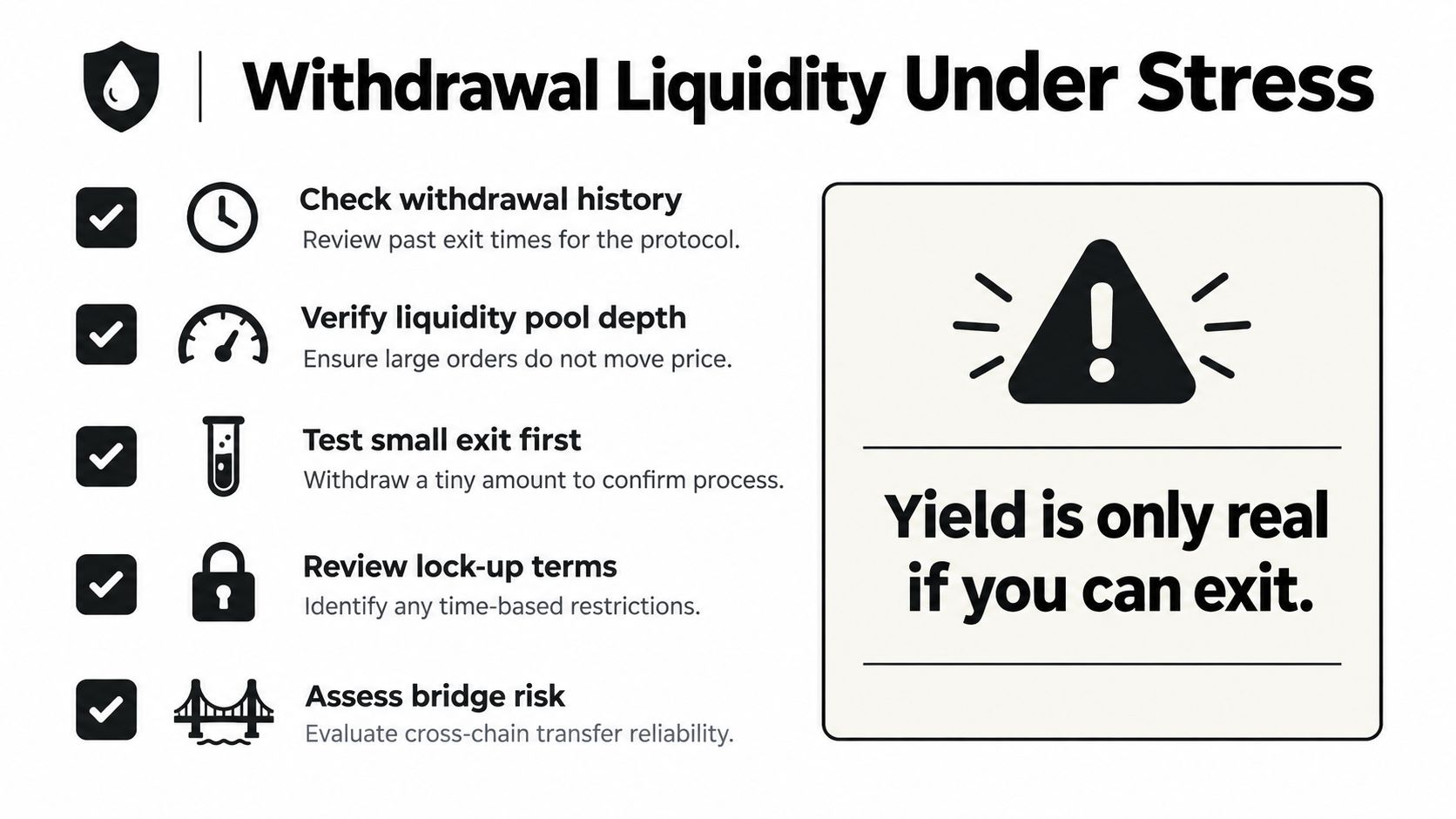
A recent market episode reportedly produced more than $5.5 billion in stablecoin withdrawals from Aave over two weeks after an exploit, which is exactly the kind of event that exposes weak exit paths. The lesson isn't that Aave is uniquely fragile. The lesson is that liquidity conditions can change violently, and the interface label “withdraw” tells you almost nothing about real-world exit quality. The withdrawal episode report is a reminder that stress is the true test.
Nominal liquidity is not enough
Nominal liquidity means the button works. Stress liquidity means you can exit near expected value when markets are messy, confidence is low, or a peg is under pressure. Those are very different standards.
A good checklist is boring, and boring is what you want here.
Check withdrawal history: look for past exit delays and how the protocol behaved under pressure.
Verify liquidity depth: make sure large exits don't rely on thin pools or fragile secondary markets.
Test a small exit first: confirm the process before you scale up capital.
Review lock-up terms: any time-based restriction should be treated as a risk, not a detail.
Assess bridge risk: if moving across chains is part of the exit, the bridge becomes part of the yield product.
A slightly lower APY with clean access can beat a higher locked yield in practical terms. That's not conservative thinking, it's realistic accounting.
Matching Strategies to Real User Types
The right yield depends on who's holding it, how often they'll touch it, and what breaks their sleep. I wouldn't give the same answer to a beginner, a treasury manager, and a busy investor, because they're solving different problems. The comparison only works when the use case is honest.
If you're new, start with the least moving parts
A DeFi beginner should favor simplicity, clean withdrawals, and familiar stablecoins over chasing extra basis points. Blue-chip lending markets or a hands-off allocation tool can be sensible because the user gets exposure without building a full operational stack from scratch. Yield Seeker fits that pattern as one example, it automates stablecoin allocation across DeFi protocols and is designed around continuous monitoring, but the user still needs to understand that the return is variable.
If you run a treasury, auditability matters more than the flashiest rate
Treasury managers care about traceability, withdrawal certainty, and the ability to explain the position to stakeholders. For that profile, I'd rather see a clean money-market style setup or a conservative wrapper than a clever structure that needs a whiteboard to defend. Auditability is part of the yield, because unclear positions become expensive when accounting, reporting, or redemption timing gets questioned.
If you're busy, use automation, but don't outsource judgment
A time-poor investor should use automation to reduce screening and rebalancing work, not to erase oversight. The right product here is one that keeps funds accessible, surfaces changes clearly, and doesn't bury the user in opaque steps. The trade-off is simple, you give up some control over selection speed, but you keep enough visibility to rotate out when the setup stops making sense.
The best strategy for your profile is the one you can monitor without resenting it.
Practical FAQ and Monitoring Habits
How often should you recheck yields? Weekly is enough for a normal stablecoin strategy, because rates can move when utilization shifts or incentives change. If the rate is heavily promotional or thinly supported, check it more often and assume it can fall without warning.
When should you rotate out? Rotate when the yield no longer compensates for the exit friction, or when a better option offers similar return with cleaner liquidity. High APY alone is not a reason to stay.
What should worry you most? A yield that looks generous but depends on lockups, unstable incentives, or unclear redemption terms. That's the combination that usually breaks first.
Operator habit: review, re-rank, stress test.
A good routine is simple. Review holdings weekly, re-rank opportunities monthly, and run a stress test quarterly against peg loss, platform failure, and exit delay. If you can't explain why you still hold a position after that review, you probably shouldn't.
If you want a cleaner way to compare stablecoin opportunities without staring at isolated APYs, use Yield Seeker to track, monitor, and allocate across DeFi with a risk-aware lens. It's built for people who'd rather make a solid decision than chase the loudest number.