

A crypto yield optimizer automates capital routing, compounding, and rebalancing across DeFi protocols to seek higher stablecoin returns while managing risk, and aggregators were estimated to manage about $47 billion in TVL, roughly 18% of total DeFi TVL. It can make fragmented yield markets easier to use, but it can't turn risky smart-contract exposure into cash-equivalent savings.
You may already be holding USDC or USDT, watching one lending pool advertise a reasonable rate while another dashboard shows a better opportunity on a different chain. The difficulty isn't finding one APY. It's checking whether the rate is sustainable, whether the pool has enough liquidity, whether moving funds is worth the gas cost, and whether the strategy adds risks you can explain.
That gap created the crypto yield optimizer category. The software handles repetitive decisions that a manual user would otherwise make across multiple protocols, while the user remains responsible for choosing an acceptable risk profile. The practical question isn't whether an optimizer can find a higher rate. It's whether the additional complexity produces enough net benefit to justify the exposure.
Why Stablecoin Holders Turn to Automation
A stablecoin holder usually starts with a simple objective: keep funds relatively liquid, avoid unnecessary price exposure, and earn something while the capital sits unused. In practice, that objective quickly turns into a research task. USDC or USDT may be available through lending markets, liquidity pools, automated vaults, and other DeFi strategies, each with different rates, withdrawal conditions, contract dependencies, and chain costs.
A crypto yield optimizer solves the coordination problem. It can compare available strategies, route capital toward a selected opportunity, reinvest earned rewards, and rebalance when the underlying conditions change. Instead of manually opening several dashboards and submitting every transaction, the holder delegates a defined set of portfolio actions to an automated strategy layer.
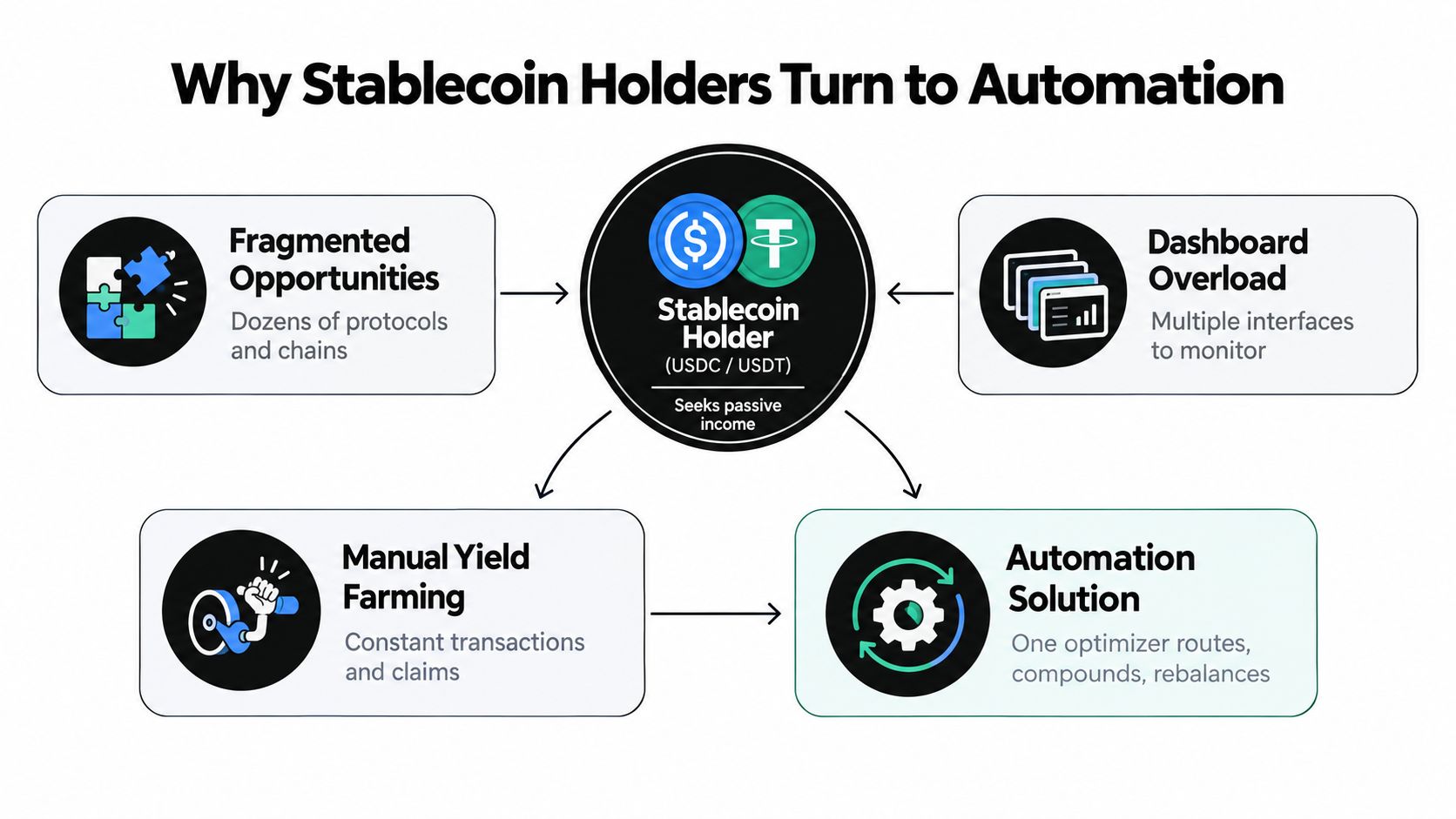
That convenience matters because the opportunity set is broad and constantly changing. An open analytics resource tracks yields across 6,000+ DeFi protocols, with hourly-refreshed APY, TVL, and pool-level details, according to DeFiLlama's yield data. A separate industry snapshot estimated that aggregators' share of total DeFi TVL had risen from roughly 12% to 18%, suggesting that automated routing has become a meaningful capital-allocation layer rather than a niche tactic.
What the optimizer actually removes
Automation removes much of the repetitive monitoring:
Rate checking: The system can compare lending and vault opportunities instead of relying on one familiar protocol.
Reward harvesting: Earned returns can be reinvested without the user initiating every claim.
Capital movement: Approved rules can move funds when a strategy no longer meets its return, liquidity, or risk requirements.
Dashboard switching: A single interface can replace repeated visits to different protocol applications.
A guide to crypto income automation is useful for understanding the distinction between earning yield and automating the work required to pursue it. The distinction matters because automation improves execution efficiency, not the quality of every underlying opportunity.
Practical rule: Treat an optimizer as a process tool. It can reduce missed opportunities and manual work, but it can't remove protocol failure, market stress, or the need for due diligence.
The market size doesn't change that limitation. A larger amount of capital using aggregators shows adoption, not proof that every automated strategy is suitable for every holder. Stablecoin users still need to decide how much liquidity they require, which chains they trust, and what level of contract and strategy risk they can tolerate.
How a Crypto Yield Optimizer Works
The easiest way to understand an optimizer is to treat it like a rules-based portfolio manager that watches several DeFi markets at once. It does not just select the largest headline APY. A useful system evaluates the expected return alongside liquidity, contract exposure, transaction costs, reward composition, and the conditions that could cause the rate to fall.
The workflow usually has three core movements.
Capital routing
First, the optimizer identifies eligible destinations for the deposited stablecoin. These may include lending markets, liquidity positions, or managed vaults. It then routes capital according to the strategy's rules, which might favor a conservative lending market over a more complex liquidity strategy even when the latter advertises a higher nominal rate.
Reported stablecoin yields have ranged from roughly 2% to over 7%, depending on the asset, platform, and market conditions, as described in coverage of changing DeFi yields. That spread explains why routing exists, but it doesn't mean the top rate is the best destination. A high rate may depend on temporary incentives, thin liquidity, high borrowing demand, or a strategy with more moving parts.

Auto-compounding
Once capital earns interest, trading fees, or protocol rewards, the optimizer can reinvest those returns. Compounding is valuable when the cost of claiming and redeploying rewards is lower than the expected benefit. A well-designed system therefore considers gas costs and transaction frequency instead of treating every claim as automatically worthwhile.
That same principle applies to smart-contract yield automation. The software must manage approvals, deposits, withdrawals, and reward actions without creating unnecessary transactions. If each small adjustment consumes too much of the expected return, automation can increase activity while reducing the user's net outcome.
For teams that need clear charts or investor-facing explanations, publication-ready financial insights can also help turn complex portfolio data into readable analysis. That communication layer doesn't replace protocol diligence, but it can make assumptions and trade-offs easier to review.
Rebalancing
Rebalancing is the adjustment step. The optimizer checks whether the current position still meets its rules, then decides whether moving capital is justified. A rate may fall because borrowers repay, incentives change, liquidity leaves the pool, or market conditions alter the expected return.
The strongest mental model is not “deposit once and forget.” It's monitor, compare, deploy, compound, and adjust. The user still needs to understand the optimizer's thresholds, eligible protocols, fees, and exit process before authorizing that workflow.
Strategies, Risk Models, and Automation Layers
A stablecoin position can look straightforward in a dashboard while drawing returns from several different mechanisms underneath. Lending protocols pay suppliers from borrower demand. Automated market makers compensate liquidity providers through trading fees and sometimes incentives. Liquidity mining adds token rewards, while more involved vaults combine several positions into one strategy.
Those mechanisms belong in different risk categories. A basic lending position may depend mainly on the lender's contracts, oracle design, available liquidity, and the stability assumptions behind the asset. A liquidity or borrowed-position strategy can add price divergence, liquidation, bridge, funding, and execution risks. A clean interface can present each option with similar ease of access even when the underlying exposures differ sharply.
How risk-adjusted evaluation works
Headline APY provides only part of the assessment. A more useful method compares trailing APY with an aggregated risk score, asking how much recent return came from each unit of assessed risk. Two pools may display similar nominal returns while differing in contract depth, composability, liquidity, and sensitivity to market conditions.
Stablecoin yield comes from peer-to-peer lending, automated market making, liquidity mining, and synthetic exposure, not from one central interest policy. Galaxy Research's analysis of on-chain yield reviews these mechanisms and risk-adjusted evaluation. The source of a return matters because it determines which event can reduce or eliminate it.
Risk scoring should also support an economic comparison. A strategy with a higher adjusted yield may still be a poor choice if its contract exposure, exit friction, or monitoring demands outweigh the improvement over a safer cash-like alternative. For how position monitoring and exit rules fit into an optimizer, see this guide to automated risk management.
Comparing common strategy types
Strategy | Yield Source | Complexity | Key Risks |
|---|---|---|---|
Lending | Interest paid by borrowers | Lower | Smart-contract failure, utilization shifts, liquidity constraints |
Liquidity provision | Trading fees and incentives | Moderate | Impermanent loss, pool imbalance, contract and oracle risk |
Yield farming | Incentive tokens and underlying strategy returns | Moderate to high | Reward dilution, token volatility, changing emissions |
Leveraged or looping strategy | Borrowed capital layered over supplied assets | High | Liquidation, cascading losses, rate changes, contract dependencies |
An optimizer can automate the transaction sequence without making the protocol mechanics simple. It may conceal how many interactions produce the quoted return, which helps execution but creates a problem when users stop inspecting the underlying position.
What automation cannot protect
Crypto yield optimizers are process-optimization layers, not risk-elimination layers. Smart-contract, bridge, lender, AMM, and strategy failures remain possible, and looped or highly exposed positions can become especially fragile under stress. A defect in the optimizer or an integrated protocol may freeze funds or cause a substantial capital loss, as discussed in this overview of DeFi yield aggregator risks.
A risk model is only as useful as its inputs. Check which contracts the system permits, how it treats paused markets, whether it can unwind positions, and what happens when an oracle becomes unavailable. Clear routing rules and a credible exit process matter more than a polished APY display.
Pros, Cons, and Hidden Complexity
Automation has a genuine practical advantage. A person managing stablecoins manually must discover opportunities, compare terms, approve contracts, execute transactions, track rewards, and decide when to exit. An optimizer can consolidate those tasks and make a repeatable strategy possible for users who don't want to spend their day monitoring DeFi.
The benefits are clearest when the user values time and access more than absolute control. The costs become more important when the balance is small, the strategy turns over frequently, or the optimizer's logic is difficult to inspect.
Where automation helps
Time savings: The system can handle recurring claims, comparisons, and reallocations.
Broader access: One interface can expose several protocols and strategies.
Consistent execution: Rules reduce the chance that a user forgets to harvest or review a deteriorating position.
Operational simplicity: A user can manage a strategy without manually coordinating every protocol interaction.
Where it adds risk
Extra contract exposure: The optimizer itself becomes another smart-contract layer.
Dependency risk: The strategy may rely on several external protocols, bridges, price feeds, or vault curators.
Fee drag: Optimizer fees, gas, slippage, and transaction costs reduce the return shown in a gross APY.
Opacity: Users may not know exactly why capital moved or how quickly the system can exit.
Strategy decay: A process that worked under one liquidity or borrowing environment may become unattractive when conditions change.
The economic comparison is often less flattering than the dashboard suggests. Recent analysis found that about 58% of stablecoin vault TVL on Ethereum and major L2s earns under 3% APY, while safer stablecoin supply yields can trail traditional cash-like alternatives, according to this stablecoin yield analysis. That doesn't make DeFi yield useless. It means the user must compare net return with the extra contract and operational risk.
More automation isn't automatically better. The right question is whether it removes enough work and improves enough execution to justify the additional layer of dependency.
For a small balance, a network transaction or an exit fee can consume a meaningful share of the expected return. For a larger treasury, manual monitoring can become the expensive option because staff time, missed rebalances, and fragmented reporting create their own operational burden.
How to Choose a Crypto Yield Optimizer
Start with custody and exit mechanics, not the advertised APY. Find out whether the service controls the assets, whether you interact directly with contracts, how withdrawals work, and whether any lockup or withdrawal fee applies. A strategy that looks attractive but makes liquidity difficult to access may not match a stablecoin holder's actual goal.
Then inspect the strategy inventory. A credible optimizer should identify the protocols it uses, explain the source of yield, disclose fees, and show whether returns include token incentives or other variable components. You should also be able to distinguish between a single lending position and a strategy that layers borrowing, liquidity provision, or bridging on top.
A practical review checklist
Feature | What to Check | Why It Matters |
|---|---|---|
Custody model | Who controls assets and transaction permissions | Defines counterparty and access risk |
Fee structure | Management fees, performance fees, gas, and withdrawal costs | Determines net yield |
Strategy transparency | Approved protocols, routing rules, and risk explanations | Shows what actually creates the return |
Chain support | Supported networks and bridge dependencies | Affects liquidity, costs, and contract exposure |
Security history | Audits, incident disclosures, and contract changes | Helps assess operational maturity |
User controls | Deposit limits, withdrawal flow, alerts, and reporting | Determines how much control you retain |
Base chain support may suit users who want a focused environment instead of manually managing several networks. Yield Seeker is one example of an AI-powered stablecoin allocation platform described as using a personalized agent to monitor approved DeFi opportunities and manage USDC positions on Base. Its stated product model includes deposits starting at $10 USDC, no lockups, and no withdrawal fees, details that should still be verified against current terms before use.
The interface matters because a good risk decision depends on readable information. You should be able to see your balance, accrued earnings, current allocation, and the conditions that would trigger a rebalance. A built-in terminal or visual walkthrough can help newer users understand the actions being authorized, while experienced users may prioritize contract addresses, transaction history, and exportable records.
The following video provides another way to assess the product experience and workflow:
Before depositing, test the withdrawal path with an amount you can afford to keep in review. Confirm the supported stablecoin, network, fees, approval permissions, and expected settlement process. A clean interface is useful, but transparency and reversibility matter more than visual polish.
When Yield Optimization Makes Economic Sense
The economic test is straightforward, even if the inputs aren't. Compare the optimizer's expected net return with a simpler cash-like alternative, then price the additional risks and work. Gross APY is only the starting point. Fees, gas, slippage, reward volatility, tax treatment, liquidity constraints, and the possibility of a contract failure all affect the result.
For safer stablecoin strategies, recent coverage has described average supply yields around 3%, while a large share of stablecoin vault capital earns below that level. The same analysis notes that stablecoin yields can trail U.S. Treasury-like cash alternatives in some periods, which makes the comparison essential rather than optional. The question isn't whether DeFi can produce a high rate somewhere. It can. The question is whether the rate available to your chosen risk profile compensates you for the added complexity.
A useful decision filter
A crypto yield optimizer is more likely to make sense when:
Monitoring is expensive: You manage treasury funds or several positions and can't manually inspect markets consistently.
The strategy is transparent: You understand the source of yield, protocol dependencies, fees, and withdrawal process.
Liquidity remains practical: You can exit without relying on a fragile market or an extended unwinding process.
The expected advantage is durable: The return doesn't depend entirely on a temporary incentive or a rate that can disappear when borrowing demand changes.
You accept smart-contract exposure: You aren't treating the position as equivalent to a bank deposit or a government-backed cash instrument.
It may not make sense when the balance is small enough that transaction costs can erase the expected improvement. It also may not fit if you need principal certainty, don't understand the strategy, or would struggle to respond to a contract pause or market disruption. In those cases, a simpler yield-bearing asset or cash-like alternative may offer a better risk-adjusted outcome even with a lower displayed rate.
Choose the simplest strategy that meets the goal
Experienced DeFi users can benefit from automation because they already understand the underlying protocols and can evaluate whether the system's routing rules match their preferences. A busy professional or Web3 team may value automated monitoring and reporting more than the ability to select every pool manually. Neither user should confuse convenience with protection.
The strongest approach starts with a target rather than a rate. Decide whether the priority is liquidity, conservative lending exposure, operational simplicity, or a willingness to accept complex strategies for a potentially higher return. Then reject any optimizer that can't explain how it pursues that objective.
Sustainable yield is a feature of a comprehensible process, not a number displayed at the top of a dashboard.
Review the position regularly even when the software rebalances automatically. Check whether the supported protocols have changed, whether fees remain reasonable, whether the stablecoin maintains its intended behavior, and whether the current return still beats the alternative after risk. An optimizer should reduce repetitive work, not eliminate judgment.
Yield Seeker offers automated stablecoin yield management on Base, with an AI agent that monitors approved DeFi opportunities and allocates capital according to yield, liquidity, and risk considerations. If you want to compare an automated workflow with manual stablecoin management, visit Yield Seeker and review the current product terms before depositing.