

You open Reddit for a quick answer and end up with twelve tabs, three wallet warnings, and a growing suspicion that half the people posting giant APYs are leaving out the hard part. That's a normal starting point when looking for DeFi passive income on Reddit.
The useful threads are out there. So is a lot of noise. Some users are sharing battle-tested approaches. Others are posting screenshots from short-lived farms, quoting dashboard APYs they never realized, or recommending protocols that won't be around next cycle.
The practical way to read DeFi Reddit is to treat it like a field report, not gospel. Look for what people did, how much work it took, what risks they accepted, and whether the strategy still makes sense once gas, rebalancing, and contract risk enter the picture. If you need a grounding in how to evaluate performance before chasing yield, Fintrack's rate of return guide is a useful refresher. If you're still getting comfortable with the basics, this plain-English primer on DeFi for beginners helps translate the jargon before you put money at risk.
Your Journey into DeFi Passive Income Starts Here
Individuals searching Reddit for passive income in DeFi want one of three things. They want stablecoins to stop sitting idle, they want a safer alternative to pure speculation, or they want to know whether the yield screenshots are real.
All three are reasonable. But the first lesson is simple. Passive in DeFi rarely means effortless. It usually means your capital is working while you manage a stack of risks in the background.
What Reddit gets right
Reddit is often better than polished marketing pages at showing the trade-offs. Users will tell you when a strategy only works if you babysit ranges. They'll admit when the displayed APY and realized return were very different. They'll also point out when an “easy” farm depends on incentives that can disappear fast.
That honesty matters more than the headline APY.
Practical rule: If a Reddit post tells you the upside but skips over smart contract risk, token exposure, or how often the position needs maintenance, it isn't a complete strategy.
The mindset that keeps you out of trouble
Start by asking four questions:
Where does the yield come from? Trading fees, borrowing demand, staking rewards, or token incentives all behave differently.
What can go wrong? Impermanent loss, depegs, bridge risk, contract bugs, and governance changes all hit differently.
How active is the strategy? Some positions are close to hands-off. Others are a disguised part-time job.
Can you exit cleanly? Liquidity, lockups, and withdrawal friction matter more than most Reddit threads admit.
The people who last in DeFi tend to be boring in the best way. They don't chase every spike. They keep size appropriate to risk. And they know that preserving capital is often a critical edge.
Decoding Reddits Favorite DeFi Income Strategies
Open Reddit after a rate cut or a market wobble and the same pattern shows up fast. One user posts a stablecoin vault paying double digits, another swears by simple staking, and someone else drops a screenshot of a liquidity pool with a huge APY. It all looks passive until you ask how much work sits behind the yield.
Reddit tends to cluster DeFi income ideas into three buckets: single-asset positions, stablecoin lending or vault strategies, and liquidity provision. They all pay differently. They also fail differently.
Single-asset strategies
Single-asset setups are usually the cleanest place to start. You deposit one token, then earn from staking rewards, lending demand, or vault allocation logic. Reddit users often prefer these because the position is easy to understand and the risk is easier to track than a two-token LP.
That simplicity hides less, but it does not remove risk. A stablecoin vault can still break if the protocol gets exploited, the chain has issues, or the stablecoin itself loses its peg. A staking position avoids impermanent loss, but you still carry asset exposure, validator risk, and platform risk if you use a liquid staking wrapper.
For stablecoin holders, the primary question is rarely “can I get yield?” It is “how many moving parts am I accepting for that yield?” That becomes clearer once you compare Reddit's stablecoin farming ideas side by side. This breakdown of stablecoin yield farming on Reddit is useful for that.
Liquidity pools and active farming
Liquidity providing gets pitched as passive income more often than it deserves. In practice, many LP strategies behave like a position you need to check, rebalance, and sometimes exit quickly when incentives change.
Reddit veterans usually separate basic LPs from active farming for a reason. Fees can be real, but so can impermanent loss, token emissions that dump faster than you earn them, and concentrated liquidity ranges that need maintenance. An ETH/USDC position might look calm for weeks, then underperform badly during a sharp move if your range is set poorly or you leave rewards unclaimed too long.
The useful Reddit insight is not a magic APY number. It is the difference between displayed yield and realized yield. Interface estimates assume conditions hold. Your return depends on price action, gas, rebalancing discipline, and whether the rewards are being paid in something you would want to own.
Busy investors run into the same problem over and over. The best-looking yield is often fragmented across several chains and apps, which turns “passive income” into a routine of checking dashboards, bridging funds, claiming rewards, and comparing vaults every few days.
That hidden labor matters.
DeFi passive income strategies at a glance
Strategy | Yield Pattern | Primary Risk | Best For |
|---|---|---|---|
Single-asset stablecoin strategy | Usually steadier, but often falls as capital floods in | Smart contract risk, platform risk, stablecoin risk | Users who want simpler exposure |
Staking or liquid staking | More predictable mechanics than farming, but tied to the asset | Asset price risk, validator or wrapper risk | Users prioritizing simplicity |
Stablecoin vault rotations | Can stay attractive, but rates move fast across protocols | Protocol risk, allocation changes, chain risk | Users willing to compare venues regularly |
ETH/USDC or similar LP positions | Can outperform during healthy volume, then lag in volatile swings | Impermanent loss, range management, execution risk | Hands-on users |
High-incentive farms and leveraged LPs | Highest headline yields, shortest shelf life | Incentive decay, liquidation risk, severe drawdowns | Experienced users only |
If you work in crypto communities and want a cleaner example of how infrastructure choices shape user payments and recurring revenue, this guide to Discord crypto payments is a good parallel. It's not about yield farming, but it does show how crypto cash flows depend on the rails you choose.
The best Reddit strategy is often the one that survives your schedule. If a yield only works when you monitor five apps and three chains, it is not passive for anyone with a real job.
The Reddit Reality Check How to Vet DeFi Advice
A typical Reddit thread goes like this. Someone posts a screenshot of a double-digit stablecoin APY, three commenters say it has been "printing," and nobody mentions how often the allocation needs to be moved, what happens when incentives dry up, or how ugly the exit can get when everyone runs for the door.
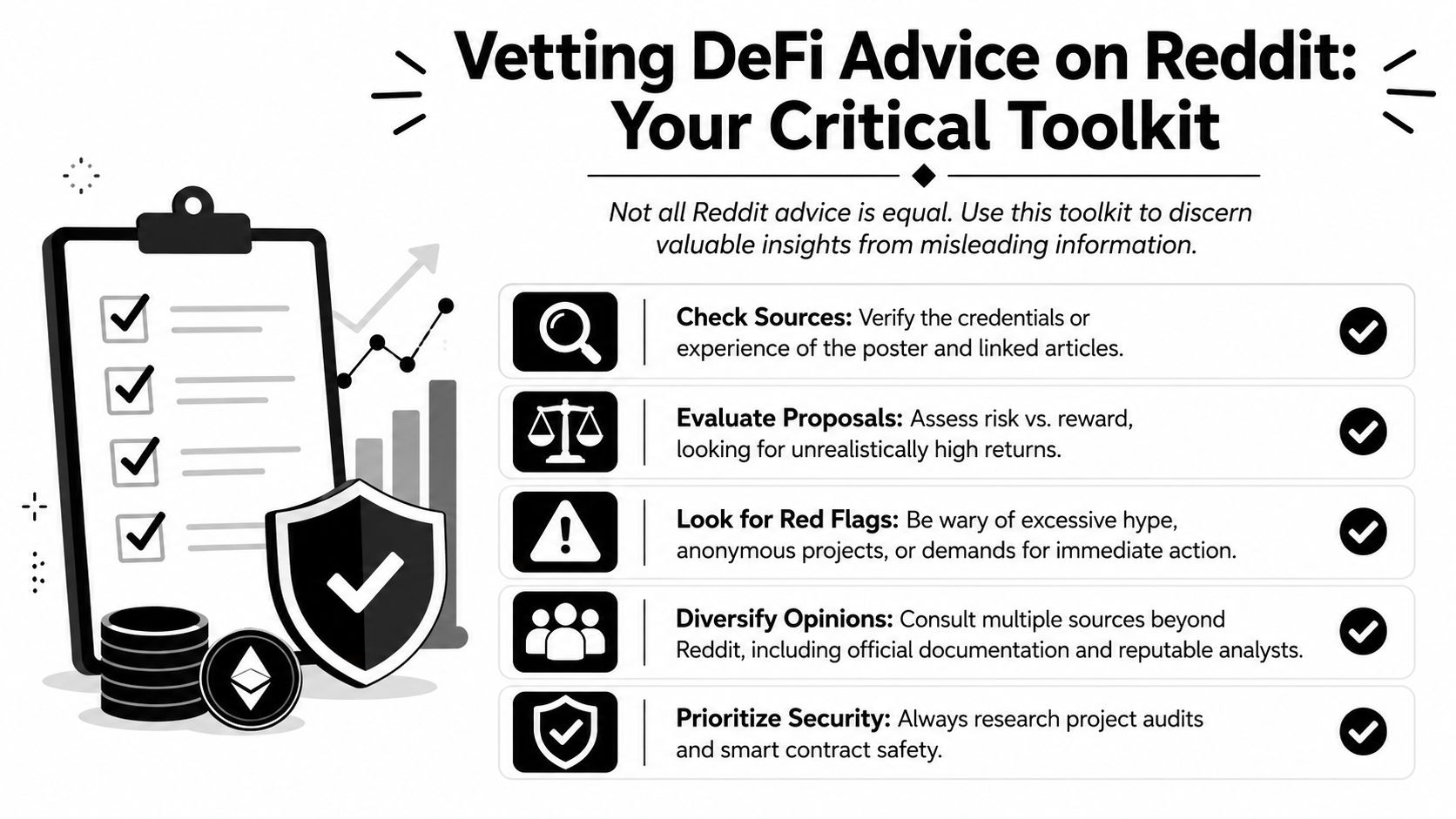
That gap matters. A lot of Reddit advice is directionally useful, but it often hides the manual labor. If you are trying to build passive income, the job is not finding one exciting comment. The job is filtering for protocols that can still make sense after fees, risk, and your available time.
Longevity matters more than hype
Old threads are a useful reality check because they show how fast confident recommendations expire. Many once-popular passive income plays are gone, illiquid, or irrelevant now. The protocols that keep showing up across market cycles tend to share a few traits: simple core products, real user demand, and fewer moving parts than the latest farm with a huge headline number.
That does not mean only old protocols deserve capital. It means survival is evidence. A protocol that has handled stress, redemptions, and falling incentives tells you more than a fresh post with a big APY and a comment section full of referral links.
A simple vetting checklist
Before you use a strategy from Reddit, check these points yourself:
Open the app before trusting the thread. If the product flow, collateral rules, or withdrawal terms are hard to verify, skip it.
Map the dependencies. Count the contracts, bridges, wrapped assets, and reward tokens involved. More dependencies usually means more failure points.
Separate operating yield from promotional yield. Borrow demand, trading fees, and liquidation revenue are different from temporary token emissions.
Test the exit path. Check liquidity depth, withdrawal queues, bridge routes, and slippage before you deposit.
Look for sober risk analysis. Audits matter, but so do incident history, governance quality, and whether the strategy still works after rewards fall. This protocol safety analysis guide is a solid framework.
The red flags that keep repeating
The same warning signs show up again and again on Reddit. A complicated strategy gets described as passive. A stablecoin vault turns out to depend on three protocols and a bridge. A farm looks attractive until you realize the yield only holds if you keep rotating capital every few days.
That last point is where busy investors get trapped. Chasing fragmented stablecoin yields by hand can feel smart for a week, then turn into a part-time operations job. You are monitoring rates, reading governance posts, checking chain-specific risk, and deciding whether the extra yield is still worth the friction.
Good DeFi opportunities hold up under boring questions. The better long-term setup is often the one that reduces manual decisions, rather than demanding constant Reddit-scrolling to stay competitive.
A Practical Starting Point for Stablecoin Holders
If you're new, or just tired of every position moving with the market, stablecoins are the cleanest place to start. They strip out a big source of noise. You're no longer trying to earn yield while also guessing whether ETH or SOL will swing against you.
That doesn't make stablecoins risk-free. It makes the risk easier to isolate.
Why stablecoins are the better training ground
With stablecoins, your main job is evaluating protocol quality, chain choice, access to funds, and how the yield is generated. You don't have to untangle that from major token volatility at the same time.
That's why so many practical Reddit conversations eventually drift back to USDC, USDT, or similar assets. Stablecoin strategies are easier to compare because the base asset is designed to stay stable. You can think more clearly about whether you're being paid enough for the risk.
How to build a stablecoin-first approach
A sensible starting framework looks like this:
Pick one chain you understand. Fewer bridges usually means fewer moving parts.
Favor single-asset positions first. They're easier to monitor and explain.
Treat liquidity pools as a second step. They can pay more, but they add another risk layer.
Keep funds liquid where possible. Flexibility matters when yields move or protocol conditions change.
Write down your reason for entering. If you can't explain the position in plain language, you probably shouldn't hold it.
The challenge with much Reddit advice is its assumption that you're already comfortable hopping between apps, chains, and wrappers. Many are not. They want something they can understand on a tired Tuesday night, not a strategy that requires a Discord call and six browser tabs.
What works better than heroic yield chasing
The strongest stablecoin setups usually share a few traits. The protocol is understandable. The source of yield is visible. Exits are straightforward. And the return doesn't depend entirely on short-term token incentives.
That sounds less exciting than a giant APY screenshot. It's also how people avoid learning expensive lessons.
The Hidden Work of Manual Yield Farming
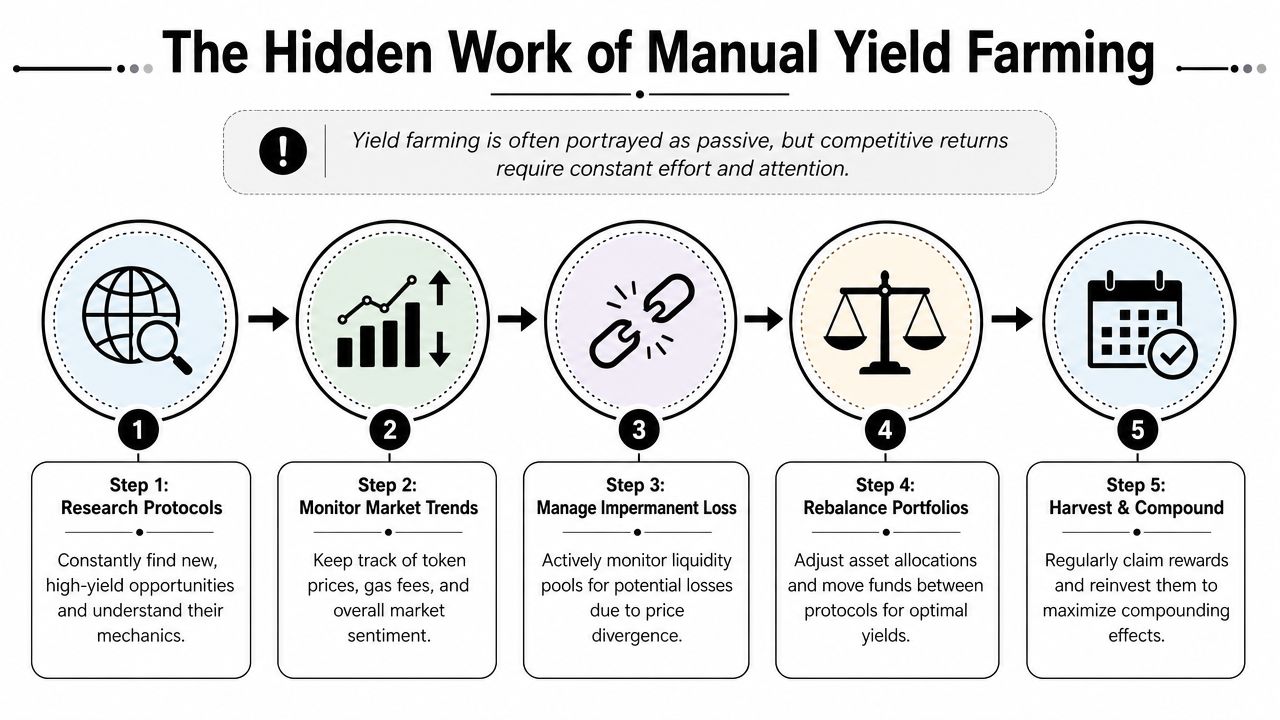
Open Reddit after work and the pitch sounds easy. Park stablecoins in a few protocols, collect yield, check back later. The part that gets skipped is the weekly maintenance. Good returns usually come from a string of small decisions that have to be made on time.
Why manual rebalancing drags returns
Stablecoin yield moves around constantly. A lending market tightens. An incentive program ends. A vault that looked solid last month slips behind a simpler option on another chain. Anyone managing this by hand has to notice the change, verify that it is real, calculate costs, then decide whether the switch is worth the effort.
That delay is expensive.
Most underperformance in manual farming does not come from one catastrophic mistake. It comes from staying in decent positions too long because checking five apps, two bridges, and a governance forum takes time. Reddit threads on passive income reflect that reality. Users describing consistent results usually sound less like passive investors and more like part-time operators (discussion on passive income strategies with $10,000).
The tasks nobody shows in screenshots
A clean APY screenshot leaves out the upkeep behind it:
Protocol screening: You keep re-checking whether the yield comes from real borrowing demand, market making fees, or temporary token emissions.
Fee math: Bridging, swapping, and depositing can wipe out the benefit of a small APY improvement.
Position maintenance: LP and concentrated liquidity positions need attention when ranges drift or volatility picks up.
Reward management: Claimed incentives only help if you convert and redeploy them without bleeding value to gas and slippage.
Risk review: Team changes, liquidity drops, oracle issues, and governance votes can change the risk profile fast.
I have found that busy investors usually lose interest at this point. Not because the opportunities are bad, but because the process keeps asking for attention.
Manual farming favors people who do not mind repetitive portfolio work. For everyone else, "passive" turns into another tab that needs checking.
Fragmentation is the primary obstacle
Capital is spread across chains, wrappers, vaults, and pools. That fragmentation creates a steady drag on results because money often sits in acceptable positions while better risk-adjusted options appear somewhere else. Then comes the usual hesitation. Is the bridge safe enough. Are fees too high today. Did the protocol just change its reward model. Is this extra 2% worth another hour of research.
That is the hidden cost Reddit advice often understates. The challenge is not only finding yield. It is keeping up with fragmented yield without turning stablecoin income into a recurring manual job.
Automating Your DeFi Income with AI
The obvious response to fragmented yield is automation. If the problem is constant monitoring, delayed moves, and too many cross-chain decisions, then software should handle more of that burden than humans do.
That's why AI-driven yield tools are getting so much attention.

What automation actually fixes
A useful automated system does more than chase the highest number on a dashboard. It helps with the part humans do badly over time: staying consistent across many small decisions.
Good automation can:
Track opportunities continuously instead of only when you remember to check
Reallocate faster when a better risk-adjusted option appears
Reduce dashboard fatigue by putting monitoring into one workflow
Apply rules consistently instead of letting emotion or procrastination drive moves
The important phrase is risk-adjusted. An AI tool that blindly chases top APY isn't solving the core problem. It's just speeding up bad decisions. The better approach is rules-based automation with clear guardrails around protocol quality, liquidity, and exposure concentration.
Why this fits busy stablecoin holders
Those holding stablecoins typically don't want to become full-time allocators. They want capital to stay productive without needing to watch every market twitch. That's where AI-assisted workflows make sense. They don't remove DeFi risk, but they can remove a lot of avoidable human delay.
For a closer look at how AI systems gather and structure changing information from messy online environments, this piece on extracting web data for LLMs is a useful adjacent read. The underlying lesson applies here too. Automation only helps if the data collection and decision logic are disciplined.
A short demo makes the shift from manual to automated much easier to picture:
The standard worth demanding
If you explore AI-powered DeFi tools, ask blunt questions. What data does the system watch? How does it avoid overtrading? What protocols does it consider? How transparent is the allocation logic? Can you exit when you want?
Those questions matter more than whether the interface looks smart.
Frequently Asked Questions About DeFi Income
Is DeFi passive income actually passive
Not in the way it is often understood. Some strategies are low maintenance, but many Reddit-favorite approaches require monitoring, rebalancing, and periodic risk review.
What's the safest place to start
Generally, a simple stablecoin-first approach is easier to understand than LPs or farms employing advanced strategies. It narrows the problem to protocol and execution risk instead of stacking on major token volatility.
Are high APYs always a scam
No. But high APYs usually mean higher risk, more active management, or rewards that may not last. If the source of yield isn't clear, walk away.
Should I trust Reddit recommendations
Use Reddit as signal, not authority. The best threads help you generate ideas and spot trade-offs. They shouldn't replace your own review of the protocol, exit path, and risk model.
What usually goes wrong for beginners
Most beginners either overcomplicate too early or chase the biggest number on the screen. A simpler position you understand is usually better than a clever one you can't monitor.
Is automation worth it
If you don't want DeFi to become a recurring weekly task, yes. Automation won't remove smart contract risk, but it can cut the manual burden that causes many users to react late or stay in mediocre allocations too long.
If you want a simpler way to put stablecoins to work without manually chasing every new opportunity, Yield Seeker is worth a look. It's built for people who want automated, AI-powered stablecoin yield with a low-friction experience, clear visibility into balances and earnings, and flexible access to funds without lockups or withdrawal fees.