
You've parked stablecoins in a wallet because you want them available, but the yield hunt has turned into a second job. One dashboard shows an attractive APY, another shows a different rate, and a third reveals that the original incentive has already changed. By the time you bridge funds, approve a token, and complete the deposit, the opportunity may no longer resemble the number that caught your attention.
A practical DeFi yield app should remove that friction without hiding the decisions that matter. It should help you discover opportunities, explain where returns come from, automate allocation when appropriate, and make exiting understandable. The central question isn't “Which app displays the highest APY?” It's “Which app can manage changing conditions without turning risk into a black box?”
Why Stablecoin Holders Need a DeFi Yield App Now
Stablecoin yield became popular because on-chain markets could offer returns that traditional cash accounts couldn't match during incentive-heavy periods. Historical DeFi TVL reached about $178 billion in November 2021, fell below $40 billion by the end of 2022, and later recovered to roughly $120 billion by early 2026, according to this history of DeFi market cycles. That cycle is more than background context. It shows how quickly the available capital, borrowing demand, and incentive budgets can expand or contract.
A stablecoin holder managing funds manually experiences that change as a stream of small decisions. You compare lending markets, inspect pool liquidity, check whether a reward token still matters, estimate transaction costs, and decide whether moving funds is worth the operational risk. A rate can look compelling in isolation while becoming unattractive after execution complexity, protocol exposure, or a difficult withdrawal process.
Practical rule: Treat a displayed APY as a changing observation, not a promise.
The need for automation is especially clear because stablecoins now form the main funding layer for many DeFi yield strategies. An IMF report placed total stablecoin market capitalization around $300 billion in Q1 2026, while later market tracking cited $305.1 billion in Q2 2026 and an industry summary reported $308.0 billion on 13 August 2026. The same summary said the market was about 14.3% higher year over year and 4.5% below its all-time peak of $322.4 billion, as reported in the IMF crypto market monitor. The exact rate environment will move, but the underlying user problem remains: capital is large, opportunities are fragmented, and conditions change faster than anyone wants to monitor.
A dedicated app should feel less like a farm dashboard and more like an operating layer. You should see what you hold, where it's deployed, what produced the return, what fees apply, and how to withdraw. Readers building a wider foundation in mastering cryptocurrency strategies may find that broader education useful, but stablecoin yield still demands product-specific judgment. Real-time monitoring also matters, especially when rates and incentives change between deposit and review, as explained in this guide to real-time monitoring benefits.
What a DeFi Yield App Does for Stablecoins
A DeFi yield app connects a user's stablecoins with on-chain opportunities and turns a fragmented research process into a managed workflow. At minimum, it discovers pools or vaults, ranks them according to selected criteria, executes transactions, monitors positions, and supports withdrawal. More advanced platforms add allocation rules, risk filters, portfolio reporting, and automated rebalancing.

The workflow usually has four practical stages:
Deposit: You connect a wallet, select a supported stablecoin and network, review the transaction, and supply capital.
Discovery: The app scans supported protocols and chains for eligible lending markets, liquidity pools, or vaults.
Ranking: It evaluates yield, liquidity, fees, incentives, contract exposure, and execution conditions rather than sorting only by headline APY.
Allocation and monitoring: The app routes funds into the selected strategy, tracks the position, and may move capital when its rules indicate that the current allocation no longer fits.
That differs from a single-protocol vault. A vault may automate compounding or strategy execution inside one system, but it doesn't necessarily compare the wider market. A manual tracker may show many opportunities, but it leaves every transaction and allocation decision to you. A useful explanation of the broader distinction appears in this overview of a DeFi yield aggregator.
Stablecoins dominate this use case because users generally want yield without taking direct directional exposure to a volatile asset. That doesn't make the strategy low risk. Stablecoin users still face de-peg events, contract failures, withdrawal constraints, changing borrowing demand, and reward emissions that can disappear. The app's job is to make those conditions visible and manageable, not to remove them.
Two terms deserve careful separation. APY attempts to express an annualized return with compounding assumptions, while incentives may come from separate reward tokens whose value and availability can change. Non-custodial generally means the platform doesn't take possession of your private keys, but you still authorize smart-contract transactions and remain exposed to the contracts you interact with. A polished interface can simplify execution, but it can't turn an on-chain position into a bank deposit.
How to Evaluate Any DeFi Yield App Before You Deposit
The most useful evaluation starts before you compare rates. A platform may have an attractive interface and broad protocol coverage, yet still give you weak information about contract exposure, exit conditions, or the source of return. Score each app against the same criteria so marketing language doesn't determine your decision.
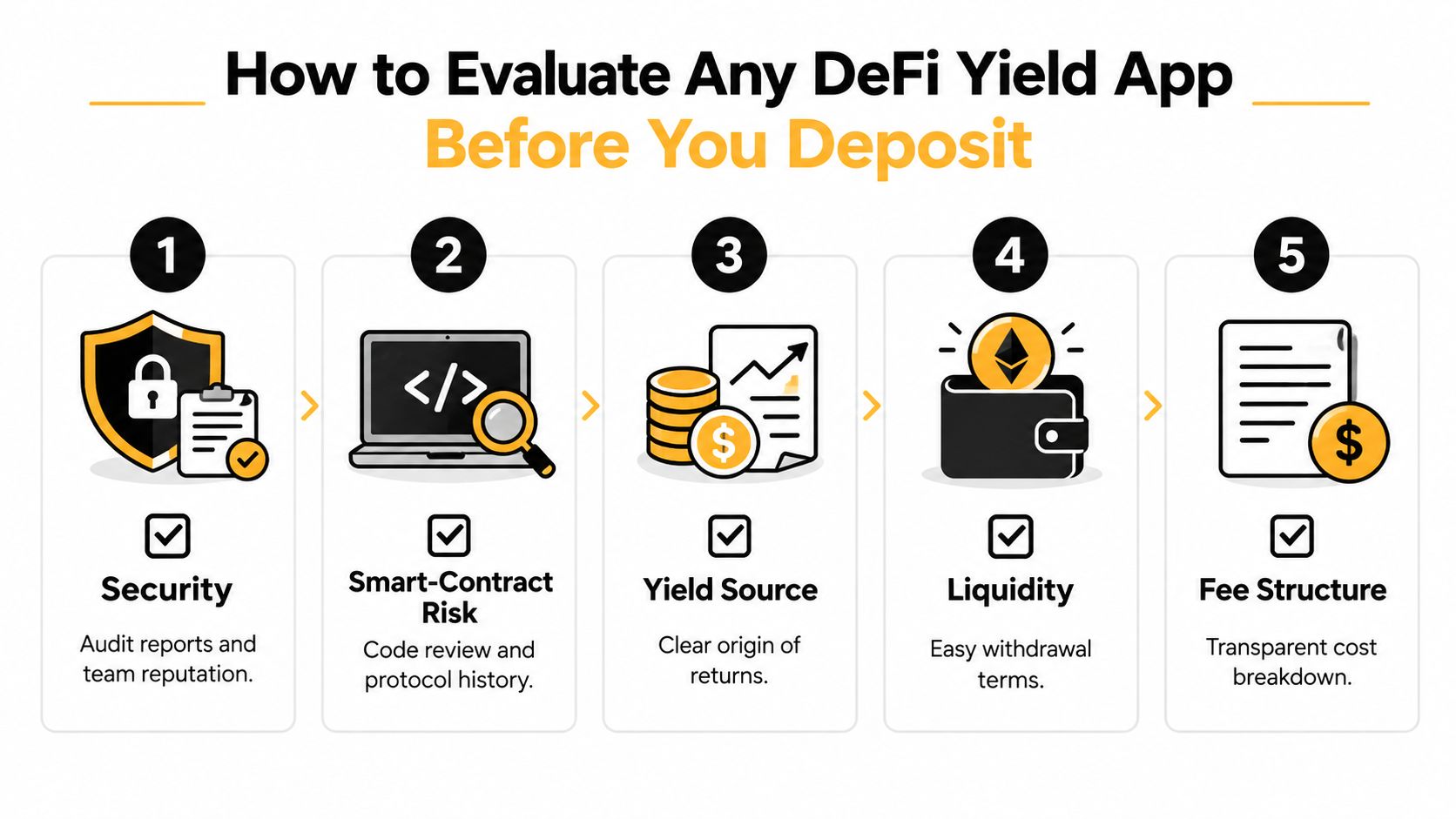
Security and contract exposure
Start with the contracts, not the dashboard. Look for disclosed protocol integrations, audit information, upgrade permissions, admin controls, oracle dependencies, and the history of the underlying protocols. An audit can identify classes of bugs, but it doesn't guarantee that a contract is safe or that a strategy will behave well during stress.
You also need to understand the app's own permissions. Check whether it uses an approval model that gives a contract broad spending authority, whether transactions are clearly presented, and whether you can revoke permissions through your wallet tools. A security process that can't explain what the user is signing is incomplete.
Yield-source transparency
The app should identify whether returns come from lending interest, trading fees, basis trades, derivatives, or token incentives. If the screen shows one blended number without separating organic yield from rewards, you can't judge how durable the return may be.
A useful product explains what could reduce the yield. Borrower demand may weaken, liquidity may leave a pool, governance may alter emissions, or an incentive token may lose value. A detailed protocol safety analysis becomes more useful than a simple APY leaderboard.
Automation quality
Automation isn't automatically beneficial. Rebalancing can improve capital placement, but each move can create gas costs, slippage, approval requirements, and additional contract interactions. A reliable app should state what triggers movement, how often it checks conditions, what thresholds it uses, and whether you can pause or override the process.
The differentiator isn't whether an app says “AI.” It's whether the system can explain an allocation, execute it safely, and leave you a simple path out.
Usability and learning support
A beginner needs more than a deposit button. The interface should display wallet balances, deployed balances, accrued earnings, strategy names, network information, transaction status, and withdrawal instructions in plain language. Built-in explanations, transaction previews, and visual walkthroughs can reduce mistakes without pretending that DeFi risk is simple.
Experienced users need the opposite kind of clarity. They may want contract addresses, protocol names, chain details, allocation history, and a terminal or advanced view. The best UX doesn't force every user into the same level of abstraction.
Integrations, chains, and liquidity
Coverage matters because the opportunity set is fragmented. DefiLlama's stablecoin yield tracker reports 2,075 pools across 488 protocols on 110 chains, providing a useful benchmark for the scale a broad discovery system may need to process. That data appears in this stablecoin yield tracker. More coverage also means more operational complexity, including bridge risk, chain-specific execution costs, inconsistent data, and different withdrawal mechanics.
Before depositing, verify the actual supported assets and networks. Then test the withdrawal path with a small amount. If the app can show where capital sits and how you reclaim it, it earns more trust than an interface that merely displays a high number.
Comparing DeFi Yield App Approaches Side by Side
Different app types solve different parts of the problem. Manual trackers maximize user control but consume attention. Classic aggregators automate strategy execution inside defined vaults. Treasury-oriented systems prioritize liquidity and reporting. AI-driven allocation platforms attempt to automate discovery and movement across a changing set of opportunities.
The right choice depends on whether your scarce resource is time, liquidity, technical judgment, or tolerance for strategy complexity.
DeFi Yield App Archetypes Compared
App Archetype | Automation Level | Best For | Trade-off to Watch |
|---|---|---|---|
Manual tracker | Low | Users who want to select every protocol and transaction | Requires ongoing research, monitoring, and execution |
Classic yield aggregator | Moderate to high | Users who prefer established vault workflows and automated compounding | Strategy may be limited to selected vaults or protocols |
Treasury-focused vault | Moderate | Teams that need reporting, access controls, and predictable operational processes | Conservative positioning may reduce upside when more active routes are available |
AI-driven allocation platform | High | Time-constrained users who want automated discovery and reallocation | The decision model must be understandable, bounded, and easy to override |
Manual tracking works when you enjoy research and can respond quickly to changing conditions. It also lets you reject a protocol for reasons that a ranking engine may not capture, such as governance concerns or a design you don't understand. The cost is attention. You must monitor rates, rewards, liquidity, contract updates, and exits yourself.
Classic aggregators reduce that workload through vault logic. They can compound rewards and package a strategy into one position, which is often easier than interacting with several protocols. The trade-off is concentration. A vault's diversification may be narrower than its interface suggests, and the vault contract adds another layer of exposure.
Treasury-focused vaults are judged differently. A Web3 team may value straightforward withdrawals, accounting records, role-based approvals, and stable operations more than a marginally higher rate. Conservative stablecoin strategies often sit in the low-to-mid single digits, while more active routing can reach higher single digits, according to an independent DeFi yield aggregator comparison. Those ranges aren't guarantees, and the extra return generally comes with additional strategy or protocol risk.
AI-driven allocation is useful only when it improves decisions rather than obscuring them. The system should define its eligible universe, expose its risk constraints, record why it selected a route, and avoid unnecessary churn. Automatic movement can become counterproductive if the model reacts to short-lived changes, ignores execution costs, or treats a temporary incentive as durable yield.
For many users, the situational winner is a hybrid. Let software handle scanning, monitoring, and routine allocation, while the user controls acceptable assets, risk boundaries, and withdrawal decisions. That arrangement preserves automation without turning the portfolio into an unexplained machine.
Real World Use Cases for Personal and Treasury Capital
A personal holder and a Web3 treasury may both own USDC, but they don't have the same definition of a good yield product. The individual may care about a guided deposit and a clear earnings screen. The treasury may care about access, reporting, approvals, and the ability to move funds when payroll, grants, or operating expenses arise.
The individual holder
Consider someone holding a modest stablecoin balance for an uncertain future expense. They don't want to lock funds away, bridge between several networks, or revisit protocol dashboards every day. Their decision triggers are simple: Can the app accept the asset they hold, explain the strategy, show current exposure, and process a withdrawal without unnecessary steps?
For that user, simplicity is part of risk management. A complicated strategy creates more opportunities for a mistaken approval, an incorrect network selection, or a missed change in protocol conditions. A guided interface should still show enough detail to answer three questions: where the money is, where the yield comes from, and what happens when the user exits.
A small starting deposit can also serve as a learning exercise. The user can inspect the transaction, follow the position, and test withdrawal before committing more capital. The point isn't to assume that a small balance is risk-free. It's to learn the product's behavior with an amount that fits the user's own risk tolerance.
The Web3 treasury
A treasury manager has a different operating rhythm. Stablecoins may sit idle between contributor payments, product expenses, or planned deployments, but the funds must remain accessible. The manager may need an allocation policy, clear records of movements, and a strategy that other signers or team members can understand.
Automation reduces dashboard hopping, but it shouldn't eliminate governance. A treasury should define which assets and protocols are acceptable, who can approve deposits or withdrawals, and what information must be recorded. The app then handles routine monitoring within those boundaries.
No-lockup access changes planning. The team doesn't have to treat every yield position as a long-term commitment, but it still needs to understand withdrawal liquidity, pending transactions, and any delay created by the underlying protocol. A treasury product that makes exit conditions visible is more useful than one that advertises passive income.
Where Stablecoin Yield Comes From and What Can Go Wrong
Headline APY hides the most important question: who is paying the yield? Stablecoin returns can come from lending spreads, basis trades, derivatives, trading fees, or DeFi incentives. Each source behaves differently when demand, liquidity, governance, or market volatility changes.
Lending yield depends on borrowers paying interest. Trading-fee yield depends on activity and the pool's economics. Basis and derivatives strategies introduce market and execution assumptions that may be difficult for a casual user to evaluate. Incentives can change through governance, and the APY can fall below the implied entry yield after conditions shift. That's why a rate screen without a source breakdown gives you insufficient information.
Three failure modes deserve priority:
Peg risk: A stablecoin can trade away from its intended value, changing the effective value of both principal and earnings.
Smart-contract risk: A bug, exploit, faulty upgrade, or dependency failure can impair a pool, vault, or routing contract.
Run risk: If users rush to exit, liquidity can disappear or become expensive to access. The BIS discussion of stablecoin and crypto risks also highlights how products can blur payment and investment functions without deposit insurance or equivalent prudential oversight.
The Federal Reserve has likewise discussed how stablecoin structures can connect crypto-market stress with traditional finance and amplify run risk. A DeFi yield app can't insure a position against these outcomes. It can, however, display exposures, distinguish incentives from underlying yield, apply allocation limits, and make the exit path clear.
The practical test is straightforward. Ask what produces the return, what assumption supports it, and what fails first if that assumption breaks. If the product can't answer those questions, the APY is doing too much of the selling.
Choosing the Right DeFi Yield App for Your Goals
Start with the capital's job. Money needed for near-term expenses should prioritize access, transparent exposure, and simple withdrawal. Capital intended for a longer strategy may tolerate more active routing, but only if you understand the contracts and can accept changing returns.
Use this decision path:
Define access needs: Decide whether you need immediate liquidity, scheduled withdrawals, or room for a strategy that may involve more complex execution.
Set boundaries: Choose acceptable stablecoins, networks, protocols, and strategy types before looking at rates.
Score the app: Review security, yield-source transparency, automation controls, usability, integrations, and exit mechanics.
Test the workflow: Deposit a small amount, inspect the transaction, observe the position, and complete a withdrawal.
Review the allocation logic: For AI-driven tools, verify what the agent can change, how it handles risk, and whether you can see or override its actions.
Beginners generally benefit from guided onboarding, visible explanations, and fewer execution steps. Experienced users may prefer an advanced view with strategy data and transaction detail. Time-constrained investors should focus on whether automation reduces monitoring without creating opaque dependencies.
Yield Seeker is one AI-powered option for this use case. It accepts USDC on Base, uses a personal AI Agent to monitor and allocate across DeFi protocols, presents balances and earnings in a simplified interface, and offers a built-in terminal and visual walkthroughs. Its product information also states that funds remain accessible without lockups or withdrawal fees. Those features address convenience, but they don't remove the need to review strategy exposure and understand the underlying risks.
The strongest choice is the app whose behavior you can explain before depositing. A transparent, controllable strategy with a moderate return can be more useful than a higher displayed APY that depends on unstable incentives or complicated exits.
If you want to reduce dashboard-hopping while keeping visibility into your stablecoin allocation, visit Yield Seeker to review its AI-powered USDC yield workflow on Base. Start by examining the strategy details, allocation controls, and withdrawal experience, then decide whether its hands-off approach fits your risk and liquidity requirements.