

So, what does it actually mean to "earn yield on USDC"? In simple terms, you're putting your stablecoins to work in decentralized finance (DeFi) protocols. These platforms will pay you interest for lending your USDC or using it to provide liquidity.
It's a straightforward way to make your digital dollars generate a return, often at much higher rates than a traditional bank, but without the wild price swings you see with other cryptocurrencies. Think of it as putting your idle cash to work for you, 24/7.
Why Earning Yield on USDC Is a Smarter Strategy
Let's be honest, holding cash in a low-interest bank account feels like running on a treadmill. You're putting in the effort, but with inflation, you're either standing still or slowly moving backward. Earning yield on USDC is a compelling alternative that combines the stability of the US dollar with the high-return engine of the crypto world.
The key here is that USDC is a stablecoin pegged 1:1 to the US dollar. Unlike Bitcoin or Ethereum, its value isn't supposed to jump around based on market hype. This stability is exactly what makes it a perfect tool for generating some predictable passive income. Instead of gambling on price action, you're simply putting a stable asset to work inside the financial machinery of DeFi. It's an approach that has absolutely exploded in popularity, and for good reason.
The DeFi Advantage Over Traditional Savings
When you compare DeFi yields to what traditional finance offers, the difference is night and day. A typical savings account might give you a tiny fraction of a percent in interest. Meanwhile, it's common to find DeFi protocols offering much more attractive Annual Percentage Yields (APYs).
This isn't some kind of financial wizardry; it's just a result of radical efficiency. DeFi runs on open, automated code, cutting out the expensive overhead and middlemen that skim profits off the top in traditional banking. That efficiency translates directly into better returns for the people actually providing the capital—you.
By participating in DeFi, you effectively become the bank. You lend your capital to others through smart contracts and earn a share of the interest paid, all without a middleman taking a significant cut.
Just to put this into perspective, let's compare the two side-by-side.
USDC Yield vs Traditional Savings: A Quick Comparison
Feature | Earning Yield on USDC | Traditional Savings Account |
|---|---|---|
Typical APY | Often 5-10% or higher | Typically below 1% |
Underlying Asset | Stablecoin pegged 1:1 to the USD | Fiat currency (e.g., USD) |
Accessibility | Global, 24/7 access with an internet connection | Restricted by banking hours and geography |
Transparency | Fully transparent on public blockchains | Opaque, controlled by the bank |
Custody | Self-custody (you control your keys) | Bank holds and controls your funds |
Insurance | No FDIC/SIPC insurance; risks are managed via smart contracts and protocol security | FDIC insured up to $250,000 in the U.S. |
As you can see, the trade-off is clear: DeFi offers potentially higher returns and greater control, but it comes with a different set of risks compared to the government-backed insurance of traditional banking.
A Market Built on Trust and Volume
The opportunity to earn on USDC isn't some small, niche corner of crypto. It's a foundational pillar of a massive, rapidly growing ecosystem. Since it launched back in 2018, USDC has cemented itself as the preferred stablecoin for DeFi.
By Q3 2024, the total value locked (TVL) in DeFi had climbed past a staggering $126 billion, and USDC was dominating the scene with an incredible 69% share of all stablecoin trading volume.
This deep liquidity and widespread trust are what make those competitive yields possible, with returns often landing in the 5-10% range, depending on what the market is doing. These numbers look even better when you compare them to traditional savings accounts, which were stuck below 1% even while high Treasury rates were hovering around 4-5% in 2024. You can always check the latest official rates on the U.S. Department of the Treasury website.
Finding Your Strategy for USDC Yield
So, you're ready to put your USDC to work. Smart move. You'll quickly find there are a few different ways to go about it, and each comes with its own set of rules, potential returns, and of course, risks.
Getting a handle on these core strategies is the first real step to building a solid passive income stream in crypto. The main paths you can take are direct lending, providing liquidity, or using an automated yield aggregator to do the heavy lifting for you.
At the end of the day, earning yield is simple in theory: you put your USDC into a system where other people can use it, and they pay you for that privilege. This simple idea is what makes a huge chunk of decentralized finance (DeFi) tick.
Direct Lending Protocols
The most straightforward way to get started is with lending and borrowing platforms like Aave or Compound. The concept is easy to grasp. You deposit your USDC into a big pool of money, and borrowers can take out loans from that pool, paying interest back as they go.
As a depositor, you get a slice of that interest. The rate you earn, or Annual Percentage Yield (APY), is always changing. It moves up and down based on the classic supply and demand model—how much USDC is in the pool versus how many people want to borrow it. When demand for borrowing is high, rates climb. When it's low, they drop. It’s a popular first step because it’s simple and avoids some of the more mind-bending risks you find elsewhere in DeFi.
Think of a lending protocol like a decentralized savings account. You drop your funds in, and they start earning interest based on real-time market activity, all without a bank sitting in the middle.
Supplying Liquidity to Exchanges
Another well-trodden path is becoming a liquidity provider (LP) on a decentralized exchange (DEX) like Uniswap. To make trades happen, DEXs need pools of assets. You can contribute your USDC to one of these liquidity pools, usually pairing it with another crypto like ETH or even another stablecoin.
For providing that liquidity, you earn a tiny fee from every single trade that uses your pool. This can be surprisingly profitable, especially for pairs that see a lot of trading action. But this approach introduces a unique risk called impermanent loss. This is where the value of your deposited assets can actually drop compared to if you had just held them, especially if the price of the asset you paired with USDC swings wildly. If you're looking to dive deeper, you can learn more about how to find the best stablecoin interest rates across different platforms.
Using Automated Yield Aggregators
What if you want the juicy yields of DeFi without having to constantly check rates and manage positions? That’s where yield aggregators come in. These platforms are designed to automatically shuffle your funds between different lending protocols and liquidity pools, always hunting for the best returns available at that moment.
Yield aggregators are all about simplification. They take care of the complicated bits for you, like:
Chasing the best APYs: They’re constantly scanning the market to find the highest-yielding spots.
Spreading the risk: They often diversify your capital across several vetted protocols, so you’re not exposed to a single point of failure.
Auto-compounding: They automatically reinvest your earnings back into the strategy, which is a powerful way to maximize your returns over time.
Platforms like Yield Seeker push this concept even further by using an AI Agent to manage everything, creating a true set-it-and-forget-it experience. You just deposit your USDC, and the agent gets to work optimizing your yield strategy. It’s like having a DeFi expert working on your behalf, giving you access to sophisticated strategies without needing to be one yourself. This is a great balanced approach to earn yield on USDC, mixing the potential for high returns with convenience and smart risk management.
Getting Your Wallet and Funds in Order
Alright, before you can start putting your USDC to work, you've got to get your setup right. This part is your foundation for everything you'll do in DeFi, so it’s worth taking a moment to get comfortable with it. Think of it as setting up your home base—a secure spot for your funds and a way to move them where the opportunities are.
First up, you need a self-custody wallet. This is different from keeping your crypto on an exchange like Coinbase or Kraken. With a self-custody wallet, you—and only you—are in complete control of your assets. Great options to start with are MetaMask or the Coinbase Wallet.
When you set one up, you’ll be given a secret seed phrase, which is a list of 12 or 24 words.
CRITICAL TIP: This is the most important part. Write down your seed phrase on a piece of paper and store it somewhere safe and offline. Never, ever take a picture of it, save it in a text file, or share it with anyone. If you lose this phrase, you lose your crypto. No one can help you get it back.
Once you’re set up, you'll have a few main paths for deploying your USDC, as this flowchart shows.
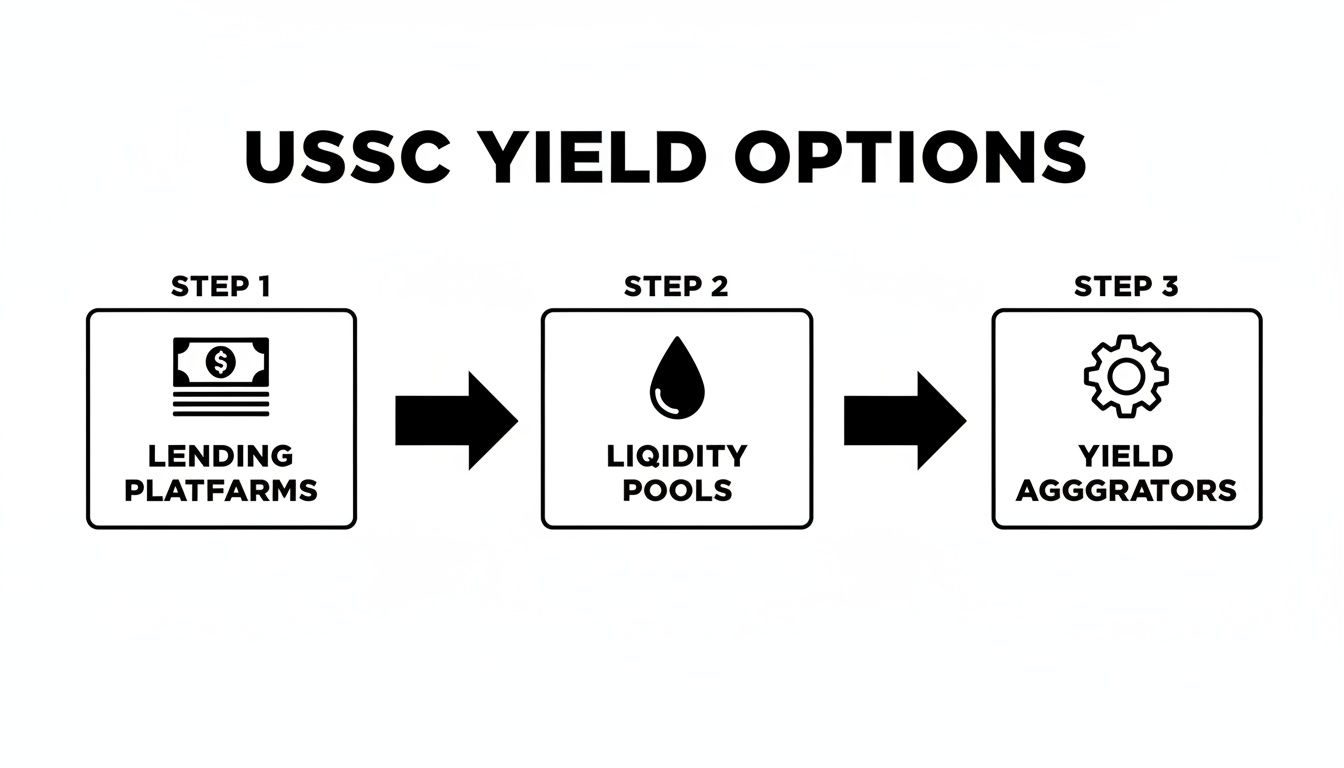
As you can see, your wallet is the starting point, from which you can lend your USDC out, add it to liquidity pools, or use an aggregator to automate the process.
Getting USDC onto the Right Network
With your wallet ready, it's time to get some USDC into it. The most straightforward way for most people is to buy it on a major exchange using your local currency.
Now, here’s where we get a bit more specific. The best yield opportunities these days are often on Layer 2 networks like Base. They're built on top of Ethereum but offer much faster transactions and way lower fees. To play in this arena, you need to "bridge" your USDC onto the Base network.
Bridging just means moving your funds from one blockchain to another. Thankfully, this has gotten a lot easier. Most major exchanges now let you withdraw your funds directly to Base, which saves a ton of hassle.
Here’s what that process usually looks like:
First, buy USDC on an exchange like Coinbase.
Find the "Withdraw" or "Send" option for your USDC balance.
Copy your wallet address from your MetaMask or Coinbase Wallet.
Paste that address into the "recipient" field on the exchange.
Crucially, select the Base network as the destination for your withdrawal.
I can't stress this enough: always double- and triple-check the wallet address and the network before you hit confirm. Sending crypto to the wrong address or on the wrong network is a painful, and often irreversible, mistake. Taking an extra five seconds to verify everything can save you a world of hurt.
Once the transaction goes through, the USDC will pop up in your wallet on the Base network, ready to be deployed into a yield strategy.
How to Start Earning Yield With an Automated Platform
Alright, you’ve got a funded wallet on the Base network. Now for the fun part: putting that capital to work. You could spend hours, even days, manually sifting through protocols, comparing rates, and getting lost in the weeds. Or, you can use an automated platform like Yield Seeker to make the whole process a breeze.
The idea here is to completely remove the guesswork and the need for constant monitoring that comes with chasing yield in DeFi.
First things first, you'll need to connect your wallet to the platform. This is standard practice across DeFi. Your wallet (like MetaMask) will pop up asking for permission to connect. Don't worry, this isn't giving the platform control over your funds; it's just letting it see your public address so it can display relevant info.
Once you're connected, you can deposit your USDC directly into the platform's smart contract. This is where the magic happens. Instead of you having to pick a specific strategy, an AI Agent takes the reins, scanning the DeFi landscape to sniff out the best risk-adjusted yield opportunities for you.
Putting Your Capital on Autopilot
The real power of this approach is automation. The platform’s tech is designed to constantly monitor a curated list of vetted protocols, shifting your USDC to wherever it can generate a competitive return. This saves you from the mind-numbing task of hunting for the best rates, which can literally change by the hour.
This entire process is built on the back of the massive liquidity and activity within the USDC ecosystem. The market for stablecoin yield has ballooned into a multi-trillion dollar opportunity, largely fueled by USDC's growth and its dominant 69% share of stablecoin volume. With a total value locked (TVL) in DeFi hitting $126 billion by October 2024, there's a deep and active market for lending and borrowing that makes these yields possible.
For most people, the biggest advantage is simply getting their time back. Instead of becoming a full-time DeFi analyst, you delegate the research and execution to a system built specifically for that job. Your role shifts from micromanaging positions to just monitoring your overall performance.
Tracking Your Earnings and Maintaining Control
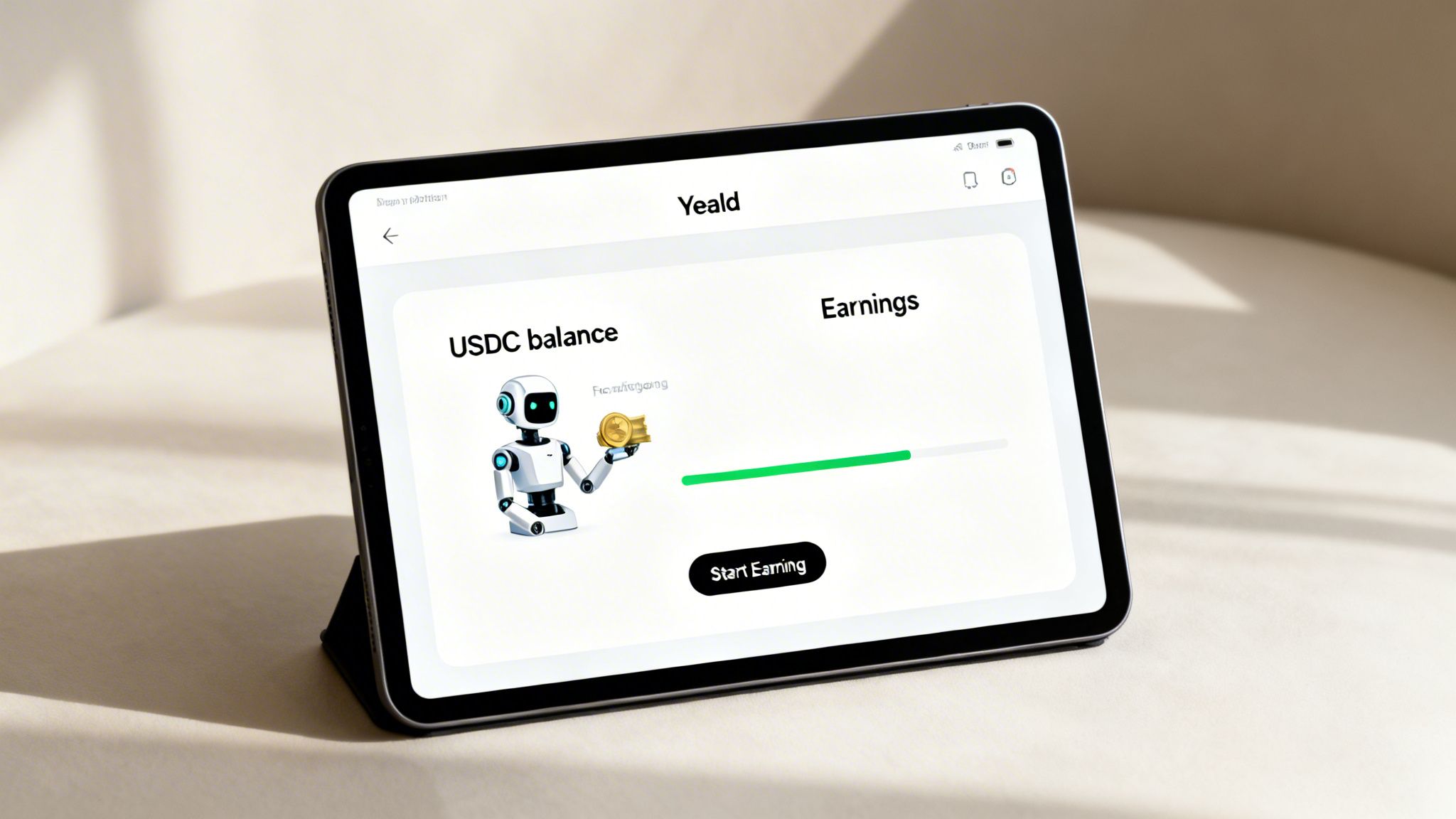
Any good platform will give you a clean, simple dashboard to track your progress. You should be able to see your total balance, the current APY, and how much you've earned in real-time. This kind of transparency is crucial for building trust.
This is exactly what you want to see—a clear view of your earnings as they accumulate.
The interface makes it easy to see your current USDC balance and the yield it's generated, so you can understand your portfolio's performance at a glance.
But perhaps the most critical feature is that you stay in control of your capital. Unlike strategies that force you to lock up funds for a set period, platforms like Yield Seeker offer complete liquidity. This means you can add more USDC or withdraw your entire balance whenever you want, without penalties or waiting periods.
This flexibility is a massive advantage. It lets you react to market changes or pull your funds for other opportunities as they pop up. You can learn more about how these systems work in our complete guide to automated investment platforms. This blend of automated efficiency and user control is a powerful way to earn yield on USDC without giving up your freedom.
Managing Your Risk and Keeping Your USDC Safe
Making a nice return on your USDC is a great feeling, but the real challenge—and the most important part—is actually keeping what you earn. In the world of DeFi, managing risk isn't just some boring footnote; it's the entire game. Your absolute number one priority has to be protecting your initial capital.
This all starts with a security-first mindset and a healthy dose of paranoia.
Your first and most important line of defense is always your own wallet. While software wallets like MetaMask are super convenient for day-to-day use, stepping up to a hardware wallet like a Ledger or Trezor adds a crucial layer of physical security. It keeps your private keys completely offline, which makes it practically impossible for a hacker to get to your funds from halfway across the world.
Beyond the hardware itself, you have to stay on top of your on-chain permissions. Every single time you interact with a new DeFi protocol, you're granting it permission to access your USDC. Over time, these approvals stack up and can create weak spots that a clever attacker might exploit. Get into the habit of using a tool like Revoke.cash to periodically review and cancel any old or unnecessary token approvals. It's a simple, five-minute task that makes a huge difference for your self-custodial security.
Vetting Protocols and Spreading Your Bets
Let's be clear: not all DeFi platforms are built the same. Before you even think about depositing a single dollar, you need to do your homework.
Look for protocols with a public track record, a vibrant community, and—most importantly—multiple security audits from well-known firms. Audits aren't a magical shield against all hacks, but they're a strong signal that the team actually takes security seriously.
Even with the most battle-tested protocols, you never want to put all your eggs in one basket. Diversifying your capital across multiple platforms is just common sense. It protects you if one protocol suffers from a bug or an exploit. Spreading your funds around means no single point of failure can wipe you out.
The core idea behind risk management in DeFi is to build multiple layers of defense. A hardware wallet protects your keys, revoking permissions limits your exposure, and diversifying across vetted protocols shields you from isolated failures.
This is actually one of the big advantages of using an automated platform like Yield Seeker. It's designed to handle a lot of this heavy lifting and due diligence for you. The AI Agent only allocates your funds to a curated and pre-vetted list of protocols, which is a powerful way to manage risk by sticking to a trusted corner of the DeFi ecosystem.
The sheer scale of the USDC market also contributes to its stability. When you see massive daily trading volumes, like the $20.47 billion worth of USDC recently traded on Kraken in just 24 hours, it creates deep liquidity. This level of activity helps underpin the yields you're earning and keeps the whole system stable.
For a much deeper dive into this topic, be sure to check out our full guide on the best practices for risk management in DeFi.
Common Questions About Earning USDC Yield
Once you’re ready to start earning yield on your USDC, a few practical questions always pop up. It's smart to get clear on the details—like fees, taxes, and risks—before you put any capital on the line. Let's tackle some of the most common ones I hear.
What Fees Should I Expect When Earning USDC Yield?
Fees are just part of the game on any blockchain, but they shouldn't be a surprise. You'll generally run into a couple of different types.
First up are network gas fees. Think of these as tiny tolls you pay to a network like Base for processing your transactions, whether you're depositing USDC or pulling it out. The great thing about Layer 2 networks is that these fees are incredibly cheap, often just a few pennies.
The other common fee is a performance fee, which some platforms charge on the yield you earn. This is usually a small slice of your profits, not your initial deposit, and it helps cover the platform's operational costs. Always poke around a platform's documentation to get the full picture of their fee structure before you commit.
How Is the Yield I Earn on USDC Taxed?
Crypto taxes are a tricky, ever-changing beast. Broadly speaking, the yield you make from your USDC is often treated as income, much like the interest you'd earn from a regular savings account.
But here's the catch: tax laws are wildly different depending on where you live, and the rules are constantly being updated. This is why I can't stress this enough: you absolutely have to chat with a qualified tax professional in your area. They're the only ones who can give you advice that's tailored to your situation and keep you on the right side of the law.
Is It Possible to Lose My USDC While Earning Yield?
Yes, it's possible, and you need to go in with your eyes wide open to the risks. While USDC is built to be stable, the DeFi protocols where you deploy it have their own set of dangers. The two big ones to watch out for are smart contract vulnerabilities and de-pegging events. A bug in a protocol's code could be exploited by a hacker, or some major market shock could cause USDC to briefly lose its tie to the dollar.
This is exactly why choosing the right protocols is so critical. Sticking with platforms that only use heavily audited, battle-tested protocols is one of the best ways to dial down these risks significantly.
A golden rule in DeFi is to never invest more than you can comfortably afford to lose. The yields can be tempting, but protecting your capital should always be job number one.
How Do Automated Platforms Choose Protocols?
Automated platforms aren't just throwing your funds at random opportunities. They have a strict, security-first checklist for vetting protocols before they even consider interacting with them. An AI-driven system, for instance, will dig into things like:
Security Audits: Has the protocol been picked apart by multiple reputable security firms?
Historical Performance: Does it have a long, stable history without any major incidents?
Liquidity: Is there enough cash flowing through the protocol to handle deposits and withdrawals smoothly?
This kind of tough screening process is designed to weed out the new, risky, and unproven protocols, creating a much safer playground for your USDC.
Ready to put your USDC to work without all the manual grind? Yield Seeker uses a smart AI Agent that automatically finds and manages the best yield opportunities for you on the Base network. It's time to start earning smarter, not harder.