
Are your stablecoins just gathering digital dust in your wallet? It's a question worth asking. In the wild world of decentralized finance (DeFi), letting your assets sit idle means you're leaving money on the table.
Putting Your Stablecoins to Work in 2026
If you're holding stablecoins like USDC, you’re actually sitting on a powerful tool for generating income. Because they’re pegged to a stable value, they're the perfect foundation for building a predictable yield strategy, unlike their more volatile crypto cousins. The whole game is about lending your assets to decentralized protocols where they fuel activities like trading and borrowing. In return, you get a cut of the action.
This guide is all about getting your stablecoins to work for you. We'll cut through the noise and focus on the reliable, cornerstone methods that are actually working in DeFi today. I'll show you how to spot the difference between those flashy, high-risk APYs that disappear overnight and sustainable "real yield" strategies that are built to last.
The Shift to Real Yield
One of the biggest changes I've seen in crypto is the move toward 'real yield.' This has been a huge step up in maturity for the space. In the old days, crazy high yields (think 100%+ APYs) were often just inflationary token rewards from a protocol's treasury. They looked great until the music stopped and they collapsed. The market shake-up post-2022 really exposed that model.
Now, the industry is focused on real, verifiable productivity. Today's best yields come from actual economic activity. DeFi lending, for example, has ballooned to over $40 billion in Total Value Locked (TVL). At the same time, fees from liquidity providers are generating over $10 billion every year. If you want to go deeper on this, you can explore the research behind sustainable crypto returns to see just how fundamental this shift has been.
The most reliable crypto yields are no longer about speculative token rewards. They come from real usage: fees from traders, interest from borrowers, and other verifiable on-chain activities. This is the new standard for sustainable passive income.
The chart below gives you a sense of scale, showing where billions of dollars are being put to work right now.
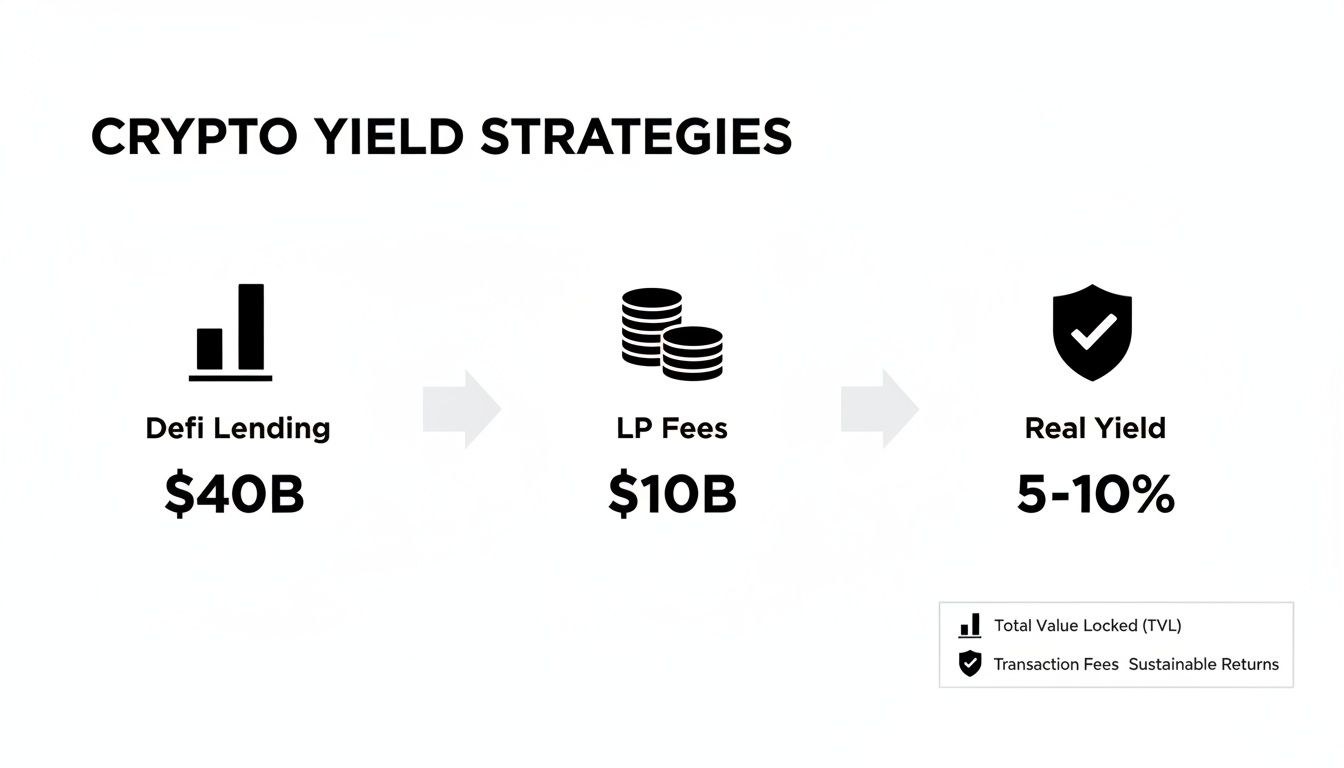
As you can see, DeFi lending is the clear heavyweight, with a market four times the size of liquidity provisioning.
To give you a clearer picture, here’s a quick breakdown of the most common strategies you'll encounter.
Common Crypto Yield Strategies at a Glance
Strategy | Typical APY Range (Stablecoins) | Risk Level | Best For |
|---|---|---|---|
Lending/Borrowing | 3% - 15% | Low to Medium | Beginners looking for simple, steady returns on platforms like Aave. |
Liquidity Provisioning | 5% - 25% | Medium | Users comfortable with impermanent loss who want to earn trading fees. |
Yield Vaults | 8% - 30%+ | Medium to High | Hands-off investors who want automated, optimized returns. |
Structured Products | Varies Widely | High | Experienced users willing to take on complexity for potentially higher returns. |
This table is just a starting point. APYs can swing based on market demand, but it gives you a good idea of the risk-reward trade-offs.
Making It Simple with AI
Trying to keep up with all these protocols, rates, and risks manually can feel like a full-time job. I've been there. This is exactly why AI-driven tools like Yield Seeker are such a game-changer. They automate the entire yield-hunting process, turning what was once hours of research into a completely hands-off experience.
Instead of juggling a dozen browser tabs and constantly moving your funds, you can just:
Deposit your stablecoins into a single, secure platform.
Let an AI agent analyze the market to find the best risk-adjusted returns.
Automatically earn yield as the AI moves your capital to vetted opportunities.
It's time to stop letting your digital dollars sit on the sidelines. Let's walk through the exact steps to get you started on earning yield the smart way.
Diving into the Main Stablecoin Yield Strategies
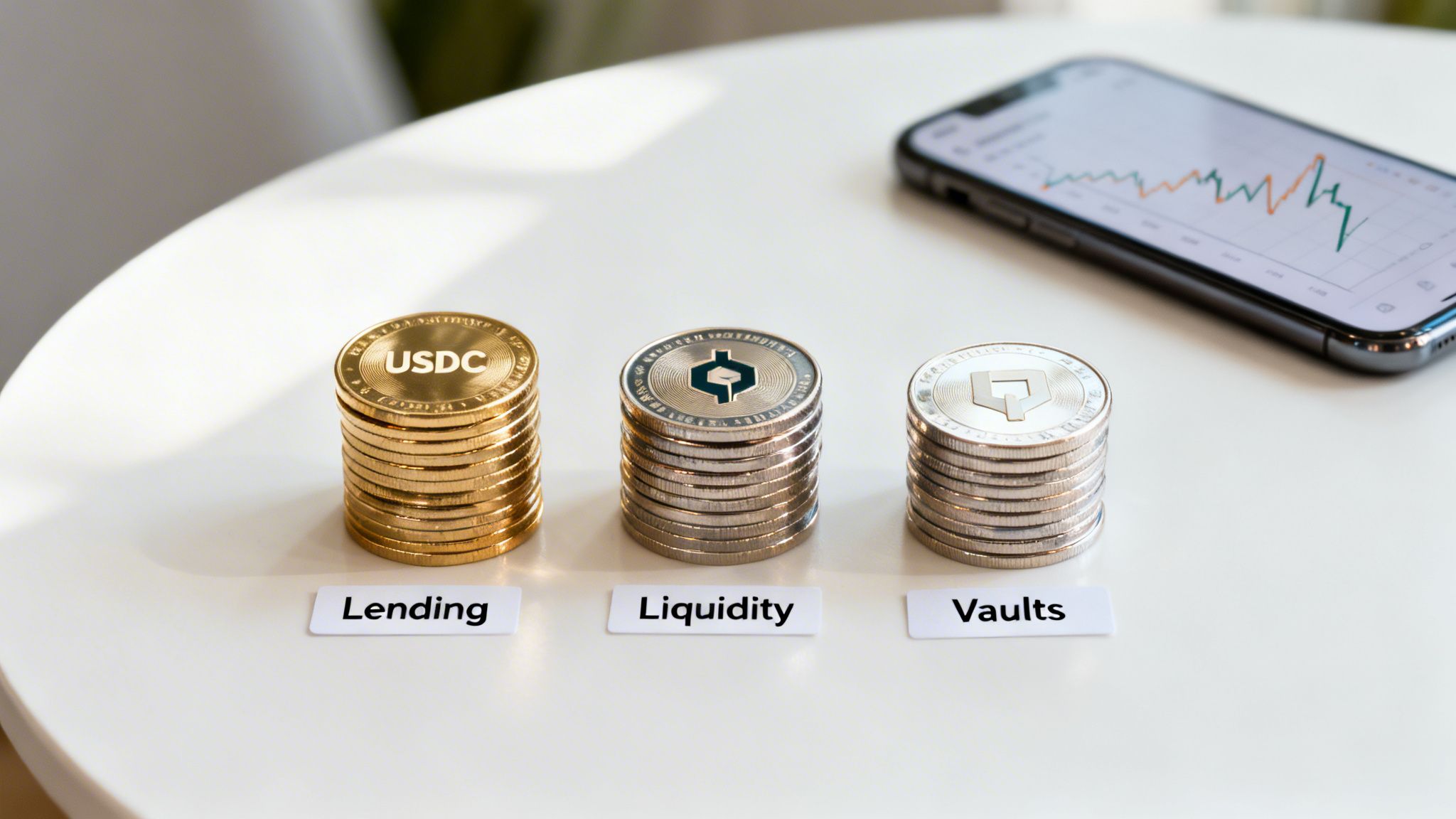
Before you can earn yield in crypto, you have to understand where it actually comes from. This isn't free money—it's your reward for providing capital that fuels the decentralized economy. I'm going to walk you through the core ways people generate yield on their stablecoins, starting with the simplest methods and working our way up.
Each one has its own unique mix of risk, reward, and hands-on effort. My goal is to give you a real feel for how they work so you can figure out what makes sense for you.
Lending & Borrowing: The Foundation of DeFi Yield
The most common starting point is simple lending. You can think of it as a crypto-native savings account. You take your stablecoins, like USDC, and deposit them into a big-name lending protocol like Aave or Compound. These platforms then lend your funds to borrowers who pay interest for the loan.
You get a slice of that interest, and that’s your yield. The rates aren't fixed; they move up and down with supply and demand. When lots of people are looking to borrow, the interest rates for lenders like you will climb. It's generally one of the lower-risk strategies because the top protocols require borrowers to put up collateral that’s worth more than the loan itself.
Your Role: You're the capital provider, basically acting like a small, decentralized bank.
How You Earn: You collect a variable interest rate paid by borrowers.
Primary Risk: The biggest worries are smart contract vulnerabilities (a bug in the protocol's code) and the financial stability of the protocol itself.
Lending is an excellent way to get your feet wet. If you want to go deeper on this, our complete guide to DeFi lending will give you a solid footing.
Liquidity Provisioning: Earning from Trading Fees
Another popular strategy is to become a liquidity provider (LP) for a decentralized exchange (DEX) like Uniswap. To make trading possible, a DEX needs deep pools of different assets. As an LP, you'd deposit a pair of tokens—say, USDC and ETH—into a specific trading pool.
When someone comes along and swaps between those two assets, they pay a small fee. As a liquidity provider, you get a share of those fees based on how much you contributed to the pool. This can definitely be more profitable than just lending, but it introduces a very specific risk called impermanent loss.
Impermanent loss is what happens when the price of one of the assets in your pair moves a lot relative to the other. The total value of your assets in the pool can end up being less than if you had just held them separately in your wallet. It's a fundamental concept you absolutely need to grasp before you jump into being an LP.
This approach is better suited for folks who are comfortable with a bit more risk and want to earn from the market's trading activity. The yields can be great, but they require you to keep a closer eye on things.
Yield Vaults: The Auto-Compounding Powerhouse
If all that sounds like a lot of work, that’s where yield vaults come in. These platforms, also known as aggregators, basically do the yield farming for you. The concept was really pioneered by protocols like Yearn Finance.
It's simple: you deposit your stablecoins into a vault, and its pre-programmed strategy gets to work. It might lend your funds on Aave, then take the interest it earns and use it to provide liquidity somewhere else, constantly compounding your returns automatically. This not only saves you a ton of time but also a lot in gas fees.
These vaults are a huge reason why stablecoin yields in DeFi have become so attractive for passive income. As the markets found their footing through 2025, many of these on-chain strategies settled into a healthy 7-12% APY range. That's a world away from the 0.35-1.06% you might see for TrueUSD (TUSD) on certain centralized exchanges. You can see the data for yourself in this great breakdown of the on-chain yield landscape to really understand the difference.
Structured Products: For the Advanced Crowd
Finally, we have structured products. These are much more complex instruments, really designed for experienced DeFi users who understand financial derivatives. They use tools like options and futures to create some pretty unique risk-and-reward scenarios.
A classic example is a "cash-covered put" strategy. You'd deposit USDC into a vault that then sells put options on an asset like ETH. You earn the option premium as your yield. If ETH’s price stays above the strike price, you just keep your USDC and the premium you earned. But if the price drops, your USDC could be used to buy ETH at that predetermined price.
While these strategies can offer some juicy returns, they require a solid understanding of how derivatives work and come with much higher risks. I definitely wouldn't recommend them for anyone just starting out.
Automating Your Yield Strategy With AI
Let's be honest: manually chasing the best yields across DeFi is a full-time job. Rates change in minutes, new protocols pop up daily, and figuring out the real risks is a nightmare. This is exactly where AI comes in, turning a high-effort grind into a source of passive income you can actually set and forget.
AI-powered platforms, like our own Yield Seeker, are built to handle this chaos for you. Think of it as your personal, automated investment analyst that works 24/7 to find the best spots for your money. Instead of you spending hours researching and moving funds around, the AI does all the heavy lifting.
Getting Started With an AI Yield Agent
The whole process is surprisingly simple, even if you're new to the DeFi world. It really just boils down to a single deposit.
For example, you could connect your wallet and deposit $100 in USDC on a low-cost network like Base. That's often the only manual step you'll ever need to take. The moment you do, your personalized AI agent wakes up and gets to work.
This is what your agent immediately starts doing:
Scans the Market: It’s constantly watching dozens of vetted DeFi protocols, tracking real-time annual percentage yields (APYs).
Analyzes Risk: It doesn't just blindly chase the highest number. The AI digs into the risks of each opportunity, sticking to audited, battle-tested platforms.
Deploys Your Capital: Based on its analysis, the AI automatically moves your capital to the strategy that offers the best risk-adjusted return at that very moment.
The beauty of this is the hands-off approach. Your funds are never locked, and you always have full control. The AI optimizes your position, but you can pull your capital out anytime without penalties.
The real magic is how dynamic it is. When market conditions shift and a better opportunity appears on another protocol, your AI agent can reallocate your funds to grab it. This ensures you're always positioned for the best possible returns without having to lift a finger.
What Does AI-Powered Yield Look Like?
Once your strategy is live, a good dashboard becomes your command center. It gives you a clean, real-time picture of how your portfolio is doing without burying you in complicated data.
Here’s a look at a typical AI yield dashboard from Yield Seeker.
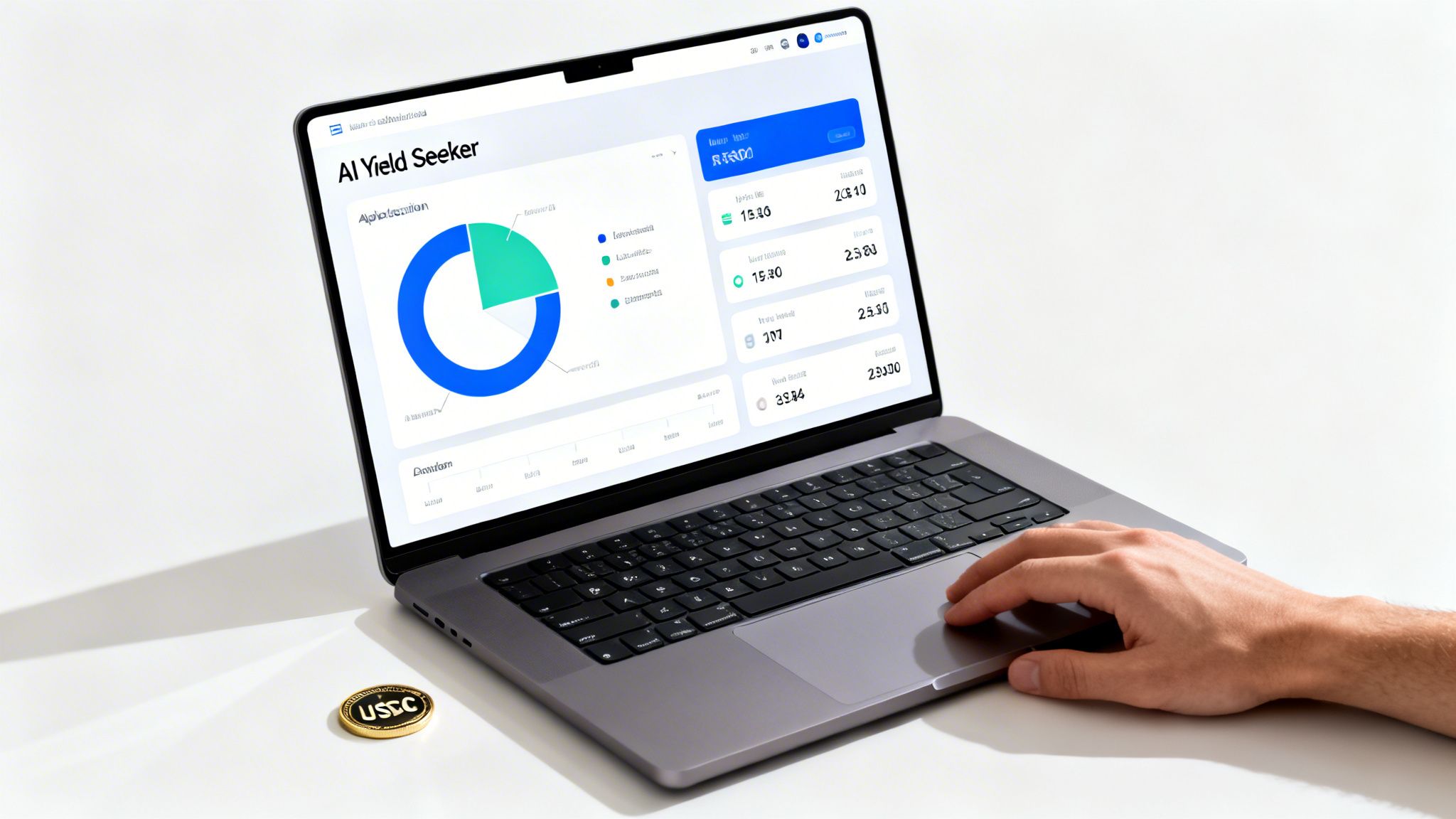
This interface instantly shows your total balance, your all-time earnings, and the current APY your agent is getting. No more connecting to five different websites just to see where your money is.
You can see exactly how your funds are being used. For instance, the dashboard might show that 70% of your USDC is currently earning 9.2% APY in a lending pool on Compound, while the other 30% is capturing 11.5% APY in a liquidity strategy on Aerodrome. This transparency is key to building trust and actually understanding how your yield is being generated. If you want a deeper look at applying AI to investing, check out our guide on how to use AI for investing.
The Autonomous Engine Behind the Scenes
This kind of automation is more than just moving funds. A proper AI yield agent can run a series of complex actions that would be a huge pain to do yourself. The engine is capable of things like "transaction batching," where it chains transactions together to maximize efficiency and save on gas fees. It also auto-compounds your earnings, putting your yield back to work to speed up growth.
When you think about the nuts and bolts of how an AI can manage these tasks, even understanding how an API for email unlocks autonomous workflows for AI agents shows how interconnected these autonomous systems can be for communication and control.
Let’s just compare the two approaches.
Manual Yield Farming:
Research: Spend hours trying to find and vet protocols.
Transact: Pay gas fees to deposit into Protocol A.
Monitor: Constantly check if there's a better yield somewhere else.
Rebalance: Pay more gas to withdraw from A and deposit into Protocol B.
Repeat: This cycle never ends and eats into your profits.
AI-Powered Yield Farming:
Deposit: Make one deposit to your AI agent.
Relax: The AI handles all the research, monitoring, and rebalancing for you.
The difference in time, effort, and cost is massive. By letting an AI handle the operational side of yield farming, you get to tap into one of the best parts of DeFi—earning yield on your crypto—without all the stress and complexity. It lets you focus on your bigger financial picture while your assets work for you around the clock.
Managing Risks and Protecting Your Crypto

Chasing those juicy high APYs is exciting, but let's be real: the number one rule in this game is protecting your capital. DeFi is an incredible space filled with opportunities, but it's also a wild frontier with very real risks. If you want to stick around and actually profit long-term, you absolutely have to develop a risk-aware mindset. It’s non-negotiable.
One of the scariest and most common threats is smart contract risk. Every single DeFi protocol runs on code. If that code has a bug or a vulnerability, hackers can and will exploit it. These aren't just isolated incidents, either. Back in 2022, exploits like these drained over $3 billion from the industry. That's a staggering number that should get your attention.
This is precisely why a protocol's security is everything. While tools like Yield Seeker do a lot of the heavy lifting by only using reputable, audited protocols, it’s still on you to understand the basics of what makes a platform safe.
Your Due Diligence Checklist
Before I even think about putting a single dollar into a new protocol, I run through a mental checklist. A few minutes of homework can literally save you from losing everything. It's time well spent.
Here’s a quick framework you can borrow for your own research:
Check for Audits: Has the protocol been audited by well-known security firms? I’m talking about names like CertiK, Trail of Bits, or OpenZeppelin. Don't just settle for one; multiple audits are always better.
Review the TVL and History: How much Total Value Locked (TVL) does the protocol hold, and how long has it been running without a major security breach? A long, clean track record speaks volumes.
Assess Community and Transparency: Is the team public (doxxed)? Do they have a lively Discord or Twitter where they openly talk about development, issues, and updates? A ghost town is a bad sign.
Look for Bug Bounties: Does the protocol run a bug bounty program on a platform like Immunefi? This shows they’re serious about security and are willing to pay white-hat hackers to find flaws before the bad guys do.
A protocol with no audits, an anonymous team, and a dead community is a massive red flag. No matter how high the promised yield is, just walk away. It’s almost never worth the risk.
Understanding Market and Custody Risks
Beyond the code itself, you have to watch out for market forces. Since we're focused on stablecoins, de-pegging risk is always in the back of my mind. This is when a stablecoin that’s supposed to be worth $1 suddenly isn’t. We’ve seen this happen even to some of the bigger players.
The best way to protect yourself is to stick with battle-tested, highly liquid stablecoins like USDC. They have a proven history of holding their peg, even when the market gets chaotic. We've actually written an entire guide on this, and you can get a much deeper understanding of the nuances of stablecoin risks here.
Then there’s custody. This is a big one. You should always use non-custodial tools where you, and only you, control your private keys. If a platform ever asks you to send your crypto to an address they manage, you're handing over ownership. That’s a "no" from me. With a non-custodial wallet paired with a platform like Yield Seeker, the funds stay in your wallet. The AI agent just gets permission to move them between vetted protocols for you.
And while we're on the topic of security, don't forget the bigger picture. Many of the platforms that make DeFi yield possible are built on cloud services. This means that understanding the broader security risks of cloud computing adds another valuable layer to your defense.
By staying diligent and putting security first, you can navigate DeFi with confidence and build a real, sustainable strategy for earning yield on your crypto.
Right, so you’ve deployed your capital and your crypto is officially out there earning yield. Job done? Not even close.
Getting your strategy set up is just the first step. The real art is in monitoring your performance and making sure those flashy APY numbers are actually translating into real, sustainable profit in your wallet. This is where you separate the dabblers from the serious long-term earners.
A good performance dashboard is more than just a number going up. It should show you the compounding effect in action—how your earnings are being reinvested to generate even more yield. Honestly, watching this happen in real-time is one of the most satisfying parts of DeFi.
But smart monitoring is also about knowing when to pivot. The crypto world moves at a breakneck pace; a killer opportunity last week might be just average today. While AI-driven tools are brilliant at automating these adjustments, it’s still smart to pop in and understand the "why" behind your returns.
Navigating the Hidden Costs of Crypto Yield
Earning yield in DeFi is rarely free. If you’re trying to manage everything yourself, you'll quickly run into a minefield of fees that can chip away at your profits. The biggest and most frustrating culprit? Gas fees.
Gas is the cost you pay to execute any transaction on a blockchain. Every single move—from depositing funds into a protocol to claiming your earnings—costs gas. On a busy network like Ethereum, these fees can sometimes be higher than the yield you’re trying to collect, especially if you're working with smaller amounts. It’s a high-friction environment that actively punishes hands-on management.
And it’s not just gas. Other costs can sneak up on you:
Withdrawal Penalties: Some protocols will hit you with a small fee or a lock-up period if you try to pull your funds out early.
Protocol Commissions: Most yield vaults and aggregators take a cut of the profits as a performance fee. It's how they make money for managing the strategy for you.
Swap Fees: When you’re moving between different assets to jump into a new strategy, you'll pay trading fees on decentralized exchanges along the way.
This constant nickel-and-diming is exactly why the manual approach can be so frustrating. You might find a great 12% APY opportunity, but after paying for a bunch of transactions to get in, claim, and get out, your actual return could easily be closer to 8%.
The Efficiency of an Automated Approach
This is where automated platforms like Yield Seeker have a massive advantage. When you use an AI agent, you get to sidestep many of these direct costs. Our platform, for instance, is built on a zero-withdrawal-fee model, which means you can get to your capital whenever you need it without getting penalized.
The AI also works its magic behind the scenes, often batching your transactions with others to slash the gas cost for each individual user. This kind of efficiency means more of your hard-earned yield stays in your pocket instead of going to network validators.
Key Takeaway: An automated yield tool isn't just about making your life easier; it's about being smarter with your money. By slashing transaction costs and getting rid of withdrawal fees, it boosts your net returns in a way that’s almost impossible to do on your own.
A Quick Word on Taxes and Crypto Earnings
Finally, you absolutely have to think about the tax implications of all this. While tax laws differ from country to country, a common rule is that crypto yield is treated as income. This means the value of the crypto you earned, at the moment you received it, is typically taxable.
So, if you earn $500 in USDC from a lending protocol over the year, that $500 would likely need to be reported as income on your tax return. Keeping detailed records of every transaction and all your earnings is non-negotiable if you want to stay compliant.
Because the rules are complex and always changing, this is one area where you should not go it alone. I strongly advise talking to a qualified tax professional who specializes in digital assets. They can give you advice tailored to your specific situation and make sure you’re meeting all your obligations without any nasty surprises come tax season.
Got questions? Good. When you're dealing with your own money, you should be asking a lot of them.
Whenever I talk about earning yield on autopilot, a few questions always pop up. Let's tackle them head-on.
How Much Can I Realistically Earn on Stablecoins?
Look, you’re going to see some protocols out there flashing insane triple-digit APYs. I've learned to just ignore them. Most are just temporary token rewards propping up a risky platform that could be gone next week.
A real, sustainable yield on stablecoins like USDC in 2026 will land somewhere in the 7-12% APY range. This is the "real yield" that comes from actual economic activity—lending fees, trading revenue, that sort of thing. It's the boring, consistent stuff that actually builds your stack over time.
This is exactly where a tool like Yield Seeker shines. It isn't chasing those crazy, unsustainable numbers. Instead, it’s designed to consistently find the best risk-adjusted opportunities at the higher end of that 7-12% sweet spot, moving your funds around intelligently as the market shifts.
A steady 9% from a solid, vetted protocol is infinitely better than chasing a 150% APY from some unaudited farm. Trust me on this one—consistency is the game.
Is It Safe to Use an AI Tool to Manage My Crypto?
This is probably the most important question, and the answer comes down to one word: non-custodial.
A proper AI yield tool never takes control of your funds. You—and only you—hold the private keys. The AI is just a smart router you give permission to move your capital between a list of pre-vetted, audited DeFi protocols. Your money is always in your wallet, not theirs.
Honestly, for a beginner, it can be even safer than going it alone. Manually exploring DeFi is a minefield of potential scams and high-risk contracts. It’s way too easy to click the wrong link and connect your wallet to something malicious. A good AI tool acts as a guardrail, keeping you within a safe, battle-tested ecosystem.
Here’s what you absolutely must look for:
Non-custodial design: Your keys, your crypto. Period.
Full transparency: You should be able to see exactly where your funds are and why.
Focus on audited protocols: The AI should only interact with platforms that have a proven security track record.
What Is the Minimum Investment to Start Earning Yield?
Just a few years ago, this was a real problem. Gas fees on Ethereum could eat up $50 or $100 in a single transaction, meaning you needed thousands of dollars just to make it worth your while.
Thankfully, those days are over.
With modern Layer 2 networks like Base, gas fees are pennies. This has completely changed the game. You can use an automated tool and get started with as little as $10 USDC. It makes earning yield accessible to pretty much anyone, letting you test the waters and scale up as you get more comfortable.
Do I Need to Be a Crypto Expert?
Not anymore. The whole point of these AI-powered platforms is to handle all the complicated stuff for you.
My old routine—manual yield farming—was a full-time job. It meant hours of research, constantly monitoring Discord and Twitter for new strategies, and trying to understand complex risks like impermanent loss. It was stressful and time-consuming.
Now, with a tool like Yield Seeker, your job is just to deposit the stablecoins. The AI takes over from there, doing all the research, risk analysis, and optimization 24/7. You get to tap into competitive crypto yields without needing to become a DeFi degen yourself.
Ready to stop letting your stablecoins just sit there? With Yield Seeker, you can put your crypto to work effortlessly. Let our AI find the best risk-adjusted yield opportunities for you. Start earning smarter today.