
You open your brokerage app and see a reassuring balance. Then you check an exchange, connect a wallet tracker, search a DeFi protocol for a stablecoin position, and discover that your spreadsheet hasn't recorded the transfer between them. The numbers don't agree, a reward token is missing, and tax season suddenly feels like an investigation.
That setup is common because tracking investments is no longer just checking an account balance. A useful system needs to follow traditional holdings, self-custody assets, stablecoin positions, fees, cash movements, benchmarks, and the decisions that caused money to move. It also needs to distinguish what a fund earned from what you personally earned after deposits, withdrawals, timing, gas, and protocol changes.
The practical answer is a repeatable workflow. Define the boundaries, record every movement, select the right return metric, reconcile the data, and use automation where manual monitoring becomes unreliable.
Why Tracking Your Investments Feels Overwhelming
Most fragmented tracking systems start innocently. Your brokerage has its own performance page, your exchange reports trades separately, your wallet contains assets that never appear in either account, and a spreadsheet fills the gaps. Each screen may be accurate within its own boundary, but none of them explains the complete portfolio.
The result is more than visual clutter. You can miss a stablecoin rotation because the wallet tracker shows a balance without comparing available yields. You can mistake a transfer for a sale, lose the original cost basis, or overlook a network fee. By the time you need a year-end report, you're reconstructing decisions from exports, wallet addresses, and partial memories.
Practical rule: Treat every transfer between accounts, chains, and protocols as an event that needs a record, not as administrative noise.
A balance is not a decision system
A dashboard can tell you what you hold today. It may not tell you when you entered, which cash flow funded the position, what you paid in fees, whether a reward token belongs to the strategy, or whether the position is producing the return you expected.
That distinction matters in traditional portfolios and becomes sharper in DeFi. A brokerage position can show shares and market value, while a stablecoin strategy may involve a deposit, a vault share, accrued yield, reward emissions, claim transactions, bridge activity, and gas. A single “USDC balance” can hide all of those components.
A 2021 academic study of retail investors found that investors who logged into their investment accounts more often performed better, while attention to analytical information was associated with worse performance. The study used the number of days investors logged in during 2017 as a proxy for investor attention, making account review a measurable part of the investment process (academic study on retail investor monitoring). The useful lesson isn't that checking more is always better. It's that the quality and purpose of review matter.
What a unified workflow should preserve
A coherent tracker should let you answer four questions without opening five unrelated apps:
What do I own? Include traditional securities, cash, crypto, stablecoins, wallet balances, and protocol positions.
How did it get there? Preserve deposits, purchases, transfers, swaps, withdrawals, rewards, and fees.
What did it earn for me? Calculate returns using my actual cash-flow timing, not only the asset or fund's published result.
What action should I consider? Compare allocation, benchmark performance, yield changes, risk signals, and portfolio goals.
That's the standard the rest of the workflow should meet. The point isn't to create a more elaborate spreadsheet. It's to build one source of truth that helps you review the portfolio without losing the details that explain its performance.
Define What You Are Tracking Before You Pick a Tool
The first tracking decision isn't which app to download. It's the boundary of the portfolio. If you don't define what belongs in the system, your return figures will change whenever you remember another account or wallet.
Start with a written inventory. Include fiat accounts that fund investments, brokerage and retirement accounts, exchanges, custodial wallets, self-custody wallets, hardware wallets, lending markets, liquidity pools, vaults, staking positions, and any private or restricted assets you want represented. If an account can send money into the portfolio or receive money from it, decide whether it belongs inside the tracking boundary.

Set the four boundaries
Accounts come first. Write down the institution, account type, base currency, and data source. For a wallet, record the address and network. For a DeFi position, record the protocol, pool or vault, and the wallet that controls it.
Asset classes come next. Separate equities, funds, bonds, cash, commodities, cryptoassets, stablecoins, staking rewards, protocol receipts, and collectibles rather than grouping everything under “investments.” This makes allocation analysis more useful and prevents a stablecoin lending position from appearing equivalent to unproductive cash.
Choose the benchmark before reviewing results. The CFA Institute's portfolio performance guidance says a benchmark should be chosen in advance, unambiguous, investable, measurable, appropriate, and accountable (CFA Institute portfolio performance evaluation guidance). A broad equity fund needs a relevant equity benchmark. A cash-like stablecoin strategy needs a comparison that reflects its objective and risk, not an unrelated stock index.
Fix the time horizon. Track since inception for the complete investor story, then add monthly, quarterly, and annual views for diagnosis. A short window can show a tactical outcome. A longer window reveals whether the allocation and behavior fit the goal.
Decide how currencies and networks will appear
Pick a reporting currency, but preserve each transaction's original currency and exchange rate. A multi-currency portfolio can gain value from both the asset and currency movement, so a single converted balance isn't enough to explain performance. Store the original amount, converted value, conversion date, and rate source where possible.
Do the same for networks. Ethereum, Base, Arbitrum, Solana, and other chains should remain distinct in the raw data even if the dashboard consolidates them. Network identity is essential for finding missing transactions, calculating gas, and separating a bridge from a trade.
Finally, decide whether you'll show nominal results only or also compare them with inflation and your actual goal. The answer depends on the decision you're making, but the choice must remain consistent. A tracker that changes its scope, currency, benchmark, or horizon mid-review can produce precise numbers that answer no stable question.
Choose the Right Return Metric for Each Decision
A return metric answers a specific question. Choose it based on whether you are reviewing one position, comparing a strategy, measuring growth over time, or assessing how your own cash-flow timing affected the result.
For a single purchase, ROI measures gain or loss against the amount invested. It fits a stock, ETF, token, or stablecoin deployment with straightforward cash flows. For growth across multiple periods, CAGR expresses the smoothed annualized growth rate, which helps compare investments held for different lengths of time.
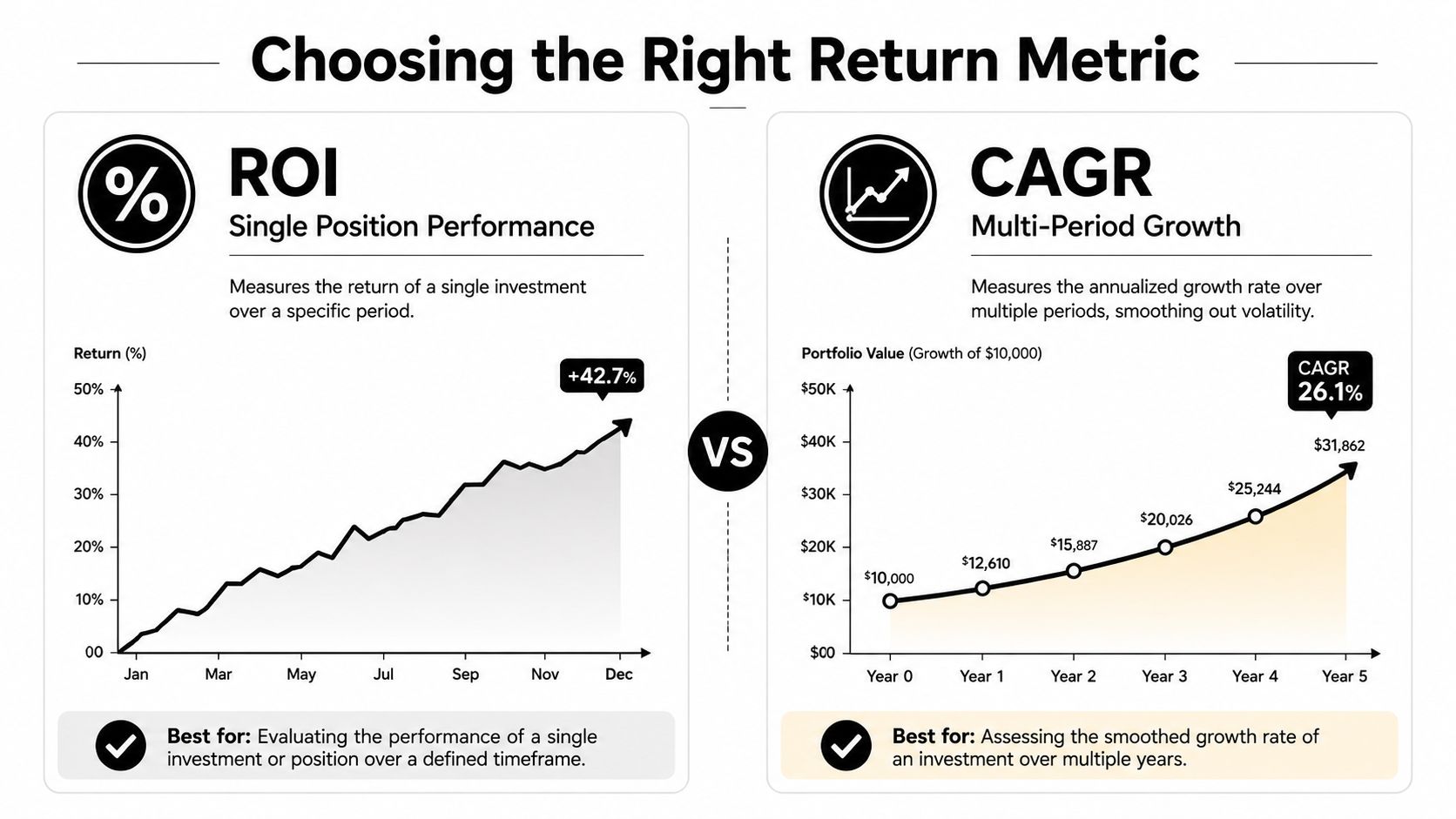
Match the metric to the question
Use time-weighted return, or TWR, to evaluate the portfolio or manager without allowing your deposits and withdrawals to distort the result. TWR divides the measurement period around external cash flows and compounds the linked sub-period returns. That makes it useful for comparing a fund or strategy with an appropriate benchmark.
Use money-weighted return, or MWR, also called IRR, when the timing and size of your cash flows belong in the result. MWR includes deposits, withdrawals, and their dates, so it often gives the clearest view of what your capital experienced. The formulas and use cases are outlined in this explanation of investment return methods.
Consider dollar-cost averaging into an index fund. The fund may report a strong period return, while your personal result differs because each contribution entered at a different price. The same gap appears when stablecoins move between lending markets and vaults. A protocol's displayed APY describes a stated rate, but realized performance depends on deployment days, capital moved, reward tokens received, fees, and the timing of each rotation.
Morningstar's analysis, cited in a portfolio-tracking review, found that over the past 10 years, the average dollar invested in U.S. mutual funds and ETFs earned 1.2% less per year than the funds themselves returned (Morningstar-based investor return discussion). The difference shows why a personal tracker must record behavior and cash flows instead of copying headline fund performance.
Keep comparison metrics separate
A tracking system can calculate TWR and IRR from the same transaction history, but those outputs should not be merged into one score. Keep the portfolio's market performance separate from the investor's funding decisions, then review both against a relevant benchmark, inflation, and the investment goal.
For strategy evaluation, use TWR so deposit timing does not obscure the strategy's result. For personal decisions, calculate MWR or IRR to show what your actual capital experienced. Apply ROI to a discrete position and CAGR to multi-period growth when their assumptions fit the data.
The same discipline applies across brokerage and DeFi records. A dashboard may show a stablecoin balance and a protocol APY, yet omit idle periods, bridge transfers, reward claims, fees, or redeployments. Preserve those events and report the metric that matches the decision. No single return figure can explain both strategy execution and investor behavior.
Build a Tracking Template That Actually Scales
A scalable tracker separates positions from events. The holdings view tells you what exists now. The transaction ledger explains how it arrived, changed, and left. Mixing both into one row per asset works only until you add partial sales, transfers, rewards, reinvested dividends, or a stablecoin position that changes protocol.
Use five data blocks:
Holdings: Current asset, quantity, price, value, currency, and allocation.
Cash flows: Deposits, withdrawals, contributions, distributions, and transfers.
Transactions: Buys, sells, swaps, claims, staking actions, bridges, and protocol deposits.
Fees: Trading fees, management fees, withdrawal charges, gas, and other costs.
Benchmark and metadata: Benchmark price or return, account, venue, chain, protocol, tax tags, and notes.
The columns that keep earning their place
For every event, capture the date and time, asset, quantity, transaction type, price, cost basis, venue, account, chain, protocol, fee asset, fee amount, and transaction identifier. Add the source file or wallet address so you can trace a row back to evidence.
For DeFi stablecoin positions, add underlying protocol, network, pool or vault, APY at entry, reward token, reward quantity, reward status, and exit date. A generic portfolio app may show that your wallet contains a stablecoin, but it may not preserve whether the token is idle, deposited, represented by a receipt token, or earning a separate reward. Points and airdrop eligibility should have notes even when they don't yet have a realizable market value.
Block | Column | Purpose | Traditional | DeFi/Stablecoin |
|---|---|---|---|---|
Holdings | Asset and quantity | Identifies the current position | Ticker and shares | Token and token balance |
Cash flows | Date and amount | Connects performance to investor timing | Contribution or withdrawal | Deposit, withdrawal, or bridge |
Transactions | Type and venue | Explains how the position changed | Buy, sell, dividend | Swap, vault deposit, claim, or migration |
Fees | Amount and asset | Prevents costs from disappearing | Commission or fund fee | Gas, protocol fee, or withdrawal fee |
Benchmark | Benchmark and period | Supports fair comparison | Relevant index or fund | Cash or yield reference |
Metadata | Account, chain, protocol | Enables reconciliation and filtering | Broker and account | Wallet, network, and protocol |
Rewards | Token and status | Records non-price sources of return | Dividend and reinvestment | Yield token, points, or airdrop |
Calculate current value as quantity multiplied by the selected price, then calculate allocation as position value divided by total portfolio value. Keep realized gains tied to disposed lots and unrealized gains tied to open lots. Don't overwrite historical cost basis when a position moves between wallets.
Tax treatment varies by jurisdiction and transaction type, so use a specialist reference when designing tags. The EndureGo Tax cryptocurrency advice is a useful starting point for thinking about records, taxable events, and the need to preserve transaction evidence. Your tracker should support professional review, not pretend to replace it.
Compare the Main Categories of Tracking Tools
Tool choice depends on the decisions your records must support. Consider the number of institutions and chains involved, the quality of records required for review, and how much manual correction you can maintain without losing the link between fund-level performance and your own cash-flow timing.

Tool category | Strongest use | Main limitation | Best fit |
|---|---|---|---|
Spreadsheet and broker apps | Custom records and familiar account views | Manual imports, fragile formulas, limited on-chain interpretation | Investors with simple portfolios |
Multi-chain aggregators | Wallet balances and broad network visibility | Protocol labels, cost basis, and tax classifications can require corrections | Crypto users with several wallets |
Portfolio software | Transactions, performance, dividends, fees, and benchmarks | Setup effort and subscription or integration trade-offs | Investors needing a durable record |
AI-automated monitoring | Alerts, allocation signals, and recurring comparisons | Recommendations still need risk review and source validation | Users managing changing DeFi positions |
What each category gets right
Spreadsheets and broker-linked apps offer transparency and flexibility. You control the columns, inspect every formula, and import broker statements. The model becomes harder to maintain after adding token migrations, several wallets, on-chain activity, or frequent stablecoin transfers. Copying data by hand also creates a weak control point. One missed row can distort later calculations and make investor-level returns look better or worse than the underlying fund result.
Multi-chain aggregators make it easier to inspect public wallet activity across networks and confirm current balances. They help when you no longer remember which address holds an asset. Their limitation is interpretation. A bridge, liquidity position, vault receipt, reward claim, and ordinary transfer may appear similar without protocol-aware classification. Stablecoin monitoring also needs more than a balance view. Yield, utilization, depeg risk, and reward composition can change while the displayed dollar value stays flat.
Portfolio software generally provides the clearest historical model. It can organize transaction history, realized and unrealized gains, dividends, fees, IRR, TWR, and benchmark comparisons. The feature set described in the investment tracking platform overview shows why this category suits investors who need records that remain useful during review. Setup takes time, but consistent cost basis and cash-flow treatment make the resulting audit trail more dependable.
A practical DeFi workflow often needs a separate monitoring layer. The DeFi portfolio tracking discussion addresses the gap between seeing a stablecoin balance and assessing whether its yield remains appropriate for its risks. That distinction matters because investor returns depend on deposit and withdrawal timing, not only on the strategy's quoted performance.
Don't choose by feature count alone
Check integrations, export quality, correction tools, benchmark support, currency handling, and tax fields. A comparison should test the criteria behind each feature, not reward the longest list. The Wine Labs pricing comparison offers a useful example of evaluating options by underlying criteria rather than headline coverage.
A durable setup often combines categories. Use an aggregator or API connection for discovery, a structured ledger as the source of truth, and automation for alerts and recurring checks. Review how each tool handles deposits, withdrawals, rewards, and transfers before trusting its performance figures. No dashboard should be assumed to classify every transaction correctly.
Set Up Alerts, Reconciliation, and Tax-Ready Reports
A tracker becomes useful only when it changes what you do. Set alerts around decisions you'd make, not every market movement. Useful triggers include a price move that changes your allocation, a stablecoin depeg signal, a material APY drop, a reward rate change, a position drifting outside its intended range, or a failed wallet synchronization.
Record the condition behind each alert. “APY changed” is weak. “Review the position if the quoted rate falls below the strategy's acceptable threshold or if the protocol's risk assumptions change” gives you a decision rule. Never treat APY as guaranteed income. Rates can move, rewards can dilute, and smart-contract or liquidity risks can change independently of the displayed yield.
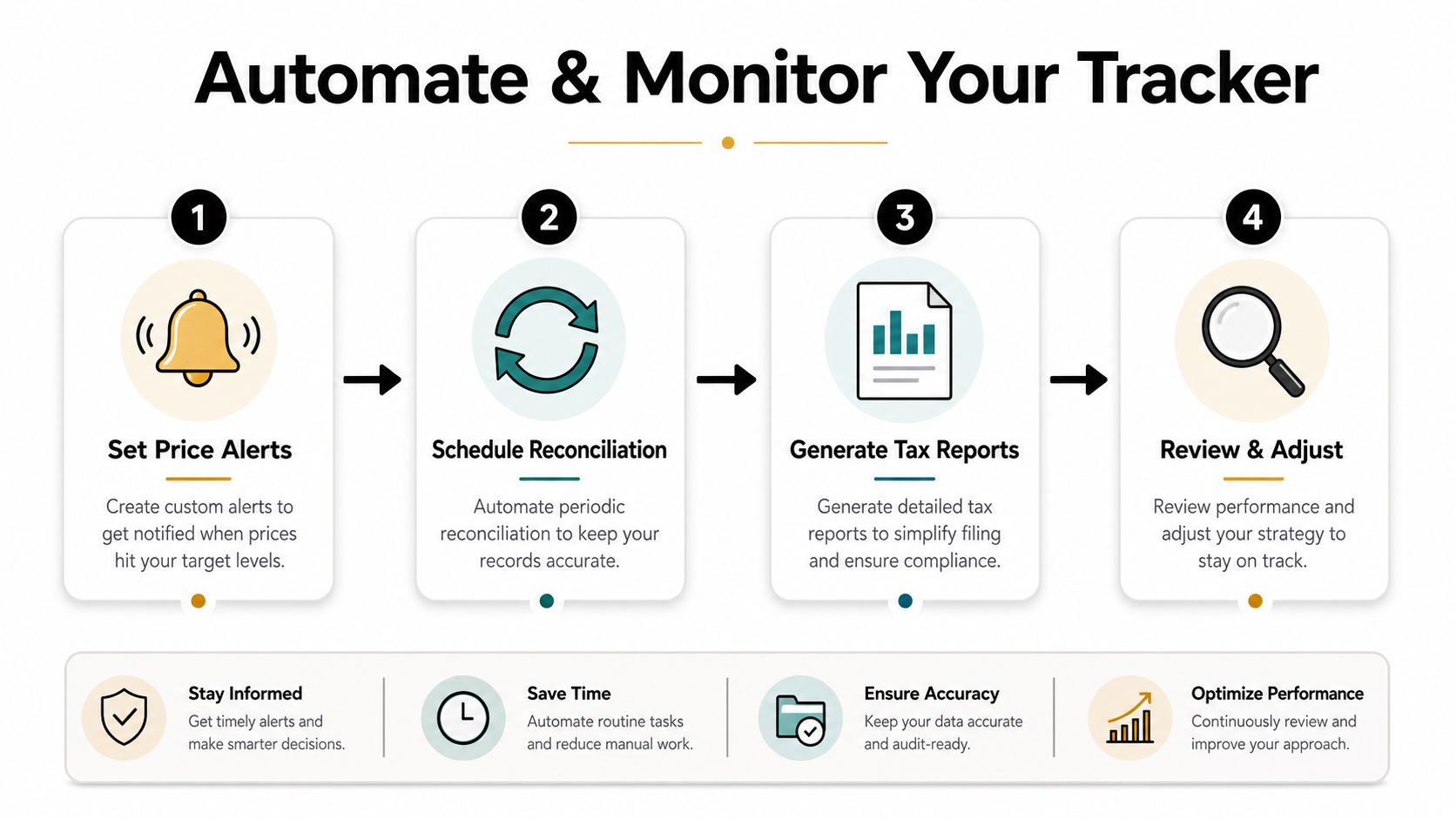
Use a reconciliation cadence
A simple cadence catches more errors than occasional heroic cleanup.
Daily check: Review alerts, unexpected transfers, failed transactions, depeg signals, and material yield changes. This should be a quick exception review, not compulsive price watching.
Weekly reconciliation: Match broker statements, exchange exports, wallet activity, protocol balances, reward claims, and gas records against the ledger. Investigate missing rows immediately while the transaction context is still clear.
Monthly close: Confirm positions, prices, currencies, cash flows, fees, and benchmark values. Lock the period after correcting duplicates and classification errors.
Quarterly review: Compare MWR or IRR with the selected benchmark and goal, inspect allocation drift, and decide whether a position still belongs in the portfolio.
Make the records tax-ready
Tax preparation starts with data hygiene. Tag each lot and preserve acquisition dates, disposal dates, cost basis, proceeds, income-like rewards, dividends, staking distributions, swaps, and fees. Capture gas in the original network asset and retain transaction hashes or statement references.
Stablecoin portfolios need extra care because a tracker may classify a deposit, withdrawal, reward claim, and swap differently. Keep reward tokens separate from principal, record whether rewards were claimed or merely displayed, and add notes for points or airdrop activity that has no clear realized value. Don't delete a position because a protocol migrated its token. Record the migration as an event and retain the original relationship.
For jurisdiction-specific crypto reporting considerations, consult this guide to crypto tax reporting requirements. A savings and personal-finance perspective can also complement an investment ledger, such as the practical material in the Compass+ savings blog. Neither replaces advice from a qualified tax professional who understands your residence and transaction history.
Audit habit: Export raw statements and wallet data before editing classifications. Keep the original files, the corrected ledger, and the reason for each manual adjustment.
Putting It All Together and How Yield Seeker Fits In
A durable system has a clear order:
Define scope: List accounts, asset classes, wallets, networks, currencies, benchmarks, and horizons.
Capture events: Record deposits, purchases, swaps, transfers, rewards, fees, and withdrawals.
Choose metrics: Use ROI for a simple position, CAGR for multi-period growth, TWR for strategy comparison, and MWR or IRR for personal cash-flow performance.
Reconcile: Match the ledger with statements and on-chain activity before trusting the dashboard.
Monitor exceptions: Alert on allocation drift, yield changes, depeg signals, missing data, and protocol events.
Review decisions: Compare results with the benchmark, inflation, and the goal, then document what changed.
The common failures are predictable. Investors track balances without transaction history, ignore gas and fees, compare personal MWR with a fund's TWR, and treat APY as a promise. Others build a detailed spreadsheet but never reconcile it, so the system becomes an attractive record of stale assumptions.
For stablecoin holders, Yield Seeker can serve as an automated monitoring and allocation layer. It uses an AI Agent to monitor and allocate stablecoin capital across DeFi protocols in real time, while its dashboard shows balances, earnings, protocol locations, and an audit trail of agent activity. Users can start with $10 USDC on Base, with no lockups or withdrawal fees, according to the product information provided by Yield Seeker. That doesn't remove the need to understand risk or review records. It reduces the manual burden of checking fragmented opportunities while keeping the activity visible.
Save this checklist and use it during your next portfolio review:
Every account and wallet is included.
Every transfer has a source and destination.
Fees and gas are recorded separately.
Rewards have their own asset and status fields.
The benchmark was selected before evaluation.
Personal cash flows are measured with MWR or IRR.
Yield changes and depeg conditions trigger review.
Raw exports are preserved for reconciliation and tax work.
Automation is becoming more useful as portfolios cross brokers, exchanges, wallets, and protocols. The best workflow won't be the one with the most charts. It'll be the one that preserves the evidence behind every number and helps you act when the numbers change.
If fragmented stablecoin dashboards are slowing down your reviews, visit Yield Seeker to monitor earnings and protocol activity in one interface. You can explore an AI-managed stablecoin workflow with a $10 USDC starting deposit on Base, no lockups, and no withdrawal fees, then use its activity record as part of a more complete investment-tracking system.