

Think of your crypto assets like cash sitting under your mattress. It's safe, but it's not doing anything for you. Yield farming is the art of putting that crypto to work in the world of decentralized finance (DeFi) to earn more crypto—sort of like a high-interest savings account, but on a whole new level.
You simply deposit your crypto into a DeFi protocol, and in return, the protocol rewards you with fees, interest, or even brand-new tokens.
Decoding How Yield Farming Works
At its heart, yield farming is all about making your cryptocurrency productive. Instead of just letting digital assets like USDC or ETH sit idle in a wallet, you can lock them into a smart contract on a DeFi platform. These locked funds provide the essential liquidity that powers the entire DeFi ecosystem, allowing other users to trade, borrow, or lend assets.
It’s like being a supplier for a bustling digital marketplace. The marketplace needs a constant stock of goods (crypto) to function, and yield farmers are the ones who stock the shelves. For providing this vital service, the protocol pays you. This payment, or "yield," comes from a few places:
Trading Fees: A small cut from every trade that happens in a liquidity pool you've contributed to.
Interest: Earned when you lend your assets to others who pay a fee to borrow them.
Token Rewards: Many platforms sweeten the deal by giving out their own native tokens to attract users and build their community.
This simple idea has sparked some serious growth. The DeFi yield farming market, valued at a respectable $79.4 million in 2024, is expected to more than double to $154 million by 2031. It’s a key driver behind the massive influx of capital into DeFi, which saw the total value locked (TVL) shoot past $90 billion in 2024.
To help you get a clear picture of who does what, here's a quick breakdown of the key players and ideas in the yield farming world.
Key Roles and Concepts in Yield Farming
This table breaks down the essential roles and concepts in yield farming for quick reader comprehension.
Component | Role or Purpose | Analogy |
|---|---|---|
Yield Farmer | An individual who provides crypto assets to a DeFi protocol to earn rewards. | An investor putting money into a high-yield savings account or a business. |
DeFi Protocol | The platform (e.g., a decentralized exchange or lending market) that uses the crypto. | The bank or marketplace that needs capital to operate its business. |
Liquidity | The crypto assets supplied by yield farmers that enable the protocol to function. | The "inventory on the shelves" or the "cash in the bank's vault." |
Yield | The rewards (fees, interest, new tokens) paid to the yield farmer. | The "interest payments" or "dividends" earned on an investment. |
Each part plays a crucial role in making the whole system work, turning static assets into active, income-generating tools.
The Role of Liquidity Pools
A core piece of the yield farming puzzle is the liquidity pool. You can think of it as a big, shared pot of money where users deposit pairs of assets, like ETH and USDC. These pools are the lifeblood of decentralized exchanges (DEXs), letting people trade instantly without needing a traditional buyer-seller order book.
When you add your crypto to one of these, you become a liquidity provider (LP). Our guide on what are liquidity pools breaks this down in much more detail.
By providing liquidity, you are essentially becoming a micro-bank or a market maker for the decentralized world, earning a slice of the financial activity you help make possible.
Of course, to really get your head around yield farming, you first need a solid handle on the assets you're putting to work. Understanding the basics of What Is Cryptocurrency is the foundation for everything else in DeFi. It's this knowledge that helps you see how you can transform simple asset ownership into an active way to generate income.
The Four Core Strategies for Earning Yield
So, you get the basic idea of yield farming. But to actually make it work, you need to understand the how. What are the actual strategies farmers use to generate those juicy returns?
These methods are the real engines of the DeFi economy, and each one comes with its own set of rules, risks, and rewards. Once you get a handle on these four core approaches, you can start putting your crypto to work.
The fundamental process is simple enough: you deposit your assets into a DeFi protocol and get paid for your contribution.
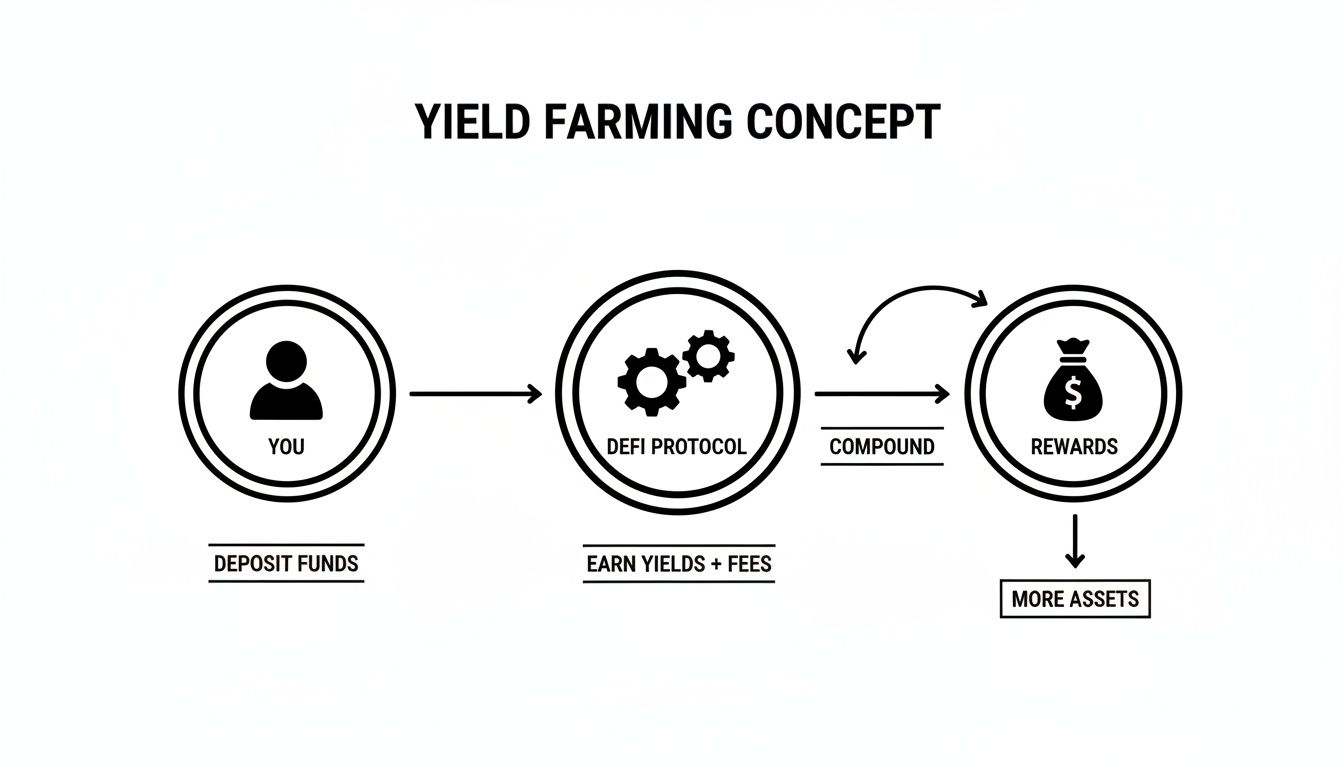
This diagram breaks it down nicely. It shows how you, the user, interact with a DeFi protocol to earn and then compound your rewards. It’s a powerful cycle that underpins all the strategies we’re about to explore.
1. Liquidity Providing
The most common way to get started in yield farming is by becoming a liquidity provider.
Think of it like being a co-owner of a currency exchange booth at an international airport. You stock it with both US dollars and Euros so travelers can swap between them. For every single trade, you pocket a small fee.
In DeFi, you do the same thing by providing a pair of crypto assets (like ETH and USDC) to a liquidity pool on a decentralized exchange (DEX). For supplying this liquidity, you earn a cut of the trading fees every time someone uses that pool to swap tokens. It’s the bread and butter of yield farming.
2. Lending and Borrowing
Another cornerstone strategy is lending. This feels a lot like a high-yield savings account at a bank, but with a decentralized spin that puts you in control. You deposit your crypto into a lending protocol, which then allows other users to borrow those funds.
In return for lending out your capital, you earn interest. These interest rates are usually variable, moving up and down based on the supply and demand for that specific asset within the protocol. This is an especially popular strategy for people holding stablecoins, as it can generate solid yield with much lower volatility than other crypto assets.
By acting as a lender in DeFi, you essentially become the bank. You provide the capital that fuels the borrowing market and get paid directly for it—without a traditional middleman taking a huge slice of the pie.
3. Staking
Staking is all about locking up specific tokens to help secure and run a blockchain network. You can compare it to buying a government bond—you commit your capital for a certain period to support the system’s health and stability, and in return, you’re paid a reward, often in the form of more tokens.
There are a couple of main ways to stake:
Proof-of-Stake (PoS) Staking: This involves directly supporting a blockchain’s security, like staking ETH on Ethereum to help validate transactions.
Protocol Staking: This is where you lock up a platform’s native token to gain governance rights (a say in its future) or a share of the protocol's revenue.
4. Yield Aggregators and Auto-Compounding
Finally, we have yield aggregators, also known as auto-farmers. Think of these platforms as your personal, hyper-efficient financial advisor for crypto.
Instead of you having to manually move funds between different protocols to chase the best returns (a process called "crop rotation"), these platforms do it all for you automatically. They deploy complex strategies to sniff out the highest yields and will auto-compound your earnings by reinvesting them to maximize your returns.
This approach has become much more accessible. Between 2025 and 2026, yield farming took a massive leap forward thanks to Layer-2 solutions and AI-powered aggregators. These innovations slashed the high gas fees that used to eat up a huge chunk of profits on networks like Ethereum.
As the tech matured, platforms like Uniswap V3 introduced mechanics for more efficient fee capture, while aggregators like Beefy began connecting dozens of protocols to automatically find the best yields. You can discover more insights about the evolution of yield farming strategies on bitcoinethxrp.com.
Understanding the Metrics That Drive Your Returns
When you first dive into yield farming, you’re immediately hit with flashy percentages promising massive returns. But not all these numbers tell the same story, and figuring them out is essential to understanding how yield farming actually works for your wallet. To make smart moves, you need to see past the big headline numbers and get what's really driving your potential earnings.
First things first, let's clear up two of the most common metrics you'll see: Annual Percentage Rate (APR) and Annual Percentage Yield (APY). Think of APR as simple interest—it's the flat return you get on your initial deposit over a year, without any compounding effects. It's a clean, straightforward number.
APY, on the other hand, is where the magic of compounding comes into play. It shows you the return you’d earn if your profits were constantly put back to work, generating even more profits on top of your original investment. Since many protocols automatically re-invest your rewards for you, APY often gives a much more realistic picture of your long-term growth. If you want to go deeper, check out our guide on what APY means in the world of crypto.
Dissecting Your Yield Sources
Your total yield isn't just one number; it's usually a cocktail of different income streams. When you're providing liquidity, your returns typically break down into two main parts:
Trading Fees: This is your slice of the fees charged for every single swap made in the pool. It’s the base layer of your earnings.
Token Incentives: These are bonus rewards, often paid in the protocol's own native token, designed to attract more liquidity. These incentives are usually what create those eye-popping initial APYs.
These bonus tokens were the star of the show during the famous 'DeFi Summer' of 2020. For example, Curve's CRV token launched with APYs hitting 300-500%, and at one point, it even spiked over 2,500%. The market has cooled down since then, but there are still plenty of solid opportunities. Uniswap, with its $5.15B in liquidity, still offers sustainable 5-20% APYs on many popular pairs. You can read more about these historic and current yield farming benchmarks on coinspeaker.com.
Gauging Protocol Health with TVL
Another metric you absolutely must watch is Total Value Locked (TVL). This number tells you the total dollar amount of all assets users have deposited into a DeFi protocol.
Think of TVL as a protocol’s health and trust signal. A high TVL often means lots of users are confident in the platform's security and stability—just like a bank with huge customer deposits is seen as more reliable. A TVL that's climbing fast can be a sign of growing momentum, while a sudden drop might be a red flag telling you to dig a little deeper.
Navigating the Four Biggest Risks in Yield Farming

While those juicy double-digit APYs are what draw everyone to yield farming, they don't come for free. It’s a classic rule of investing: high rewards always come with high risks. In the wild, fast-moving world of DeFi, ignoring these dangers can wipe out your stack in the blink of an eye.
Success isn't just about chasing the highest numbers. It’s about knowing what can go wrong and having a plan. So, before you deposit a single dollar, let's break down the four biggest risks you absolutely need to understand.
Impermanent Loss
Impermanent Loss (IL) is a strange and often misunderstood beast unique to liquidity providing. It's a risk you take on any time you deposit a pair of assets into a liquidity pool.
Imagine you put an equal value of ETH and USDC into a pool. The protocol’s job is to keep the value of both sides of that pair balanced, roughly 50/50. If the price of ETH suddenly moons, the protocol automatically sells some of your ETH for USDC to keep that balance.
When this happens, you're left with less of the asset that's pumping (ETH) and more of the stable one (USDC). If you were to pull your funds out at that moment, the total value might be less than if you'd just held both tokens in your wallet. The "loss" is only "impermanent" because it's not realized until you withdraw, but it’s a constant drag on your potential gains.
Smart Contract Risk
Every DeFi protocol is built on smart contracts—bits of code that execute transactions automatically on the blockchain. While this is what makes DeFi so powerful, that code is written by humans. And humans make mistakes.
Bugs, flaws, or hidden backdoors can exist in the code, and hackers are always on the hunt for them.
A smart contract bug is like leaving a back door unlocked on a bank vault. No matter how secure the front door is, an attacker who finds that vulnerability can walk right in and take everything.
Hundreds of millions of dollars have been drained from protocols due to these exploits. Given the very real threat of hacks, actively managing digital risks with specialized expertise is essential for protecting your capital.
Liquidation Risk
This one’s for the farmers who get into borrowing and lending. When you deposit crypto as collateral to borrow another asset, you have to keep your loan healthy by maintaining a specific collateralization ratio.
If the value of your collateral drops too much—or the value of what you borrowed spikes—the protocol can automatically sell your collateral to pay back the loan. This forced sale is called a liquidation, and it’s ruthless.
For example, if you deposit $1,000 of ETH to borrow $500 of USDC, a sharp crash in ETH’s price could trigger a liquidation event. Just like that, your deposited ETH is gone for good.
Stablecoin De-Peg Risk
Many farmers stick to stablecoins, thinking they’re playing it safe since their value is pegged to a real-world asset like the US dollar. But that peg isn’t guaranteed.
A "stable" coin can lose its $1.00 value—an event called a de-peg. This can happen for all sorts of reasons: problems with the reserves backing it, a flaw in its stability mechanism, or just a sudden loss of market confidence.
Farming with a stablecoin that de-pegs can be catastrophic, instantly wiping out your principal and any yield you've earned along the way.
To help you keep these dangers in mind, here's a quick summary table comparing each risk.
Yield Farming Risk Comparison
This table breaks down the main risks, what causes them, and how you can start thinking about protecting yourself.
Risk Type | What It Is | How to Mitigate It |
|---|---|---|
Impermanent Loss | The value of your liquidity pool assets is less than if you had just held them, due to price changes. | Provide liquidity for correlated assets (e.g., stablecoin pairs), use protocols with IL protection, or focus on single-sided staking. |
Smart Contract Risk | Bugs or exploits in the protocol's code that can be used to steal funds. | Stick to protocols that are audited by reputable firms, have been around for a while ("Lindy effect"), and have a bug bounty program. |
Liquidation Risk | Your collateral is automatically sold to repay a loan if its value falls too low. | Avoid over-leveraging, monitor your collateralization ratio closely, and set up alerts for price drops. |
Stablecoin De-Peg Risk | A stablecoin loses its $1.00 peg, causing its value to drop significantly. | Diversify across different stablecoins (e.g., USDC, USDT, DAI), and research the stability mechanism and reserves of each one you use. |
Understanding these four risks is the first and most crucial step. It's not about avoiding risk entirely—that’s impossible in DeFi—but about making informed decisions so you're not caught by surprise.
Your First Steps: A Practical Checklist for Safe Farming
Alright, let's move from theory to practice. This is where the real learning happens.
I've put together this checklist to walk you through your first yield farming venture as safely as possible. We'll stick with stablecoins to sidestep all the crazy price swings. Think of it like a pre-flight inspection before you take off—following these steps will help you build confidence and make your first farm a valuable lesson, not a costly mistake.
Foundational Due Diligence
Before you even think about depositing a single dollar, doing your homework is non-negotiable. The quality of a protocol is the bedrock of safe farming. A platform waving a massive APY but built on shaky ground is just a recipe for disaster.
Here are the key areas to dig into:
Security Audits: Has the protocol been audited by well-known security firms like Trail of Bits, OpenZeppelin, or CertiK? Seeing multiple audits is a fantastic sign. Don't just look for a badge on their website; find the full audit reports and check if they actually fixed the issues that were found.
Team and Community Trust: Is the team public and do they have a track record? Anonymous teams are a massive red flag in this space. A buzzing, active community on places like Discord and Twitter is also a great signal. It shows other users are engaged and keeping a close eye on the project.
Total Value Locked (TVL): A high and stable TVL suggests that a lot of capital trusts the platform. If you see sudden, sharp drops in TVL, it could mean something is wrong under the hood. You can use DeFi tracking tools to keep an eye on this metric.
Executing Your First Farm
Once you’ve vetted a protocol and feel good about it, it’s time to take your first, cautious steps. The goal here isn't to get rich overnight. It's to learn the mechanics of yield farming in a live environment without putting significant capital at risk.
Start with an amount you are genuinely okay with losing. Seriously. Think of your first deposit as the price of your education. This mindset takes the emotion out of it and lets you focus on the process.
Tools are popping up to make this research phase way easier. They pull together data from different protocols, letting you compare your options based on yield, risk, and other key factors.
Using trusted platforms like this to get a lay of the land is a smart way to manage your risk.
Here’s a simple, step-by-step process for that first deposit:
Choose a Low-Fee Network: Start on a Layer 2 network like Base or Arbitrum. The gas fees are a tiny fraction of what you'd pay on Ethereum mainnet. This lets you experiment with small amounts without getting eaten alive by fees.
Start Small: Your first deposit should be minimal. I'm talking $50 to $100. This is more than enough to learn the process of depositing, see how rewards add up, and practice withdrawing.
Track and Learn: Keep an eye on your position. Watch how the rewards accrue and how the platform's APY fluctuates. Go through the motions of withdrawing a small portion just to make sure you understand the entire lifecycle from start to finish.
How Automation Is Making Yield Farming Effortless

The days of manually hopping between protocols to chase the highest yields are quickly fading. The whole complex dance of yield farming is being simplified by a new wave of automation tools, making it far more accessible and frankly, less of a headache for everyone.
Think of it like having a dedicated financial analyst working for you 24/7. That's essentially what modern yield farming platforms do. They use smart algorithms to constantly scan the entire DeFi market, pinpoint the most promising opportunities, and automatically rebalance your funds to capture the best risk-adjusted returns.
The Rise of Hands-Off Farming
This hands-off approach brings some huge advantages over trying to do it all yourself. First and foremost, it saves an incredible amount of time and mental energy. No more late nights spent researching obscure protocols or worrying about missing a crucial rebalancing window.
Automation also dramatically cuts down the chance of human error. In the fast-paced world of DeFi, a single misplaced transaction or a delayed decision can be costly. These automated systems execute strategies with precision, sticking to the rules you set without letting emotion get in the way.
Automation transforms yield farming from an active, high-effort pursuit into a more passive form of income generation. You keep full control over your assets while the platform handles the tricky day-to-day management.
This new experience is all about simplicity. Modern platforms focus on clarity, showing you your balance, earnings, and strategy allocation at a glance. The whole point is to handle the complexity in the background so you can focus on your high-level goals instead of getting lost in the weeds.
If you're curious about the nuts and bolts, you can learn more about the specific mechanisms of yield farming automation and how these platforms actually work under the hood.
Ultimately, these tools are opening up sophisticated strategies to a much wider audience. They help manage risk through automated diversification and constant monitoring, so you can put your capital to work with a lot more confidence.
Got Questions About Yield Farming?
As you start wrapping your head around yield farming, a few common questions always pop up. It's totally natural. Let's tackle some of the most frequent ones to clear things up and build your confidence.
Can You Lose Money With Yield Farming?
Yes, absolutely. Losing money is a very real risk, and anyone who tells you otherwise isn't giving you the full picture. The main culprits are impermanent loss (when you're providing liquidity), smart contract hacks or bugs, and the scary possibility of a stablecoin losing its peg to the dollar, known as de-peg risk.
This is exactly why you have to do your own research. Start small, with an amount you're genuinely okay with losing. Think of it as tuition money for your DeFi education.
The secret to long-term success in yield farming isn't about dodging every risk—that's impossible. It's about understanding the risks you're taking and managing them smartly.
How Much Money Do You Need to Start?
You don't need a fortune to get started. Thanks to cheap Layer 2 networks like Base or Arbitrum, the barrier to entry has dropped dramatically. You can realistically begin with as little as $50 to $100.
The goal of your first farm isn't to get rich overnight. It's to learn the ropes—the process of depositing, claiming rewards, and withdrawing—without the stress of big money on the line.
Is Yield Farming Truly Passive Income?
This is a classic "it depends" situation. If you're manually chasing the best yields, hopping between protocols, and constantly rebalancing your positions, it's anything but passive. It’s an active, hands-on job.
However, if you use automated yield aggregators, it can become a highly passive income stream. These platforms do all the heavy lifting for you—finding the best opportunities, compounding your earnings, and moving funds around to optimize returns.
Ready to put your stablecoins to work without all the manual effort? Yield Seeker uses AI to automatically find and manage the best yield opportunities for you. You can get started with as little as $10 at https://yieldseeker.xyz.