
If you're holding stablecoins and wondering why earning yield still feels harder than it should, Ethereum's base layer is usually the reason. You find a vault, lending market, or LP position that looks attractive. Then gas spikes, the transaction takes longer than expected, and a routine deposit suddenly feels like you're paying institutional overhead for a retail-sized move.
That friction shaped DeFi for years. Plenty of strategies worked on paper but broke down in practice because execution costs ate the edge. Layer 2 changed that. It didn't just make crypto feel faster. It made a whole class of stablecoin strategies usable for normal deposit sizes, more frequent rebalancing, and less painful capital movement.
Why Your Crypto Transactions Are So Slow and Expensive
The classic Ethereum experience is easy to recognize. You approve a token, submit a deposit, and then stare at a pending transaction while the network gets crowded. If demand keeps rising, you either wait, overpay, or cancel and try again.

That isn't just annoying. It changes which strategies are worth doing. Small stablecoin deposits become inefficient. Frequent compounding stops making sense. Moving between protocols becomes a cost decision instead of an investment decision. If you need a refresher on the underlying rails, this blockchain primer for DeFi users helps frame why the base layer gets congested in the first place.
One crowded settlement layer
Ethereum mainnet is the settlement engine for a massive amount of on-chain activity. That strength creates the bottleneck. Everyone competes for the same block space, from traders and NFT users to protocols and bots.
Historically, that meant real delays and high costs during busy periods. Layer 2 changed the operating environment by shifting execution away from the main chain while still settling back to Ethereum.
Practical rule: If a strategy only works when gas is cheap, it isn't robust enough for most users on Ethereum mainnet.
The difference is already visible in usage and cost. Ethereum layer 2 networks process over 1.54 million transactions daily, ahead of Ethereum mainnet's roughly 1 million, and fees are often under $0.20 instead of the tens or hundreds of dollars seen on mainnet during peaks, according to Cash2Bitcoin's layer 2 overview.
Why that matters for yield
For a yield seeker, lower fees aren't just a quality-of-life upgrade. They change the math.
Smaller deposits become viable because execution costs no longer consume a large share of expected returns.
Rebalancing gets easier when moving funds doesn't feel like a major capital event.
Automation becomes practical because a strategy can react to changing opportunities without being crushed by gas.
That's why layer 2 matters. It solves a user problem before it solves a technical one.
What Exactly is a Layer 2
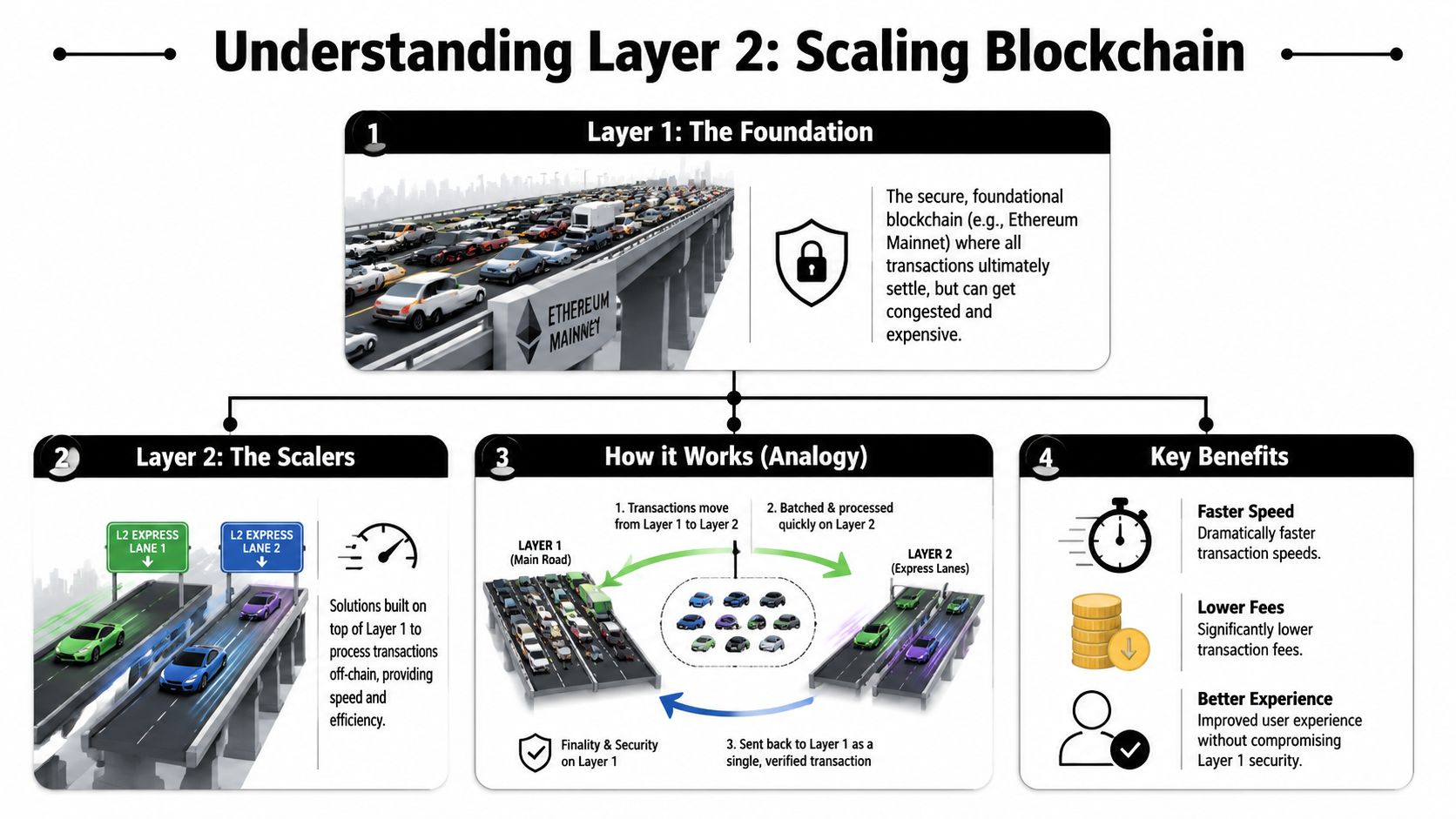
A good mental model is a highway system. Layer 1, like Ethereum mainnet, is the main interstate. It's secure, heavily traveled, and the final place where everything matters. But when too many drivers try to use the same road, traffic slows to a crawl.
A layer 2 is the express lane built beside that highway. It handles a large share of the traffic separately, moves it faster, and then reconnects back to the main route for final settlement.
The core mechanism
The key idea is simple. Instead of asking Ethereum to process every individual action directly, the layer 2 handles activity off the main chain and sends back a compressed result.
In practice, rollups batch many transactions together and post transaction data, proofs, or state updates back to Ethereum. That means users get a chain that feels much faster and cheaper, while Ethereum remains the base settlement layer underneath it.
You don't need to think like a protocol engineer to use this well. You just need to remember three things:
Execution happens on the layer 2. That's where your swaps, deposits, and withdrawals are processed day to day.
Settlement anchors to Ethereum. The final trust model still points back to the base chain.
Cost falls because the main chain isn't handling every action one by one.
Why this model won
This architecture works because it preserves what people want from Ethereum without forcing every user to live with Ethereum mainnet's cost profile. It also explains why layer 2 has become the practical default for many DeFi users.
For teams trying to explain the concept internally, I like to describe it this way: Ethereum is the court of record. Layer 2 is the operational workspace.
The best layer 2 explanations focus less on abstract scaling theory and more on where your transaction is executed, where it settles, and what assumptions change in between.
If you're talking to finance teams or business operators who are newer to crypto terminology, this resource on cryptocurrency insights for Ashfield businesses is a useful non-technical companion.
What layer 2 is not
It isn't a replacement for Ethereum. It also isn't free of trust assumptions, risk, or UX trade-offs.
A lot of weak explanations make layer 2 sound like pure upside. The better framing is this:
Concept | What it means in practice |
|---|---|
Faster execution | Transactions usually feel responsive enough for normal app usage |
Lower fees | Strategies that failed on mainnet can become workable |
Ethereum settlement | The base layer still matters for finality and security |
New moving parts | Bridges, sequencers, and rollup design choices introduce trade-offs |
That last row matters more than most marketing pages admit.
Optimistic Rollups vs ZK-Rollups
Most users eventually run into two families of layer 2 rollups: optimistic rollups and ZK-rollups. They solve the same broad problem, but they don't validate activity the same way.
The simplest distinction is this. Optimistic systems use a trust first, challenge later model. ZK systems use a prove correctness up front model.
How optimistic rollups work
Chains like Base and Arbitrum are in the optimistic camp. They assume submitted transaction batches are valid unless someone challenges them during a fraud-proof window.
That design is one reason optimistic rollups reached strong app compatibility early. They felt familiar to teams building on Ethereum, and the developer experience was straightforward enough to attract major DeFi activity.
According to Ethereum's layer 2 documentation, Optimism and Arbitrum can process up to 2,000 TPS using a 7-day fraud-proof challenge window, and Arbitrum fees averaged $0.05 versus Ethereum's $2+ during peaks. The operational trade-off is built into the model: if you want to move value back to Layer 1 through the canonical path, you may need to wait out that challenge period.
How ZK-rollups work
ZK-rollups take a different route. They generate cryptographic validity proofs that show a batch is correct. That changes the trust model and often improves withdrawal characteristics from a user perspective.
The upside is clear. You don't need to assume a batch is valid and leave room for disputes in the same way. The cost is complexity. ZK systems are harder to build, harder to optimize, and in some cases less straightforward for developers depending on the stack and tooling.
When choosing between rollup types, users usually care less about the cryptography than they think. What matters is app availability, withdrawal behavior, cost, and whether the chain is where the liquidity already is.
Optimistic vs ZK-rollups at a glance
Attribute | Optimistic Rollups (e.g., Base, Arbitrum) | ZK-Rollups (e.g., zkSync, Starknet) |
|---|---|---|
Validation model | Transactions are assumed valid unless challenged | Transactions are validated with cryptographic proofs |
Security mechanism | Fraud proofs during a challenge window | Validity proofs posted to Layer 1 |
Withdrawal experience to L1 | Can involve a wait tied to the challenge period | Typically better suited to faster final verification |
EVM familiarity | Often strong compatibility and easier migration paths | Can vary by implementation and tooling |
Practical strength | Mature app ecosystems and familiar UX | Strong cryptographic assurances and efficient verification |
Main trade-off | Delay and trust assumptions around disputes and operation | More technical complexity |
Which one matters more for yield users
For most stablecoin users, the deciding factor isn't ideology. It's where the opportunity lives and how much operational friction you're willing to accept.
If the best lending markets, DEX liquidity, or automation tools are on an optimistic rollup, that's usually where capital goes. If a ZK-rollup offers better settlement properties but thinner app support, some users will still prefer the ecosystem with more working venues.
In other words, rollup design matters. But app depth, bridge support, and day-to-day usability usually matter first.
Understanding Layer 2 Security and Trust
A lot of layer 2 marketing compresses the story into one line: your funds inherit Ethereum security. That's directionally true, but it's incomplete in a way that matters for anyone earning yield.
When you deposit into a protocol on a layer 2, you're not only relying on Ethereum. You're also relying on the rollup's contracts, its transaction ordering system, the bridge design, and the DeFi app you're using on top.
Security inheritance is real, but not total
The phrase works best if you hear it as settlement inheritance, not risk elimination. Ethereum still anchors the system, but the path between your wallet and final settlement includes extra components.
That's especially relevant on optimistic rollups. The Blockdaemon discussion of sovereign L2 trade-offs notes that the fraud-proof challenge window is typically 7 days, and sequencer centralization, such as Base using Coinbase's sequencer, creates a potential point of failure or censorship that doesn't exist in the same way on decentralized Ethereum mainnet.
The two risks users should actually watch
The first is challenge-window risk. On optimistic systems, disputes can still happen during that period. For most users, this shows up less as daily danger and more as a withdrawal and settlement constraint.
The second is sequencer risk. A sequencer orders transactions and packages activity for the rollup. If that function is centralized, users take on operational trust assumptions they don't face in the same form on Ethereum mainnet.
Don't ask whether a layer 2 is "safe" in the abstract. Ask who orders transactions, how exits work, and what happens when the chain has operational issues.
A practical trust stack for yield farming
When evaluating a layer 2 yield opportunity, think in layers:
Base chain trust means Ethereum still underpins settlement.
Rollup trust means understanding whether you're on an optimistic or ZK design and what that implies.
Sequencer trust means asking who controls ordering today.
Bridge trust means checking how assets move in and out.
Protocol trust means reviewing the DeFi app itself, because a bad vault on a good layer 2 is still a bad vault.
This is why the phrase "inherits security" can mislead beginners. It skips the operational details that determine user experience and incident exposure.
What works in practice
The safest mindset is boring and disciplined. Use established bridges where possible. Prefer widely used apps over new farms with flashy incentives. Treat every extra contract as added surface area.
The strongest layer 2 users aren't the ones who memorize every technical term. They're the ones who understand where trust moved when they left mainnet.
How to Move Funds and Interact with Layer 2s
Using a layer 2 is much less intimidating than it sounds. The main action is bridging, which just means moving assets from one network to another so you can use apps there.
If you're starting with stablecoins on Ethereum or an exchange, the goal is simple: get those funds onto the target layer 2, then interact with apps on that network the same way you would on Ethereum.
The basic path
Most users follow a flow like this:
Choose the target network. If you're using Base, make sure your wallet is configured for Base before sending funds.
Move the asset onto the chain. You might withdraw directly from an exchange to that network if supported, or use a bridge from Ethereum.
Confirm the received token. Check that the stablecoin you expect is in your wallet on the destination chain.
Use DeFi apps normally. Once you're there, swaps, lending, LP deposits, and vault interactions feel familiar.
If you're specifically working with dollar-denominated assets on Base, this guide to using USDC on Base for DeFi activity is a practical next read.
What feels different after you arrive
The biggest surprise for first-time users is how normal it feels. Wallet confirmations still look familiar. App layouts still resemble Ethereum DeFi. The difference is that routine actions stop feeling expensive.
That changes behavior. Users are more willing to move between venues, harvest, rebalance, or test smaller positions because the network overhead is lower.
The caveat most users learn later
Getting onto a layer 2 is usually the easy part. Exiting back to Ethereum mainnet can be slower depending on the rollup design.
For optimistic rollups, the canonical withdrawal path may involve waiting through the challenge period discussed earlier. That's not a bug. It's part of the security model. In practice, many users either plan around that delay or use alternative liquidity routes when they need faster movement.
The right habit is to think about your exit path before you bridge in, not after your funds are already deployed across three protocols.
A simple operating checklist
Step | What to check |
|---|---|
Before bridging | Wallet network, token type, and destination address |
After bridging | Token arrived on the correct chain and is recognized by the app |
Before depositing | Protocol supports that exact asset on that exact network |
Before exiting | Whether you're using a canonical withdrawal or another route |
Layer 2 UX is now good enough that most mistakes come from rushing, not from complexity.
The Layer 2 DeFi Boom and Stablecoin Yield
Layer 2 didn't just reduce fees. It reopened parts of DeFi that had become impractical on mainnet for anyone who wasn't moving larger size.

On Ethereum mainnet, many stablecoin strategies were structurally awkward. You could lend, provide liquidity, or rotate between protocols, but each action carried enough cost that smaller balances got squeezed. The result was a DeFi market that often rewarded scale more than discipline.
Layer 2 changed that by lowering the cost of doing ordinary portfolio maintenance. Suddenly, stablecoin users could move capital, test multiple venues, and react to changing on-chain conditions without paying mainnet prices for every decision.
Why Base became such an important venue
Base is a good case study because it combines a familiar optimistic-rollup model with a broad retail on-ramp. That matters more than people sometimes admit. Good yield opportunities don't help much if the path to access them feels clumsy.
According to Blockchain App Factory's guide to layer 2 adoption, Ethereum layer 2 networks hold over $10.4 billion in TVL as of mid-2025, and Base alone holds approximately $3.4 billion TVL. That kind of capital concentration tells you developers, users, and liquidity providers are taking the venue seriously.
For stablecoin strategies, that's important because a healthy chain usually attracts the ingredients yield seekers need:
Reliable liquidity for entering and exiting positions
Multiple protocols so capital isn't trapped in a single venue
Better routing options for swaps and reallocations
Lower transaction friction that makes active management possible
If you want a closer look at how those opportunities show up in practice, this overview of Base layer 2 yield opportunities is a helpful companion.
What layer 2 makes economically possible
On a low-cost chain, the abstract scaling story becomes concrete. Strategies that depend on regular movement become workable. A user can shift funds between a lending market and a liquidity venue, or adjust a stablecoin position when conditions change, without treating every click like a major expense.
That matters for both beginners and experienced operators. Beginners can start smaller and learn by doing. More advanced users can automate or semi-automate capital allocation without mainnet gas turning every rebalance into a tax on returns.
A short explainer is useful here:
What still doesn't work
Low fees don't rescue bad strategy design. Chasing headline APRs on thin, newly launched protocols is still dangerous. Stablecoin yield on layer 2 works best when the user treats cost savings as an enabler, not as permission to ignore smart contract risk, liquidity depth, or exit conditions.
Cheap block space is a tool. It isn't due diligence.
The winning mindset is simple: use layer 2 to improve execution quality, not to justify lower standards.
Your Next Steps for Safely Earning on Layer 2
The safest way to start is also the least exciting. Move slowly, keep position sizes modest at first, and verify every step before you optimize anything.

A workable first-pass checklist
Start with one chain. Pick a single layer 2 such as Base or Arbitrum and learn its normal wallet, bridge, and app flow before branching out.
Use one stablecoin first. Keeping the asset constant reduces confusion when you're learning how different apps represent balances and approvals.
Check the protocol's reputation. Look for an established product, active user discussion, and documentation that explains how deposits, withdrawals, and risks work.
Understand your exit route. Don't bridge in unless you know how you'll move funds out if conditions change.
Keep records as you go. Save transaction hashes, app names, and deposit amounts so you can reconstruct what happened if something looks off later.
What experienced users do differently
They don't just ask whether a yield source looks attractive. They ask what assumptions sit underneath it.
A solid review usually includes:
Question | Why it matters |
|---|---|
What chain am I on | Network mistakes are still one of the most common user errors |
Who controls the sequencing | Operational trust differs across layer 2s |
What contracts hold funds | Yield always comes with protocol-level exposure |
How do I exit | Liquidity and withdrawal design matter as much as entry |
A practical starting sequence
Send a small amount of stablecoins to the target layer 2.
Test one swap or one deposit.
Withdraw or unwind once, just to prove the full cycle works.
Only then scale the position.
That approach sounds conservative because it is. In DeFi, operational clarity is part of risk management.
Frequently Asked Questions About Layer 2
Are my funds on a layer 2 controlled by one company
Not in the simple sense, but sometimes there is a more centralized operational component than users expect. On some optimistic rollups, a sequencer run by a single entity handles transaction ordering. That doesn't mean the operator owns your funds outright, but it does mean the system can rely on a party with meaningful control over day-to-day operation.
What happens if a layer 2 network has issues
Usually, the immediate problem is usability, not permanent loss. Transactions may be delayed, apps may feel unreliable, or bridging may become less convenient for a period. The reason experienced users care about rollup design is that recovery paths and trust assumptions differ depending on how the chain is built and how decentralized its infrastructure is.
Why can it take so long to withdraw from Base or Arbitrum to Ethereum
On optimistic rollups, the delay comes from the fraud-proof challenge model. Transactions are assumed valid unless challenged, so the system leaves time for disputes before finalizing certain exits back to Layer 1. That's the trade-off for the trust model those chains use.
Is layer 2 only useful for advanced traders
No. In practice, layer 2 is often most useful for ordinary stablecoin users because it removes the cost barrier that made simple DeFi actions awkward on mainnet. The technical design matters, but the day-to-day benefit is straightforward: cheaper execution makes more strategies usable.
What's the biggest mistake new users make
They focus only on yield and ignore operations. Most preventable problems come from bridging to the wrong network, using unfamiliar protocols too quickly, or not understanding how to exit a position. The safer habit is to treat each new chain like a new operating environment until you've tested the full flow yourself.
If you want a simpler way to put these ideas into practice, Yield Seeker helps stablecoin holders earn on Base with AI-assisted, risk-aware automation. You can deposit from as little as $10 USDC, monitor balances and earnings in a clean interface, and stay flexible with no lockups or withdrawal fees.