
Forget the wild stories you hear about crypto—the overnight millionaires and the gut-wrenching losses from some random meme coin. That’s one side of the coin, but it’s not the whole picture.
True low-risk crypto investing isn’t about gambling; it's about making your digital assets work for you to generate a steady, predictable income. Think of it less like playing the lottery and more like finding a high-yield digital savings account.
What Low-Risk Crypto Investing Actually Means
When most people hear "crypto," their minds immediately jump to Bitcoin's crazy price swings. But there's a whole other corner of the digital asset world focused on the exact opposite: stability and passive income. The core idea is simple—put your assets to work while doing everything you can to protect your initial capital. This isn't a get-rich-quick scheme; it's a way to build wealth sustainably over time.
This approach isn't about chasing the next 100x gain on assets like Ethereum or Solana. Instead, it's all about generating yield, much like you'd earn interest from a bank or dividends from a stock.
To really nail this down, let's compare the two approaches side-by-side.
High-Risk vs Low-Risk Crypto Investing at a Glance
The table below breaks down the fundamental differences between speculating on volatile assets and focusing on stable, income-producing strategies. It’s a completely different game with different rules and goals.
Characteristic | Low-Risk Investing (e.g., Stablecoin Yield) | High-Risk Investing (e.g., Meme Coin Trading) |
|---|---|---|
Primary Goal | Generate consistent, predictable income (yield). | Achieve massive capital gains through price appreciation. |
Key Assets | Stablecoins (USDC, USDT) pegged to real-world currency. | Volatile cryptocurrencies (meme coins, new altcoins). |
Success Metric | Annual Percentage Yield (APY) earned. | Percentage increase in the asset's price (e.g., 100x). |
Risk Profile | Low. Focus is on capital preservation. | Extremely High. Potential for total loss of capital. |
Time Horizon | Medium to long-term wealth building. | Short-term, often speculative trades. |
Mindset | Investor. Seeking steady, reliable returns. | Trader/Gambler. Chasing huge, quick profits. |
As you can see, these two worlds couldn't be more different. One is a sprint, the other is a marathon.
The Foundation of Stability
So, how do we get that stability in a market famous for its volatility? The answer is stablecoins.
Stablecoins are the bedrock of almost every low-risk crypto strategy. They are digital currencies specifically designed to hold a stable value because they're pegged to a real-world asset, usually the U.S. dollar. For every one stablecoin like USDC or USDT, there is (in theory) one dollar held in a bank account somewhere.
This peg achieves one crucial thing: it takes price volatility out of the equation. Once you do that, you can stop worrying about whether your asset's value will crash overnight and focus entirely on the yield your digital dollars can generate.
The goal of low-risk crypto investing is to achieve predictable returns by minimizing exposure to market volatility. By using assets that hold a stable value, investors can focus on earning reliable interest from decentralized finance protocols.
Shifting Focus From Price to Income
With price swings neutralized, the game completely changes. Your success isn't measured by an asset's price jumping 100%. It’s measured by the consistent annual percentage yield (APY) you can lock in, which makes for a much more predictable financial plan.
This model is gaining serious traction, especially as people look for safer ways to engage with the crypto ecosystem. In fact, the stablecoin market cap is projected to blow past $2 trillion by 2026, a clear signal that the infrastructure for earning passive income is here to stay. You can check out SVB's 2026 report for more on this outlook.
For investors, this means a robust and growing landscape where conservative strategies can often pull in a very competitive 4-8% APY while keeping your principal pegged 1:1 to the dollar.
Ultimately, low-risk crypto investing is the perfect entry point for anyone intrigued by blockchain but put off by the headline-grabbing volatility. It offers a structured path to participate in the digital economy, putting capital preservation and steady growth first.
The Core Strategies for Earning Stable Crypto Yields
Okay, so we've established our goal is stable, predictable income, not chasing those crazy 100x moonshots. The next logical question is: how do we actually do it?
Earning a steady yield in crypto isn't about one magic bullet. It comes down to a few core strategies, each with its own mechanics, potential returns, and risk profile. You can think of them like different types of digital savings or investment accounts, each built for a slightly different purpose.
This flowchart pretty much nails the core idea.
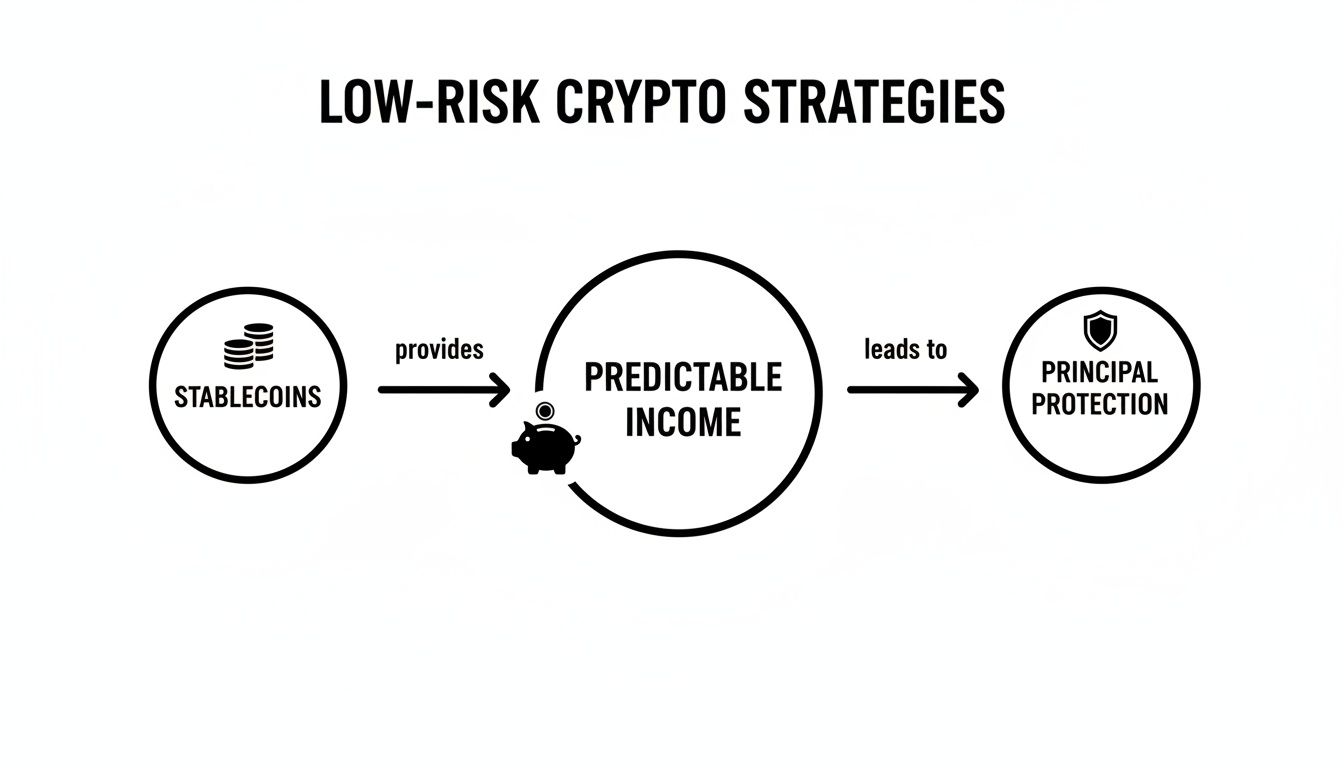
It all starts with stablecoins as the foundation, which generate that predictable income we're after. That income, in turn, helps achieve the main goal: protecting your initial capital.
Let's break down the main ways people are putting their crypto to work for low-risk yield.
To make things easier to compare, I've put together a quick overview table. It's a handy reference for seeing how these strategies stack up against each other at a glance.
Comparing Low-Risk Crypto Income Strategies
Strategy | Typical APY Range | Primary Risks | Best For |
|---|---|---|---|
Stablecoin Lending | 3% - 15% | Smart contract bugs, platform insolvency, de-pegging events. | Beginners looking for a straightforward, "set-it-and-forget-it" digital savings account. |
PoS Staking (ETH) | 3% - 5% | Slashing penalties, smart contract risk (liquid staking), asset price volatility. | Investors comfortable holding major assets like ETH long-term and earning network rewards. |
Stablecoin LP | 5% - 20% | Smart contract failure, minor de-pegging causing small temporary losses. | Active users who understand DeFi mechanics and want to earn from trading fees. |
Tokenized RWAs | 4% - 6% | Issuer risk (the company tokenizing the asset), smart contract vulnerabilities. | Risk-averse investors who prefer yields backed by traditional financial assets like government bonds. |
Each path has its place, and the "best" one really depends on your comfort level with the technology and the specific risks involved.
1. Stablecoin Lending: Your Digital Savings Account
This is the most direct and easy-to-understand strategy of the bunch.
Think about how a high-yield savings account at a traditional bank works. You deposit your cash, the bank lends it out to other customers, and in return, you get a slice of the interest they collect. Simple.
Stablecoin lending on DeFi platforms is the exact same concept. You deposit your stablecoins (like USDC) into a lending protocol's pool. Other users then borrow from that pool, usually by putting up their own volatile crypto as collateral to secure the loan.
For providing your capital, you earn a variable interest rate. It's paid out in the same stablecoin you deposited, making it a cornerstone strategy for anyone just dipping their toes into low-risk crypto investing.
Its popularity comes from this simplicity. You're just earning interest on your digital dollars, plain and simple.
2. Proof-of-Stake Staking: Earning Network Dividends
Next up is staking, specifically with a massive, battle-tested network like Ethereum. The best analogy here is earning dividends from a blue-chip stock you hold in your portfolio.
When you stake a Proof-of-Stake (PoS) asset, you're essentially locking up your coins to help run the network—validating transactions and keeping everything secure. For that contribution, the network rewards you with more of that same coin.
While this does mean you're holding a volatile asset (ETH), the rise of liquid staking has changed the game. It allows you to get the staking yield without having your capital completely tied up. More advanced users might even stake ETH, get a liquid staking token back, and then use that token as collateral to borrow stablecoins for other yield strategies.
It's a bit more complex than simple lending, for sure, but it’s a fundamental part of the wider DeFi ecosystem.
3. Stablecoin Liquidity Providing: The Digital Currency Exchanger
Ever been to an airport and seen a currency exchange booth? Every time someone swaps their dollars for euros, the booth owner takes a tiny fee. That's pretty much what you're doing here.
As a liquidity provider (LP), you deposit a pair of different stablecoins—say, USDC and USDT—into a "liquidity pool" on a decentralized exchange (DEX). When traders come to the DEX to swap between those two stablecoins, they pay a small trading fee. That fee is then split among all the liquidity providers in the pool, including you.
The key is to stick with stablecoin-only pairs. This helps you avoid a nasty little risk called impermanent loss, which can happen when the prices of the two assets you provided drift apart. Since both of your assets are pegged to the dollar, that risk is almost completely gone, leaving you to just collect those sweet trading fees.
4. Tokenized Real-World Assets: The Blockchain Treasury Bill
This is a newer, but rapidly growing, corner of the low-risk world. It's all about bringing the safety and stability of traditional finance onto the blockchain.
The clearest example is tokenized U.S. Treasury Bills (T-Bills). You're essentially buying a digital token that represents ownership of a U.S. government bond—arguably one of the safest investments on the planet. This setup gives you access to reliable, government-backed yield but with the speed and transparency of blockchain technology. You can find a more detailed breakdown of how these and other stablecoin interest rates are generated to get a better feel for it.
This strategy is ideal for anyone who wants to keep their crypto-native risk to an absolute minimum. As the lines between traditional and decentralized finance continue to blur, these Real-World Assets (RWAs) are becoming a must-have for any diversified, low-risk portfolio. And if you're curious about the broader crypto income landscape, it's also worth checking out different strategies for earning Bitcoin income to see how it all fits together.
How to Understand and Manage DeFi Risks
Let's get one thing straight from the start—in the world of finance, "low-risk" never means "no-risk." Every investment, from government bonds to your digital dollars, carries some form of risk. The goal of low-risk crypto investing isn't to pretend risk doesn't exist. It's about understanding it, managing it, and keeping it at a level you’re comfortable with.
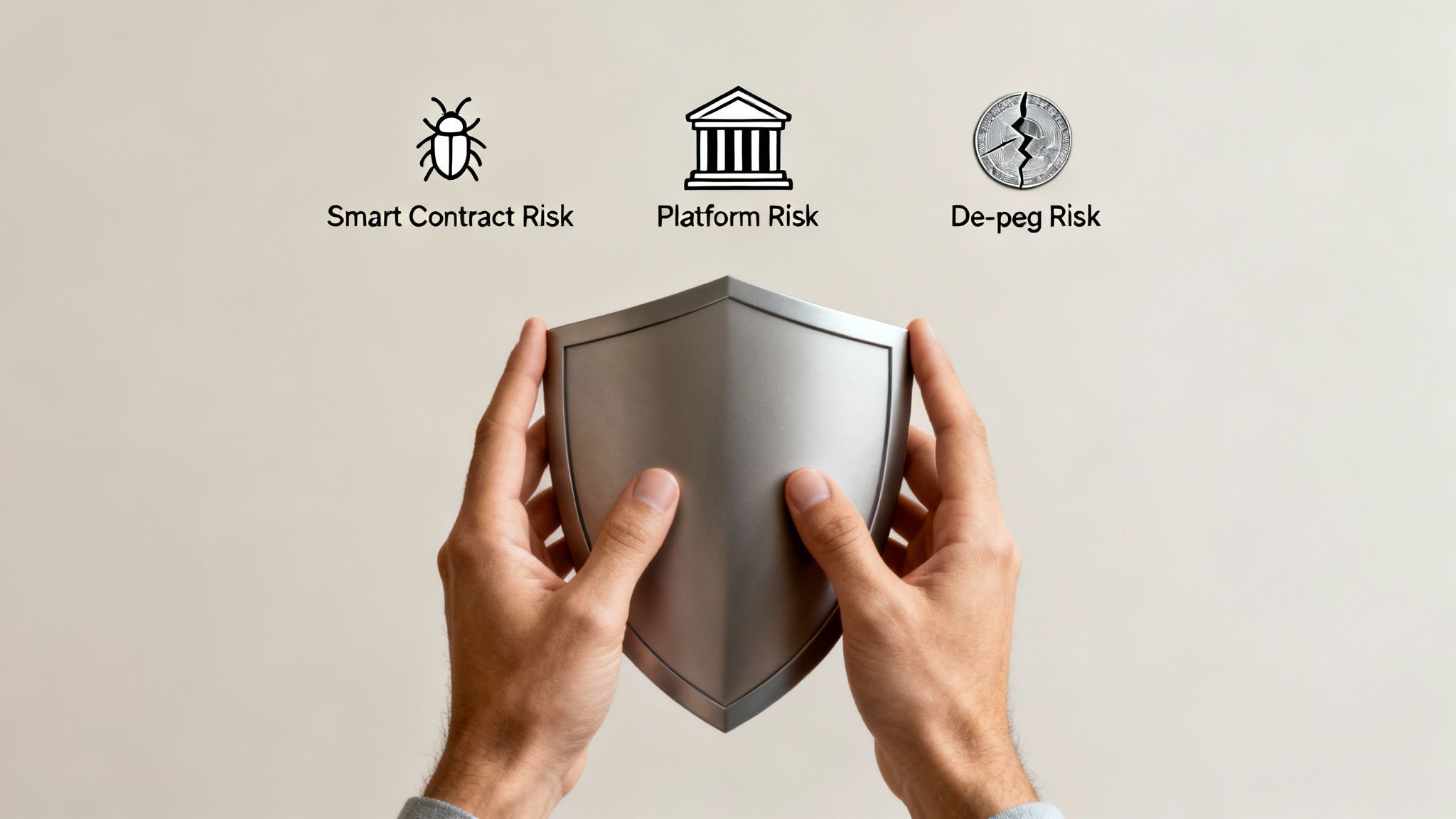
The only way to invest with real confidence is to take an honest look at what could go wrong. When you know what to watch for, you can build a resilient strategy that protects your money while it earns a yield. The good news is, most DeFi risks fall into three main buckets, and each has clear ways to protect against it.
Smart Contract Risk: The Bug in the Vault
Think of a DeFi protocol like a digital bank vault that runs entirely on code. This code, called a smart contract, handles everything—deposits, loans, and interest payments—without needing a human banker. It's incredibly efficient. But what if there's a tiny, hidden flaw in the vault's programming?
That flaw is smart contract risk. A hacker could exploit that bug to drain the vault. This is easily the most common and dangerous risk in DeFi. In 2023 alone, hacks and exploits led to losses of over $1.8 billion, with a huge chunk of that coming from buggy smart contracts.
How to Protect Yourself:
Stick to the Classics: Use protocols that are battle-tested. Look for ones that have been around for years and are trusted with billions of dollars. Time is the ultimate stress test.
Check for Audits: Good projects pay security firms to hunt for bugs in their code. Look for multiple audits from well-known firms like Trail of Bits or OpenZeppelin.
Use Risk Dashboards: Certain tools and platforms provide safety scores for protocols, giving you a quick read on their security.
Platform Risk: The Bank's Own Problems
Now, let's imagine the vault's code is perfect, but the bank running the vault is a mess. The management team might make terrible decisions, their internal systems could fail, or the whole thing could be a scam. This is platform risk.
It all comes down to the integrity and competence of the team behind the DeFi protocol. Even with perfect code, a project can go under if its leadership is weak or its operations are sloppy.
Navigating these challenges requires a layered approach. Our comprehensive guide on DeFi risk management dives deeper into creating a robust framework to protect your assets from various threats.
Going beyond just DeFi protocols, it's also smart to understand broader concepts like third-party risk management. This helps you size up the reliability of every single tool in your financial stack.
Stablecoin De-Peg Risk: The Shaky Guarantee
Finally, let's talk about the money inside the vault. Your stablecoins are supposed to be worth exactly one dollar. De-peg risk is the danger that this guarantee breaks and the stablecoin loses its 1-to-1 peg to the dollar.
This can happen for a few reasons. Maybe the reserves backing the stablecoin aren't what they claim to be, or a market panic causes a massive sell-off. While top-tier stablecoins like USDC have a strong track record, you can never just ignore this risk.
How to Protect Yourself:
Choose Wisely: Stick to stablecoins that are highly collateralized and totally transparent about the assets backing them.
Diversify Your Holdings: Don't go all-in on a single stablecoin. Spreading your capital across two or three different ones means that if one has issues, your entire stack isn't at risk.
The good news is that as big institutions pile in, the space is getting safer. Crypto is slowly shifting from a speculative playground into a legitimate asset class. By 2026, 76% of global investors plan to increase their exposure to digital assets, and this is fueling the growth of safer options like on-chain U.S. Treasuries that deliver bond-like yields with blockchain efficiency. This whole movement is bringing more robust, audited, and reliable choices to the market.
Automating Your Strategy With AI-Powered Tools
Let's be honest: managing a handful of DeFi strategies yourself is a full-time gig. It means you're constantly hunting for information, jumping between different platforms, and trying to perfectly time the market to get the best yields. This complexity is a huge hurdle for anyone who just wants to put their money to work safely, without having to become a part-time DeFi analyst.
This is where automation and modern tools completely change the game. They make sophisticated low-risk crypto investing something anyone can do. Instead of burning hours managing your positions, you can let intelligent systems do all the heavy lifting for you.
Let AI Be Your Smart Financial Advisor
Picture this: you hire a personal financial advisor who works for you 24/7. They're always scanning the market, finding the absolute best risk-adjusted returns for your stablecoins. That's pretty much what AI-powered yield platforms like Yield Seeker are all about. These tools are built from the ground up to take the manual work and guesswork out of earning a solid, stable yield.
Here’s a glimpse of how clean and simple these platforms can be.
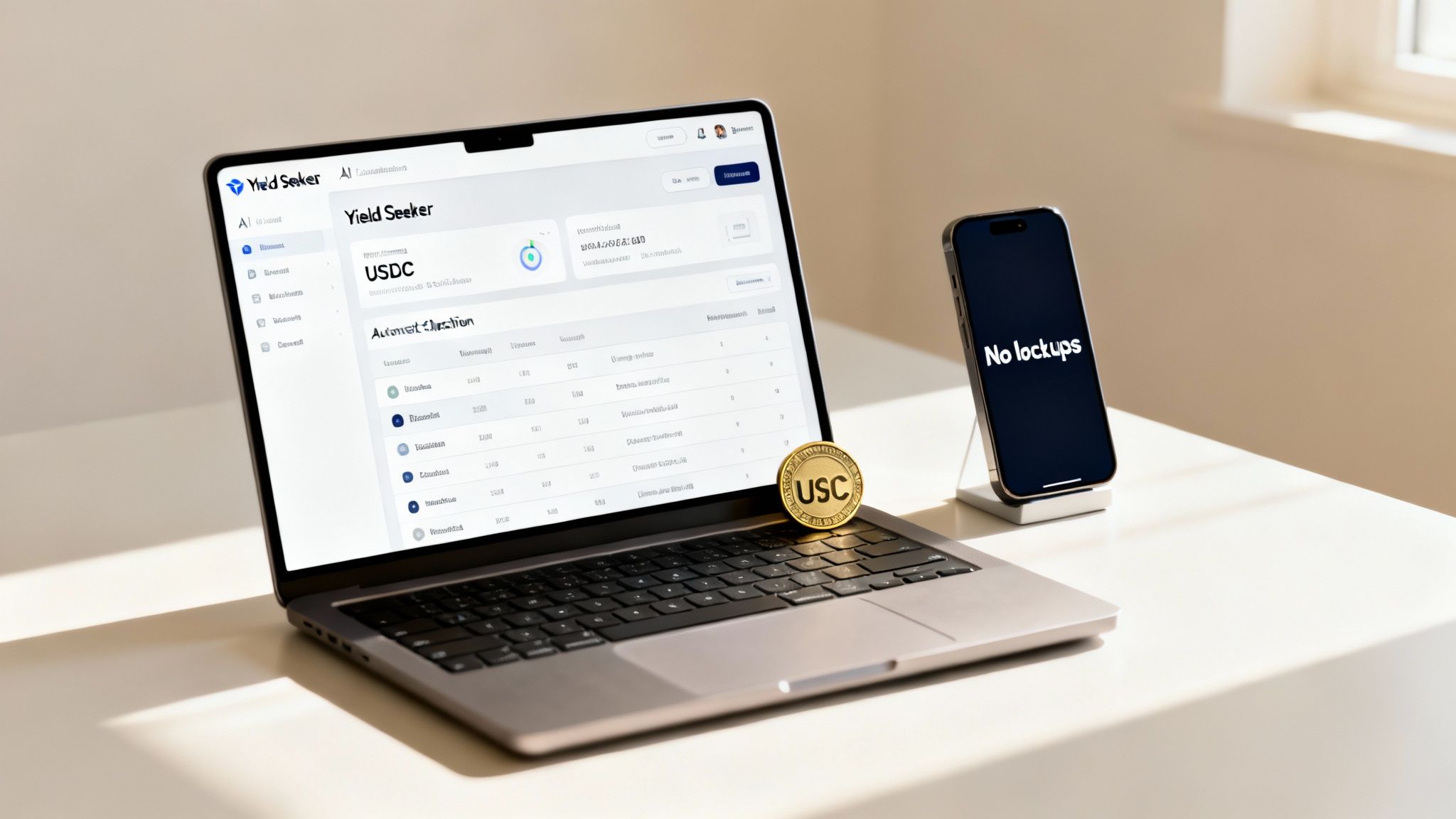
The whole point is clarity—showing you what you're earning and where your money is, without the usual mess of a typical DeFi dashboard.
The process itself is incredibly straightforward. You deposit a stablecoin like USDC, and your own personalized AI agent gets to work. This agent keeps a close eye on a pre-vetted list of trusted DeFi protocols, analyzing their yields, security ratings, and overall health in real-time.
Based on this live data, the AI automatically moves your capital to the spots that offer the most attractive yield for a risk level you're comfortable with. If the market shifts and a better opportunity pops up, the AI can reallocate your funds to grab it.
This hands-off approach makes sure your capital is always working as hard as possible, grabbing competitive returns without you having to do a thing. You can get a deeper look into how these systems operate in our guide to AI crypto investing.
Key Benefits of an Automated Approach
Handing your strategy over to a dedicated tool isn't just about saving time; it fits perfectly with the whole philosophy of low-risk investing. The biggest wins are all centered around safety, transparency, and keeping things flexible.
Three Core Advantages of AI-Powered Tools:
Continuous Risk Monitoring: An AI agent can chew through market data way faster than any human. It’s constantly checking protocol security and market vibes to keep your capital safe.
Optimized Yield Capture: The DeFi market is all over the place, with yields changing by the minute. Automation means you’re always in the best position to capture the top available rates from a pool of safe, vetted sources.
Effortless Management: You get all the perks of a complex, multi-protocol strategy without the headache of actually running it yourself.
Features That Support Low-Risk Principles
The best automated platforms are laser-focused on security and user control, which are absolutely non-negotiable for low-risk investors. They aren't "black box" systems; they're designed to give you clarity and keep you in the driver's seat.
When you're looking at platforms, keep an eye out for features designed to give you peace of mind.
Essential Safety and Flexibility Features:
No Lockups: Your funds should never be locked away from you. Real low-risk investing demands liquidity, giving you the freedom to pull your capital out whenever you need it, no questions asked and no penalties.
Transparent Reporting: You should always have a crystal-clear view of where your funds are and how much they're earning. Easy-to-read dashboards are a must-have.
Focus on Vetted Protocols: The platform should only interact with a hand-picked group of the most secure, audited, and battle-tested DeFi protocols. This massively cuts down on both smart contract and platform risk.
By using technology to handle the research, allocation, and monitoring, these tools make it possible for anyone to build and run a sophisticated, low-risk crypto portfolio. It's a practical use of tech that turns what was once a complex grind into a simple, passive income strategy. This shift is empowering more people to get into the DeFi economy safely and effectively.
Alright, theory is one thing, but putting your money to work is where the real action is. It might feel like a huge jump from reading about low-risk crypto to actually earning your first dollar, but if you break it down, it's pretty straightforward.
Let's walk through the entire process, step-by-step. We'll cover the three main things you need to do: get a personal wallet to secure your funds, buy the right asset, and then connect to a platform that puts your money to work.
Step 1: Set Up Your Own Wallet
Before you can do anything in DeFi, you need a wallet that you actually control. This is what we call a self-custody wallet. Think of it as your own personal bank vault on the internet. When you keep your crypto on an exchange, you're trusting them. With a self-custody wallet, you hold the keys, meaning nobody can touch your funds without your permission.
For anyone just starting, MetaMask is easily one of the most popular and user-friendly wallets out there.
Download and Install: Grab it as a browser extension for your computer or as a mobile app.
Create Your Wallet: The setup process is simple, just follow the on-screen instructions.
Secure Your Seed Phrase: This is the most important part. You'll get a 12-word "seed phrase." This is the master key to all your funds. Write it down on a piece of paper and hide it somewhere safe and offline. Never, ever store it on your computer or phone. If you lose this phrase, your assets are gone for good.
Once your wallet is set up, you have a secure home base for your crypto journey.
Step 2: Buy Some Stablecoins and Move Them Over
For these low-risk strategies, our go-to asset is a stablecoin pegged to the U.S. dollar. We’ll use USDC for this walkthrough because it has a solid reputation for being transparent and reliable. First, you'll buy it on a regular crypto exchange and then send it over to your new MetaMask wallet.
Buy on an Exchange: Use a trusted exchange like Coinbase or Kraken to purchase USDC with your local currency (like USD, EUR, etc.).
Start the Withdrawal: Find your USDC balance on the exchange and look for the "Withdraw" or "Send" button.
Enter Your Wallet Address: Open MetaMask and copy your public wallet address—it’s that long string of characters starting with "0x...". Paste this into the destination field on the exchange. I always double, even triple-check the address before hitting send.
Pick the Right Network: You'll need to choose which blockchain to send it on. For platforms like Yield Seeker, you'll want a low-cost network like Base. This is crucial, as sending on the wrong network can lead to lost funds.
Confirm and Send: Give everything one last look and confirm the transaction. The USDC should pop up in your MetaMask wallet in just a few minutes.
Step 3: Connect to a Platform and Start Earning
This is the fun part—putting your capital to work. Now you’ll connect your wallet to a platform that generates yield and deposit your USDC.
The whole idea is incredibly simple: you connect your wallet, deposit your funds, and the platform does all the heavy lifting. It finds and manages the best risk-adjusted yields for you, so you don’t have to spend your time researching and hopping between dozens of different DeFi protocols.
Once you’re on the platform, you'll just need to approve the deposit transaction from your MetaMask wallet. As soon as that's done, your money starts earning interest almost instantly. You can then watch your balance and earnings grow in real time right from your dashboard.
A Sample Portfolio and How to Keep Tabs on It
To bring this all to life, let's imagine a $1,000 investment for someone who's playing it safe.
Allocation | Amount | Strategy Focus |
|---|---|---|
Core Yield | $700 (70%) | Stablecoin lending and liquidity on audited, blue-chip protocols. |
RWA Exposure | $200 (20%) | Tokenized U.S. Treasury Bills for government-backed yield. |
Liquid Staking | $100 (10%) | Earning staking rewards on a major asset like Ethereum. |
This kind of balanced approach gives you a solid base in stablecoin yield while diversifying into government-backed assets and network rewards. You don't need to obsess over it, either. A simple monitoring routine is all it takes to stay on top of things.
Your Weekly Monitoring Checklist:
Check Earnings: Pop into your platform's dashboard and see how much yield you've made for the week.
Review Protocol Health: A good platform will give you an overview of the underlying protocols. Just make sure everything still looks secure and healthy.
Re-evaluate Quarterly: Once every three months, take a look at your allocations. Have your goals or risk tolerance changed? If so, it might be time to make a few adjustments.
Where Low-Risk Crypto is Headed Next
The world of low-risk crypto investing isn't standing still—far from it. As the dust settles from the early days of pure speculation, a much more mature and sustainable ecosystem for earning predictable yield is starting to take shape. This isn't about chasing fleeting pumps; it's about building a solid foundation for reliable returns, and these shifts are making safe crypto strategies more accessible than ever.
One of the biggest drivers behind this change is the slow but steady march of institutional adoption. When the big financial players step into DeFi, they bring more than just a truckload of capital. They bring demands—for better security, more transparency, and clear compliance—which ultimately raises the bar for everyone and creates a safer playground for the rest of us.
The Rise of Real-World Assets
A truly game-changing trend is the tokenization of Real-World Assets (RWAs), which is just a fancy way of saying we're bringing things like U.S. Treasury bills, real estate, and private credit onto the blockchain. By doing this, investors can suddenly tap into the rock-solid safety of government debt or the steady returns of private lending, all with the speed and clarity of a digital asset.
For anyone serious about low-risk crypto, this is a massive deal. It opens up brand new streams of stable yield that have absolutely nothing to do with whether Bitcoin is up or down, giving your portfolio a foundational layer of security.
Why Automation is No Longer Optional
As the number of opportunities grows, so does the complexity. Let's be honest, manually tracking yields across dozens of protocols, trying to figure out the risks, and constantly moving your funds around is a full-time job. It's just not realistic for most people.
This is where AI-powered platforms are becoming essential. These tools are like your own personal analyst, working 24/7 to sniff out the best risk-adjusted returns without you having to lift a finger.
The future of smart, low-risk investing is all about automation. By letting technology do the heavy lifting—the complex analysis and the trade execution—everyday investors can now access sophisticated strategies that were once walled off for the pros. It’s about making sure your capital is always in the right place at the right time, safely.
Of course, even with powerful new tools and stronger assets, the old-school rules of investing still apply. Doing your homework, understanding what you're getting into, and never forgetting to protect your capital will always be the keys to winning in the long run. The future looks bright, blending the best of traditional finance with the power of decentralized tech.
Got Questions?
Diving into any new corner of the financial world is going to kick up some questions, even when you have a solid plan. So, let's tackle some of the most common ones about low-risk crypto to get you comfortable and confident.
What Kind of Returns Are We Talking About?
Being realistic is key. For conservative strategies like stablecoin lending, you can generally expect to see yields floating between 4% to 8% APY. Another solid low-risk play, tokenized U.S. Treasuries, usually hovers around the 5% mark.
These numbers are a good deal better than what your typical savings account offers, and you get to sidestep the crazy price swings of assets like Bitcoin. If you ever see a platform promising wild APYs (think 50% or more), your alarm bells should be ringing—those kinds of returns almost always come with huge hidden risks.
Is My Money Really Safe in These Automated Platforms?
Platforms built with safety in mind make risk management their number one job. They stick to battle-tested DeFi protocols—the ones that have been thoroughly audited and have a long history of being reliable.
Critically, they use a self-custody wallet. This is a huge deal because it means you, and only you, are in full control of your funds. You can pull your money out whenever you want, no questions asked.
It's important to remember that all DeFi has some level of smart contract risk. Your best defense is to stick with platforms that are completely transparent about where they're putting your money and have a public track record of prioritizing security above all else.
Do I Need a Ton of Cash to Get Started?
Absolutely not. This is one of the best parts about decentralized finance—it's open to everyone. Many platforms, including Yield Seeker, let you get your feet wet with as little as $10.
This low entry point is perfect for just trying things out. You can learn the ropes with a small amount of capital before you even think about committing more. The smart money always starts small, gets a feel for the process, and then slowly ramps up as confidence grows.
Ready to put your stablecoins to work the smart way? With Yield Seeker, you can start earning automated, risk-aware yield in minutes. Let our AI-powered platform do the heavy lifting while you stay in control. Get started with as little as $10 today.