

The most popular advice about low risk yield farming is also the least useful: find the highest APY on a reputable protocol and deposit. That approach confuses a visible income rate with a safe position. A yield opportunity can look conservative while depending on unstable token incentives, shallow exit liquidity, a fragile oracle, or several smart contracts layered together.
A better question is not “Which farm pays the most?” It's “What risks am I willing to budget, and how will I know when I've exceeded them?” Stablecoins reduce direct exposure to the price swings of non-pegged crypto assets, but they don't remove the possibility of loss. Sustainable yield comes from understanding what pays you, what can impair your principal, and whether you can exit when other users are trying to do the same.
Rethinking What Low Risk Actually Means in DeFi
Calling a strategy “low risk” without defining the risk is marketing language, not portfolio management. A single-asset USDC lending position, a tokenized Treasury product, and an incentive-heavy liquidity pool may all appear in the same conservative category, yet they expose capital to different contracts, liquidity conditions, pricing mechanisms, and sources of return.
The distinction matters because yield usually compensates you for something. Conservative stablecoin strategies commonly yield 3–6% APY, while enhanced strategies can reach 8–12% APY, with the higher range reflecting basis risk, stablecoin depeg exposure, liquidity constraints, or added smart-contract complexity, as described in this analysis of DeFi lending returns. A higher number isn't proof of superior execution. It may be payment for risks you haven't identified yet.
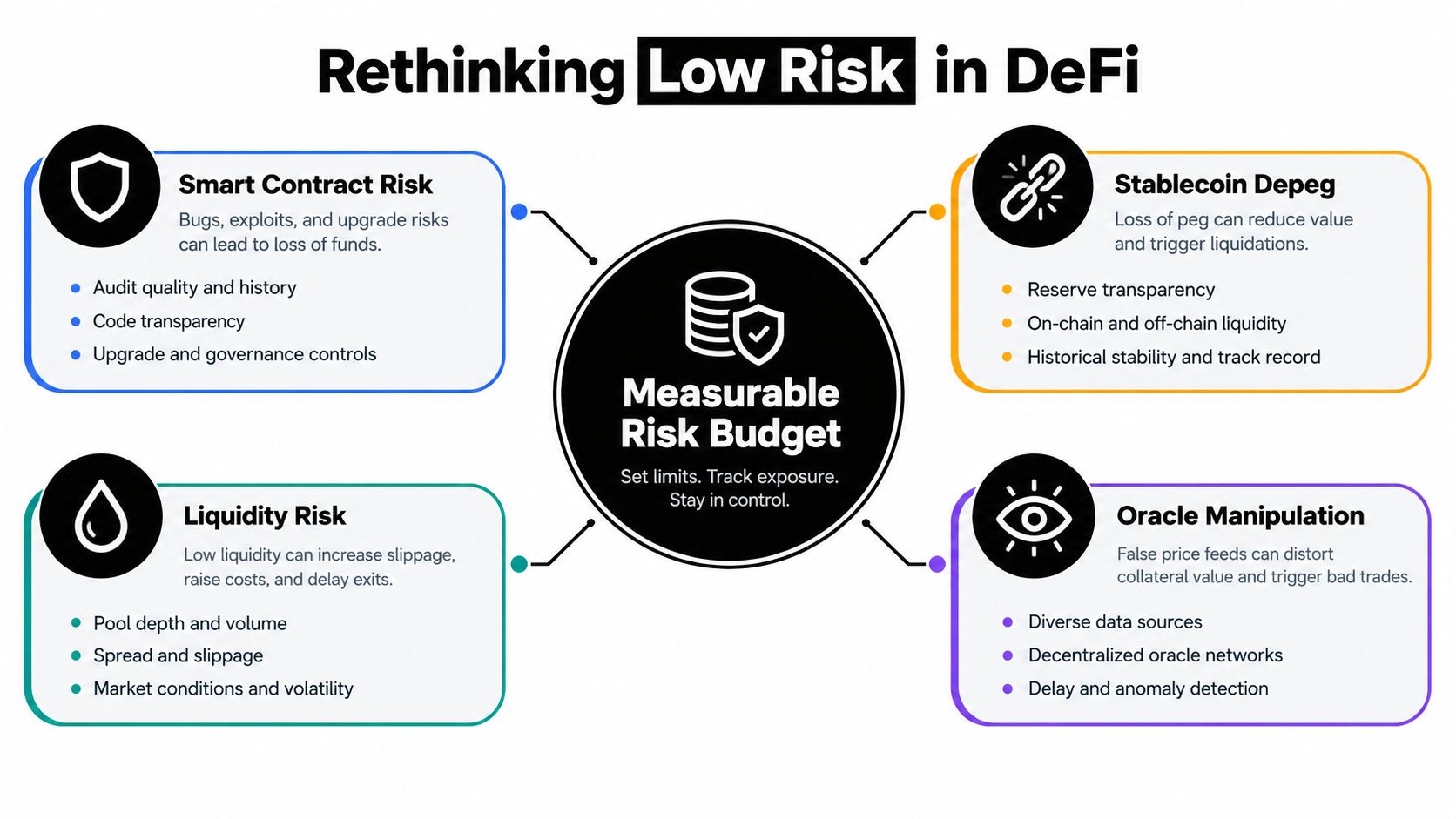
Turn the label into a risk budget
I use three separate tests for a genuinely conservative position:
Principal risk: What could make the amount of stablecoin you withdraw worth less than the amount deposited? Smart-contract exploits, a depeg, bad collateral, or an oracle failure belong here.
Access risk: Can you withdraw promptly, at close to the intended value, when utilization rises or liquidity disappears?
Income risk: How much of the quoted APY comes from variable lending interest, and how much comes from token emissions that can shrink or lose value?
These risks shouldn't be blended into one score. A strategy may have modest principal risk but meaningful access risk. Another may offer easy withdrawals while producing income that falls quickly when incentives change. “No lockup” only addresses one part of the problem.
Why stablecoin growth doesn't guarantee safety
Stablecoins became central to DeFi because they let users seek lending or liquidity income without taking the same direct directional exposure as a token-only strategy. CoinGecko reports that stablecoins represented roughly 2% of total crypto market capitalization at the start of 2020 and approximately 6% during the early DeFi expansion, while total stablecoin market capitalization later peaked at about $181.7 billion in 2021. By July 2024, it had recovered to approximately $161.2 billion, up 35.4% from $119.1 billion earlier in that period, according to CoinGecko's stablecoin market report.
Those figures establish demand for on-chain dollar liquidity. They don't establish that a specific pool is safe, that a stablecoin will hold its peg, or that a past APY will survive a change in utilization or emissions. My practical definition is narrower: low risk means a position fits a predetermined loss, access, and income budget after fees, slippage, incentives, and operational dependencies are considered.
Understanding the Core Risk Vectors in Yield Farming
Yield farming fails in recognizable ways. The contract can break, the asset can move away from its intended value, the exit can become expensive, or the price feed can report something that doesn't reflect a functioning market. These are separate failure modes, but they often reinforce one another during stress.

Smart contracts and governance
A lending market can be audited and still carry execution risk. Bugs, faulty integrations, unsafe upgrades, or unexpected interactions with another protocol can block withdrawals or impair collateral. Governance adds another layer. A proposal can alter supply caps, collateral parameters, incentives, or supported assets, changing the risk profile after you've deposited.
Aave's technical documentation identifies liquidity and smart-contract risk as core protocol risks. It also describes controls such as loan-to-value ratios, liquidation thresholds, supply caps, and borrowing caps as important mitigations in the Aave V3 technical paper.
Check the contract's operating history, audit scope, upgrade authority, emergency controls, and governance process. An audit is evidence of review, not an insurance policy. Conservative allocation also means limiting how much capital depends on one protocol, one chain, or one administrator.
Stablecoin depegs
A stablecoin is designed to track a reference value, but market confidence, redemption mechanics, reserves, liquidity, and collateral design can fail. A pool holding two assets can also suffer when one asset moves away from its intended value. The pool may continue functioning technically while your position becomes exposed to the weaker asset.
Don't treat “stablecoin” as a synonym for “cash.” Identify the issuer or collateral model, redemption route, exchange liquidity, chain presence, and dependencies on bridges or external custodians. A depeg test should ask what happens to your position if the asset trades below its intended value, not merely whether the interface still shows a withdrawal button.
Liquidity during an exit
Normal liquidity is a weak test. The relevant question is whether the market can absorb your withdrawal when utilization spikes, borrowers remain outstanding, or other depositors rush to leave. A position may be contractually withdrawable yet economically impaired by a queue, price impact, delay, or discount.
Before depositing, compare available liquidity with your intended position size. Watch utilization, borrow demand, withdrawal queues, redemption limits, and the depth of the market used to convert back to your preferred stablecoin. Keep a separate liquidity buffer rather than assuming every DeFi balance is immediately cash-like.
Oracles and bad prices
Lending protocols use price feeds to value collateral and determine liquidations. If an oracle relies on thin liquidity, stale data, or a manipulated venue, the protocol may calculate an unsafe loan or liquidate a healthy position. Oracle dependence is especially important when a strategy combines lending, magnified exposure, derivatives, or exotic collateral.
The practical warning signs are unusual price divergence, stale updates, abnormal trading volume, and governance changes to oracle sources. For a conservative strategy, simpler collateral and fewer pricing dependencies usually beat a complicated route with a marginally higher displayed return. More detail on identifying these failure modes is available in this guide to yield farming risks.
Comparing the Most Common Low-Risk Strategies
The safest choice depends on what you're trying to protect. If your priority is transparent income from a single stablecoin, lending is usually easier to inspect than a multi-asset liquidity strategy. If you want exposure to network staking rewards, liquid staking may fit, but it introduces validator, slashing, redemption, and asset-price considerations that stablecoin lending doesn't have.
Automated vaults sit between convenience and complexity. They can route capital across venues, but every additional contract, adapter, and rebalancing rule expands the surface area you need to trust. The table below is a decision aid, not a promise of returns.
Strategy | Risk Level | Typical APY Range | Complexity | Best For |
|---|---|---|---|---|
Single-asset stablecoin lending | Lower relative complexity | Variable, market-dependent | Low to moderate | Users prioritizing simple exposure and transparent lending mechanics |
Liquid staking | Moderate | Variable, network and market-dependent | Moderate | Users comfortable with validator, redemption, and underlying token risks |
Automated vaults | Moderate to high, depending on design | Variable, strategy-dependent | Moderate to high | Users who value automated allocation and accept additional contract dependencies |
Single-asset lending
In a lending market, deposited USDC or USDT is supplied to borrowers. Supplier income generally responds to utilization. When more available liquidity is borrowed, rates tend to rise; when demand falls, supplier yield tends to decline. That makes the rate variable, not guaranteed.
This is often the cleanest starting point because the return source is easier to separate from token incentives. It still carries contract, oracle, stablecoin, borrower, and withdrawal risks. Use protocol caps, diversify only when the benefit justifies added operational work, and avoid assuming that a large interface or familiar brand eliminates loss.
Liquid staking
Liquid staking represents a claim on staked assets while the underlying network earns staking rewards. The token can trade away from its expected value, redemptions can depend on validator and protocol conditions, and staking penalties or network events can affect outcomes.
Liquid staking isn't automatically conservative because the yield source sounds native to the chain. You're accepting both staking exposure and the market structure of the liquid token. It may suit a user who already wants that underlying asset, but it isn't a direct substitute for stablecoin income.
Automated vaults
Vaults package allocation, compounding, or rebalancing into a contract. They reduce manual monitoring, but they don't remove risk. A vault can hold several protocols, use adapters, rely on incentives, or execute trades during unfavorable liquidity conditions.
When comparing products, inspect the strategy logic, allowed protocols, withdrawal process, fee model, emergency procedures, and exposure limits. For broader context on assessing monetization alongside downside, this crypto risk analysis resource can complement protocol-level due diligence.
How to Evaluate APY Against Real Risk Exposure
Start by decomposing the yield instead of accepting the headline. Separate base lending interest, trading or liquidity income, governance-token rewards, points, and any temporary subsidy. A strategy whose quoted APY depends heavily on a reward token has a different risk profile from one earning mostly through borrower demand.
DeFi research emphasizes that risk-adjusted yield requires stress testing liquidity and depeg scenarios. Conventional performance ratios can omit impermanent loss, smart-contract vulnerabilities, oracle dependence, governance risk, and regulatory uncertainty, as discussed in this study of liquidity-pool risk and returns.
A practical underwriting sequence
Map the position. List the stablecoin, chain, protocol, contracts, oracle sources, bridges, collateral, and withdrawal route. If you can't draw the path from deposit to withdrawal, you don't understand the exposure yet.
Calculate exposure-weighted yield. If capital is split across strategies, weight each expected return by its allocation. Then subtract expected gas, slippage, withdrawal costs, and the effect of reward-token volatility. A higher gross APY can produce a lower realized return after those adjustments.
Run the depeg scenario. Model the position under a 1–5% depeg, using the range described in the risk framework rather than treating the stablecoin as perfectly fixed. Ask how much of the position remains exposed, whether a pool rebalances into the weaker asset, and whether a redemption route remains available.
Test withdrawal depth. Compare available liquidity with your position size. Check utilization, reserves, queue mechanics, redemption limits, price impact, and whether an exit depends on a bridge or another protocol.
Score durability. Mark how much return comes from organic borrowing demand versus emissions. A sudden APY spike deserves investigation, not celebration. Incentives can disappear, token prices can fall, and participation economics can become unsustainable.
A useful checklist resembles other risk-scoring disciplines, including scoring dark web exposure for clients. The point isn't to create false precision. It's to force consistent questions before you compare opportunities.
For changing market rates and the mechanics behind them, use this guide to DeFi yield farming rates. Rates are observations at a point in time, not commitments about what your position will earn.
Practical rule: If you can't explain why the yield exists, assume you're being paid to accept a risk you haven't mapped.
Automating Low-Risk Strategies with Yield Seeker
Manual farming becomes difficult when rates, utilization, incentives, and liquidity change across several dashboards. A conservative process still needs monitoring after the initial deposit. Someone has to notice when a protocol becomes too concentrated, when a reward source weakens, or when a withdrawal route becomes less attractive.
Yield Seeker is designed for that monitoring and allocation workflow. Users can deposit as little as $10 USDC on Base, then use an AI Agent to monitor and allocate capital across DeFi protocols in real time. The product offers risk-aware yield selection, no lockups, and no withdrawal fees, according to the provided product information.
The useful distinction is between automation and delegation. Automation can reduce repetitive rate checking and reallocation. Delegation doesn't eliminate the need to understand the strategy, its allowed protocols, or the conditions that trigger movement. Users should still review exposure limits, supported assets, withdrawal mechanics, and how the platform handles changing market conditions.
What the workflow looks like
A practical deployment starts with a small test deposit, confirmation that the balance and earnings display correctly, and a review of the strategy's stated risk parameters. The agent can then monitor eligible opportunities and allocate capital according to the configured approach rather than leaving the user to compare fragmented lending markets manually.
Real-time inputs matter because DeFi conditions change quickly. A system that combines protocol data, liquidity information, and current market context has more useful inputs than a static APY list. Teams building similar monitoring systems may also find a real-time web context API useful for gathering changing information, although data collection alone doesn't replace protocol risk controls.
The important benefit is operational consistency. A human may check rates enthusiastically for a few days and then stop. Automated monitoring can apply the same allocation rules repeatedly, while the user retains responsibility for choosing an appropriate risk budget and deciding how much capital to deploy.
For a deeper look at the operational model, see this explanation of yield farming automation. The right expectation is not guaranteed yield. It's less manual work, clearer monitoring, and a more repeatable process for managing stablecoin exposure.
Building Your Low-Risk Yield Farming Checklist
A workable checklist should fit on one screen:
Define the budget: Set separate limits for principal loss, delayed access, and income volatility.
Start with structure: Prefer single-asset lending and audited, long-operating contracts before adding multi-asset pools, or complex vault routes.
Cap concentration: Limit exposure by protocol, stablecoin, chain, and strategy rather than treating all stablecoin yield as interchangeable.
Inspect the return: Separate base interest from emissions, points, and reward-token assumptions.
Stress the exit: Test a depeg, higher utilization, reduced liquidity, oracle disruption, and a crowded withdrawal environment.
Watch governance: Review parameter changes, supply caps, collateral rules, oracle updates, and emergency actions.
Keep liquidity aside: Don't deploy funds needed for near-term expenses into a position whose exit depends on market depth.
Reassess when conditions change: A sudden APY increase, new dependency, withdrawal delay, or sharp utilization move should trigger review.
Low risk isn't a permanent property of a protocol. It's a relationship between the strategy and your limits. A simple position that you understand, can exit, and can monitor may be more appropriate than a higher-paying strategy whose return depends on several correlated assumptions.
Yield Seeker helps automate stablecoin yield monitoring and allocation on Base, with deposits from $10 USDC, no lockups, and no withdrawal fees. Review the available approach and start with an amount that fits your own Yield Seeker risk budget.