
Machine learning brings a dose of automated, data-driven smarts to the wild world of decentralized finance. It's about using complex algorithms to chew through mountains of market data, spot trends, and execute strategies way faster and more accurately than any human could. The end goal? Better returns and smarter risk management, all without you having to stare at charts 24/7.
A Smarter Approach to Decentralized Finance
The DeFi landscape is buzzing with opportunity, but let's be honest—it's incredibly complex and can be overwhelming. Trying to manually chase the best yields across hundreds of different protocols is a full-time job, a high-stakes game that very few people can win consistently.
This is exactly where machine learning in DeFi comes in. Think of it as having a team of tireless financial analysts working for you around the clock.
To really get what this means, it helps to understand the bigger picture of What Is Artificial Intelligence in Business. In DeFi, it acts like an expert system that’s constantly sifting through market data, predicting which lending pools will offer the best returns, and making automated decisions to protect and grow your funds.
Automating Opportunity and Managing Risk
Bringing AI into DeFi platforms is completely changing how we interact with the market. AI-driven protocols can spot patterns in the noise that would otherwise stay hidden, automate routine tasks, and help make much better decisions about where to put capital. This is especially huge on Ethereum, which still controls 63.4% of the entire DeFi market, making any AI integration there incredibly impactful.
This shift really boils down to two massive advantages:
Reduced Human Error: Automation takes away the clumsy mistakes that happen with manual trading and miscalculations.
Improved Risk Assessment: AI can process countless variables at once to get a much clearer picture of risk, which is critical when the market gets choppy.
Think of it this way: While a human investor might track a dozen protocols, an AI agent can monitor thousands simultaneously, analyzing everything from transaction volume and liquidity depth to smart contract interactions, all in real time.
Visualizing AI-Powered DeFi
Platforms like Yield Seeker put this into practice by using intelligent AI agents to automatically generate stablecoin yields. This approach means you don't have to become a financial wizard yourself. The dashboard below is a great example of how all that complex data gets simplified into a clean, easy-to-use interface.

This kind of interface gives you a live look at how your portfolio is doing, showing you how the AI agent is actively managing your assets to get the best returns. It translates the machine's complex number-crunching into simple, understandable metrics, making sophisticated DeFi strategies accessible to anyone.
How AI Makes Sense of the DeFi Market
At its heart, machine learning in DeFi is all about turning a firehose of raw data into smart predictions and, eventually, automated actions.
Think about it this way. If you wanted to find the safest, highest-yielding place for your crypto, what would you do? You’d probably check out historical interest rates, look at transaction volumes, and maybe even scroll through Twitter to see what people are saying.
An AI model does the exact same thing, just on a completely different scale. It doesn't just glance at a few data points; it crunches millions of them every single second to build a living, breathing picture of the entire DeFi ecosystem. This allows it to make decisions that are not only faster but also way more informed than any human could ever hope to be.

To pull this off, the AI needs a constant stream of information. This data is the fuel for its engine, and it typically comes from three main places.
The Three Pillars of DeFi Data
An AI agent’s market savvy is only as good as the data it’s fed. A truly effective model needs to pull information from three distinct sources to get the full picture.
On-Chain Data: This is the ground truth—direct, verifiable information straight from the blockchain. We're talking about every trade on a decentralized exchange (DEX), every smart contract interaction, liquidity pool sizes, and gas fees. Think of it as the official public ledger for everything happening in DeFi.
Off-Chain Data: This bucket covers all the relevant stuff happening outside the blockchain. It could be breaking market news, developer activity on platforms like GitHub, or sentiment analysis from social media. This off-chain data adds critical context that the on-chain numbers alone just can't provide.
Oracle Data: Oracles are the secure messengers that bring reliable off-chain data (like the real-world price of ETH from centralized exchanges) onto the blockchain. This is vital for smart contracts and AI models that need to react to external events, making sure their decisions are based on accurate, real-world info.
By weaving these three data types together, an AI can see not just what is happening, but also start to understand why it's happening.
From Data to Predictions
Once the AI has all this data, it uses specialized machine learning models to spot patterns and make forecasts. These aren't just wild stabs in the dark; they're statistical probabilities calculated from historical and real-time information.
For instance, by analyzing thousands of past liquidity pool deployments, an AI can learn to identify the early warning signs of a "rug pull" or a protocol vulnerability. It connects subtle on-chain actions with historical outcomes to flag high-risk situations.
Different models are used for different jobs, just like you'd use a different tool for each task in a workshop. Two of the most common approaches are regression and classification.
Regression Models for Forecasting: These models are built to predict a continuous number. In DeFi, a regression model might forecast the future Annual Percentage Yield (APY) of a lending protocol by looking at its past rates, current liquidity, and broader market conditions. This is exactly how an AI agent like Yield Seeker’s can decide where to move capital for the best returns.
Classification Models for Identification: These models are used to sort data into specific categories. A classic use case is fraud detection, where a model analyzes a transaction and labels it as either "legitimate" or "suspicious." It learns the tell-tale signs of shady activity—like weird transaction sizes or interactions with known scammer wallets—and flags them instantly.
This one-two punch of comprehensive data collection and targeted modeling is what powers intelligent DeFi. It takes the chaotic, fast-moving market and turns it into a structured environment where an AI agent can systematically find opportunities, manage risks, and execute strategies to boost performance and security for its users.
Practical Ways Machine Learning Is Upgrading DeFi
Enough with the theory. Let's get down to brass tacks and see how machine learning in DeFi is actually solving real problems and opening up new doors. This isn't about some far-off algorithmic dream; it's about delivering real benefits like better returns, tighter security, and a whole lot less manual grunt work for users. The most powerful applications are already live, changing how we move capital and manage risk across the decentralized world.
One of the most valuable jobs for AI is dynamic yield optimization. This is the art of automatically sniffing out and pouncing on the best returns available at any given moment.
Imagine trying to manually compare APYs across dozens of lending protocols—think Aave, Compound, and a host of smaller, newer platforms. By the time you do the research, make a decision, and move your funds, the rates have probably already shifted. An AI agent, on the other hand, does this 24/7. It crunches yield histories, liquidity levels, and even predictive signals to shuttle capital to the highest-performing, risk-adjusted pools on your behalf.
Automated Yield Optimization in Action
This hands-off approach is a complete game-changer, especially as the DeFi market continues its explosive growth. All that capital flooding in creates a ridiculously complex landscape where trying to optimize yield manually just isn't practical for most people. The numbers tell the story: the market ballooned from just $9.1 billion in July 2020 to $55.95 billion locked in DeFi platforms by January 2024. Projections from ElectroIQ see it hitting $78.49 billion by 2030, which just screams for automated tools that can handle this complexity.
Platforms like Yield Seeker use this exact strategy. A user's personalized AI agent can:
Monitor hundreds of pools in real-time.
Calculate gas fees and potential slippage to make sure a move is actually profitable.
Execute transactions automatically to grab those fleeting high-yield opportunities.
It's a world away from the old method of parking your funds in one protocol and hoping for the best, likely missing out on better returns popping up elsewhere. To get a better feel for how these systems operate, check out our guide on how to use AI agents.
Advanced Risk Assessment and Scoring
Beyond chasing yield, machine learning gives us a much sharper lens for looking at risk. Traditional DeFi risk analysis often stops at simple metrics like Total Value Locked (TVL) or whether a protocol has been audited. AI goes so much deeper.
Models can be trained to comb through smart contract code, flagging functions or patterns that have shown up in past exploits. It’s like having an automated security researcher constantly on the lookout for weak spots.
But it doesn't stop there. AI can also run economic risk scoring. It simulates extreme market events—think a "flash crash" or a major liquidity crunch—to see how a protocol might hold up under pressure. By pinpointing which protocols are more resilient, an AI agent can steer clear of those that might crack when things get volatile.
For instance, an AI might spot that a protocol's stability is leaning too heavily on a single, volatile asset. It would then slap a higher risk score on it and either avoid it completely or just allocate a smaller slice of your capital, shielding your portfolio from that concentrated risk.
Proactive Fraud and Anomaly Detection
DeFi’s open and permissionless nature is one of its superpowers, but it also rolls out the red carpet for bad actors. Machine learning steps in as a critical line of defense through fraud and anomaly detection.
AI models learn what "normal" on-chain behavior looks like—for a specific wallet, a protocol, or even the entire network. They analyze everything from transaction patterns and contract interactions to the flow of funds. When something strays too far from that baseline, it gets flagged as a potential threat.
This could be anything from:
A wallet suddenly interacting with a known scam address.
A new smart contract deploying with code that looks suspiciously like a phishing attack.
Weird transaction volumes flowing into a low-liquidity pool, which can be a classic setup for a pump-and-dump.
By catching these oddities early, AI-powered security can warn users or even block malicious transactions before any funds are lost. It’s a proactive stance that’s essential for building trust and making DeFi safer for everyone. In short, these smart algorithms become a digital immune system for your assets.
To wrap things up, here's a quick summary of how these different ML applications are making a difference in the DeFi space.
Machine Learning Applications in DeFi
Use Case | Problem Solved | Example ML Approach |
|---|---|---|
Yield Optimization | Manual yield farming is slow and inefficient; users miss out on better returns. | Reinforcement learning or predictive models that rebalance assets across pools based on APY, gas costs, and risk. |
Risk Scoring | Simple metrics like TVL don't capture code vulnerabilities or economic instability. | Anomaly detection on smart contracts; stress testing simulations for protocol resilience under market shocks. |
Oracle Price Prediction | Price oracles can lag or be manipulated, leading to liquidations and bad trades. | Time-series forecasting (e.g., LSTMs) to predict price movements and identify oracle data deviations. |
Fraud & Anomaly Detection | Bad actors exploit the open nature of DeFi for scams, hacks, and rug pulls. | Clustering and classification models to identify unusual transaction patterns that deviate from a user's or protocol's baseline. |
Liquidity Management | Protocols struggle to maintain optimal liquidity, leading to high slippage or inefficient capital use. | Predictive models that forecast trading volume and user behavior to adjust liquidity provider incentives dynamically. |
As you can see, the applications go far beyond just chasing higher numbers. They're about making DeFi smarter, safer, and ultimately more accessible for everyone involved.
The Lifecycle of a DeFi AI Model
Building an AI that can actually win in the wild, fast-paced world of DeFi is a surprisingly structured process. You don't just flip a switch and let some black box go to town with your capital; it's a careful cycle of prepping data, training models, and then testing them relentlessly. This whole lifecycle is designed to make sure a model isn't just "smart," but also tough and reliable enough for the high-stakes DeFi arena.
It all kicks off with data collection and preprocessing. Think of an AI model like a student—it can only learn from the books you give it. This first step is all about vacuuming up huge amounts of raw data from everywhere: on-chain transaction histories, smart contract event logs, off-chain social media sentiment, even macroeconomic indicators. This data is usually a total mess, so it has to be cleaned up, normalized, and arranged into a neat format the model can actually make sense of.
From there, we get to one of the most important parts of the whole game.
From Raw Data to Actionable Signals
The next phase is feature engineering, which is really more of an art form. This is where we turn that clean, structured data into meaningful signals, or "features," that the AI can actually learn from. A raw transaction amount by itself doesn't tell you much, but when you start combining it with other data points, it can become a powerful clue for predicting what happens next.
For example, a model might weave together:
The transaction amount.
The gas fee paid.
The time of day.
The historical activity of the wallet.
Suddenly, these separate points create a single feature that could signal anything from a routine swap to a potential security threat. This part of the process demands some serious domain expertise—you need to know both DeFi and machine learning inside and out to pick and create features that truly capture how the market moves and where the risks are. Without solid feature engineering, even the most powerful algorithm is flying blind.
Once we have a rich set of features, the model is ready for training. We feed it historical data and let it chew on the complex relationships between all those market signals and what they led to. To get a feel for different ways this is done, you can learn more about how various machine learning trading algorithms are built.
This flow chart gives you a simplified look at how an AI agent optimizes capital, assesses risk, and spots fraud in DeFi.
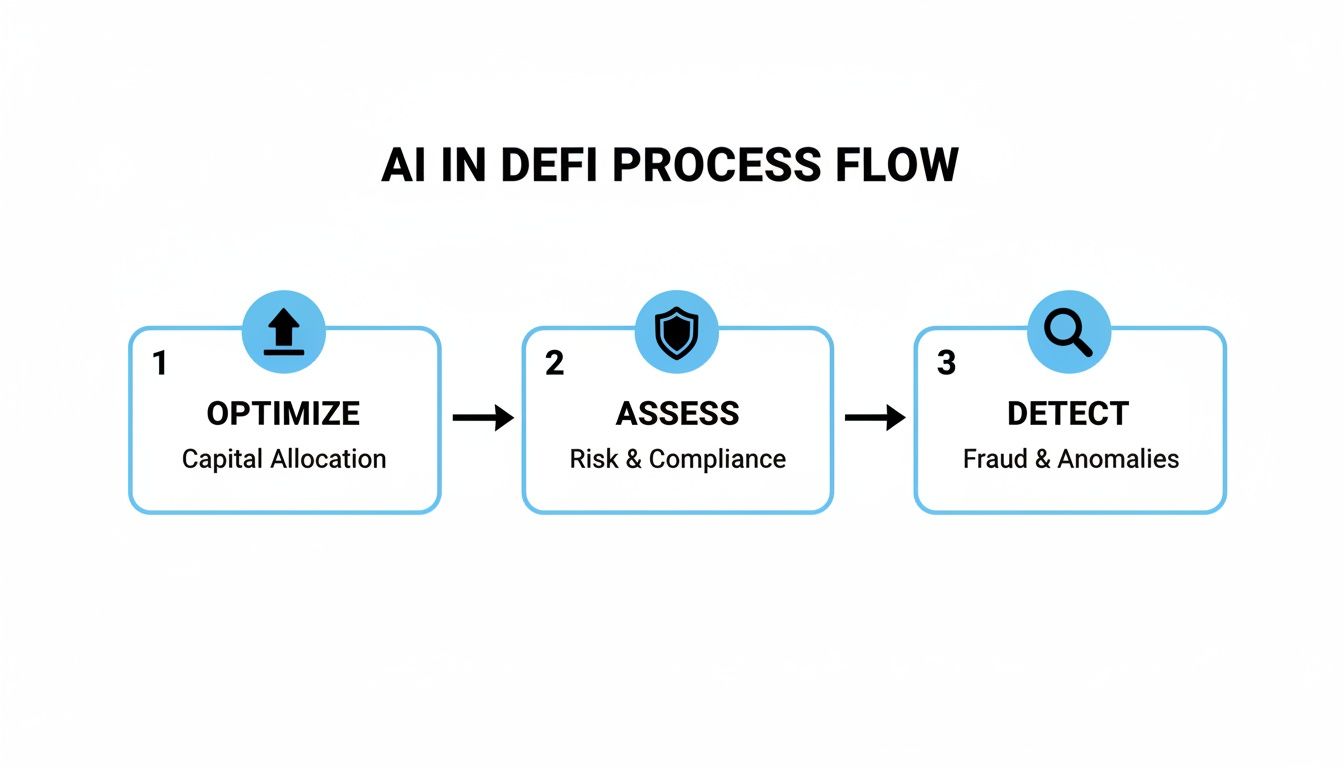
As you can see, it's a continuous loop: find yield opportunities, evaluate the risks tied to them, and always be on the lookout for anomalies. This is the core job of a DeFi AI agent.
The Critical Gauntlet of Backtesting
After its initial training, the model faces what is arguably the most crucial stage: rigorous backtesting. This is where we simulate the model's strategy against historical market data to see how it would have actually performed. But backtesting in DeFi is a different beast altogether, with unique headaches you just don't find in traditional finance.
A simple simulation that just ignores real-world blockchain constraints is totally useless. To be worth anything, a backtest has to grapple with:
Gas Fees: Transaction costs on chains like Ethereum can swing wildly. A strategy that looks like a winner on paper can easily become a money pit once you factor in what you'd actually pay in gas.
Network Latency: Transactions aren't instant. The model has to account for the time it takes for a transaction to get confirmed on-chain, because the market can flip in a matter of seconds.
Slippage: Big trades move prices in liquidity pools. The backtest has to accurately simulate this price impact, or "slippage," to give you a realistic picture of what your returns would have been.
A classic trap here is 'lookahead bias,' where a model accidentally gets information during a simulation that it wouldn't have had in real time. Painstakingly designed backtesting frameworks are built specifically to prevent this, making sure the AI's performance is judged fairly and honestly.
Only after a model has proven it can be profitable and resilient through this brutal backtesting gauntlet is it even considered for deployment. This methodical, step-by-step lifecycle—from a pile of raw data to a battle-tested strategy—is what's behind building machine learning in DeFi tools that are not just effective, but truly trustworthy.
Understanding the Risks and Future of AI in DeFi
While plugging machine learning into DeFi brings a ton of power, it’s no silver bullet. This tech introduces its own unique set of headaches and risks that need to be handled with a clear-eyed, proactive approach. Getting a handle on these weak spots is the first step to building intelligent finance systems that are actually resilient and trustworthy.
One of the biggest worries is something called adversarial attacks. This is basically where bad actors deliberately feed a model garbage data to trick it into making terrible decisions.
Imagine a scammer faking a bunch of trading volume to make a worthless token look like the next big thing, fooling an AI into throwing capital straight into a rug pull. These attacks are designed to exploit the very data an AI depends on to see the world.
Another major vulnerability is model risk, particularly the danger of an AI completely failing to cope with sudden, off-the-charts market chaos. Models are trained on historical data, which makes them experts on the past.
But what happens during a “black swan” event—a freak market crash or a brand-new exploit that nobody has ever seen before? An AI trained on normal, everyday market behavior might just freeze up or, even worse, make catastrophic decisions because its training data never prepared it for such a wild outlier.
Mitigating New Forms of Risk
Protecting against these sophisticated threats demands a multi-layered defense strategy. You can't just deploy a model and cross your fingers.
Continuous Model Monitoring: An AI's performance can degrade over time as the market shifts under its feet. You have to constantly monitor it to spot when its predictions start drifting away from reality. This lets teams retrain or tweak the model before it causes any real damage.
Human-in-the-Loop Safeguards: For the really big, high-stakes decisions, you absolutely need a human expert in the mix to provide a final sanity check. This approach blends the raw speed of AI with the contextual judgment only a person can provide, creating a powerful safety net. A human can hit the emergency brake if an AI starts acting erratically during a market meltdown.
The goal isn't to create some perfect, all-knowing AI—that’s just not realistic. It’s about building a robust system where automated intelligence is balanced with sharp human oversight and solid risk-management guardrails.
The Future of Intelligent DeFi
Looking down the road, the evolution of machine learning in DeFi is set to make the whole ecosystem more secure, transparent, and easier to get into. The adoption of AI in finance is definitely picking up steam. In fact, data from the Bank of England shows over 75% of UK financial firms are already using AI in some capacity.
The big strategic shift expected by 2026 is moving away from clunky, general-purpose models toward specialized AI agents built for specific financial jobs. You can dive deeper into this trend and other 2026 predictions at EKMH Innovators.
This trend points toward a future dominated by a couple of key developments.
First, we're going to see the rise of verifiable on-chain intelligence. This means creating models whose decision-making processes are totally transparent and can be cryptographically proven on the blockchain. This will let users trust not just the final outcome, but the actual process an AI used to get there, bringing a whole new level of accountability to automated systems.
Second, specialized AI agents will become the standard. Instead of one massive model trying to do everything, we’ll see whole ecosystems of agents, each an expert in its own little domain—one for risk assessment, another for yield optimization, and yet another for security monitoring. As we look to the horizon of AI in DeFi, advanced technologies like Large Language Models (LLMs) present both groundbreaking opportunities and novel challenges that warrant careful consideration.
These are the trends paving the way for a more mature DeFi, one where AI acts as a reliable and powerful co-pilot for navigating the wild world of financial markets.
How to Begin Your AI-Powered DeFi Journey
Jumping into the world of machine learning in DeFi can feel like a massive leap, but getting your feet wet is way easier than you might think. It’s all about finding an entry point that fits your comfort level. For most people, that means starting with a platform that does all the heavy lifting for you.
Services like Yield Seeker are built to hide all the gnarly complexity of AI models and on-chain wizardry. Instead of worrying about building data pipelines or training algorithms, you can plug into a system that’s already dialed in for security and performance.
The whole point is to give you the upside of AI without needing a data science degree. This approach makes intelligent DeFi accessible to everyone, from seasoned crypto natives to busy professionals who just want their stablecoins to do more.
Your First Steps with an AI Agent
If you're new to the idea of automated yield, the whole process is designed to be as simple as possible. Getting your very own AI agent up and running only takes a couple of minutes.
Create Your Account: First things first, you'll set up a secure account. This usually just involves connecting a Web3 wallet you already use, which means you’re always in full control of your funds.
Make Your First Deposit: You can start small with a stablecoin like USDC. This is a great way to get comfortable with how the platform works and see your AI agent in action without a huge commitment.
Monitor Your Agent: Once it's funded, your personalized AI agent gets right to work. It starts scanning the market for high-yield opportunities and smartly allocates your capital across different audited DeFi protocols. A clean dashboard shows you exactly what it’s up to and how your earnings are stacking up in real time.
This hands-off approach is the quickest way to get an AI crypto advisor working to optimize your portfolio 24/7.
For Developers and Advanced Users
Now, if you're a developer or just a more technical user who loves to get their hands dirty, the path is a bit different but just as rewarding. The DeFi ecosystem is packed with incredible tools and data resources for building your own ML applications.
Explore Public Data Sources: Tools like Dune Analytics and The Graph are goldmines. They offer powerful APIs to query massive amounts of on-chain data—the raw fuel you need to train any custom model.
Use Open-Source ML Libraries: Frameworks like TensorFlow and PyTorch are the industry standard for building and training machine learning models. You can combine these with DeFi data to start tinkering with your own predictive strategies.
Whether you opt for a ready-made platform or decide to build from the ground up, there’s a clear path for anyone to start exploring the powerful intersection of AI and decentralized finance.
Got Questions About AI in DeFi?
Dipping your toes into the world where AI and decentralized finance meet can definitely bring up a few questions. Let's tackle some of the most common ones to clear things up and show you how machine learning in DeFi really works on the ground.
Is It Safe to Let an AI Manage My Funds?
This is always the first and most important question. Your security is everything.
Properly built platforms are always non-custodial, which means you, and only you, ever have control of your funds in your own wallet. The AI agents are given very specific, limited permissions. They can move capital between heavily audited and well-known DeFi protocols to chase yield, but they can never withdraw your assets.
On top of that, these systems are built with serious risk management frameworks. They undergo constant monitoring and are backtested like crazy to ensure the AI stays within safe, pre-approved boundaries. The key is to stick with platforms that are completely transparent about their security practices and the protocols they interact with.
Do I Need a PhD in Machine Learning to Use This Stuff?
Not at all. Actually, the whole point of platforms like Yield Seeker is to take incredibly advanced financial strategies and make them dead simple for anyone to use. The user experience is designed to be as straightforward as possible.
You just deposit your funds, and the AI agent handles all the heavy lifting—the research, the number-crunching, and the execution. While you can always dig into the strategies and learn more if you're curious, you don't need any technical AI or coding skills to get going and start earning.
Think of it this way: we’re taking the complexity and hiding it under the hood. You get the brainpower of an entire data science team without needing to be one. The tech does the work, you watch the results.
How Is an AI Agent Different from a Regular Old Trading Bot?
It’s a great question, and while they both automate things, the real difference comes down to intelligence and the ability to adapt.
A standard trading bot is pretty rigid. It just follows a simple set of rules you give it, like "if the price of ETH drops by 5%, then sell." It can't think outside of that box.
An AI agent, on the other hand, is powered by machine learning and is constantly learning from huge datasets—both historical and real-time. It can pick up on incredibly complex patterns, adjust its game plan when market conditions change on a dime, and make predictive calls that are way beyond basic "if/then" rules. This lets it manage risk and hunt for yield in a much more dynamic and sophisticated way.
Ready to see what an AI agent can do for your stablecoins? Yield Seeker gives you a simple and secure way to get started. You can deposit as little as $10 USDC and let your own personalized AI Agent find and manage the best yield opportunities out there. Start your journey with Yield Seeker today.