
A one-standard-deviation rise in a bank's CDS premium, roughly 0.6 percentage points, led other banks to delay payments by about 2.5 minutes on average after Lehman's collapse, while aggregate delays later peaked near 25 minutes per day. In DeFi, every yield source introduces another counterparty, whether it's a protocol, liquidity pool, bridge, custodian, or governance system, so the practical task is separating necessary dependencies from optional ones.
You may be looking at a stablecoin vault today because its yield appears attractive and withdrawals seem simple. The dashboard shows a balance, the contract is non-custodial, and the strategy looks automated. Then a contract exploit, oracle failure, liquidity drain, or collateral depeg turns a routine allocation into a capital-recovery exercise.
The mistake is treating “non-custodial” as “counterparty-free.” You still depend on code, administrators, market makers, bridges, asset issuers, and the people who govern the system. Managing counterparty risk means identifying those dependencies before depositing, limiting how much any one failure can damage, and monitoring conditions closely enough to act before liquidity disappears.
Why Counterparty Risk Is Your Real Yield Tax
A protocol can fail without a borrower personally defaulting. The smart contract may calculate collateral incorrectly. An oracle may report a distorted price. A liquidity pool may no longer support orderly exits. A bridge may fail to deliver the asset represented on the destination chain. Each event creates a form of counterparty exposure, even when no traditional bank holds your funds.
That's why a high advertised yield should be read as compensation for a risk stack, not as free income. If a strategy routes stablecoins through several contracts, each additional dependency can add another failure path. The yield might be generated by lending demand, trading fees, token incentives, borrowed capital, or a combination of mechanisms. Your job is to understand which risk produces the return.

The banking lesson still applies
The 2008 financial crisis showed how quickly bilateral exposures can transmit stress through payment and derivatives markets. BIS materials explain that OTC derivatives have been tracked semi-annually since 1998, and identify netting and collateral agreements as the main tools used to reduce counterparty credit risk (BIS summary of OTC derivatives and counterparty risk).
The lesson isn't that DeFi should copy banks mechanically. It's that exposure must be mapped, legally or technically enforceable protections must be tested, and gross balances shouldn't be mistaken for realizable value. In traditional markets, netting reduces the amount exchanged between parties. In DeFi, smart contracts may automate settlement, but automation doesn't guarantee that the code, collateral, or liquidity will work under stress.
Practical rule: Treat every yield leg as a dependency that can fail independently, then ask whether the extra return justifies adding it.
A useful first pass is to classify each source of yield as essential, replaceable, or optional. The stablecoin itself may be essential to the strategy. A particular bridge, governance token incentive, or liquidity loop with borrowed funds may be optional. Remove optional layers unless you understand exactly what they contribute and how you'll exit when conditions deteriorate.
Mapping Your Exposure in DeFi Protocols
Start with the asset in your wallet, then trace every contract and market it touches. A stablecoin deposited into a lending protocol may expose you to the protocol's code, its oracle, the borrowers using the market, the collateral they post, and the stablecoin issuer. A liquidity position adds the automated market maker, the paired asset, trading activity, and the mechanics that determine whether your position can be withdrawn at a fair value.
That's different from a simple credit default. A borrower can fail while the lender still has enforceable collateral and a functioning liquidation process. A smart-contract failure can disrupt the accounting, block withdrawals, misprice collateral, or make the intended recovery mechanism unavailable. The loss can arise from operational failure, market failure, or credit failure, and those categories can overlap.
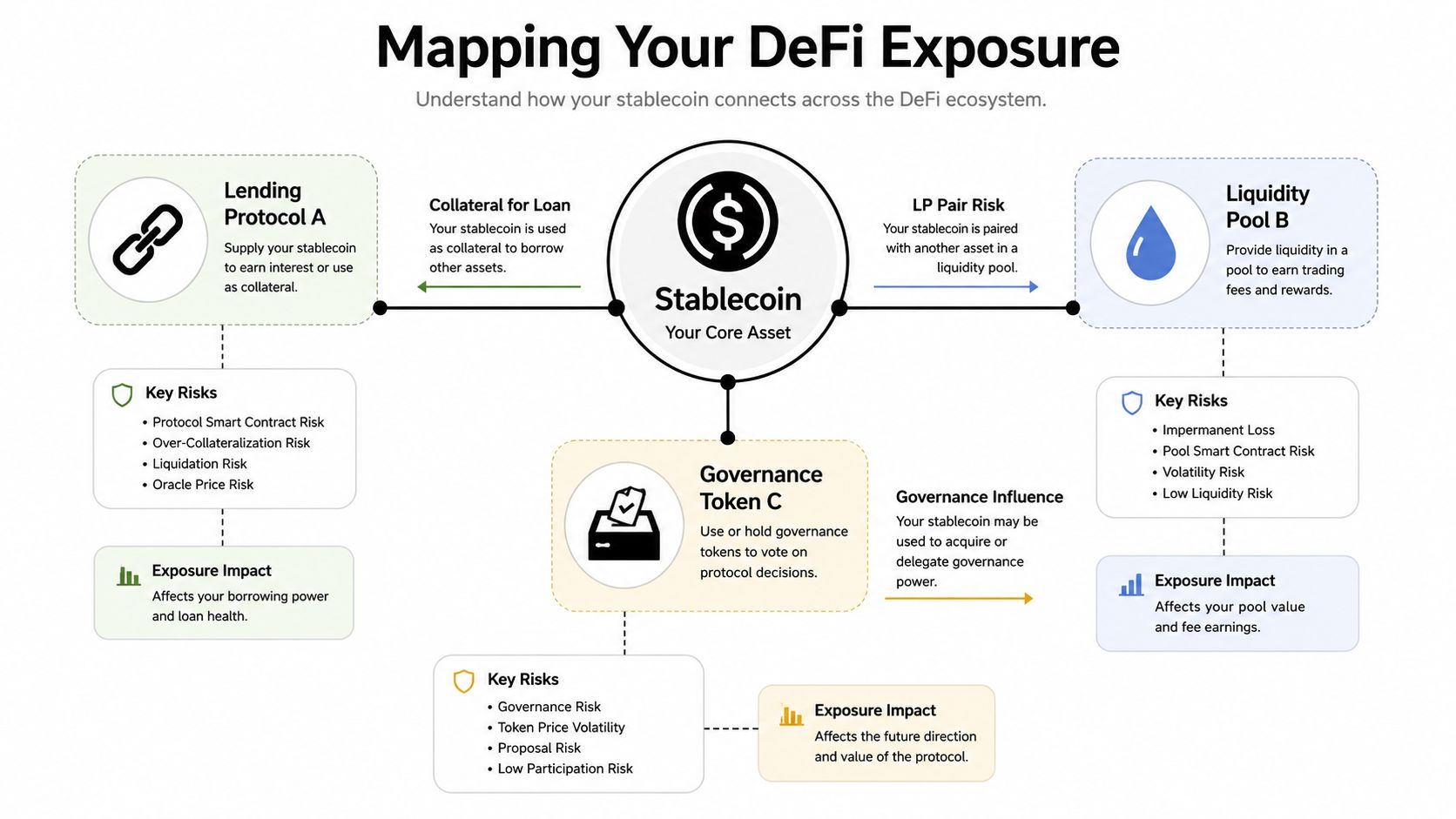
Build a dependency map
Use a simple table for every position. Don't record only the token symbol and current balance.
Layer | Question to answer | Failure you're testing |
|---|---|---|
Asset issuer | Who creates or redeems the stablecoin? | Depeg, redemption restriction, reserve concern |
Contract | Which contracts hold or route the funds? | Exploit, faulty upgrade, paused withdrawals |
Market | Who borrows, trades, or provides liquidity? | Bad debt, liquidity shortage, adverse price movement |
Governance | Who can change parameters or halt activity? | Malicious proposal, compromised admin, rushed upgrade |
Infrastructure | Which chain, bridge, oracle, or keeper is required? | Chain congestion, bridge loss, stale pricing |
Permissionless access doesn't eliminate these questions. It changes where the evidence sits. You can inspect contract addresses, administrator permissions, upgrade mechanisms, transaction history, liquidity distribution, and governance activity on-chain. Permissioned pools may provide stronger onboarding and legal recourse, but they also introduce reliance on an operator and its controls.
For lending strategies, identify both the protocol and the borrowers' collateral. For liquidity pools, examine both assets in the pair, not just the stablecoin you deposited. For an incentive-bearing strategy, trace whether the reward depends on a governance token whose value can fall when users rush for the exit.
The same mapping discipline applies outside DeFi. If you're comparing an on-chain lending venue with a peer-to-peer structure, it helps to navigate peer-to-peer lending rules so you can distinguish platform, borrower, and regulatory exposures rather than treating every yield product as the same type of risk.
This short explainer can help visualise how exposure moves through interconnected financial systems:
Write the dependency map before you compare yields. A lower-yield strategy with one transparent lending market may be easier to control than a higher-yield route that depends on a bridge, a boosted pool, and an opaque reward mechanism.
The Essential Due Diligence Checklist
Do the review before the first deposit, not after the first warning. An audit is useful evidence, but it isn't an insurance policy. It may cover a particular contract version, exclude economic exploits, or fail to identify an interaction between contracts that looks safe in isolation.
Check the mechanism before the marketing
First, explain the yield in one sentence without using promotional language. “Borrowers pay interest against posted collateral” is testable. “The strategy captures market inefficiencies” requires much more investigation.
Then inspect:
Contract scope: Confirm which contracts the audit reviewed, whether the deployed addresses match, and whether the system has changed since review.
Upgrade authority: Identify who can upgrade, pause, change fees, alter collateral parameters, or redirect funds. A multisignature wallet can reduce single-key dependence, but you still need to understand its signers and powers.
Oracle design: Find the price sources, update process, fallback behaviour, and response to thin liquidity.
Withdrawal path: Trace the exact transaction sequence required to exit. A displayed balance isn't the same as immediately available liquidity.
Economic incentives: Separate organic revenue from token emissions. Incentives can attract liquidity, but they can also create reflexive selling pressure.
Test concentration and behaviour
Look beyond total value locked. Ask how much liquidity sits in a small number of addresses, whether one asset dominates collateral, and whether a few transactions could materially change available exit liquidity. You don't need a precise score to identify a fragile structure. A protocol with concentrated liquidity, upgradeable contracts, and correlated collateral deserves a smaller allocation than a system with clearer controls.
Review the team's public history, incident response, documentation, and communication during market stress. Governance isn't just a voting page. It's the operational chain that decides who can change the system while your capital is inside it.
For operational screening, the logic behind SMS Activate fraud scoring offers a useful reminder: risk checks work best when they combine multiple signals instead of trusting one reassuring label. Apply that principle to protocols by recording evidence for code, control, liquidity, collateral, and incident handling.
Save your review alongside the position record. A practical contract risk management workflow can help turn scattered checks into a repeatable process. If you can't explain the strategy's dependencies, exit route, and failure modes, don't deposit just because the yield is visible.
Setting Hard Limits and Monitoring Strategies
Due diligence decays as soon as the protocol changes. A new contract, governance proposal, collateral asset, oracle update, or liquidity shift can alter the risk you approved. Managing counterparty risk therefore needs an operating rhythm, not a one-time research document.
Set limits at several levels:
Protocol limit: Cap the capital exposed to one contract system.
Asset limit: Control how much depends on one stablecoin, collateral type, or bridge-wrapped representation.
Strategy limit: Separate lending, liquidity provision, boosted, and incentive-driven positions.
Liquidity limit: Keep funds outside yield positions so an exit doesn't depend on selling into stressed conditions.
The exact limit should reflect your loss tolerance, liquidity needs, and ability to monitor. A treasury that needs capital tomorrow shouldn't hold the same structure as an investor who can tolerate a prolonged unwind.
Detect wrong-way risk
Wrong-way risk appears when your exposure rises at the same time that the counterparty becomes more likely to fail. Stablecoin yield creates a clear example. The collateral can depeg, reducing the value supporting a lending position, while the protocol experiences withdrawals, liquidations, or a contract incident. The market shock and the counterparty problem reinforce each other.
Banks are expected to quantify exposure daily using Potential Future Exposure, or an equivalent measure, conditional on counterparty default. Basel guidance also commonly uses an alpha multiplier of about 1.4 as a simplifying adjustment for correlated counterparty exposure, although that proxy isn't a substitute for modelling the actual relationship (Basel Committee guidance on counterparty credit risk; Federal Reserve discussion of wrong-way risk).
You don't need to reproduce a bank's model to use the principle. Stress the position under a collateral depeg, a liquidity withdrawal, an oracle disruption, and a protocol pause. Then reduce the limit if the same event damages both the asset and the exit mechanism.
Check positions daily when capital is material. Review governance, contract changes, liquidity, collateral composition, and unusual withdrawals. Set alerts where possible, and define who can act, what gets withdrawn first, and which signals trigger escalation. Automation is helpful only when the rules are explicit. A non-custodial architecture can preserve user control, but it doesn't remove the need to monitor the contracts and markets that control execution.
The Dangers of Yield Concentration
Putting every stablecoin into the highest-yielding vault is not a yield strategy. It's a concentrated bet on one contract, one operator model, one liquidity route, and often one collateral assumption.
The visible asset can create false comfort. You may hold a dollar-linked token, but the value you can recover depends on the vault's accounting, the underlying market, the withdrawal queue, and the liquidity available when you exit. If those dependencies are correlated, diversification by token balance alone won't protect you.
Diversification must follow failure paths
Holding several strategies doesn't automatically diversify risk. Two vaults may use the same lending market. Multiple pools may depend on the same bridge or oracle. Separate interfaces can conceal one shared underlying counterparty.
A better allocation review asks:
Which contracts would fail together?
Which positions depend on the same stablecoin issuer?
Which strategies require the same liquidity venue to exit?
Which collateral assets become weaker during the same market shock?
Which positions can be withdrawn without selling another distressed asset?
The BIS describes derivatives data by market, counterparty sector, and concentration measures, reinforcing a principle that carries into DeFi: gross exposure isn't enough. You must understand where exposure is concentrated and whether netting or collateral reduces loss potential (BIS OTC derivatives statistics).

Chasing incentives can also weaken the strategy you're trying to protect. When many participants pursue the same reward, capital can crowd into one mechanism, liquidity can become dependent on continued incentives, and exits can become competitive. The headline yield may rise while the underlying resilience falls.
Use protocol diversification as a risk design problem, not a shopping list. Diversify across different failure modes, preserve liquid reserves, and accept that a lower nominal return can produce a better outcome when the alternative is a permanent loss of principal.
Exit Strategies and Damage Control
A warning signal only matters if you've already decided what it means. Without a written response plan, holders often wait for confirmation while liquidity worsens, or they sell everything into the first panic candle without distinguishing a temporary price deviation from a contract exploit.
Start by classifying the event. A soft depeg is primarily an asset and liquidity problem. A smart-contract exploit is a code or control problem. In the first case, the protocol may still function while the asset's market value or redemption confidence weakens. In the second, interacting with the contract may increase your loss, especially if an attacker is draining funds or an administrator is changing permissions.
Use a priority order
When a monitored signal indicates immediate danger:
Stop new deposits. Don't add capital to lower your average entry or chase a recovery.
Check official contract and governance notices. Verify whether withdrawals are paused, an upgrade is pending, or an exploit has been disclosed.
Withdraw liquid, unencumbered stablecoins first. These positions usually offer the clearest path to reducing exposure.
Unwind liquid positions next. Review slippage and pool depth before executing, because a rushed exit can create avoidable losses.
Address locked or queued assets. Record claim rights, withdrawal timing, and any required transaction steps.
Revoke unnecessary permissions after exiting. Remove approvals or delegated access that no longer serves a live strategy.
Document the incident. Save transaction hashes, contract addresses, timestamps, and communications for later review.
Don't treat every price fluctuation as an exploit, but don't wait for perfect certainty when the contract itself may be compromised. A predefined threshold, an emergency reserve, and a human approval step can prevent both paralysis and impulsive selling.
Resilient portfolios accept that volatility is unavoidable. They reduce the chance that one protocol, collateral asset, bridge, or governance decision determines the outcome for all capital. Yield is useful only after the withdrawal path, exposure limit, and emergency response are clear.
Yield Seeker helps stablecoin holders automate allocation across integrated DeFi protocols while its AI Agent uses market data and personal risk preferences to guide reallocation. Visit Yield Seeker to explore a non-custodial approach that keeps exposure monitoring and capital control at the centre of your yield process.