
When you hear "yield farming," you might picture locking your crypto away for months, even years, to earn a return. But what if you could earn that yield without giving up access to your funds?
That’s exactly what non-lockup yield is all about. It’s a way to put your crypto—especially stablecoins—to work without ever locking it up. Your money stays liquid, ready for you to withdraw or move at a moment's notice.
The Power of Liquid Yield in DeFi
Think of it like a high-interest savings account for your crypto, but with one massive upgrade: you can pull your funds out instantly, anytime, with zero penalties. It’s the polar opposite of a traditional bank's Certificate of Deposit (CD) or even fixed-term crypto staking, both of which demand you commit your capital for a set period.
This isn't just about convenience. In the wild, fast-moving world of DeFi, liquidity is a strategic superpower. The ability to pivot on a dime lets you jump on new opportunities as they pop up or quickly pull back if the market starts looking shaky.
Why Liquidity Matters
This became painfully clear in early 2025 when average yields on DeFi stablecoins cratered to a historic low of just 5.8%. Anyone stuck in a locked, underperforming position could only watch from the sidelines. As a recent Binance report highlighted, this kind of market shift makes flexible protocols, where your funds are never trapped, incredibly appealing.
It’s why both individual investors and Web3 treasuries are increasingly focused on non-lockup strategies. The benefits are obvious:
Immediate Access: Your funds are on-call 24/7. No waiting periods, no anxiety—just total financial agility.
Opportunity Capture: Spot a new protocol with a juicy APY? You can move your capital over instantly instead of waiting for a lockup to expire.
Risk Management: If a protocol starts looking risky or market conditions turn sour, you can exit your position immediately.
Of course, earning yield is only half the battle. You also have to think about the tax implications. It’s well worth your time learning how to calculate crypto taxes so you can report your earnings correctly. And if you want to go deeper on this topic, check out our full guide to generating stablecoin yield.
At its heart, non-lockup yield is about balancing growth with freedom. It lets your capital work for you without forcing you to sacrifice control—a powerful tool for anyone managing digital assets today.
So, how does this liquid approach really stack up against traditional locked-yield strategies? The table below breaks down the key differences to give you a clearer picture.
Non-Lockup Yield vs Locked Yield at a Glance
Feature | Non-Lockup Yield | Locked Yield |
|---|---|---|
Liquidity | Instant access to funds, withdraw anytime | Funds are locked for a fixed period (days to years) |
Flexibility | High. Easily move capital to new opportunities | Low. Capital is committed until the lockup ends |
Yield Type | Typically variable APY that fluctuates with market | Usually a fixed APY, known upfront |
Risk Management | Agile. Can exit positions quickly to avoid loss | Limited. Exposed to risk for the entire lockup duration |
Best For | Active managers, traders, and those who value flexibility | Long-term holders who prefer a "set and forget" approach |
Ultimately, choosing between non-lockup and locked yield comes down to your personal strategy. Do you prioritize the freedom to react to the market, or are you comfortable with a hands-off approach in exchange for a potentially predictable return? For many in DeFi, the answer is increasingly clear: liquidity is king.
How DeFi Protocols Generate Non-Lockup Yield
So, where does this flexible, non-lockup yield actually come from? The magic happens within the core engines of Decentralized Finance (DeFi), mostly through two powerful mechanisms: lending protocols and decentralized exchanges.
These platforms have built financial ecosystems where your assets are always in motion, generating value without ever being chained down. Let's break down how each one works.
The diagram below shows the core differences between the flexible world of non-lockup yield and the more rigid structure of locked yield.
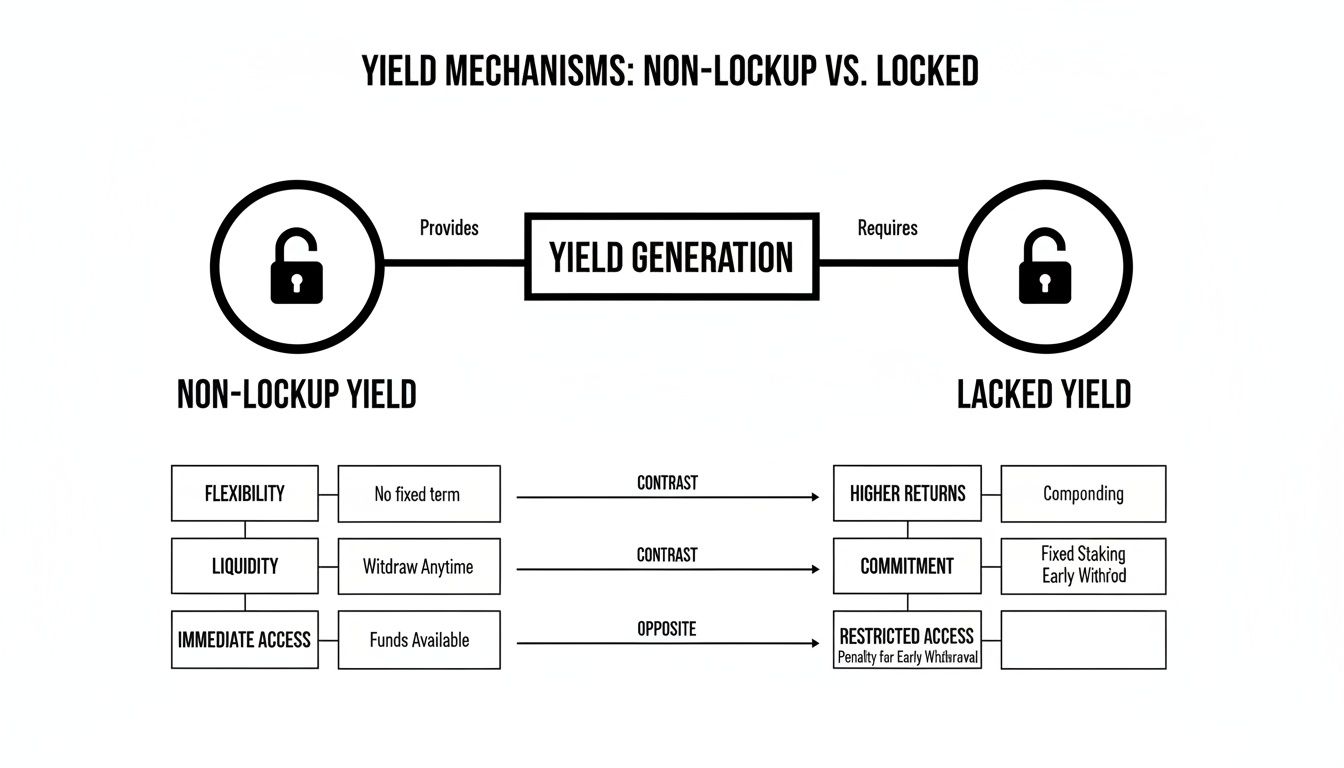
This really just highlights one simple fact: while both can generate returns, only non-lockup strategies preserve your ability to react to the market instantly.
Lending Protocols: The Community Banks of DeFi
Think of a DeFi lending protocol like Aave or Compound as a massive, automated community bank. Instead of putting your money into a stuffy savings account, you contribute your stablecoins to a giant, collective pool of capital.
Borrowers can then take loans from this pool, but there's a catch—they must provide more collateral than the loan is worth. This is known as overcollateralization, and it dramatically cuts the risk for lenders like you.
The interest they pay on their loans is then shared with everyone who supplied capital to the pool. Simple.
You Deposit: You add your USDC to a lending pool.
Borrowers Pay Interest: They borrow from the pool and pay a variable interest rate based on supply and demand.
You Earn Yield: You get a slice of that interest, and you can pull your funds out whenever you want.
This model has proven incredibly popular. A recent Galaxy Research report on onchain yield pointed out that by mid-2025, DeFi lending markets swelled to $85 billion in deposits. Interestingly, only about $35 billion was actively borrowed, leaving a massive amount of liquid capital ready to earn. This supply-demand dynamic is what drives the algorithmic interest rates you see on platforms like Aave, which can offer 5-8% APY on USDC without any lockups.
Decentralized Exchanges: The Market Makers
The second major source of non-lockup yield comes from Automated Market Makers (AMMs). These are the engines that power decentralized exchanges (DEXs) like Uniswap.
Instead of a traditional order book with buyers and sellers, AMMs use liquidity pools to make trades happen. As a user, you can become a mini-market maker by depositing a pair of assets (like USDC and ETH) into one of these pools.
By providing this liquidity, you make it possible for others to trade between those two assets seamlessly. In return for your service, you earn a small cut of the trading fees every time someone swaps tokens using your pool. Your funds aren't locked; you can remove your liquidity whenever you choose.
If you want to go deeper on this, check out our guide on what liquidity pools are and how they function.
Diving Into Advanced Non-Lockup Yield Strategies
Once you get past the basics of lending and providing liquidity, the world of DeFi opens up some seriously creative ways to generate yield without locking up your funds. These are for folks who want to get a bit more granular with their exposure or just put the whole process on autopilot.
One of the coolest ideas to come out of DeFi is yield tokenization.
Imagine you own a tree (your principal asset) that produces fruit every year (its yield). Now, what if you could sell a claim to next year's fruit today for a lump sum, all while keeping your tree? That's the essence of what some platforms let you do.

This process literally splits your asset into two new tokens: one representing your original principal and another representing its future yield. Your principal token stays completely liquid, and you can sell the yield token on an open market. This allows for some pretty advanced moves, like locking in a fixed return right now or betting on where you think interest rates are headed—all without tying up your core capital.
Automated Yield Aggregators
If you're more of a "set-it-and-forget-it" type, yield aggregators and money-market vaults are your best friends. Think of them as intelligent robo-advisors for your crypto. Instead of you manually hunting for the best rates across dozens of protocols, these platforms do all the heavy lifting for you.
They are constantly scanning the DeFi landscape, finding protocols that offer the highest and most stable returns for your assets. The moment a better opportunity pops up, the aggregator can automatically shift your funds over to capture it. This approach gives you two massive wins:
You save a ton of time: No more obsessively checking different platforms and manually moving funds around.
Your returns are optimized: The system is built to constantly chase the best possible non-lockup yield, which can often earn you more than if you just parked your funds in one spot.
These platforms are perfect for anyone who wants to maximize their earnings but doesn't have the time to become a full-time DeFi analyst.
The Rise of Yield Tokenization
Platforms like Pendle Finance have taken this concept and run with it, showing just how powerful yield tokenization can be. After launching in June 2021, Pendle went from just $15M in total value locked (TVL) in late 2022 to experiencing explosive growth by 2025.
When yields across DeFi were low, Pendle was offering rates like 12.4% on certain assets. It did this by letting users trade fixed and variable yield components separately, all while their principal stablecoins remained liquid. It's a method perfectly suited for sophisticated, AI-driven allocation strategies. You can learn more about how DeFi innovates and evolves on Zircuit.
By splitting principal from yield, these advanced protocols give you a level of control that just wasn't possible before. You can keep your base asset for stability while actively trading or selling off its future earnings. It’s a flexible and incredibly powerful way to generate non-lockup yield.
These advanced strategies are a perfect example of DeFi's core superpower: composability. By building new financial tools on top of existing ones, the ecosystem is always finding more specialized and efficient ways to put capital to work without demanding you give up your liquidity.
Navigating the Risks of Liquid Yield Farming
Earning yield without locking up your funds is an incredible way to grow your assets while staying completely in control, but let's be clear—it's not a free lunch. The freedom of liquid yield farming comes with its own unique set of traps for the unwary. Getting a handle on these risks is your first, most important step to playing the game safely and successfully.
The dangers you'll face in this space really boil down to three main categories. Think of them as different potential points of failure, from the code itself to the wild market swings that can mess with your returns.
Understanding the Core Risks
First up, and arguably the most critical, is smart contract risk. Every single DeFi protocol is built on code. And even the most buttoned-up, meticulously written smart contracts can have hidden bugs or vulnerabilities. A clever attacker could exploit one of these flaws to drain the protocol's funds, leaving users with a total loss.
Next, you have protocol risk. This is all about the operational health and integrity of the platform itself. We're talking about potential issues with the team behind the curtain, centralization risks in how it's governed, or even economic models that just don't hold up under pressure. The code can be flawless, but a poorly managed protocol can still go down in flames.
Finally, there’s good old market risk. The juicy APY you see today on a non-lockup strategy is almost always variable. That means it could drop off a cliff tomorrow. This volatility is driven by constant shifts in borrowing demand, liquidity levels, and the overall crypto market mood, all of which can torpedo your expected returns without any warning.
A Playbook for Staying Safe
Knowing the risks is one thing, but you need a practical game plan to protect your capital. The key is to be deliberate and do your homework, rather than just blindly chasing the highest yield you can find.
A fantastic starting point is diversification. Seriously, never put all your eggs in one basket, no matter how shiny that basket looks. Spreading your funds across several well-respected platforms can soften the blow if one of them hits a snag. For a much deeper dive on this, our guide on liquidity pool risks is a must-read.
Key Takeaway: Your best defense in liquid yield farming is thorough due diligence. Always prioritize protocols that are transparent, have passed multiple third-party security audits, and have a long, proven history of operating without major incidents.
Before you deposit a single dollar, run through this mental checklist:
Security Audits: Has the protocol been audited by reputable firms? Look for multiple audits, not just a single rubber stamp.
Team Reputation: Is the team public and known in the space? Anonymous teams are a much bigger gamble.
Community and TVL: Does the protocol have a lively community and a hefty amount of Total Value Locked (TVL)? A large TVL is often a good sign of trust from other users.
To give you a more structured way to think about this, here’s a simple checklist to keep in your back pocket.
Common Risks and Mitigation Checklist
Use this table as a quick reference to make sure you're covering your bases before jumping into a new protocol or strategy. It’s all about asking the right questions.
Risk Category | What to Look For | Mitigation Strategy |
|---|---|---|
Smart Contract Risk | Vulnerabilities, bugs, or exploits in the protocol's code. | Check for multiple, recent security audits from reputable firms (e.g., Trail of Bits, OpenZeppelin). Favor protocols with bug bounty programs. |
Protocol Risk | Centralized control, anonymous team, or poor economic design. | Verify the team's identity and track record. Review governance structure—is it truly decentralized? Assess the tokenomics for sustainability. |
Market Risk | Volatile APYs, impermanent loss, or de-pegging of assets. | Diversify across different types of yield sources (lending, LPs, etc.). Understand how the yield is generated and what drives its fluctuations. |
Liquidity Risk | Inability to withdraw funds due to low liquidity in a pool. | Stick to platforms and pools with high TVL and trading volume. Avoid small, illiquid markets, especially with large positions. |
Thinking through these points systematically can help you avoid many of the common pitfalls that trip up less careful investors.
It's also super important to understand how sensitive your positions are to different market forces. A concept from traditional finance, explained brilliantly in this guide on What is Delta in Options Trading: A Clear Guide to Risk, Reward, and Profit, shows how an asset's value can change based on underlying factors. Applying that same critical mindset here is a smart move. Combine careful vetting with smart diversification, and you'll be able to put your capital to work with much more confidence.
Alright, let's put some of this theory into practice. Getting your assets to work in a non-lockup strategy is a lot more straightforward than you might think. It all starts with getting your digital foundation sorted.
We'll walk through the essential first moves before jumping into two of the most popular ways to earn your first dollar without locking up your crypto.

First things first, you need a self-custody wallet. Think of it as your personal bank in the DeFi world. Wallets like MetaMask or Rabby give you the keys to your own kingdom—complete control over your assets.
Once you’re set up, you'll need some ammo. Grab some stablecoins like USDC or USDT from an exchange and fire them over to your new wallet address. To keep gas fees from eating into your returns, it's a smart move to bridge these funds over to a cost-effective blockchain, like a Layer 2 network.
With that done, you're ready to pick your path.
The Manual DIY Approach
For anyone who likes to be hands-on and in total control, depositing directly into a battle-tested protocol is the classic move. This path puts you squarely in charge of where your money goes.
A perfect example is getting involved with a lending protocol like Aave. The process is dead simple:
Head over to the protocol’s official website.
Connect your self-custody wallet to the platform.
Pick the stablecoin you want to supply (e.g., USDC).
Punch in the amount you want to deposit and approve the transaction.
That's it. Once the transaction is confirmed on the blockchain, your funds are in the lending pool, and you'll immediately start earning a variable interest rate. You can watch your earnings tick up in real-time and pull your capital out whenever you want by just reversing the steps.
This DIY method is empowering because you're the one calling the shots. But it also means you're the one responsible for everything—monitoring rates, judging the risks, and manually shifting your funds to chase better opportunities as they pop up.
The Automated Platform Approach
If you'd rather "set it and forget it" and let your yield strategy run on autopilot, an automated platform is your best bet. These services do all the heavy lifting, intelligently managing your capital for you.
Instead of picking one protocol and hoping for the best, you deposit your funds into a smart vault. The platform's system then gets to work, allocating your capital across a whole portfolio of vetted protocols to find the sweet spot between risk and return.
This approach makes the whole experience a breeze:
Connect & Deposit: Just link your wallet and deposit your stablecoins. One simple transaction and you're done.
Automated Management: The system takes over from there, constantly scanning the market and moving funds to squeeze out the best possible yield.
Effortless Tracking: You get a clean dashboard to see your balance and earnings without having to juggle a dozen different websites.
This is the perfect route for busy professionals or anyone who just wants to benefit from the dynamic world of non-lockup yield without the constant grind of research and manual transactions.
Using AI Platforms to Automate Your Yield Strategy
Why spend hours chasing the best non-lockup yields when an intelligent system can do it for you?
Trying to manually track dozens of protocols, figure out the shifting risks, and constantly move your funds around is practically a full-time job. AI-driven platforms offer a much smarter way to play the game.
These services basically act as your personal DeFi analyst and portfolio manager, working for you 24/7. Instead of just parking your stablecoins in one place, an AI agent sifts through thousands of real-time data points across the entire market—yield rates, liquidity depth, gas fees, and protocol risk scores.
Based on this constant stream of information, the system makes intelligent decisions to get you the best possible risk-adjusted returns. It's the modern answer for busy people and Web3 teams who want to capture DeFi's best opportunities without being glued to a screen all day.
How AI Makes Yield Generation Simple
Think of it like upgrading from a basic savings account to a sophisticated wealth management firm, but for your crypto. The AI platform handles all the heavy lifting:
Continuous Optimization: The AI is always scanning for higher yields and safer protocols. The moment a better opportunity pops up, it can move your capital to take advantage of it.
Built-in Risk Management: It automatically diversifies your funds across multiple vetted protocols. This cushions the impact if any single platform runs into trouble.
Cost Efficiency: By bundling transactions and using low-fee networks, these systems cut down on the gas fees that can eat away at your profits when you're doing it all manually.
The bottom line is simple: automation lets you earn smarter, not harder. By handing off the complex research and execution to a specialized AI, you get to tap into advanced non-lockup yield strategies with minimal effort.
Platforms like Yield Seeker are built on exactly this idea, giving you an effortless way to put your stablecoins to work. The system manages all the complicated backend decisions, so you just get a clear view of your earnings while your funds stay completely liquid and ready to withdraw anytime.
Your Questions About Non-Lockup Yield, Answered
Jumping into the world of DeFi can feel like learning a new language. You're bound to have questions. This section tackles the most common ones I hear about non-lockup yield, aiming to give you the clarity and confidence to move forward.
Is Non-Lockup Yield Actually Risk-Free?
Nope, and it's super important to understand that. While it solves the big problem of having your funds stuck, you're still playing in the DeFi sandbox. That means you're exposed to the usual suspects: smart contract bugs, protocols going bust, or yields suddenly tanking.
The smart move is to stick with well-audited platforms that have been around the block and to spread your capital across a few different strategies. Think of it as not putting all your eggs in one basket—it's the best way to soften the blow if one thing goes wrong.
The whole point of non-lockup yield is to give you maximum liquidity and flexibility, not to wipe out risk entirely. Your best defense is always smart risk management.
So, How Much Can I Realistically Make?
This is the million-dollar question, and the honest answer is: it varies. A lot. Yields are constantly shifting based on what's happening in the market, like how many people are borrowing or how much liquidity is in a protocol. You might see rates anywhere from a few percent to over 10% APY when conditions are right.
But the real magic of a non-lockup approach isn't chasing a specific high number. It's the freedom to hop from one opportunity to the next, capturing the best yields as they pop up. This is exactly the kind of thing an AI-driven platform can do for you on autopilot.
What’s the Minimum I Need to Get Started?
One of the coolest things about modern DeFi is that it’s not just for the whales anymore. If you're managing everything yourself, you might need a decent chunk of capital to make the transaction fees worth it. But many automated platforms are built for everyone.
Platforms like Yield Seeker, for example, let you get started with as little as $10 USDC. It really lowers the barrier to entry.
Do I Still Actually Own My Crypto?
Yes, absolutely. In almost every DeFi protocol, you're always in control. When you deposit your funds into a smart contract, you usually get back a special token that's like a receipt for your deposit. This token is your claim on the funds you put in.
This is the core idea of self-custody and the very essence of non-lockup yield. It allows you to pull your original assets out whenever you want. Remember the golden rule: your keys, your crypto.
Ready to put your stablecoins to work without getting locked in? Yield Seeker uses AI to automatically hunt down and manage the best non-lockup yield opportunities for you. You can get set up in just a few minutes.