
You're at your laptop late at night, staring at the same steady paycheck, and the question keeps coming back: do you keep selling time, or do you build something that pays without you clocking in? That's the passive income vs active income decision, and it matters more now because capital moves faster, DeFi tooling is more usable, and taxes still punish sloppy classification. The wrong choice doesn't just change how you make money, it changes how much of your life gets consumed by making it.
Criterion | Active Income | Passive Income |
|---|---|---|
Time commitment | Requires ongoing labor and attention | Requires upfront setup, then lighter maintenance |
Scalability | Grows by adding more work or raising rates | Grows by adding capital or systems |
Control | High, because you can intervene directly | Lower, because systems and assets do the work |
Tax treatment | Usually tied to earned work, with familiar reporting | Can trigger special tax rules and loss limitations |
Best use case | Replacing immediate income needs | Building compounding cash flow over time |
Why the Active vs Passive Income Question Matters Right Now
A salaried professional staring at a spreadsheet at 11 p.m. is not asking an abstract finance question. They're asking whether their current lane is the only lane, or whether they can build a second engine that doesn't demand another calendar block.
That matters because active income still dominates many lives, but the pressure to find something more scalable is stronger than ever. In the U.S., the IRS still draws a hard line through material participation, and that line affects how income is classified, reported, and offset by losses, which is why this is not just motivational language, it's a real tax issue IRS passive income framework. If you're in major markets, the same basic tension shows up even when the local labels differ, active work pays now, passive structures pay later.
The practical takeaway is simple. If you want more free time, you need income that doesn't break when you stop working. If you want more control, you need a stream you can manage directly.
Practical rule: active income buys certainty today, passive income buys optionality tomorrow.
That's why the question is so urgent in 2026. The people who keep waiting for the “perfect” passive setup usually end up doing nothing. The people who pick one clean, manageable passive stream and keep their core earnings intact usually do better.
What Active Income and Passive Income Actually Mean
Active income is money tied directly to labor. Salaries, hourly wages, commissions, consulting fees, and freelancer invoices all fall into that bucket because the cash stops when the work stops.
Passive income is money generated by an asset or system that you already put in place. Rental income, dividends, royalties, and some automated investment systems fit that pattern because they keep producing after the initial setup. The key point is not that passive income takes no effort, it's that the effort is front-loaded or intermittent rather than constant.
The IRS line is where the distinction becomes real. Under the material participation rule, passive income generally comes from rental activities or from a trade or business where the taxpayer does not materially participate, while active income is the opposite case where the taxpayer is meaningfully involved IRS passive income framework. Passive income can also run into the 3.8% Net Investment Income Tax when adjusted gross income exceeds $200,000 for individuals or $250,000 for married couples filing jointly IRS passive income framework.
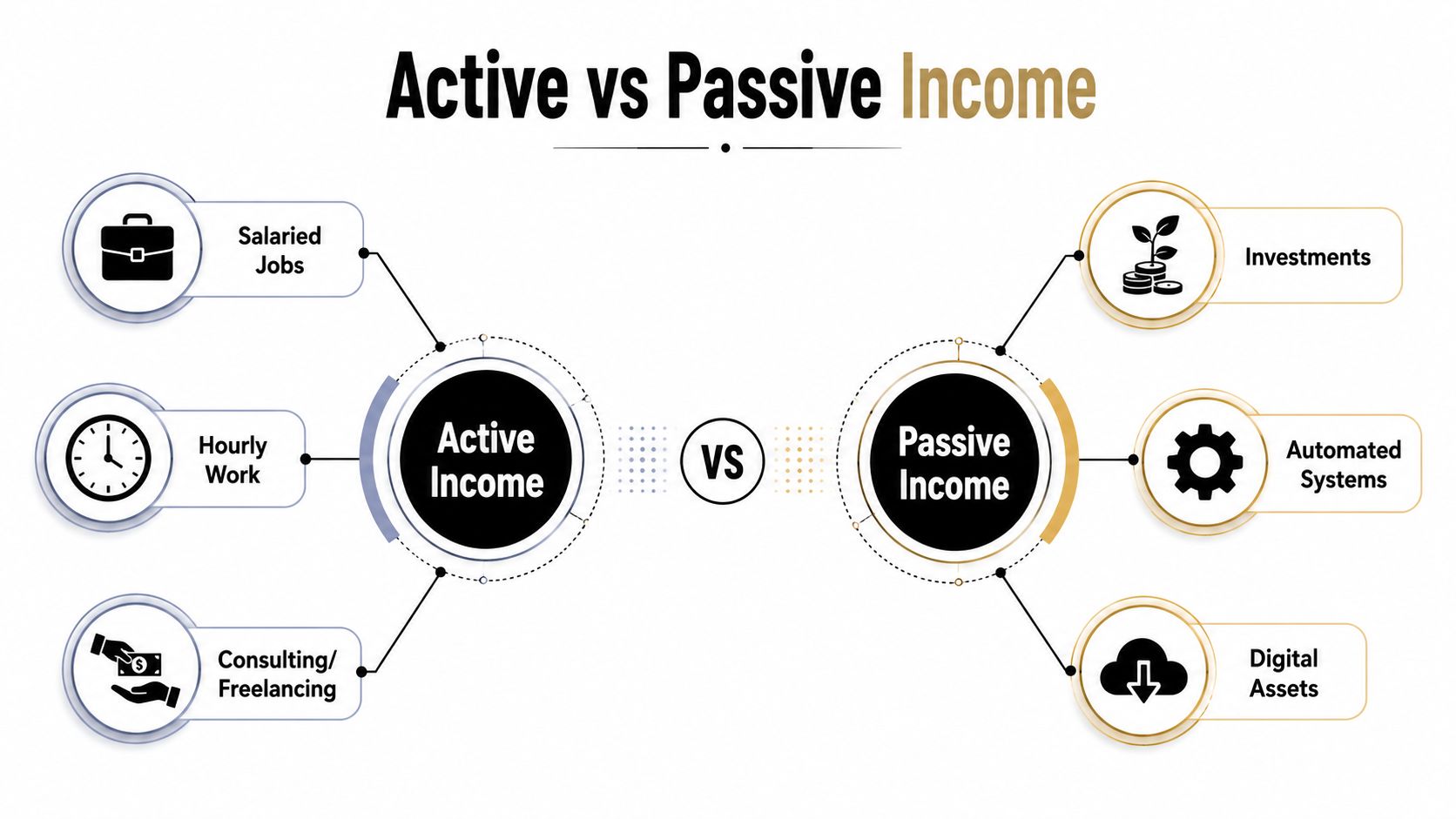
The cleanest way to remember it is this. Active income is payment for participation. Passive income is payment for ownership, structure, or deployed capital.
That distinction matters outside the U.S. too, because most serious tax systems care about whether income comes from labor or assets, even if they use different terminology. If you don't know which side your earnings sit on, you're not really planning, you're guessing.
Side-by-Side Comparison Across Five Decision Criteria
The comparison gets easier when you stop asking which one is “better” and start asking which one performs better under a specific constraint. Time, scalability, risk, expected return, and tax treatment all push the answer in different directions.
Time and control
Active income demands your attention every day. You can usually steer it quickly, which is a real advantage if your situation changes fast. Passive income gives you more freedom, but only after the system is built, and even then it still needs some oversight.
Scalability and intervention
Passive structures scale better because they rely on capital or systems instead of hours. FINRA describes active investing as frequent buying and selling with short holding periods, while passive investing is a buy-and-hold approach with far fewer trades FINRA on active vs passive investing. That same logic carries into income design, fewer moving parts usually mean easier scaling, but also less room for tactical intervention.
Risk and return
Active income is easier to understand and often easier to control. Passive income can be more efficient over time, but it can also become messy if fees, taxes, or maintenance creep up. A useful benchmark from practitioner income tracking is to judge active streams on $75/hour true rate and passive streams on $50/hour effective rate by month 6, then drop anything that stays below target for too long effective hourly rate framework.
Tax treatment and a simple benchmark
Passive income is still taxable, and it can face loss limitations under the IRS passive activity rules as summarized by Jackson Hewitt IRS passive income summary. That means gross yield is not the right metric. Post-tax, post-fee, time-adjusted return is the metric that matters.
Passive income wins when the setup cost is recovered and maintenance stays low. Active income wins when speed, control, and certainty matter more than long-run scale.
Criterion | Active Income | Passive Income |
|---|---|---|
Time | Ongoing labor | Front-loaded setup with lighter oversight |
Scalability | Limited by hours and energy | Limited more by capital and system quality |
Risk | More personal, more controllable | More structural, more dependent on the asset |
Expected return | Clear, immediate, tied to work | Can compound, but varies by asset and fees |
Tax treatment | Straightforward labor-based reporting | Can involve special passive rules and loss limits |
If you want a deeper framework for weighing yield against drawdown and fee drag, the most useful companion read is risk adjusted APY in DeFi. That's the right lens once you stop comparing slogans and start comparing actual cash flows.
Real-World Examples From Both Sides
A salaried software engineer has active income whether they like the title or not. The paycheck is reliable, the tax handling is familiar, and the trade-off is obvious, when they stop working, the income stops too.
A freelance designer billing hourly sits in the same bucket, just with more volatility. They can raise rates, cut bad clients, or take on more projects, but they still have to show up and deliver. A consultant is even more direct, the moment they stop scoping calls, writing decks, or managing clients, revenue slows.
Passive income looks different, but it's not one thing. A landlord collects rent from an asset, but the asset still needs repairs, tenant management, financing decisions, and tax attention. If you want a grounded overview of the property side, the guide on buying an investment property is a useful reality check, because rental income only looks “hands-off” from far away.
Dividend stocks and royalty streams are cleaner on paper, but they still need monitoring. You still have to decide whether to reinvest, rebalance, or sit on cash. That's why the phrase passive income often hides a more honest label, semi-passive.
Stablecoin yield is the newest version of that same pattern. A holder can keep capital parked in a DeFi system and earn yield without managing every trade manually, but only if the workflow stays disciplined and the allocation logic stays current. If you're curious about the operating mechanics, the practical breakdown in automated DeFi strategies is worth reading before you try to run yield by hand.

The useful move is not to memorize categories. It's to locate yourself clearly. If your earnings stop when you stop, you have active income. If your earnings keep moving because capital or systems are working, you have something closer to passive income, even if it still needs maintenance.
Why Most Passive Income Is Really Semi-Passive
The clean “passive” label is usually misleading. Rentals get tenant calls, dividend portfolios need rebalancing decisions, and DeFi positions need protocol monitoring. The work doesn't vanish, it just changes shape.
That's why the better question is not “is it passive?” The better question is how much active maintenance does this require per dollar earned. That framing is blunt, but it's more useful than pretending all passive income is equally hands-off.
A lot of internet advice falls apart here. People sell passive income as if it were a switch you flip once and forget forever, which is exactly the kind of fantasy that creates bad financial decisions. The critique in debunking passive income myths lines up with the real-world problem: the label often hides the upkeep.
AI tools are changing the maintenance curve, but they don't erase it. They reduce research time, automate routing, and make ongoing optimization less painful. That still leaves judgment, risk tolerance, and periodic review in the loop.
If an income stream needs regular intervention, call it semi-passive and plan accordingly.
That is the most honest model for modern investors. It keeps you from overpromising to yourself, and it pushes you to compare opportunities on workload, not just on headline yield. The best systems are the ones that keep maintenance light enough that the effective hourly return stays attractive over time.
Which Model Fits Your Profile
A full-time employee should keep active income as the core. The right side income is something low-friction, not another job disguised as an asset. The trap is trying to turn evenings into a second career before you've built any capital cushion.
A freelancer or small business owner should do the opposite of what social media tells them. Active income is already their engine, so the side goal is to convert some of that cash flow into a structured passive stream, not to pile on more client work. The trap is confusing busy work with wealth building.
A crypto-native should lean into passive structures, but only with discipline. This person already understands wallets, risk, and protocol behavior, so the right move is to make capital work while avoiding unnecessary manual farming. The trap is chasing every shiny APY without a maintenance plan.
A Web3 creator or treasury manager needs both. Active income keeps the operation alive, while passive yield can put idle stablecoins to work. The trap is letting treasury management become a part-time trading desk.
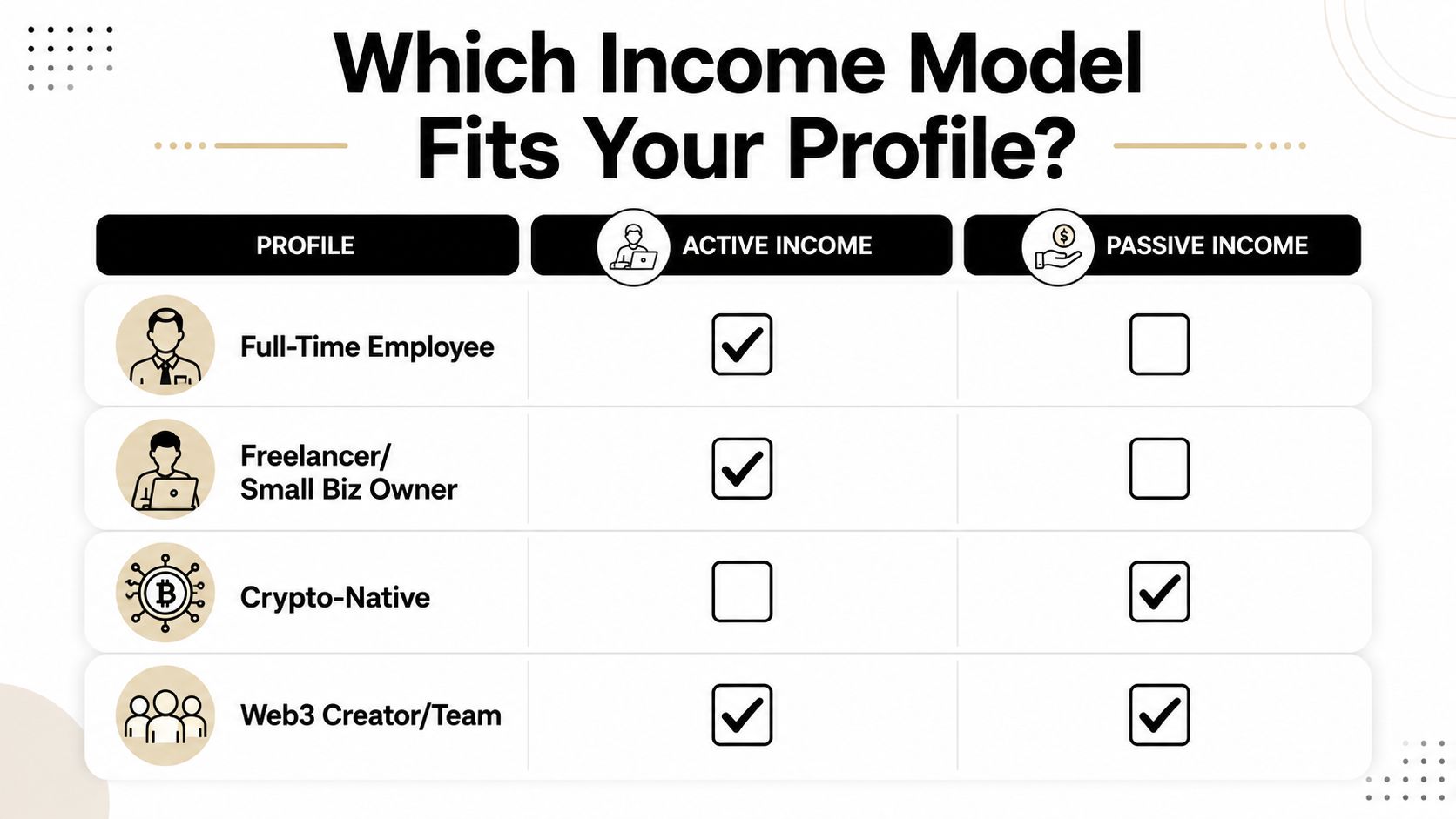
Use this quick filter:
Employee: keep your job, add one manageable passive stream.
Freelancer: stabilize revenue first, then route surplus into assets.
Crypto-native: automate yield, don't micromanage every position.
Web3 team: separate operating cash from yield-bearing reserves.
The strongest rule is boring, and that's a good thing. Protect your core income, then build one extra system that doesn't demand your full attention.
Putting Passive Yield to Work With Stablecoins and Yield Seeker
Stablecoins are one of the few places where the passive-income pitch makes sense for a busy reader. You're not betting on price appreciation, you're parking capital in a dollar-denominated asset and trying to earn yield without babysitting the position. That's cleaner than most “passive” ideas, because the cash flow problem is clearer and the accounting is less chaotic than volatile-token speculation.
The core advantage lies in workflow discipline. A manual multi-protocol approach can work, but it requires you to monitor rates, track exposures, and decide when to move capital. This is active work disguised as passive.
Yield Seeker is built around the more honest version of this idea. You deposit as little as $10 USDC on Base, the platform's AI Agent monitors and allocates across DeFi protocols in real time, and you keep access to your funds with no lockups or withdrawal fees. The point isn't magic, it's reducing the ongoing labor that usually turns “passive” yield into a part-time job.
The practical setup is simple. Fund the wallet, deposit USDC, review the dashboard, and let the system handle allocation instead of clicking around five different apps. If you want the broader category context first, the guide on stablecoin yield farming is a useful baseline before you compare platforms.
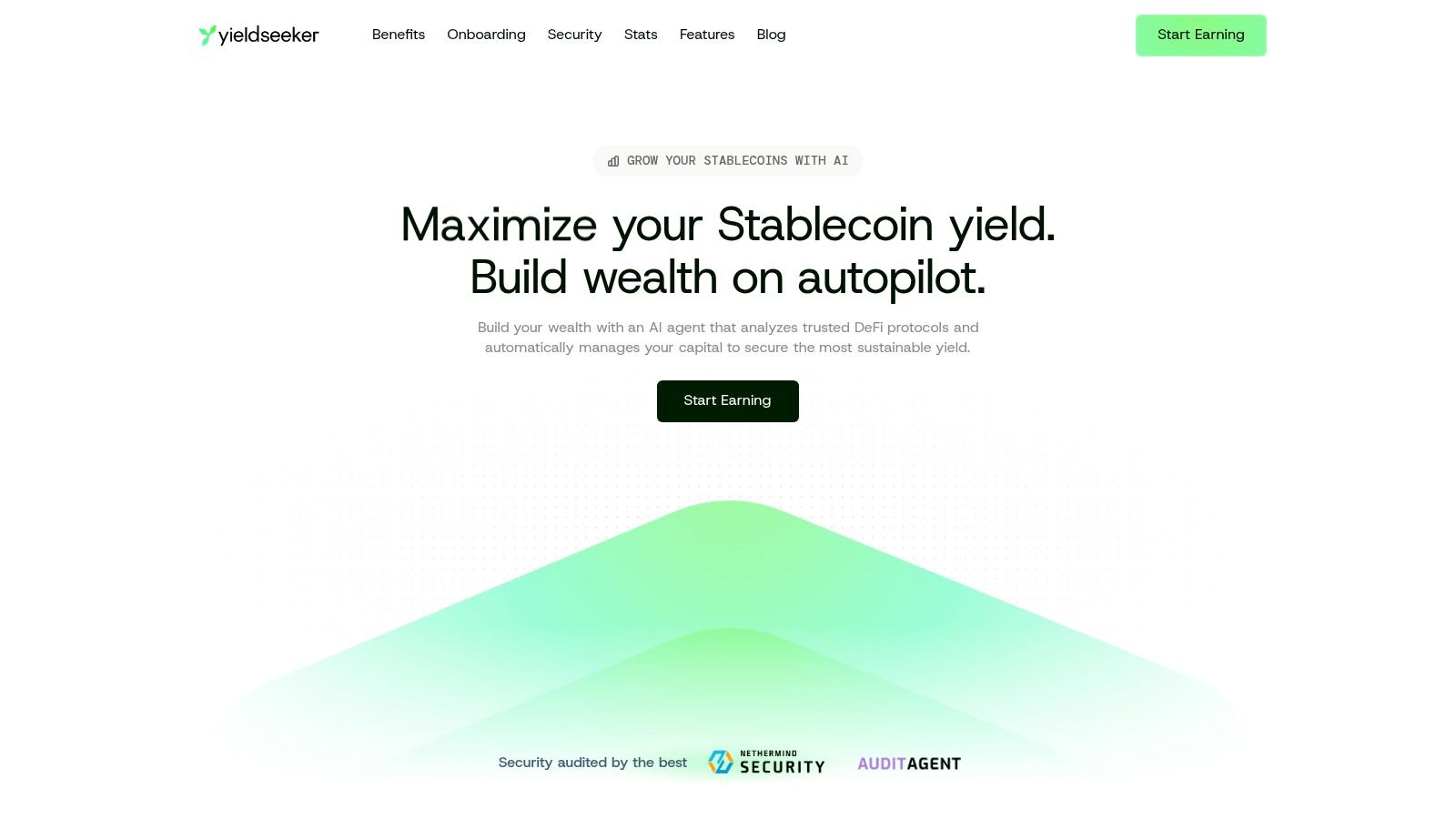
The appeal here is not just yield. It's that the system matches the semi-passive reality of modern income better than hand-built strategy hopping does. You still own the capital, but you stop doing the repetitive work that destroys consistency.
Here's the cleanest way to think about it, stablecoin yield is passive enough to matter and simple enough to manage, which is rare. If you're trying to build a second engine without becoming your own full-time treasury desk, this is the lane worth taking seriously.
The Decision Framework You Can Actually Use
Ask three questions. How much time are you willing to spend, how scalable does this need to be, and what is your post-tax hourly return after fees and upkeep? If the answer to the first question is “almost none,” you need a passive or semi-passive system, not another active hustle.
My recommendation is straightforward. Keep active income as the core, layer in one well-chosen passive stream, and review it every quarter. If you want a low-friction DeFi route, that passive layer should be stablecoin yield with automation rather than manual protocol hopping.
Yield Seeker gives you a cleaner way to turn stablecoins into a working income stream without turning the process into another job. If you want hands-off DeFi yield with real control, visit Yield Seeker and see how an AI-managed stablecoin strategy fits alongside your core income.