

You deposit USDC into several DeFi pools, check the dashboard a few days later, and notice that the allocation no longer matches your plan. One pool's yield attracted more capital, another position earned less, and the portfolio that started evenly distributed now carries more exposure to a single protocol than you intended. Nothing dramatic happened, yet your risk profile changed.
That quiet shift is why portfolio rebalancing matters in stablecoin yield farming. Rebalancing isn't primarily about finding the highest advertised APY or trading every market move. It's the process of bringing your capital back toward a deliberate risk arrangement while accounting for gas, slippage, taxes, liquidity, and the cost of intervention.
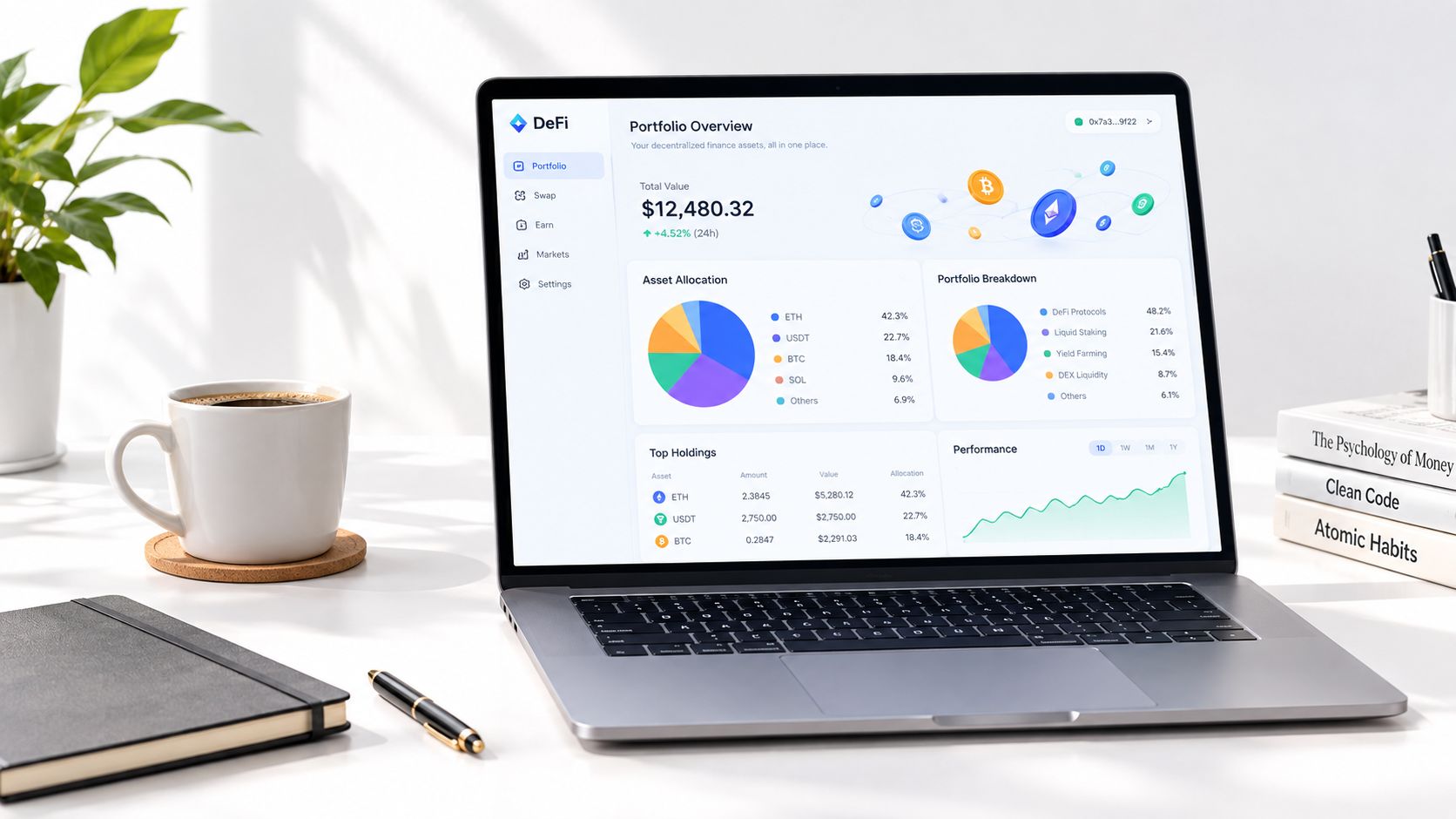
If you're still learning how yield is quoted, start with this plain-language guide to what APY means. Then use the framework below to decide how much drift you'll tolerate, when a trade is justified, and where automation can reduce the burden of watching several protocols at once.
Why Your Stablecoin Portfolio Drifts Without You Noticing
Suppose you begin with a simple plan. You place half of your USDC in a lending market, divide the rest between another lending venue and a liquidity strategy, and intend to keep each position within a comfortable range. You aren't trying to maximize every last unit of yield. You want diversification across strategies and protocols so that one weak point doesn't dominate the whole account.
Over time, the weights move. A pool's yield changes, interest accumulates in one position, a rewards program ends, or withdrawals from another venue reduce its balance. Even if every asset remains a stablecoin, the portfolio can become more dependent on a particular smart contract, chain, liquidity source, or yield mechanism.
The drift may be hard to notice because your account balance can look healthy. A dashboard might show positive earnings while hiding the fact that one position now represents much more of the portfolio than your original policy allowed. In that situation, your return isn't the only question. You need to ask whether you'd still accept the same concentration if you were choosing the allocation today.
Why stablecoin exposure still needs boundaries
“Stablecoin” doesn't mean “risk-free.” Different stablecoins can carry different issuer, collateral, liquidity, depeg, and smart-contract considerations. A lending market can add utilization and liquidation-related risks, while a liquidity pool can introduce pricing and imbalance risks. Spreading funds across venues may reduce concentration, but it also creates more balances to monitor.
Portfolio rebalancing gives you a repeatable way to respond. You define the intended mix, measure the current weights, and move capital only when the difference matters enough to justify the cost and operational risk. The objective is to preserve the portfolio you meant to own, not to react emotionally to every changing yield display.
Practical rule: A higher yield is only useful if the added exposure still fits your risk limits.
Doing nothing is also a decision. If one protocol becomes overweight, you're accepting that concentration until you manually correct it or an automated rule does so. Rebalancing turns that passive drift into an explicit choice.
What Portfolio Rebalancing Really Means in DeFi
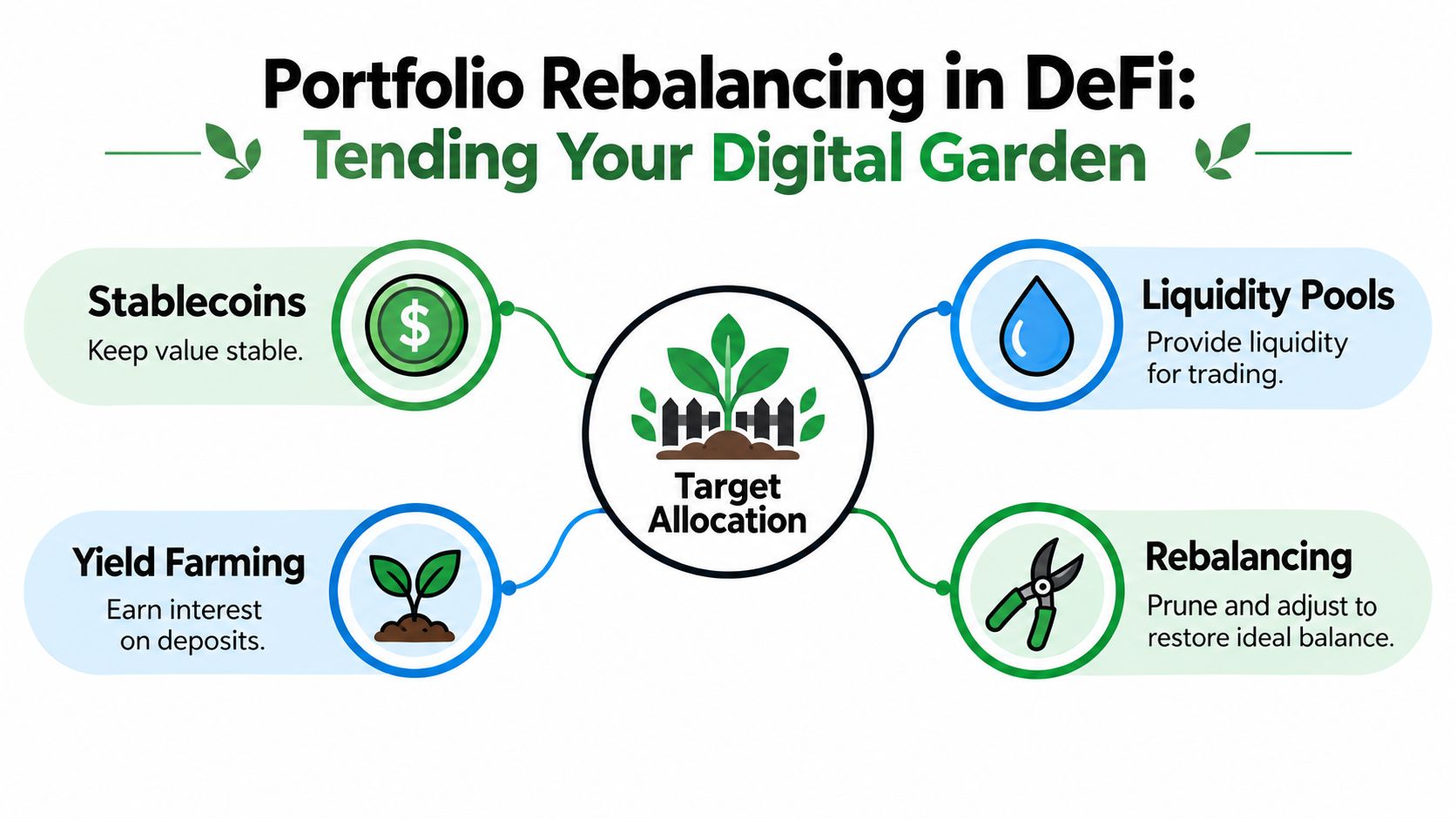
Think of a boat carrying supplies in separate compartments. If one side gradually collects more weight, the boat may still move forward, but it won't have the balance you planned. Rebalancing means moving some weight back to the lighter side so the boat behaves as intended.
A yield portfolio works in much the same way. First, choose target allocations. For example, you might decide that a portion belongs in a lending market, another portion in a liquidity pool, and the remainder in a lower-complexity reserve. The exact mix depends on your objectives, but the important point is that each allocation has a job.
Next, measure current weights rather than looking only at dollar balances. If your total is distributed across several positions, calculate each position as a share of the whole. A position can grow through yield, while another falls behind, causing the portfolio to depart from its target even without a new deposit or withdrawal.
Finally, restore the chosen balance. You might withdraw part of an overweight position and supply the proceeds to an underweight one. You might also direct new USDC toward the underweight allocation, avoiding a sale. Either way, the action is guided by the target and the acceptable drift range.
Translating the idea to stablecoin yield
In traditional investing, rebalancing often means adjusting stocks and bonds. In DeFi, the categories can be more operational:
Stablecoins: The assets you hold, such as USDC, with their own liquidity and issuer considerations.
Protocols: Lending markets, vaults, automated market makers, and other smart-contract systems.
Chains: Networks where transaction costs, liquidity, and execution conditions differ.
Strategies: Passive lending, liquidity provision, incentive-driven farming, or reserve holdings.
This makes portfolio rebalancing a risk-control process. It can reduce unwanted concentration, but it doesn't guarantee higher returns. In fact, selling an overweight position may mean leaving a currently attractive yield. That trade can still be sensible if the position's size has moved beyond the level you consider acceptable.
The Norges Bank Investment Management study found that, across its 1970 to 2011 sample, rebalanced portfolios delivered higher returns and lower risk than a passive drifting portfolio. Its reported trigger point occurred when the average portfolio was about 4.2% away from its strategic allocation. The study also showed that rebalancing activity varied across decades, which supports a flexible conclusion: market drift and the chosen trigger matter more than a universal calendar rule. The full institutional study explains this historical relationship.
The lesson for DeFi is straightforward. Set the balance before you chase yield, then treat every adjustment as a decision about exposure.
Three Common Rebalancing Methods Compared
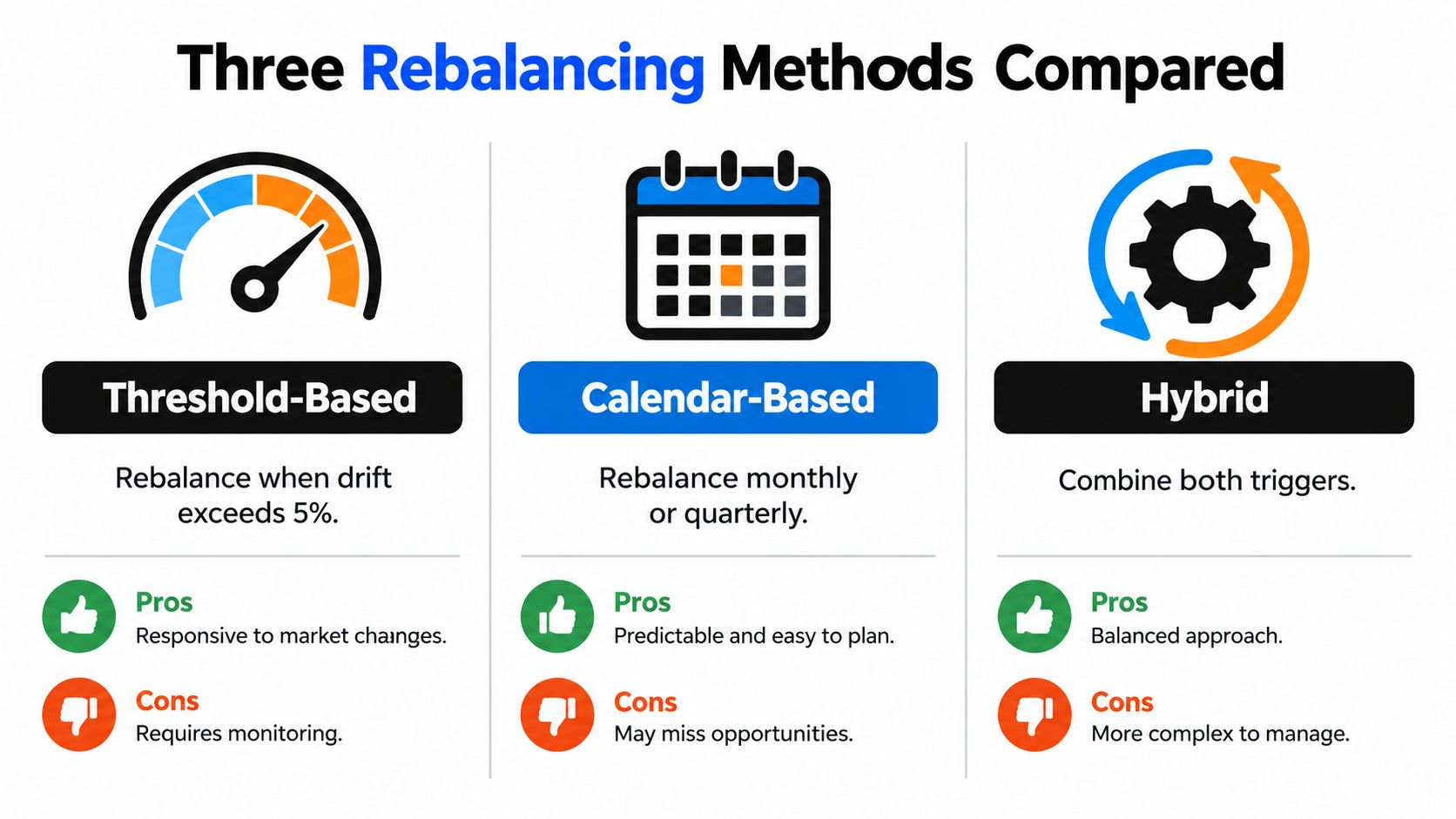
Three approaches appear most often in portfolio management. Threshold-based rebalancing acts when an allocation moves outside a permitted band. Calendar-based rebalancing reviews or trades on predetermined dates. Continuous or hybrid rebalancing combines monitoring with rules that decide whether the expected benefit is large enough to act.
A threshold rule might say that a position should be reviewed when it moves 5 percentage points away from its target. The benefit is responsiveness. If one stablecoin strategy becomes overweight during a rapid change, the rule doesn't wait for a monthly or quarterly appointment. The weakness is that volatile markets can produce repeated triggers, especially when the band is narrow.
Calendar-based rebalancing is easier to operate. You might review positions at a chosen interval, compare actual weights with targets, and trade only when the deviation is material. This creates a predictable workflow and can reduce the temptation to react to every short-term movement. Its limitation is timing. A portfolio can drift significantly between reviews.
A hybrid model adds a schedule to a threshold. The calendar creates a regular safety check, while a drift trigger can authorize an earlier review when concentration becomes uncomfortable. For a small portfolio, this can be more practical than attempting to respond to every movement in real time.
Method | How It Triggers | Trade Frequency | Best For |
|---|---|---|---|
Threshold-based | A position crosses a defined drift band | Variable, depending on volatility and drift | Portfolios where exposure control matters more than predictable timing |
Calendar-based | A scheduled review date arrives | Predictable, but dependent on the chosen schedule | Investors who want a simple routine and limited monitoring |
Continuous or hybrid | Ongoing monitoring, often paired with threshold or calendar rules | Potentially responsive, with rules to limit unnecessary trades | Larger or more fragmented portfolios with automation available |
The historical trade-off is visible in Dimensional's analysis of a U.S. 60/40 portfolio from 1979 to 2019. Quarterly rebalancing generated about twice the turnover of annual rebalancing, while keeping allocation deviation to less than half the tracking deviation associated with annual rebalancing. More frequent action held the risk mix closer to target, but implementation became more expensive. Dimensional's analysis details the turnover and deviation trade-off.
A useful video introduction can help you visualize how these rules operate before applying them to DeFi:
No method wins in every environment. The right choice depends on how much drift you can tolerate, how expensive each transaction is, how liquid the destination pool is, and whether a person or an automated agent will monitor the account.
Costs and Trade-Offs Behind Every Rebalance
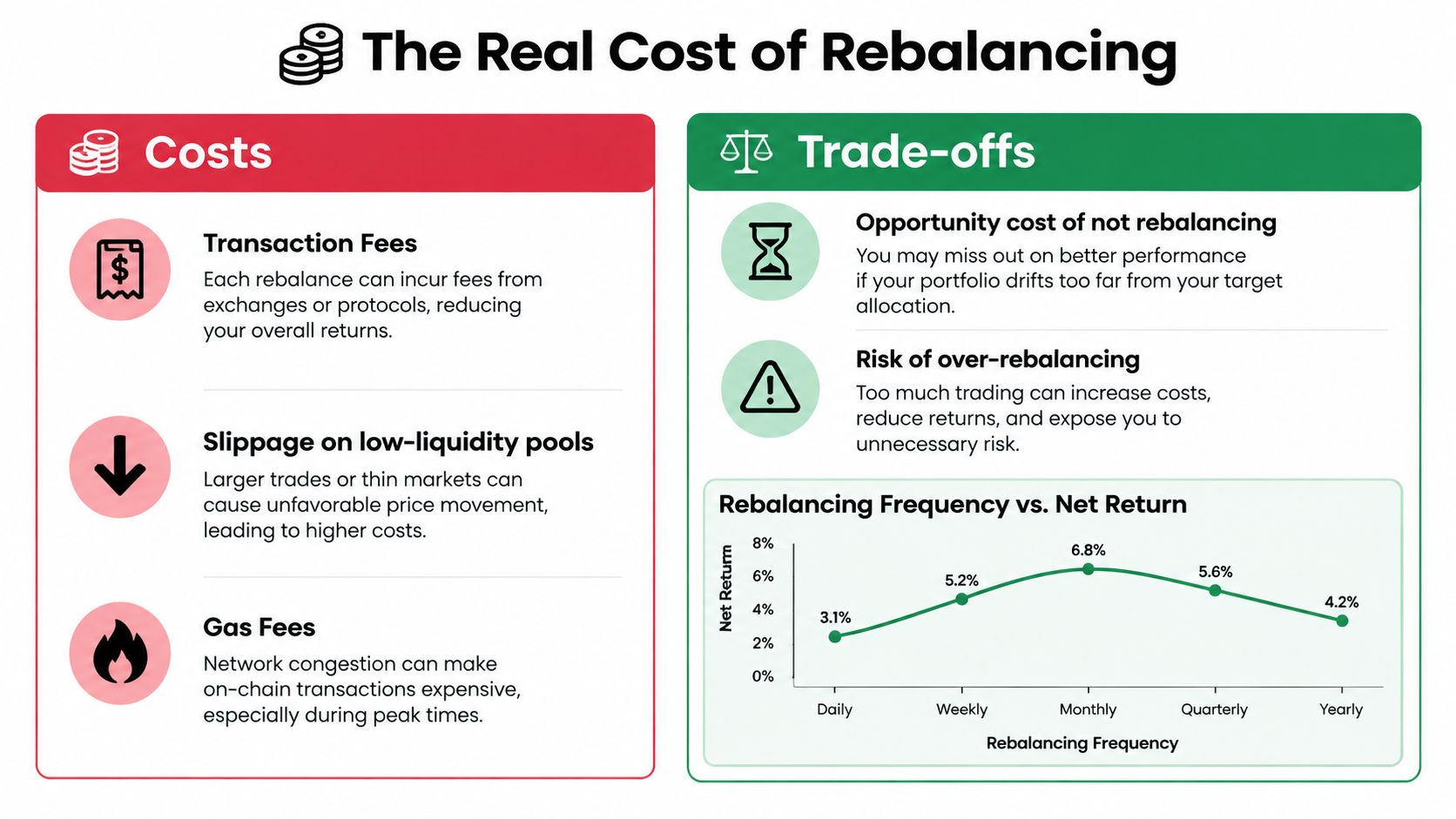
Suppose a stablecoin position drifts inside a yield portfolio. Moving it back to target may look like a simple transfer, yet each adjustment can consume value through transaction fees, pool slippage, routing charges, and gas. In a taxable account, selling an appreciated position may also create a tax consequence.
These frictions matter more as intervention becomes more frequent. Dimensional's historical comparison found that quarterly rebalancing created about twice the turnover of annual rebalancing. Tighter control keeps the risk mix closer to its target, while annual action reduces trading activity. The choice is a risk-control decision, not a contest to chase the highest yield.
A cost comparison from institutional-style research makes the trade-off concrete. An NBER working paper estimated annualized rebalancing costs of about 8 basis points for a calendar rebalancer and about 13 basis points for a threshold rebalancer in its setting, a gap of roughly 5 basis points per year before broader market-impact effects. The NBER working paper provides the cost comparison.
For a practical review of gas, slippage, and routing, see this guide to reducing transaction costs.
Where DeFi adds friction
A swap through a low-liquidity pool can move the execution price against you. Routing through several pools may improve the price, but it can also require more transactions and create extra execution risk. On Base, gas may be modest compared with more expensive networks, yet repeated small trades can still erode yield.
Taxable accounts require a separate sequence of decisions. Recent guidance recommends reviewing all accounts together, using tax-sheltered accounts first, directing new contributions toward underweight positions, and selling taxable holdings last. This sequence may reduce the need to realize gains, although your tax position determines what fits. This midyear rebalancing guidance discusses tax-aware sequencing.
Rebalancing succeeds when the risk it removes is worth more than the friction it creates.
A narrow threshold can keep weights close to target, but ordinary price movement may trigger trades that reverse soon afterward. The NBER research also discusses how higher volatility and lower liquidity can make tight bands counterproductive. In that setting, widening bands to around 5% can reduce whipsaw and lower unit costs. AI automation can monitor these conditions and combine meaningful risk changes into fewer, better-timed actions, easing the cost-frequency trade-off that manual DeFi rebalancing creates.
How Often Should You Rebalance Your Yield Portfolio
Don't begin with “monthly” or “quarterly.” Begin with the risk you're trying to control. If your main concern is concentration in one protocol, measure protocol weights. If you care about exposure to one stablecoin, measure stablecoin weights. If transaction costs dominate the account, use a wider tolerance band and let smaller deviations remain untouched.
A practical policy can combine four decisions:
Choose the target. Write down the intended allocation across stablecoins, protocols, chains, or strategy types.
Set the drift band. Decide how far a position can move before a review becomes necessary.
Add a review guardrail. Use a calendar review to catch operational problems, paused markets, or changed assumptions even if no threshold has been crossed.
Define a minimum trade size. Ignore adjustments that are too small to justify gas, routing, or execution risk.
Threshold design has a direct effect on workload. In one long-horizon stock-bond study, a 1% threshold produced 127 rebalancing events, compared with 28 events at 5% and 12 events at 10%. The study found that patient policies around 5% to 10% could preserve risk-adjusted performance while reducing transactions. The threshold study shows how bands change event frequency.
Let market conditions affect the band
Higher volatility can cause a position to cross a narrow boundary and then move back before execution settles. Lower-liquidity pools make that problem more expensive. In those conditions, a wider band can prevent overtrading, while a smaller portfolio may need a simpler rule because fixed costs consume more of each adjustment.
Strong trends create a common emotional trap. You may hesitate to reduce a position that has been producing attractive yield or appreciate the idea of “selling a winner.” But the purpose of rebalancing is to preserve the planned risk mix, not to predict whether the trend will continue. You can also use incoming deposits and earned rewards to add to underweight positions instead of selling first.
Decision test: If you wouldn't open the overweight position at its current portfolio weight, consider whether it should remain that large.
Review the policy when your goals, liquidity needs, tax circumstances, or confidence in a protocol change. A rule that worked for a diversified account may be unsuitable for a concentrated strategy with smart-contract exposure.
Real World Examples of Rebalancing in Action
Consider a portfolio divided across three stablecoin strategies. The first position uses a lending market, the second uses a liquidity pool, and the third holds a lower-risk reserve. The initial allocation reflects your preference for diversification, but the lending position starts offering a more attractive rate and becomes the largest holding.
A threshold policy doesn't move funds merely because the rate changed. It waits until the position's weight crosses the chosen band, then checks whether the expected risk reduction justifies withdrawal and redeployment costs. The action might involve moving only part of the excess into the underweight strategy, rather than forcing exact alignment.
A trigger in practice
Assume the intended allocation gives each strategy a similar role. After several yield payments, one pool is noticeably overweight while the reserve is underweight. Your monitoring system flags the deviation, estimates gas and expected slippage, and compares those costs with the benefit of reducing concentration.
If the trade is justified, you withdraw enough from the overweight position to restore the portfolio within its permitted range. The outcome isn't a guaranteed return increase. The immediate result is a portfolio whose exposure is closer to the risk plan you chose.
Rebalancing with fresh capital
Now suppose you add new USDC while another strategy is overweight. Instead of selling the overweight position, direct the deposit to the underweight allocation. You may bring the portfolio closer to target without creating a sale, and you avoid an unnecessary exit and entry sequence.
The same logic can apply to rewards. If one vault distributes earnings in a way that can be redirected, use those cash flows to correct the imbalance before selling existing holdings. In a taxable setting, account location and the nature of each transaction still matter, so keep records and confirm the treatment with a qualified tax professional.
These examples share a principle: the trade is secondary to the policy. First define acceptable exposure. Then use withdrawals, new deposits, rewards, or swaps to restore that exposure in the least costly practical way.
How Automation and AI Make Rebalancing Effortless
Manual monitoring becomes difficult when your capital is spread across protocols, chains, vaults, and changing yield opportunities. You must collect balances, calculate weights, check liquidity, estimate gas, review tax implications, and decide whether a trigger is meaningful. A missed alert can leave a position outside its intended range longer than planned, while an impulsive trade can create friction without improving risk control.
Automation changes the workflow by watching the portfolio continuously and applying preselected rules. A useful system should calculate allocation drift, compare it with your threshold, estimate execution costs, and pause when the trade doesn't justify the expected benefit. It should also support cash-flow rebalancing, because directing new deposits toward underweight positions can be cleaner than selling first.
AI can add another layer by evaluating fragmented opportunities and routing decisions against your investment profile. It shouldn't turn rebalancing into an opaque promise of higher returns. Its value is operational: fewer manual checks, more consistent rules, and a clearer record of why an adjustment occurred.
AI portfolio optimization is useful background for understanding how automated allocation decisions can fit into a broader strategy. Yield Seeker is one example of a platform that uses an AI agent to monitor and allocate USDC across supported DeFi opportunities on Base, while handling strategy execution, transaction routing, and portfolio rebalancing according to configured preferences. Funds remain accessible, and users can review balances and earnings through the interface.
Before trusting any automated rebalancer, check its supported protocols, custody model, withdrawal process, risk controls, fee policy, and handling of failed transactions. Start with a target allocation and a conservative drift rule, then review the activity until the system behaves as expected.
If you want hands-off stablecoin yield with portfolio rebalancing treated as risk control rather than return chasing, visit Yield Seeker to explore automated USDC allocation on Base. Set your preferences, review how the agent manages positions, and keep the ability to move your funds as your needs change.