
You check a stablecoin vault before breakfast. The advertised yield looks attractive, so you decide to return later and move funds. By the time you open the protocol again, the rate has changed, liquidity has thinned, and a risk signal that could have changed your decision is buried somewhere else.
That gap between seeing a change and acting on it defines much of the DeFi yield experience. Traditional passive income usually tolerates delayed review. DeFi strategies often don't, because rates, liquidity, utilization, incentives, and protocol conditions can shift while your capital remains deployed.
Real time monitoring benefits aren't limited to prettier dashboards. The deeper advantage is decision timing. Live visibility can help you capture an opportunity while it exists, contain risk before it spreads, and understand why an automated strategy made a move. It can also reduce the need to watch multiple protocols manually, provided the system sends relevant alerts instead of turning every minor fluctuation into an emergency.
This guide starts with the mechanics of real time monitoring, then connects those mechanics to yield capture, risk control, metrics, and AI-assisted action. The final question isn't whether more data is useful. It's whether your monitoring setup helps you make better decisions at the moment they still matter.
Introduction Why Timing Defines DeFi Yield Success
A stablecoin holder can follow a perfectly reasonable routine: compare rates, choose a pool, deposit, and check again later. That approach may work while conditions remain stable. It becomes fragile when a reward program changes, a pool loses liquidity, or a protocol begins showing unusual behavior between checks.
The issue isn't that manual research has no value. Research helps you understand a protocol before committing capital. The problem is that a periodic review gives you a snapshot, while the market keeps producing new events. If your decision process only wakes up when you open a dashboard, your response begins late by design.
Core idea: Real time monitoring turns yield management from periodic inspection into an ongoing decision loop.
That loop starts with fresh data. A monitoring system observes relevant signals, evaluates changes, sends an alert, and either presents a recommended action or triggers an approved workflow. The benefit comes from shortening the distance between observation, interpretation, and response, not from collecting every possible metric.
Operational monitoring offers a useful comparison. One industry source reports that manufacturers can reduce unplanned downtime by up to 75%, with predictive analytics from live monitoring associated with a 25% reduction in maintenance spending (Mestric's overview of real-time monitoring). DeFi isn't a factory, but the underlying lesson transfers: delayed information forces people to respond after a problem has grown, while live information creates room for intervention.
For stablecoin strategies, that room can mean noticing a changing opportunity, reviewing a weakening pool, or preventing an automatic move from happening under poor conditions. You don't need to stare at a screen all day. You need a monitoring process with clear thresholds, useful context, and controls that keep the final decision understandable.
How Real Time Monitoring Works in DeFi
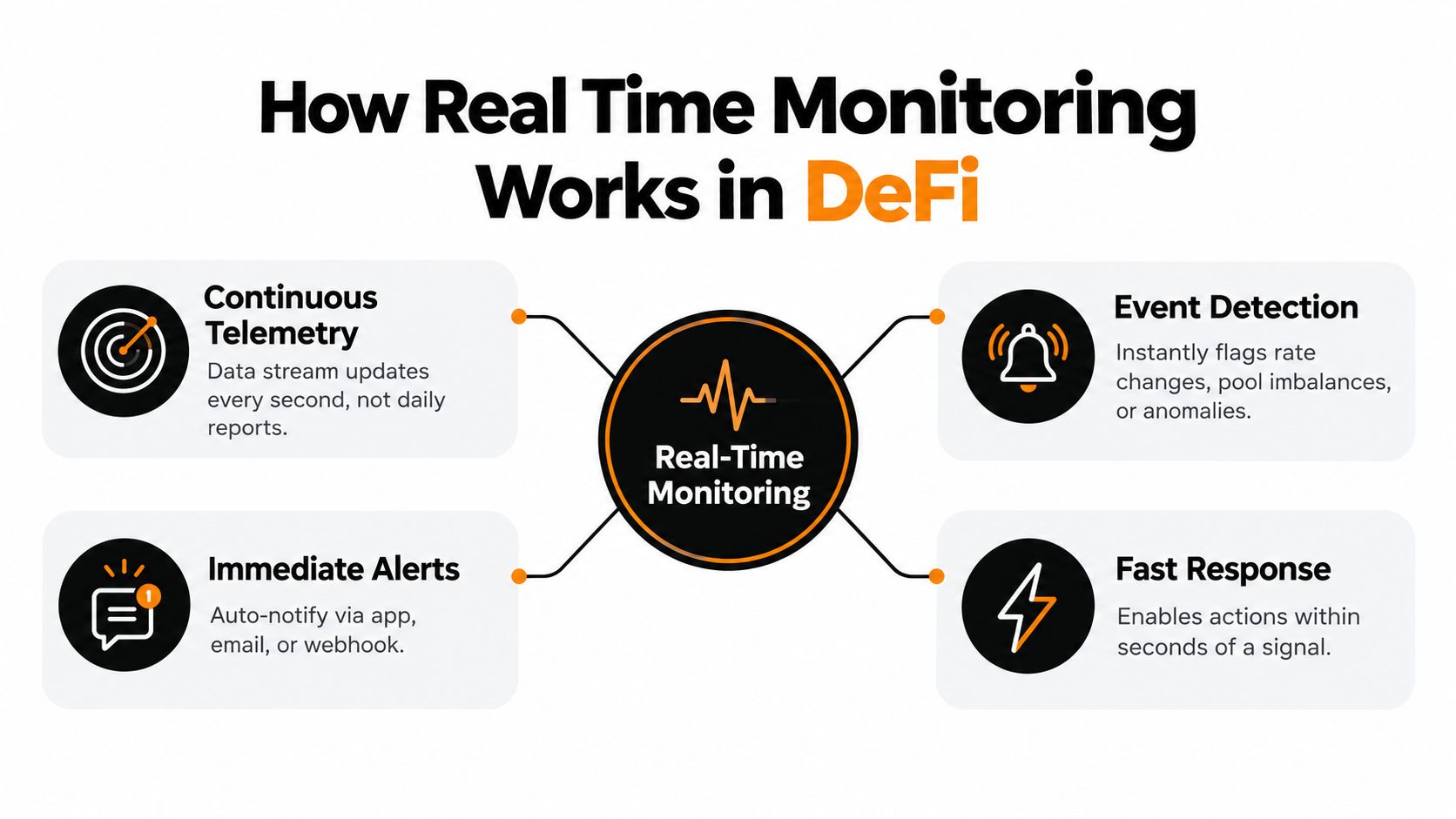
Think of real time monitoring as a live health monitor rather than a daily medical report. A daily report might tell you that something changed overnight. A live monitor can show the change as it develops, compare it with normal behavior, and call attention to a signal that deserves action.
In DeFi, the system gathers data from several places. It can observe on-chain transactions, vault balances, APY or APR changes, liquidity, utilization, reward emissions, gas conditions, price feeds, and protocol events. The system then processes those streams continuously instead of waiting for a scheduled spreadsheet or manual visit.
From raw telemetry to a decision
The workflow usually has four connected parts:
Continuous telemetry: The monitor receives fresh observations from protocols, wallets, contracts, and market data sources.
Event detection: Rules or anomaly models identify a meaningful deviation, such as a sharp rate change or unusual liquidity movement.
Alert routing: The system sends context to an app, email, webhook, or another workflow.
Response: A person or an approved agent reviews the signal and decides whether to hold, exit, rebalance, or wait.
That last step matters most. A dashboard can display a changing APY, but it doesn't automatically tell you whether the change reflects sustainable demand, temporary incentives, or rising risk. Data speed only becomes useful when it improves action timing and decision quality.
A DeFi dashboard can help you compare these signals in one place, while a broader guide on implementing continuous monitoring with CloudCops GmbH provides useful context on the collection, analysis, and alerting pattern behind monitoring systems. The same principle applies whether you're watching infrastructure or stablecoin positions: gather events continuously, filter them, and connect them to a response.
You can also use an interactive DeFi dashboard as a practical starting point for understanding how balances, rates, and strategy activity fit together. The goal isn't to create an endless stream of charts. It's to create a current operating picture that tells you what changed, why it may matter, and what action remains available.
Key Benefits That Change How You Earn Yield
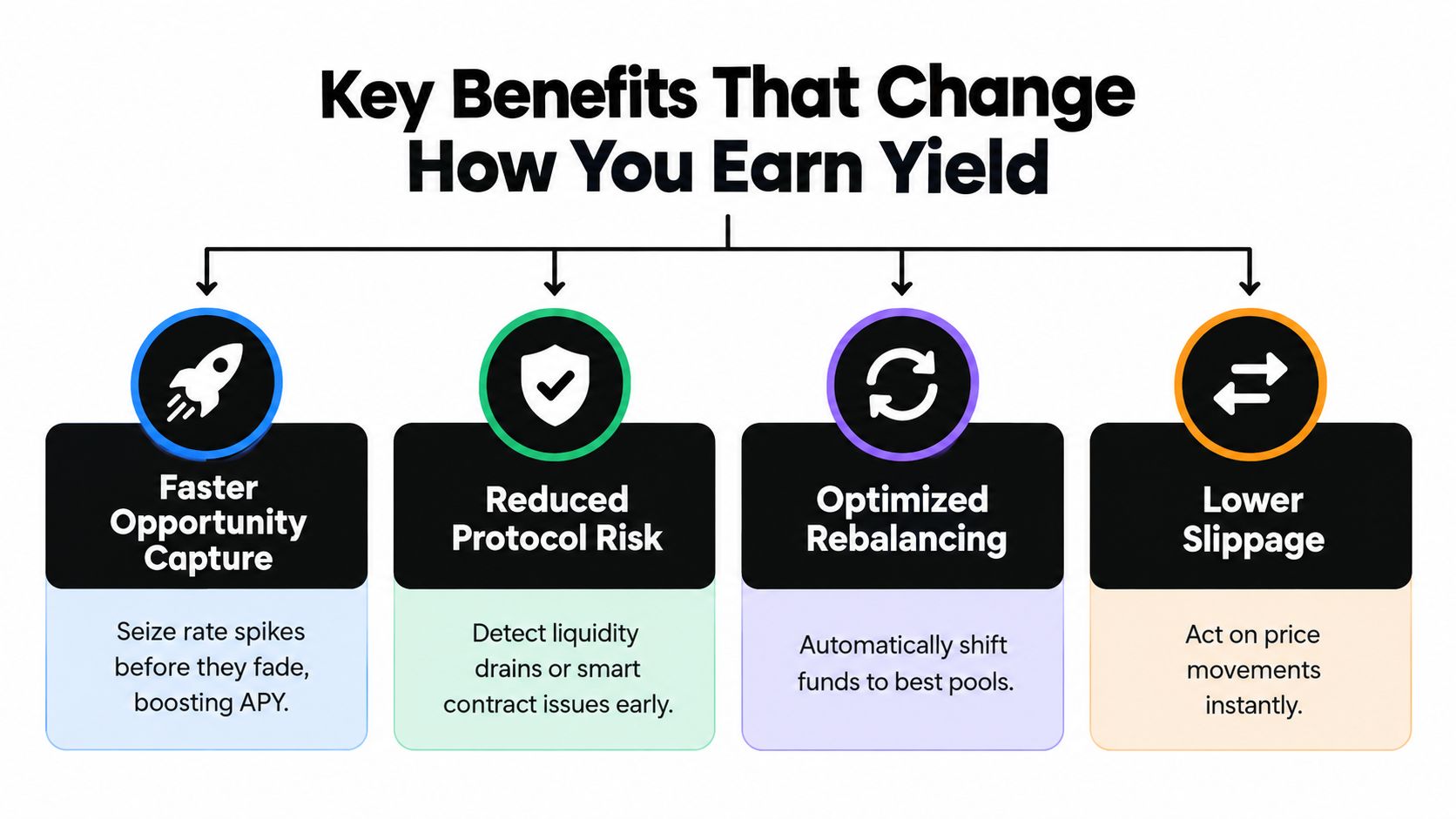
Time monitoring benefits become clearer when you follow the cause-and-effect chain. A live signal arrives, the system interprets it, and the user or agent acts before the condition becomes irrelevant.
Faster opportunity capture
Yield opportunities often depend on changing incentives, demand, and available liquidity. If you review rates only occasionally, you may see an attractive opportunity after its most useful period has passed. Continuous observation lets a strategy identify a rate movement earlier and compare it with other conditions before allocating funds.
That doesn't mean every sudden APY increase deserves a deposit. A rate spike can come with shallow liquidity, temporary rewards, or high protocol risk. The advantage is that you get enough timing and context to investigate while the opportunity still exists.
Earlier risk containment
Monitoring can also protect the downside. A falling liquidity balance, unusual contract event, or weakening stablecoin price signal may not prove that a protocol is unsafe, but it can justify a closer review. Earlier awareness gives you more choices than a late discovery after withdrawals become difficult or losses have already accumulated.
Real-time video monitoring benchmarks illustrate the importance of timing. One cited benchmark reports a 75% reduction in incident detection time and an 85% reduction in false alerts compared with manual monitoring, with some deployments showing detection-to-alert cycles of 8 to 12 seconds (Ceptory's AI-powered monitoring benchmark). Those figures describe a different operational setting, so they shouldn't be treated as a DeFi forecast. They do show why continuous observation paired with filtering can change the window available for response.
More agile liquidity management
A yield position isn't only a rate. It also has an exit path. If liquidity becomes thinner, moving capital can create more slippage or take longer to execute safely. A live monitor can flag that change while the position is still manageable, allowing you to reduce exposure, split an exit, or wait for better execution conditions.
Timing is the advantage: Monitoring doesn't create yield by itself. It helps you decide while the rate, liquidity, and risk conditions still support the decision.
The final benefit is operational. Instead of manually opening several protocols, copying rates into notes, and checking each position separately, you can define a smaller set of signals that deserve attention. That structure reduces research burden, but only if the alerts remain relevant and the strategy makes its assumptions visible.
Essential Metrics Every Yield Monitor Should Track
A useful monitor doesn't track everything equally. It watches the signals that connect directly to return, liquidity, execution, and protocol health, then assigns each signal a response.
Start with APY and APR fluctuations. A sudden increase may attract deposits, while a sudden decrease can change the position's appeal. Compare the rate movement with reward emissions, utilization, and liquidity instead of treating the headline number as a complete answer.
Total value locked provides context about capital in a protocol or pool. A rising figure can indicate growing participation, while a decline may deserve investigation. TVL isn't a safety guarantee, so pair it with contract events, withdrawal conditions, and the quality of the underlying assets.
Liquidity depth tells you how easily funds can move without excessive price impact. A pool can advertise a compelling return and still be difficult to exit if available liquidity is limited. Gas fees belong in the same decision because frequent reallocation can consume part of the expected return.
Finally, watch smart contract health and reward emissions. Upgrades, pauses, unusual transactions, or other protocol events can change the risk profile. Reward emissions can explain why a rate is high today and whether that source of return may change.
Metric | What It Signals | Action Trigger |
|---|---|---|
APY or APR movement | The current return environment is changing | Review whether the new rate is supported by sustainable activity |
TVL trend | Capital participation and possible confidence shifts | Investigate a sharp change alongside other risk signals |
Liquidity depth | How easily capital may enter or exit | Reduce size, split execution, or pause movement when exit conditions weaken |
Gas fees | The cost of acting on a signal | Delay low-value moves when transaction costs erode the expected benefit |
Smart contract health | Events that may alter protocol exposure | Escalate upgrades, pauses, anomalies, or unexpected contract activity |
Reward emissions | The source and durability of incentive-driven return | Reassess the position when rewards change materially |
Thresholds keep this checklist usable. Set a threshold for a meaningful APY change, a liquidity warning, or a protocol event, then define what happens next. A deeper on-chain data guide can help you understand where these observations originate and why context matters more than a single number.
How AI Agents Turn Alerts Into Automated Actions
An alert tells you that something happened. An AI agent helps determine whether the event deserves action and can connect that judgment to an approved workflow.
The progression usually happens in stages. At the simplest level, the system notifies you. At the next level, it summarizes the event, compares available opportunities, and recommends a response. At the most automated level, an agent can reallocate according to rules you approved in advance.
Closing the gap without surrendering control
An AI agent can scan fragmented protocols faster than a person who checks each interface manually. It can compare risk-adjusted yield, examine liquidity and gas conditions, and identify whether a rate change looks actionable. That doesn't remove the need for governance. It makes governance more important because automated action needs boundaries.
A sound setup defines:
Alert thresholds: Which changes deserve attention, and which are normal noise?
Escalation paths: Which events require a notification, a recommendation, or a pause?
Execution limits: How much capital can move, and under what conditions?
Audit visibility: Can you see what the agent observed and why it acted?
User control: Can you review, change, or stop the strategy when conditions change?
Guidance on BroLabel AI agent tools offers broader context for how agents can connect observation with task execution. In DeFi, the same design question remains central: does automation reduce decision latency while keeping the user's intent clear?
Yield Seeker provides one example of this model. Its Autoseek strategy monitors stablecoin yield opportunities and reallocates funds across DeFi protocols in real time, while its interface presents balances, earnings, and an audit trail of agent activity. Users can deposit USDC on Base, keep funds accessible without lockups or withdrawal fees, and review how the strategy operates rather than relying on an invisible process.
The practical lesson is simple. AI should reduce repetitive monitoring, not replace the user's risk preferences. A fast agent with poor thresholds can create fast mistakes. A slower, transparent workflow with clear limits may produce more trustworthy decisions.
For a deeper look at the relationship between agents and crypto workflows, explore AI agents in crypto. The strongest systems connect live signals, understandable reasoning, and controlled execution.
Real World Examples of Monitoring in Action
Consider a stablecoin pool after a liquidity migration. A manual user checks the pool during a routine review and sees that the advertised rate has changed. They may need to investigate where liquidity moved, compare the new destination, and decide whether the opportunity is still attractive. A live monitor can flag the migration as it develops, giving the user or agent time to compare alternatives before the original conditions disappear.
A second scenario involves early stress around a stablecoin. A single price movement doesn't prove a depeg, and an isolated transaction doesn't prove a contract problem. But a combination of price deviation, withdrawals, weakening liquidity, and unusual protocol activity creates a stronger reason to reduce exposure or pause new deposits. With delayed review, the user may discover the pattern only after several signals have aligned against the position.
A signal isn't a verdict. It's a reason to inspect the decision while options remain open.
Now consider utilization. A lending market can become more heavily used, changing available liquidity and the balance between supply return and withdrawal flexibility. A monitor can detect the shift, compare it with gas and alternative pools, and recommend a measured rebalance rather than forcing an all-or-nothing move.
These examples show why the dashboard isn't the main product. The important difference is the sequence. A delayed workflow asks, “What happened since my last check?” A real-time workflow asks, “What changed, does it matter, and what can I still do?”
The same event can produce different outcomes depending on that timing. Monitoring won't eliminate uncertainty, and it can't guarantee positive yield. It can make the decision process more responsive, more explainable, and less dependent on remembering to check every protocol at the right moment.
Putting Real Time Monitoring to Work for Your Yield
Start with the outcome you want to improve. Is the priority capturing changing rates, limiting exposure to protocol stress, reducing unnecessary transactions, or understanding automated decisions? A monitor becomes useful when its signals connect to a clear objective.
Then build a small decision policy:
Choose high-value signals: Track rates, liquidity, protocol events, gas conditions, and the risk indicators that matter to your strategy.
Set meaningful thresholds: Define what counts as a review, an escalation, or an approved automatic action.
Measure decision quality: Review whether alerts led to useful actions or created noise, missed events, and unnecessary intervention.
Keep an audit trail: Record what the system observed, what it recommended, and what happened after execution.
Preserve control: Make sure you can adjust rules, pause automation, and access your funds when your circumstances change.
Independent monitoring guidance emphasizes that systems should surface only relevant issues, which is a useful standard for DeFi as well (Estuary's real-time monitoring guidance). More notifications don't automatically create better oversight. The right setup gives you fewer, clearer decisions with enough context to act responsibly.
Real time monitoring benefits appear when visibility changes behavior. Pair live data with alert governance, transparent automation, and regular review, and you can manage yield with less screen time without treating automation as a substitute for judgment.
Yield Seeker helps stablecoin holders monitor and allocate USDC across DeFi opportunities through an AI-powered strategy with visible balances, earnings, and agent activity. Visit Yield Seeker to explore a more responsive approach to yield management that keeps automation, transparency, and access together.