

You've just received $10,000 in USDC from a sale or a paycheck. Leaving it in a wallet earns nothing, while moving it to a centralized exchange may introduce custody and platform risk. DeFi offers another option: supply the stablecoins to a lending protocol and receive variable interest, provided you understand what supports the return and what can interrupt it.
That last part matters more than the headline APY. Stablecoin lending is not a bank savings account, it isn't protected by an FDIC-equivalent, and the yield doesn't come from the stablecoin appreciating. It comes from borrower demand, protocol incentives, liquidity conditions, and sometimes strategies that carry risks hidden behind a simple percentage. This guide follows the money, explains the liquidation machinery, and shows how to assess a return after smart-contract, peg, custody, and liquidity risks.
What Stablecoin Lending Actually Means
Stablecoin lending is the act of supplying dollar-pegged tokens such as USDC, USDT, or DAI to a smart contract. The protocol pools deposits from many suppliers, makes those funds available to borrowers, and distributes part of the interest back to suppliers through a variable APY. You can explore the broader idea of earning on stablecoins in this stablecoin yield overview.
The basic arrangement has two sides. A supplier deposits stablecoins and seeks passive income. A borrower deposits crypto collateral, often a volatile asset such as ETH, then draws stablecoins against it. The borrower pays interest because they want liquidity without selling the collateral. The supplier earns because their capital helps fund that loan.
A useful analogy is a pawn shop. You hand over cash to the shop, the borrower leaves valuable property as collateral, and the shop charges for providing liquidity. DeFi replaces the shopkeeper with smart contracts, blockchain transactions, price oracles, and preset rules. Those rules decide how much someone can borrow, when a position becomes unsafe, and how liquidators recover the lender's funds.
The important distinction: you're not earning a return because USDC becomes worth more. You're lending a token and accepting the technical and market risks of the system that deploys it.
Stablecoin lending also isn't a guaranteed claim against a regulated bank. A protocol can experience an oracle failure, a smart-contract exploit, a liquidity shortage, or a stablecoin depeg. Even when the code behaves as designed, your APY can change as borrowers enter and exit the market.
The practical questions are therefore straightforward:
Mechanics: How does a deposit become a lending position?
Yield: Who pays the interest, and what portion comes from incentives or speculative rewards?
Failure modes: What happens during a sharp collateral decline or stablecoin depeg?
Execution: How can a newcomer start without treating a dashboard percentage as a promise?
Those questions matter more than choosing the highest number displayed on a protocol page.
How DeFi Lending Protocols Work
A DeFi lending market behaves like a collateralized pawn shop with transparent accounting. Suppliers place funds into a shared pool. Borrowers access that pool only after depositing collateral worth more than the loan, because the protocol needs a buffer against price movements and transaction delays.
The supply side
A typical deposit follows this sequence:
Connect a wallet. You select the chain and the stablecoin market.
Approve the token. The wallet grants the protocol permission to transfer the amount you choose.
Deposit the stablecoin. The transaction moves your tokens into the lending pool.
Receive a receipt token. Aave issues aTokens, while Compound uses cTokens or its newer receipt structures. These tokens represent your claim on the supplied asset and reflect accrued interest through rebasing or appreciation.
Withdraw later. You redeem the receipt position, subject to available liquidity and the protocol's rules.
The receipt token is not the same as a new source of money. It tracks your share of the pool. As borrowers pay interest, the value or balance associated with that share changes.
The borrower side
A borrower first supplies collateral, then selects a debt asset and amount within the market's risk limits. The protocol applies a Loan-to-Value limit or collateral factor. If ETH has a lower permitted borrowing ratio than a less volatile asset, the borrower must post more ETH for the same stablecoin loan.
The position also has a health factor, commonly expressed as debt-weighted collateral value divided by debt. Interest accrues continuously through blockchain state updates, so the debt grows while the collateral value changes with the market. If the health factor falls below the protocol's safety boundary, liquidation can begin.
Rates are variable because they respond to utilization, the proportion of supplied liquidity currently borrowed. A pool with abundant unused capital can offer a lower borrowing rate. As more liquidity leaves the pool, the rate rises to attract suppliers and discourage additional borrowing. Many markets use a kinked curve, with rates increasing much faster after a utilization threshold so that withdrawals remain possible.
Aave and Compound make these mechanics visible through isolated markets, collateral parameters, reserve factors, and utilization charts. MakerDAO uses a different architecture. Its vaults let users lock collateral and generate DAI, while its Peg Stability Module can facilitate a stablecoin-to-stablecoin exchange rather than operate like an ordinary pooled lending market. Recognizing that distinction prevents you from treating every DAI-related strategy as the same kind of loan.
The protocol automates enforcement, but automation doesn't remove risk. It only makes the rules execute quickly and consistently.
Where the Yield Really Comes From
A stablecoin APY is usually a bundle of different cash flows. Treating the displayed rate as one thing makes it difficult to judge whether the return can survive a change in market conditions.
Borrower interest is the core component
The cleanest source is interest paid by borrowers. Someone wants USDC, DAI, or another stablecoin, posts collateral, and pays the pool for access. The protocol distributes part of that payment to suppliers and retains a portion as reserves through its reserve factor.
This component is tied to real borrowing demand. It can fall when borrowers repay or when new suppliers add capital. It can rise when traders, market makers, or users seeking amplified exposure compete for limited liquidity. The observed spread between venues illustrates why rates must be compared as dynamic markets, not fixed coupons. Coverage of stablecoin interest-rate mechanics is useful for understanding that distinction.
Incentives can make the dashboard look richer
Protocols may distribute governance or ecosystem tokens to attract deposits and borrowing. Aave's Safety Module and Compound's COMP ecosystem are familiar examples of incentive design, although the exact programs and terms can change through governance.
An incentive token can increase the nominal APY while adding another asset to your risk profile. Its market price can fall, emissions can change, and governance can reduce or remove the reward. If you need to sell the incentive immediately to measure your return in dollars, your realized yield may be much lower than the advertised figure.
Stablecoin spreads and credit creation add complexity
Some strategies earn from differences between stablecoins, collateralized debt positions, or protocol-native issuance. A protocol can accept collateral, create a stablecoin, and manage the position through fees and liquidation rules. The return may depend on maintaining a narrow price relationship, not solely on borrowers paying interest.
Points and potential airdrops create a fourth category. New markets may reward activity before a token exists, but points have no guaranteed liquidation value. Their value depends on future distribution rules, market demand, and your ability to claim them.
Yield Source | What Backs It | Typical Share of APY | Dominant Risk |
|---|---|---|---|
Borrower interest | Demand for stablecoin loans | Variable | Utilization and liquidity changes |
Protocol incentives | Governance or ecosystem tokens | Variable | Token-price and emissions risk |
Stablecoin spreads | Peg management, issuance, or arbitrage | Variable | Depeg and strategy risk |
Points and airdrops | Possible future rewards | Uncertain | No guaranteed value |
The four sources can add together on a dashboard, but their risks stack too. When an APY materially exceeds the borrowing rate paid by genuine demand, investigate the difference. It may be funded by incentives, a spread strategy, or speculative points rather than durable lending income.
The Risk Stack Behind That APY
Liquidation is the clearest way to understand why stablecoin lenders inherit borrower risk. Suppose a borrower deposits $1,000 of ETH, borrows $600 of USDC, and receives a permitted 70% Loan-to-Value ratio. If ETH falls, the debt remains denominated in USDC while the collateral becomes worth less.
At a 5% decline, the collateral is worth $950. At a 10% decline, it's worth $900. At a 20% decline, it's worth $800. Those figures alone don't determine liquidation, because the protocol also uses a liquidation threshold, asset-specific parameters, accrued interest, and oracle prices. The borrower's health factor deteriorates as the collateral value falls relative to the debt.
A protocol liquidates when the position no longer provides enough collateral protection. The liquidator repays some or all of the debt and receives collateral at a discount. Research on DeFi liquidation design describes two broad approaches, auctions that let liquidators bid over time, and atomic fixed-spread liquidations that close positions immediately at a preset discount. Aave allows liquidators to purchase collateral at up to a 15% discount, as documented in this overview of decentralized lending and liquidation mechanics.
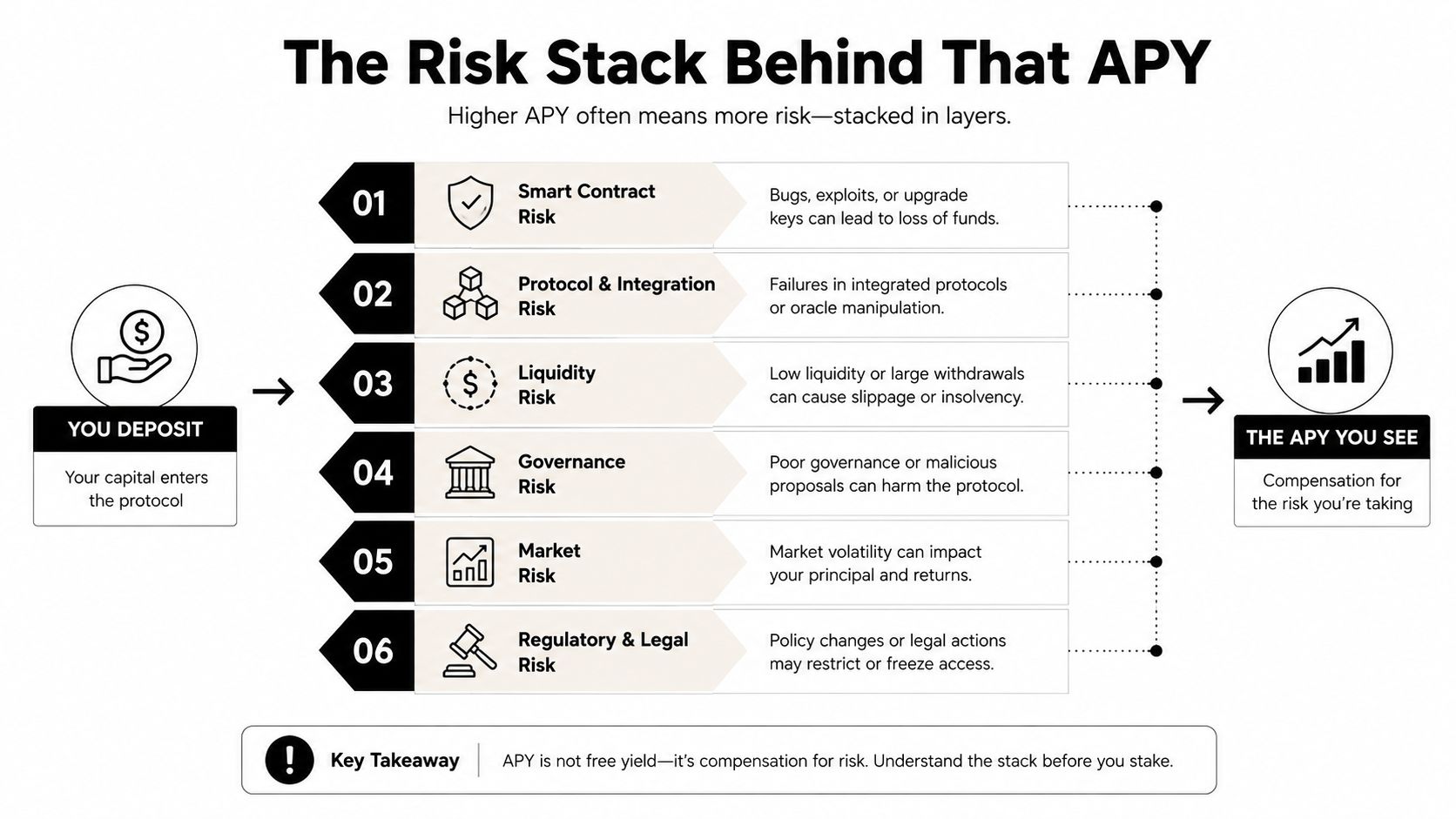
The layers lenders need to price
Collateral risk: Volatile assets can decline faster than liquidators can close positions.
Oracle risk: A faulty or delayed price feed can misstate collateral health.
Smart-contract risk: Bugs, reentrancy, and unsafe upgrades can redirect or freeze funds.
Stablecoin risk: A token can trade below its intended peg or face issuer and reserve concerns.
Liquidity risk: A lender may be unable to withdraw when much of the pool is borrowed.
Incentive risk: Rewards paid in a volatile token can lose value independently of the lending pool.
MakerDAO's vault system uses keeper-driven liquidation processes, while Compound has used auction-style mechanisms in parts of its liquidation design. The details differ, but the lender's problem is similar: a position must be unwound before losses consume the available collateral buffer.
The stablecoin itself adds another layer. DAI depends on collateralized protocol design, USDC carries issuer and reserve exposure, and USDT introduces questions around reserve transparency and market liquidity. Historical depeg events involving USDC and UST show why “stable” describes a target, not an absolute guarantee.
For a broader framework on examining protocol teams, permissions, audits, and operational exposure, this practitioner's crypto due diligence guide offers a useful checklist.
This video provides another visual explanation of the risk stack and liquidation process:
Risk-adjusted return is the number that matters. A lower nominal APY from a mature, liquid market may be preferable to a higher rate dominated by volatile incentives, thin liquidity, or an unfamiliar contract.
DeFi Versus CeFi Stablecoin Lending
The central difference between DeFi and CeFi is the interest rate. It's who holds your assets, who sets the rate, how much information you can verify, and who absorbs a borrower or platform failure.
In DeFi, you generally interact with a smart contract from your own wallet. Pool balances, borrows, collateral, and utilization are recorded on-chain. The system normally requires overcollateralization and uses automated liquidation rules. That transparency helps you inspect the mechanism, but it doesn't guarantee that the code is safe or that liquidity will remain available.
In CeFi, you transfer assets to a company. The company owes you a custodial claim and may use a balance sheet, lending desk, or other arrangements to generate the advertised return. You may receive a smoother interface and simpler support process, but you're relying on the platform's solvency, controls, counterparties, and withdrawal policy.
Dimension | DeFi Lending | CeFi Lending |
|---|---|---|
Custody | User-controlled wallet interacting with contracts | Platform controls the deposited assets |
Rate source | Pool utilization and protocol incentives | Platform policy, balance-sheet economics, or promotional funding |
Transparency | On-chain positions and rules are inspectable | Internal lending and rehypothecation may be difficult to verify |
Collateral process | Automated rules and liquidators | Platform-managed collections or risk controls |
Main failure exposure | Contracts, oracles, liquidity, pegs | Company solvency, custody, counterparties, withdrawals |
Available market coverage reported DeFi stablecoin lending rates commonly clustering around 2% to 6% APY, while regulated CeFi platforms more often appeared in the 4% to 8% APY range. Higher advertised CeFi rates sometimes reached 11% to 30% APY, but those offers were less uniform and carried additional platform, credit, or liquidity risk, as discussed in this comparison of stablecoin-backed lending platforms.
The gap can therefore be misleading. A higher CeFi rate may compensate you for trusting a centralized borrower with limited visibility into how funds move. A lower DeFi rate may reflect deeper liquidity and tighter collateral rules, although it still leaves you exposed to code and market infrastructure.
Compare the risk bearer, not just the APY. A rate is only attractive after you identify the party and mechanism paying it.
Putting Your First Dollar to Work Safely
A first deposit should feel more like a controlled test than a leap. Start with an amount whose temporary loss would not affect rent, payroll, taxes, or emergency savings.
Select the wallet and chain deliberately
A hardware wallet can protect high-value signing operations, while a reputable hot wallet may be more convenient for a small test deposit. The important distinction is not the brand. It's whether you understand which account is signing and what permission the transaction grants.
Avoid approving an unlimited token allowance by default. Set an allowance that matches the amount you intend to supply, or revoke unused permissions later with a trusted allowance-management tool. A malicious or compromised contract can use an approval to move tokens, so the approval deserves the same attention as the deposit itself.
Chain selection changes the trade-off. Ethereum mainnet generally offers deep liquidity for major markets such as USDC and DAI, while Aave deployments on Base or Arbitrum can reduce transaction costs. Lower fees don't eliminate risk. If assets reach the chain through a bridge, include bridge design and security in your assessment.
Make the deposit and inspect the position
A cautious sequence looks like this:
Verify the official interface. Confirm the protocol, chain, token contract, and market before connecting.
Approve only the intended token. Read the wallet prompt and reject unexpected spender addresses.
Deposit a test amount. Confirm that the receipt token or supply balance appears correctly.
Check available liquidity. A high supply APY alongside scarce withdrawal liquidity deserves scrutiny.
Confirm no borrow position exists. Supplying stablecoins alone shouldn't create debt, but the interface should show your collateral and borrow balances clearly.
After depositing, monitor the stablecoin's market price through established market data and liquidity venues such as CoinGecko or Curve. Watch the protocol's utilization, reserve factor, governance activity, and contract history. An audit is helpful, but it doesn't prove that every deployment, upgrade, oracle, or integration is safe.
For readers who want automated routing and rebalancing rather than manually comparing every pool, Yield Seeker's AI-agent flow can monitor DeFi venues and allocate supported USDC deposits on Base, while the DeFi onboarding guide explains the broader setup considerations. Automation can reduce repetitive work, but it shouldn't replace understanding the assets and contracts involved.
Best Practices for Stable Yield Over Time
Stablecoin lending rewards a risk-management routine, not a one-time hunt for the highest APY. A durable process limits exposure, tests assumptions, and treats rate changes as signals about liquidity and borrower demand.
Build a portfolio that can survive one failure
Avoid placing every stablecoin in one protocol, chain, or issuer. Spreading exposure can reduce the effect of a contract bug, oracle malfunction, liquidity squeeze, or depeg. It cannot remove losses caused by stress shared across the market.
Write an allocation rule before depositing. Set the portion reserved for established markets, the amount allowed in newer incentive programs, and the conditions that trigger a withdrawal. A pre-set rule is easier to follow during a rate spike than a decision made while prices and liquidity are changing quickly.
Audit the system, not just the code
Review recent audits, public bug bounties, administrator permissions, upgrade controls, oracle providers, and incident history. Check whether governance can change parameters quickly, and whether a multisig or timelock limits that power. No known exploit does not mean the protocol is risk-free.
Read rate movements as signals
A rising APY can mean borrowers need liquidity. It can also show that utilization is nearing a level where withdrawals become harder. Check the utilization curve, available liquidity, reserve growth, incentive emissions, and the source of the displayed return.
Market conditions can reprice stablecoin lending quickly. Research cited by Galaxy recorded on-chain borrow rates around 4.7% on March 31, 2025, 4.96% by July 31, 2025, and a later aggregate spike to 7.9% after the rsETH exploit (Galaxy, Q2 2025). A calm dashboard can therefore show a rate that changes sharply during a liquidity shock. The advertised APY is a snapshot, not a promise of risk-adjusted return.
Automate only after you can explain the strategy
An AI agent can route funds, monitor venues, and rebalance under defined rules. It cannot remove protocol, liquidity, asset, or peg risk. Before delegating, explain which assets it uses, which risks it accepts, how it reacts to falling liquidity, and whether it can move funds when conditions change.
A good automation rule is explicit: preserve liquidity first, pursue yield second, and never treat an incentive token as guaranteed income.
Yield Seeker provides automated stablecoin yield routing for supported USDC deposits on Base, with monitoring across DeFi lending and vault venues. Visit Yield Seeker to review the managed workflow, then begin with an amount small enough to verify each step before increasing exposure.