
Most advice on stablecoin passive income starts with the wrong promise. It sells sleeping money and skips the part where your yield changes, your protocol risk changes, and your principal can still be tied up in systems that fail when stress hits.
The practical mindset is simpler. Treat stablecoin yield as paid risk, not free income. If you can't explain where the return comes from, what can break, and how fast you can exit, you're not investing, you're guessing.
The Reality Behind Stablecoin Passive Income
A lot of people arrive here expecting something close to a cash account. That's the dangerous comparison. Stablecoin yield is usually the byproduct of someone else's borrowing, trading, or incentive structure, and those conditions move constantly.
During the DeFi expansion from 2020 to 2022, lending became the main engine behind this idea. The Bank for International Settlements reported that total value locked in DeFi lending rose from nearly zero at the end of 2020 to about $50 billion by early 2022 (BIS report). That growth did not happen because stablecoins themselves created value, it happened because people wanted exposure to dollar-linked assets that could be deployed into lending markets, collateral loops, and liquidity strategies.
Practical rule: if a yield product can't tell you who is paying, it's hiding the real source of return.
The key lesson from that period still matters today. Stablecoin yield comes from supplying liquidity to borrowers, not from the token magically producing income on its own. Returns can come from lending demand, borrowing against collateral, arbitrage, market-making, or protocol incentives, and they move with utilization, liquidity, market conditions, and smart-contract risk.
That's why “passive” is a misleading word if you take it at face value. The work is not in pressing a button. The work is in understanding the mechanism, checking the downside, and deciding whether the return still makes sense after fees, latency, and risk.
Understanding Stablecoins and DeFi Yield
A stablecoin is a crypto asset designed to track a reference value, usually the U.S. dollar. Some are asset-backed, which means they rely on reserves or collateral structures, while others are algorithmic, which try to maintain the peg through programmatic incentives and market behavior. The distinction matters because the peg is the whole point, and not every design protects it the same way.
In DeFi, stablecoins are useful because they stay close to a dollar value while still moving through wallets, protocols, and collateral systems. That makes them a common base asset for lending, liquidity provision, and automated strategies. They're easier to reason about than volatile assets like BTC or ETH when the goal is to earn yield without taking directional price risk.
Where the yield actually comes from
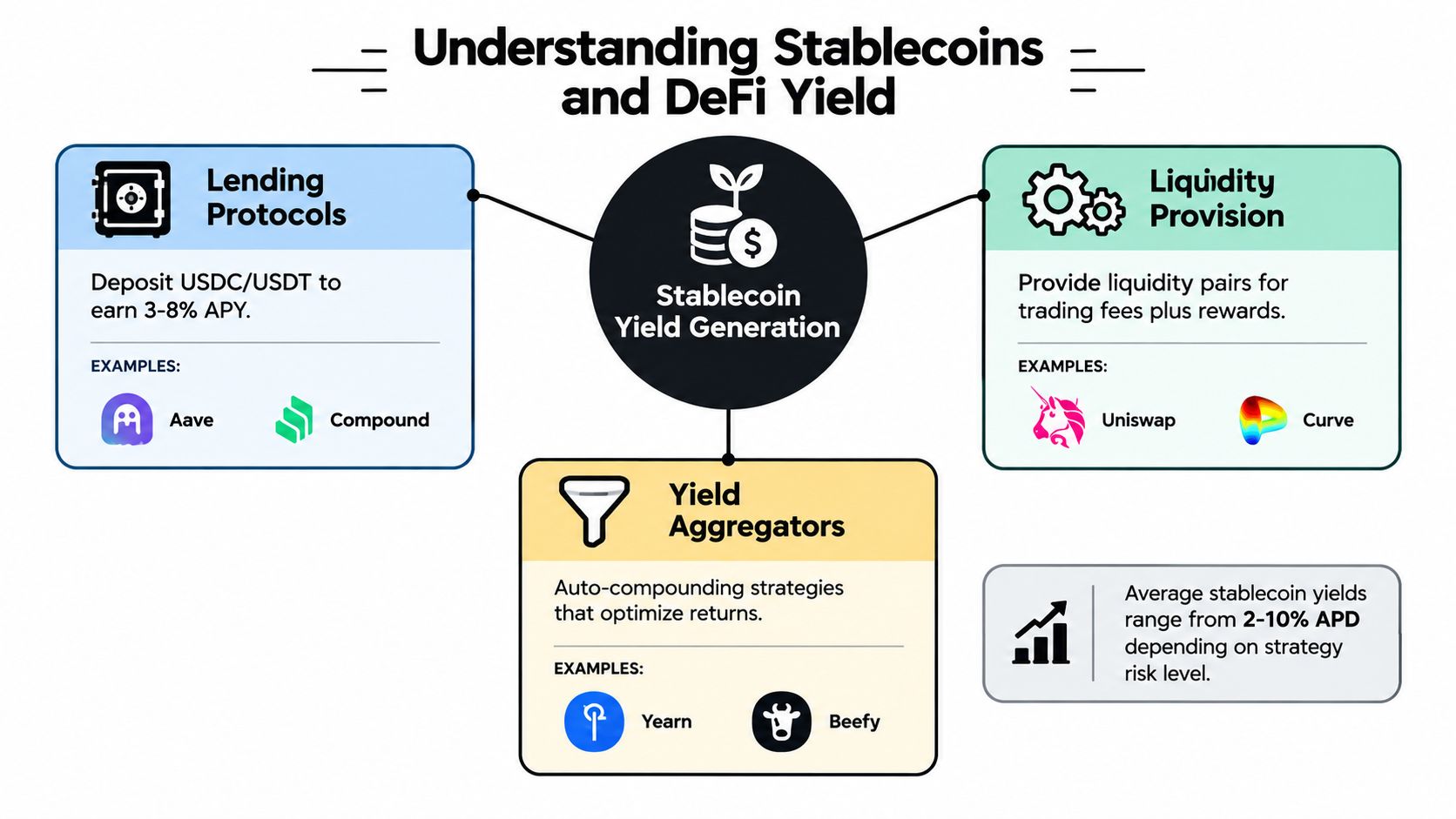
The cleanest mental model is simple. You deposit stablecoins, and the protocol routes that capital into an economic activity that produces revenue or rewards. In lending, borrowers pay interest. In liquidity provision, traders pay fees. In aggregators, capital is moved around to capture the most attractive net return.
Stablecoin yield is not one product category. It's a wrapper around several very different cash-flow engines.
That's why two strategies can both advertise “stablecoin yield” and still behave nothing alike. A lending position may be relatively straightforward, while a liquidity position can expose you to pool imbalance, reward decay, or contract complexity. Yield aggregators sit on top of that stack and try to reduce manual work, but they also introduce dependency on another layer of smart contracts.
The beginner mistake is focusing only on APY. The better question is whether the return is base yield, incentive yield, or temporary promotional yield, because those don't decay at the same pace. The more a strategy depends on incentive programs, the more likely it is to look strong early and fade later.
Primary Strategies for Earning Stablecoin Yield
Lending protocols are usually the first stop because they're easier to understand. You deposit stablecoins into a market like Aave or Compound, borrowers post collateral, and the protocol routes interest back to lenders. The appeal is obvious, but the yield depends on borrowing demand, market utilization, and whether the asset is in a crowded or lightly used pool.
Liquidity provision works differently. Instead of lending directly, you supply stablecoins to a trading pool, and you earn from swap activity plus any rewards the protocol adds. This can be efficient when trading volume is healthy, but it's also more exposed to shifting incentives and pool-specific mechanics. A trader-friendly pool can look attractive one week and dull the next if rewards are cut or liquidity floods in.
The third common path is a yield aggregator. These systems take your stablecoins and route them through underlying strategies, then compound the results. The attraction is convenience, and the trade-off is another layer of contract and governance risk. If you want a practical overview of this style of setup, the discussion around low-risk yield farming is a useful companion read.
Strategy | What you're really doing | Main advantage | Main trade-off |
|---|---|---|---|
Lending | Supplying capital to borrowers | Simple mechanics | Rate changes fast |
Liquidity provision | Funding swap activity | Can combine fees and rewards | More moving parts |
Aggregators | Delegating routing and compounding | Less manual work | Adds another protocol layer |
The best choice depends on whether you want simplicity, flexibility, or automation. I usually tell people to start with the mechanism they can explain in one minute, not the one that advertises the biggest headline return.
Hidden Risks and Common Misconceptions
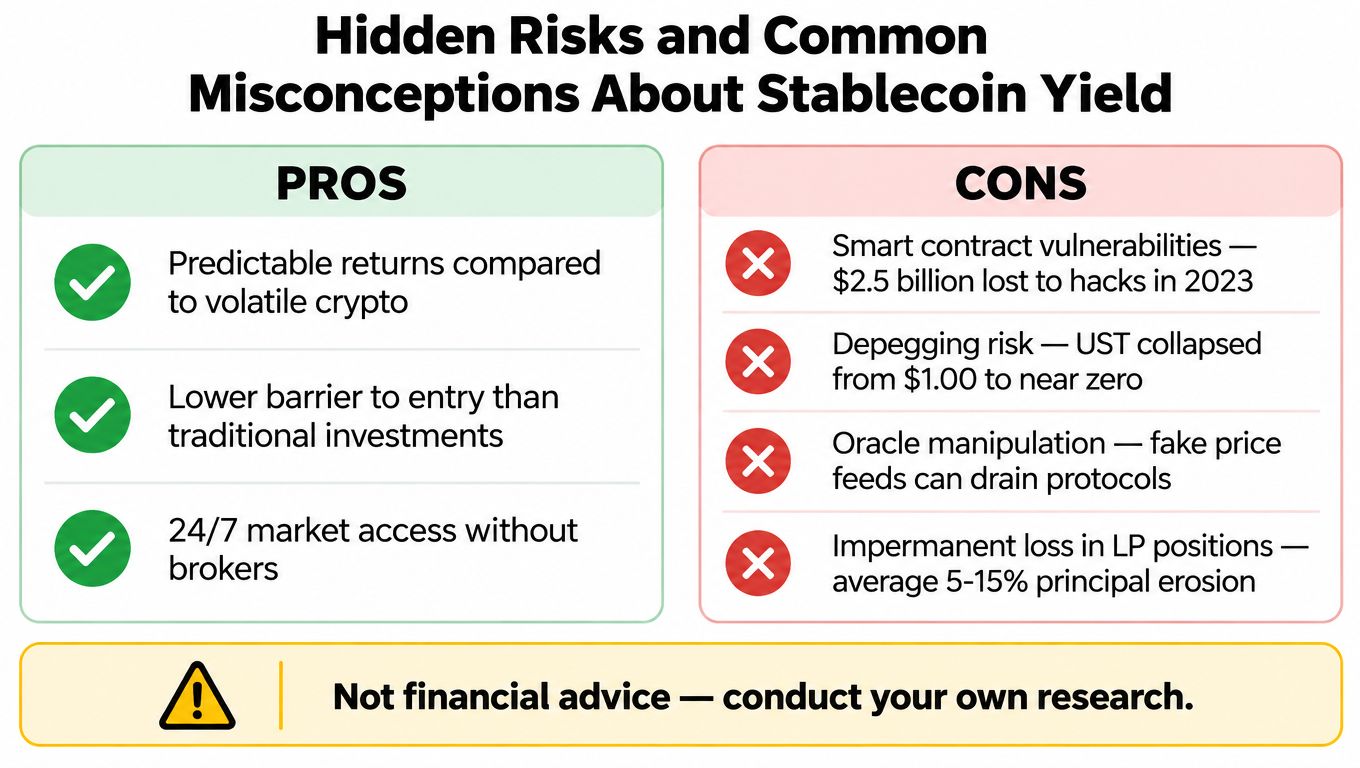
The biggest misconception is that a stablecoin strategy is “safe” because the price doesn't swing much. That's not how the risk works. The asset may stay near a dollar while the protocol, bridge, oracle, or governance layer creates the actual loss.
A more useful frame is to separate issuer risk, depeg risk, protocol risk, chain or bridge risk, and strategy risk. Those are different failure modes, and each one needs a different kind of check. If a platform can pause withdrawals, rehypothecate assets, or depend on fragile oracle inputs, the word “stable” doesn't mean much.
The scale of the security problem is not theoretical. Approximately $2.5 billion was lost to crypto hacks and scams in the first half of 2025, which is a strong reminder that smart-contract safety still matters even when the yield looks conservative (CoinDesk on DeFi losses). Audits help, but they don't eliminate failure, especially when integrations, governance, or liquidity assumptions change.
What people get wrong
A common error is assuming that “no lockup” means instant liquidity in every condition. It doesn't. A protocol may technically allow withdrawals while the underlying markets are strained, queues are forming, or slippage has exploded. Another mistake is treating every drop in yield as bad news, when lower yield can sometimes mean less borrowing or less dependence on aggressive incentives.
If you need help tracking realized gains and losses across wallets and pools, a tax and recordkeeping service like Allied Tax Advisors crypto tax help can save you from messy year-end cleanup. That matters because yield strategies often generate more transactions than people expect, even when the position looks simple.
For a tighter checklist on what can fail before you deposit, the notes in understanding stablecoin risks pair well with a risk-first approach. The point is not to fear every protocol. The point is to know exactly which failure mode you're accepting for the return you expect.
The Role of Automation and AI Agents
Manual yield hunting gets old fast. Rates move, incentives decay, liquidity shifts, and the best-looking strategy at 9 a.m. can be stale by dinner. That's where automation starts to matter, not as a magic profit engine, but as a way to keep pace with moving conditions.
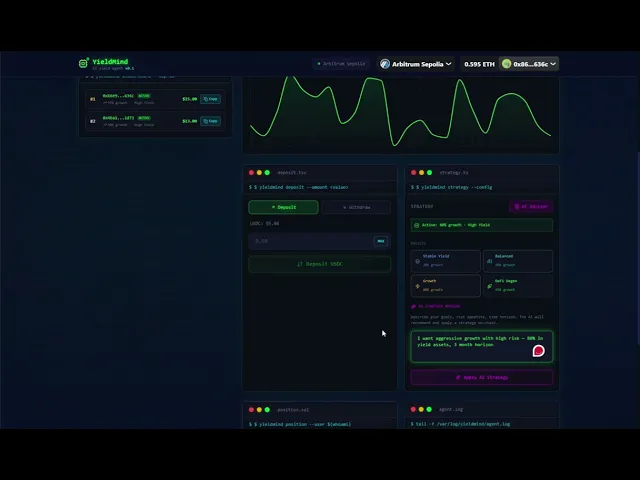
The strongest use case is monitoring, not prediction. An automated system can scan opportunities, track rate changes, and reallocate capital without forcing you to babysit five dashboards. For users who want a more hands-off approach, tools such as Yield Seeker can automate stablecoin allocation across DeFi protocols while keeping the position accessible instead of locked away.

Automation helps most when the strategy changes often enough that manual management becomes the bottleneck. It also helps reduce emotional mistakes, like chasing a temporary spike or leaving capital in a weak market because you haven't had time to move it. The catch is obvious, though, because automation only works as well as the rules behind it.
The broader shift is clear in the rise of AI-assisted DeFi tooling. A practical walkthrough of this category is available in the AI agents in DeFi material, which frames the agent as an operational layer rather than a promise of guaranteed return.
Automation should reduce attention cost, not remove judgment.
Comparing Approaches to Stablecoin Passive Income
Different investors want different outcomes, and the right answer isn't always the highest APY. If you care most about preserving capital and keeping the setup understandable, conservative lending is usually the cleanest starting point. If you want more upside and can tolerate more moving parts, liquidity-heavy strategies can make sense, but only if you understand where the return is coming from.
A practical decision lens
Approach | Risk posture | Best fit |
|---|---|---|
Conservative lending | Lower complexity, lower moving parts | People who want a simpler starting point |
Moderate yield farming | Balanced trade-off between effort and return | Users comfortable with periodic monitoring |
Aggressive liquidity mining | More dependence on rewards and market conditions | Experienced users who can absorb volatility |
Institutional-style setups | More process-driven, more capital-aware | Treasuries and larger balances |
The filter is not just risk tolerance. It's time commitment, operational discipline, and how much variance you can stomach before you start second-guessing the plan. A strategy that requires frequent attention is a bad fit for someone who wants true hands-off income.
One thing I've learned the hard way is that the most attractive setup on paper can become the worst fit in practice if it doesn't match your behavior. If you hate checking positions, don't choose a strategy that needs constant tuning. If you need liquidity, don't lock yourself into something that punishes fast exits.
Getting Started with Stablecoin Yield
Start with the wallet you already trust, then decide whether you want self-custody or a more guided setup. Self-custody gives you more control, but it also means you own the security habits, backups, and transaction discipline. Custodial or semi-custodial options can reduce friction, but they also add platform dependence.
Next, define the job for the capital. If the goal is simple earning with limited attention, use a basic lending market or a guided automation layer. If the goal is active yield optimization, be honest about how often you're willing to review positions, because strategies only stay “passive” if someone or something is watching the inputs.
A useful way to avoid bad first moves is to check four things before you deposit:
Liquidity depth, so you know whether you can exit without ugly slippage.
Protocol permissions, so you understand whether withdrawals can be paused.
Yield source, so you know if the return is coming from borrowing, fees, or incentives.
Monitoring plan, so you know who will notice a change first, you or the market.
The first deposit should be small enough that you can learn from it without stress. Stablecoin yield gets easier once you have seen for yourself how confirmations, compounding, and rate changes behave in the wild. That experience is worth more than another glossy APY chart.
Start with a position you can explain to someone else without reaching for jargon.
Frequently Asked Questions
Is stablecoin passive income safe?
Safer than chasing volatile token prices, usually yes. Safe in an absolute sense, no. The return is compensation for protocol, issuer, liquidity, and smart-contract risk, so the relevant question is whether the risk is acceptable for the yield you're getting.
Do stablecoin yields stay fixed?
No. They move with borrowing demand, protocol incentives, market liquidity, and changes in strategy design. A product that looks attractive today can compress quickly if capital floods in or incentives expire.
What's the biggest mistake beginners make?
They compare APY and ignore the mechanism. Two strategies can show similar returns while carrying very different withdrawal rules, counterparty exposure, and failure modes.
How should I monitor a position?
Check yield source, contract changes, governance updates, and liquidity conditions. If a strategy depends on more than one moving part, assume something can change while you're not looking.
For setup basics and common platform questions, the FAQ and setup guide is a useful reference point even if you're using a different workflow. The general principle is the same across platforms, understand the mechanics before you commit capital.
Yield Seeker automates stablecoin yield management across DeFi so you don't have to chase rates by hand. If you want a risk-aware way to monitor allocations and keep capital working without constant dashboard hopping, visit Yield Seeker and see how it fits your stablecoin strategy.