
You deposit a stablecoin into a yield app because you want boring money behavior. You want one dollar in, roughly one dollar out, plus some return for putting capital to work. What you trust, though, isn't “digital cash” in the abstract. You trust a stack of smart contracts, admin permissions, oracle feeds, collateral rules, and operational processes that decide who can mint, who can pause, who can upgrade, and what happens when the outside world stops cooperating.
That distinction matters more than most users realize. Stablecoin-based payments processed over $40 billion daily via smart contracts in Q3 2025, and total on-chain stablecoin transfers exceeded $20.2 trillion by May 2025, according to smart contract adoption in finance statistics. At that scale, a stablecoin smart contract isn't a side feature. It's financial infrastructure.
If you need a clean refresher on the broader mechanics behind Ethereum DApps and smart contracts, that guide helps frame why these systems behave more like automated institutions than simple tokens. For a DeFi-specific lens, Yield Seeker also has a useful primer on smart contracts in yield strategies.
Your Money Is a Smart Contract
The stablecoin in your wallet looks passive. It isn't.
Every transfer, approval, mint, burn, freeze, redemption, liquidation, and fee adjustment comes from code. Some of that code is visible onchain. Some of the risk sits one layer above it, in governance controls and offchain dependencies. That's why experienced users don't stop at “Is this stablecoin popular?” They ask, “What can this contract do, and who can make it do something different tomorrow?”
What you're actually trusting
When you hold a stablecoin or use it in a vault, you're usually relying on several moving parts at once:
Token logic: The ERC-20 contract that tracks balances and transfers.
Privilege controls: Roles for minting, pausing, blacklisting, or upgrading.
Collateral processes: Rules that decide whether supply expansion is justified.
External data: Oracle inputs for prices, collateral health, and liquidations.
Redemption pathways: The practical route back to dollars or equivalent assets.
A lot of failures happen because users inspect only the first line item.
Practical rule: If a stablecoin can change supply, freeze transfers, or upgrade logic, you should treat those permissions as part of the asset itself.
Why this isn't just for developers
Non-developers often assume code review is someone else's job. In practice, anyone earning yield on stablecoins already has technical exposure. You may not read Solidity line by line, but you're still taking contract risk.
That matters because money onchain is programmable by default. If the contract has a pause switch, that switch is part of your risk. If it depends on an oracle, that oracle is part of your risk. If a multisig can push an upgrade, governance is part of your risk.
The old mental model was simple. A stablecoin was a digital dollar. The better mental model is sharper. A stablecoin is an automated financial product with a dollar target.
The Four Blueprints for Digital Dollars
Not all stablecoins try to stay at one dollar the same way. If you don't identify the design first, it's easy to misunderstand the actual risk.
A quick backgrounder on understanding stablecoins is useful if you're sorting through the categories for the first time. For a DeFi-oriented overview of the asset class, this guide on stablecoins and yield use cases helps connect the design choice to the way people use them.
Stablecoin Model Comparison
Model Type | Backing Mechanism | Core Risk | Example |
|---|---|---|---|
Fiat-collateralized | Offchain cash and cash-equivalent reserves | Centralized control and redemption dependence | USDC |
Crypto-collateralized | Onchain crypto collateral locked in smart contracts | Collateral volatility and liquidation stress | DAI |
Algorithmic | Supply and demand logic without robust reserve backing | Reflexive loss of confidence | UST |
Yield-backed or delta-neutral | Hedged positions and structured yield mechanisms | Strategy complexity and basis or execution risk | USDe |
Fiat-backed feels like a digital vault
This is the easiest model for most users to grasp. A company issues tokens and claims each token is backed by reserve assets held offchain. The smart contract usually handles transfer logic and admin controls, but the primary anchor comes from the issuer's balance sheet and redemption process.
That simplicity is the appeal. If reserves are sound and redemptions work, the peg is intuitive.
The trade-off is control. Fiat-backed systems often keep strong issuer powers because regulators, banking partners, and compliance obligations push them in that direction. That can include pausing, blacklisting, or contract upgrades.
Crypto-backed works more like an automated pawn shop
You lock volatile crypto into a contract and mint a smaller amount of stablecoins against it. If the collateral value drops too far, the system liquidates positions to protect solvency.
This model moves more of the trust onchain. You can inspect collateral rules, liquidation thresholds, and contract behavior directly. It also tends to be more transparent to crypto-native users.
The cost is capital efficiency. To create one unit of stable value from volatile collateral, the system often needs a cushion. If markets move sharply, the liquidation machinery has to work exactly as designed.
A crypto-backed stablecoin can be transparent and still be stressful. Transparency doesn't cancel volatility.
Algorithmic systems promise elegance and often hide fragility
The pitch is attractive. Instead of overcollateralizing or holding bank reserves, the protocol uses market incentives and supply adjustments to maintain the peg. In quiet markets, that can look efficient.
The problem appears when confidence breaks. If stability depends mainly on traders continuing to believe the mechanism will recover, a loss of faith can turn into a feedback loop. UST became the cautionary example because it showed how fast “clever” monetary design can become an unwind machine.
Yield-backed and delta-neutral designs are powerful but less intuitive
This newer category tries to create a stable-looking asset from hedged exposures, basis trades, or structured positions that generate income while neutralizing directional risk.
For experienced users, the attraction is obvious. A stable asset with embedded yield mechanics can be more capital productive than idle reserves.
For everyone else, the danger is also obvious. These designs are harder to reason about in stress conditions. You have to ask whether the hedge stays effective, whether counterparties perform, and whether the contract logic can adapt without hurting holders.
Anatomy of a Stablecoin Smart Contract
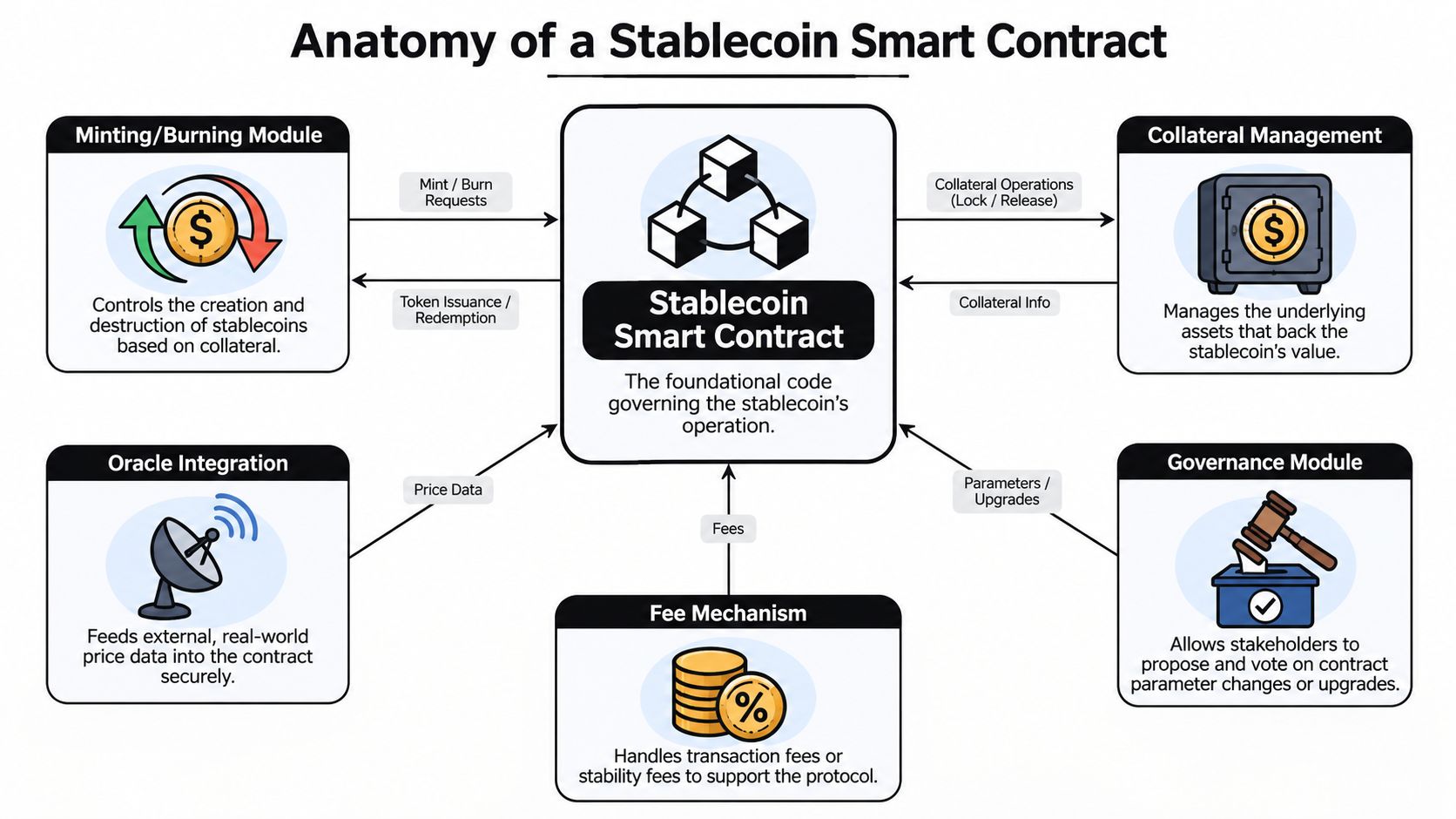
A stablecoin smart contract has to do more than move balances around. It has to preserve the idea that one token is interchangeable with another, redeemable under known rules, and predictable enough to serve as money.
According to NIST IR 8408, an effective design on EVM-compatible chains implements ERC-20 with EIP-2612 support for gas-efficient approvals, uses a multi-layer oracle stack to validate collateral, and includes a decentralized Stability Engine for automatic liquidations. That architecture supports the key stablecoin properties of fungibility and non-volatility.
If you're new to price feeds, this explainer on oracle design and failure modes is worth reading before you trust any collateralized system.
The token layer and supply controls
At the base is the token contract. ERC-20 gives wallets, exchanges, and DeFi protocols a standard way to interact with balances and transfers. EIP-2612 adds permit signatures, which let users approve token spending without a separate gas-heavy approval flow.
That sounds like a convenience feature, but it also affects usability and composability. If a stablecoin doesn't integrate cleanly with the rest of the ecosystem, users end up facing friction at the exact moments they need liquidity.
Supply controls sit next to that token logic. Someone or something has to decide when tokens are created and destroyed. In fiat-backed systems, that usually maps to issuer-side mint and redemption operations. In collateralized systems, the contract often links minting directly to deposited collateral and burns directly to repayment or redemption.
Oracles are the instrument panel
A smart contract can't see the outside world on its own. It needs an oracle to tell it what collateral is worth, whether the peg is drifting, and when liquidations should trigger.
The simplest analogy is a cockpit instrument panel. The plane may be mechanically sound, but if the readings are stale or wrong, the pilot makes bad decisions.
A strong setup doesn't rely on a single feed. It uses a primary source and fallback sources, then defines what happens when data conflicts, lags, or disappears. Good oracle design is less about perfect prices and more about safe behavior when prices become uncertain.
Collateral and the Stability Engine
Collateral management is where a stablecoin becomes more than a transferable token. The contract needs rules for locking assets, measuring collateral health, and enforcing liquidation when positions become unsafe.
The Stability Engine is the part that acts automatically when those rules are violated. It is the shock absorber of the system. If collateral drops below acceptable thresholds, the engine has to protect solvency before the peg damage becomes permanent.
A healthy architecture usually includes:
Collateral accounting: Track what backs issued tokens and under what conditions.
Liquidation logic: Force corrective action when collateral quality deteriorates.
Immutable state history: Keep decisions and balances visible onchain.
Fee mechanisms: Charge stability or usage fees that support the protocol's economics.
The design question isn't only “Can this stablecoin hold a peg?” It's “What exact mechanism takes the loss when conditions turn ugly?”
Governance sits above the engine
Even highly automated stablecoins rarely run with zero human control. Teams and DAOs still set parameters, rotate oracle providers, adjust collateral types, and sometimes upgrade contract logic.
That governance layer is where engineering meets politics. If it is too rigid, the protocol can't adapt. If it is too flexible, users hold an asset that can change underneath them.
How Secure Contracts Fail Attack Vectors and Mitigations
You hold a stablecoin that passed an audit, the peg still reads one dollar, and then redemptions slow down because the oracle stalls, the multisig cannot reach quorum, or the issuer freezes a function during a volatile market. From a user's perspective, that feels like failure. The contract may still be doing exactly what the code says.

That is why audit status is only one layer of the review. Stablecoins break through code bugs, but also through the infrastructure and governance wrapped around the code. A contract can be mathematically sound and still become bad money if its price feed lies, its admin keys are abused, or its issuer comes under financial pressure and changes the rules at the worst moment.
The first line of defense is still disciplined engineering. The stablecoin development guidance in this stablecoin development guide points to strict role separation, where minting authority is isolated from pausing and upgrade authority, typically through multisig controls, with rate limits, quotas, emergency revocation, fuzz testing, and formal verification for privileged flows.
Code-level failures are only the obvious ones
Classic contract failures still do real damage. Access control mistakes let the wrong party mint or upgrade. Broken liquidation math can leave the system undercollateralized. Bad pause logic can trap honest users while an attacker finds the open path. Oracle integration bugs are especially dangerous because they turn a bad input into a system-wide pricing error.
The practical pattern is narrow privileges and small blast radius.
Separate powers: The account that mints should not also control upgrades, pauses, or blacklist functions.
Use multisig governance: A single compromised key should not be enough to change monetary policy.
Constrain minting: Quotas, cooldowns, and per-epoch caps limit damage if an admin path is abused.
Test privileged paths hard: Admin functions, upgrade hooks, and emergency procedures deserve the most adversarial testing.
Teams should apply the same discipline used in other production systems. For process-minded readers, implementing robust SDLC security offers a useful software-lifecycle lens that maps well to smart contract operations too.
Hidden dependencies fail before the code does
A stablecoin depends on more than Solidity. Oracles work like sensors on a machine. If the sensor freezes or reports nonsense, the controller can make the wrong move while following its rules perfectly. RPC providers, validators, relayers, custody banks, and redemption operations create the same problem. They sit outside the contract, but users still depend on them.
Research discussing stablecoin plumbing risk highlights functional freeze, where non-code infrastructure such as RPC providers, oracle lag, or validator faults can make a secure contract unusable, even when backing assets remain intact, as described in the analysis of stablecoin technological substrate risk.
This is the failure mode many technically curious users miss. Theft is only one way to lose. If you cannot transfer, redeem, liquidate, or verify the right price during stress, your dollars are trapped inside a system that has stopped acting like money.
A stablecoin can stay solvent on paper and still fail in practice.
Here's a practical explainer that frames some of the surrounding issues well:
Mitigation starts with failure planning
Good mitigation design assumes bad days will happen. The key question is how the system degrades.
Teams that take resilience seriously usually build in:
Oracle fallback rules: If the main feed stops, the contract should pause sensitive actions or switch to a bounded backup source instead of accepting stale prices.
Clear runbooks: Operators need written procedures for oracle outages, chain congestion, signer loss, and redemption backlogs.
Tight emergency powers: Admins need enough authority to contain damage, but not enough to rewrite user rights on short notice.
Redemption transparency: Users should know whether they can still exit if the chain is live but banking, custody, or support systems are impaired.
The uncomfortable trade-off is that every mitigation adds trust somewhere. More fallback logic can mean more complexity. More emergency powers can mean more governance risk. More issuer discretion can help during a crisis, but it also creates a path for abuse if the issuer is under pressure. That is where “secure contract” analysis needs to grow up. The code matters, but the surrounding control system decides how that code behaves when the easy assumptions break.
How to Evaluate a Stablecoin Smart Contract A Checklist
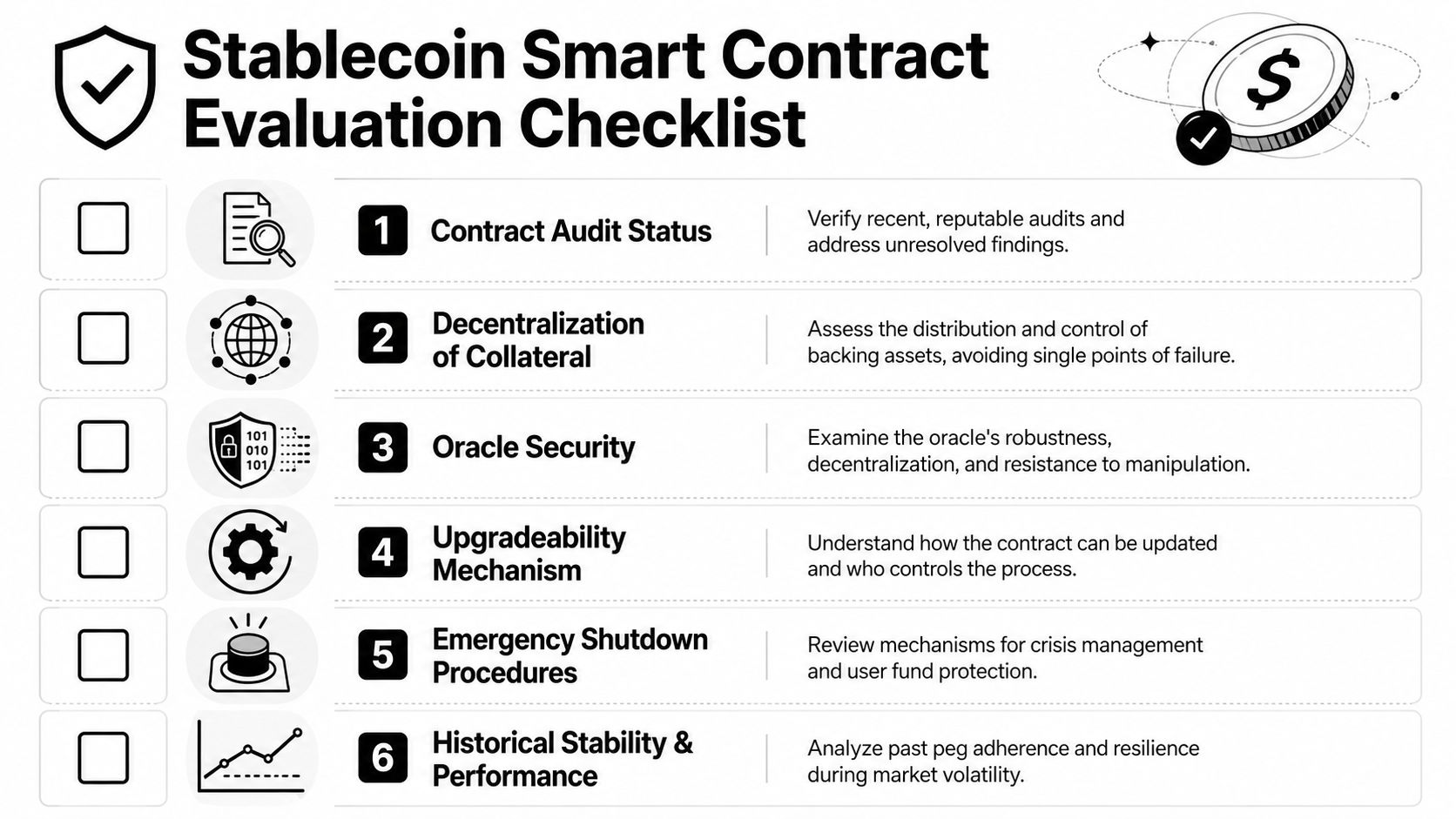
Most users stop at the audit badge. That's not enough. A real review asks what the audit ignored, what the issuer can still change, and which dependencies could fail without showing up as code vulnerabilities.
One overlooked governance issue is especially important. The Atlantic Council notes that under financial stress, an issuer may have incentives to use upgradeability to alter redemption terms or other user-relevant behavior, which means static audits don't simulate the full risk of the upgrader role under issuer stress.
Read the permissions before the marketing
Start with contract authority, not branding.
If a stablecoin has roles for minting, pausing, freezing, blacklisting, upgrading, or changing oracle sources, map those powers first. Then ask who controls each role and how many signatures are required. A decentralized front-end doesn't change centralized contract permissions.
Review the audit for what's missing
An audit report can be useful, but the absence of alarm isn't proof of safety. Look for whether the report discusses:
Admin paths: Can privileged actors bypass normal limits?
Upgradeability: Is the implementation proxy-based, and who controls it?
Oracle assumptions: What external systems does the contract rely on?
Failure behavior: Does the system pause, liquidate, or drift when dependencies fail?
A lot of reports are strongest on code correctness and weakest on governance realism.
Inspect the oracle design
If the stablecoin depends on external pricing, don't accept “uses oracles” as a sufficient answer. Ask how many sources exist, whether there are fallback feeds, what happens if the primary source lags, and whether the contract rejects obviously bad values.
This is one of the biggest separators between systems that look good in docs and systems that survive live markets.
Watch the edges, not the center. Stablecoin systems usually fail at dependency boundaries.
Treat upgradeability as a live risk
Upgradeability isn't automatically bad. It can fix bugs, add collateral types, and improve risk controls. But every upgrade path is also a governance path.
The practical questions are straightforward:
Who can trigger an upgrade?
Is there a timelock users can monitor?
Can an emergency process bypass that timelock?
Would users have time to exit if terms changed?
If the answers are vague, the risk is real.
Check the business model, not just the code
This is the part many technical guides skip. If an issuer's economics tighten, governance pressure increases. Teams under stress may widen powers they promised to use sparingly.
That doesn't mean every upgradeable stablecoin is dangerous. It means financial incentives and smart contract permissions must be evaluated together.
Build a simple personal scorecard
For non-experts, a lightweight framework is often more useful than pretending to be a full-time auditor:
Green flags: Clear role separation, transparent redemption logic, fallback oracles, visible governance process.
Yellow flags: Complex hedging model, vague docs on emergency controls, broad multisig powers.
Red flags: Unclear backing, opaque upgrade authority, weak oracle explanation, redemption rights that seem discretionary.
Real World Examples and Case Studies
Theory becomes easier once you map it to familiar names. Different stablecoins solve the same one-dollar problem with very different machinery.
USDC shows the fiat-backed model clearly
USDC fits the digital-vault pattern. The token itself is straightforward to integrate across DeFi, but the core trust rests on issuer-managed reserves and a redemption structure outside pure onchain logic.
That makes it useful as a building block. It also means users should care about issuer permissions and offchain operations, not just ERC-20 behavior.
DAI demonstrates onchain collateral logic
DAI is the classic example of a crypto-collateralized stablecoin. Instead of relying mainly on an offchain reserve manager, it relies on vaults, collateral accounting, and automated liquidation logic.
For technically curious users, DAI is often easier to reason about at the contract level because more of the mechanism is visible onchain. The trade-off is that the peg depends on collateral quality, oracle reliability, and liquidation performance during volatility.
UST remains the cleanest warning on algorithmic risk
UST is useful as a teaching case because it exposed the limits of stability mechanisms built around confidence loops. The failure wasn't just “the contract had a bug.” The design itself couldn't absorb a collapse in trust.
That's the lesson many people miss. Some stablecoins don't break because code is malformed. They break because the economic mechanism was too fragile.
USDe highlights the new generation of structured designs
USDe represents the category of yield-backed or delta-neutral stablecoins that package more advanced market structure into the product. These designs can be attractive because they aim to keep capital productive rather than idle.
They also demand more from the user. You need to understand hedge maintenance, venue dependence, operational complexity, and how quickly the system can respond when assumptions stop holding.
Why Ethereum still matters most
Most of the stablecoin smart contract action still clusters around Ethereum and EVM-compatible environments. In late 2025, Ethereum deployed a record 8.7 million smart contracts in a single quarter and hosted roughly 54% of the global stablecoin supply, according to reporting on Ethereum smart contract deployments and stablecoin supply in late 2025.
That matters for one simple reason. The place where developers build, test, and integrate most aggressively becomes the default home for financial primitives. If you're evaluating any stablecoin project, EVM compatibility isn't just a developer convenience. It's often the difference between deep composability and a much thinner operating environment.
Navigating the Stablecoin Ecosystem Safely
You send payroll to a wallet, park treasury cash between settlements, or keep dry powder onchain for a trade. In each case, you are trusting a system that can fail in more than one place. The contract matters, but so do the oracle feeds, redemption rails, governance keys, custodians, banking partners, and the financial incentives of the issuer behind the peg.
That is the part many checklists miss.
A stablecoin can pass an audit and still become unsafe to hold if the issuer comes under funding pressure, an oracle starts reporting bad data, or governance can push through a change faster than users can react. Secure code is only one layer. The hidden infrastructure around that code often decides whether a stablecoin holds up during stress.
A practical operating framework
If you hold meaningful size in stablecoins, assess them like products with operational dependencies, not like cash in a bank app. Start with a few questions.
Who can change the rules? Admin keys, multisigs, pause roles, blacklist powers, and upgrade paths matter more than polished branding.
What keeps the peg in line? Check whether stability depends on fiat redemption, overcollateralization, arbitrage, hedging, or some mix of all four.
What external systems can fail first? Oracles work like sensors in an automated factory. If the sensor is wrong, the machine can do the wrong thing perfectly.
What happens if everyone exits at once? Redemption terms, queue mechanics, liquidity depth, and settlement delays tell you more than the homepage promise.
What kind of failure are you concentrated in? Holding three fiat-backed coins from the same banking network is not real diversification. It is one risk wearing three logos.
Then revisit those answers. Permissions change. Collateral mix shifts. Governance passes upgrades. Market structure that looked safe in calm conditions can behave very differently in a stressed week.
Monitoring is the real workload
The hard part is not reading one audit report. The hard part is keeping up with a live system.
You need to watch contract upgrades, governance proposals, oracle changes, collateral policy updates, custody disclosures, exchange dependencies, and whether redemptions still work as advertised. That is more like monitoring production infrastructure than buying a static asset.
Some users rely on tooling to reduce that workload. Yield Seeker is one example. It uses an AI agent to monitor and allocate stablecoin capital across DeFi protocols while keeping funds accessible. That does not remove contract or issuer risk. It reduces how much of the ongoing monitoring and allocation work the user handles by hand.
Good stablecoin risk management is continuous supervision of code, infrastructure, and incentives.
One rule helps avoid expensive mistakes. If you cannot explain, in plain English, how a stablecoin keeps its peg and how you get out during stress, do not treat it like cash. Treat it like a financial product with dependencies, because that is what it is.
If you want a simpler way to stay on top of stablecoin yield opportunities without manually tracking every protocol, oracle dependency, and governance update, take a look at Yield Seeker. It gives you a practical interface for automated, risk-aware stablecoin allocation while keeping you in control of your funds.