
For decades, U.S. Treasury bonds were the absolute bedrock of any income-focused portfolio. But things have changed, and their reliability has slipped, pushing investors to hunt for treasury yield alternatives.
The options are pretty diverse, ranging from old-school choices like high-yield savings accounts and corporate bonds all the way to modern DeFi stablecoin strategies. At the heart of it all is a simple motivation: the search for better real returns in an economy that looks nothing like it used to.
Why Investors Are Looking Beyond Treasury Yields
The whole role of U.S. Treasury bonds is shifting right under our feet. They were once the undisputed safe haven for generating reliable income, but now, these government-backed securities pose a real challenge for everyone from individual investors to corporate treasurers.
The two big reasons for this are brutally simple: stubbornly low yields and the relentless, corrosive power of inflation.
For most of modern financial history, Treasuries gave you a "risk-free" rate that comfortably beat inflation, protecting and even growing your capital. That’s just not the world we live in anymore. A multi-decade downward slide has completely eroded that advantage.
Just look at the 10-year Treasury yields. They soared above 15% back in the 1980s but have since fallen off a cliff, recently hovering around 4.26%. This historic collapse means a portfolio built on Treasuries just doesn't produce the income it once did. It's a massive problem.
This yield crunch becomes a disaster when you factor in inflation. When the inflation rate is higher than the yield on your Treasury bond, your real return goes negative. That means your purchasing power is actively shrinking, even though your initial investment is technically "safe."
The core issue here is that safety of principal no longer guarantees safety of purchasing power. An investment that fails to outpace inflation is, in real terms, a losing proposition.
Frankly, a deeper understanding inflation's impact on traditional investments makes it crystal clear why investors are increasingly looking elsewhere. For more on this, check out our guide on how to protect against inflation.
This new reality has forced a complete strategic rethink. Investors now have to look beyond the traditional safety of government debt to find income sources that can actually deliver meaningful, inflation-adjusted returns.
This sets the stage for exploring a whole landscape of treasury yield alternatives, each with its own unique risk and reward profile. The game is no longer just about preserving capital, but about preserving its value over time.
Comparing the Top Treasury Yield Alternatives
When you start looking for alternatives to Treasury yields, you're really stepping into a world of trade-offs. It's a balancing act. Each option has a unique mix of potential return, risk, and how quickly you can get your cash back. To make a smart call, you have to look past the flashy yield numbers and really get what makes each of these instruments tick.
The chart below tells the story of why we're even having this conversation. It shows the long, slow decline of Treasury yields from their peak.
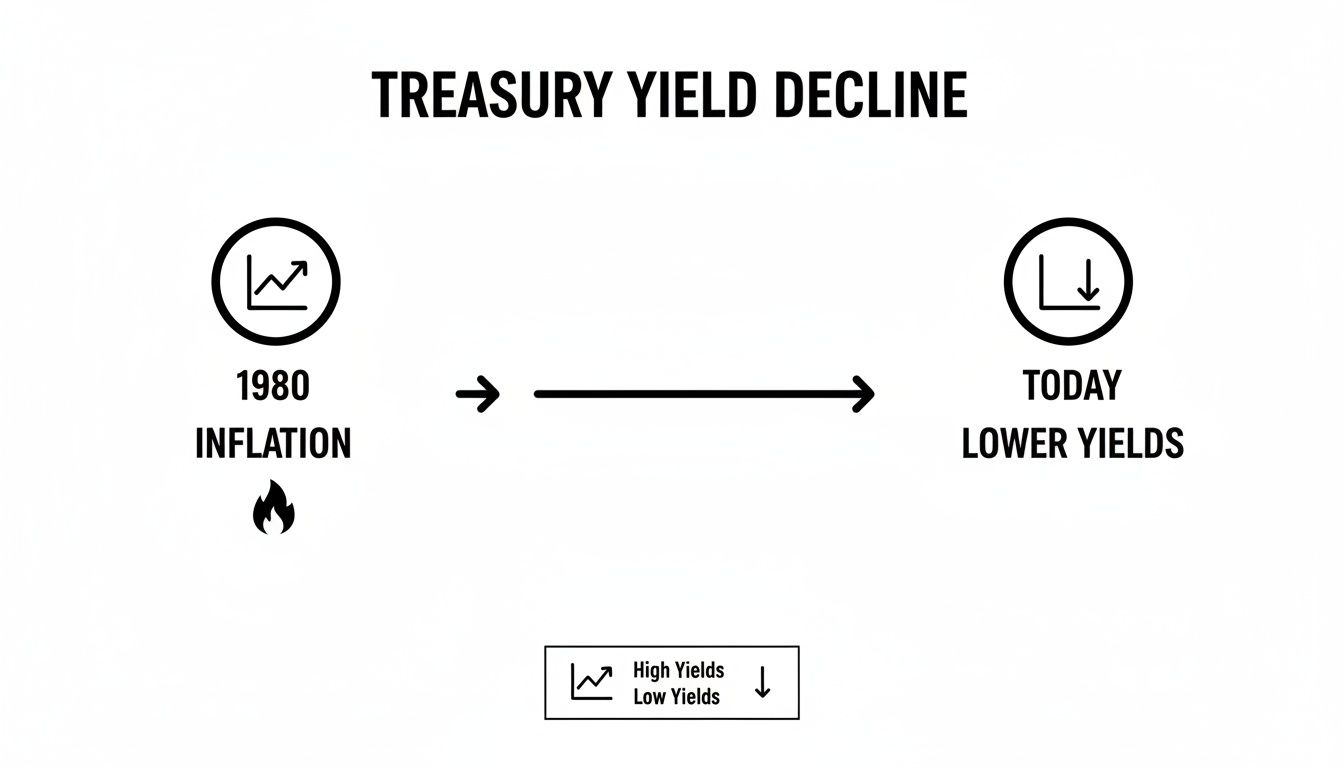
What you're seeing is the massive shift from the high-yield days of the 1980s—when the Fed was fighting off crazy inflation—to the much lower yields we see today. This long-term squeeze is exactly why so many investors are now hunting for better places to park their cash.
So, let's break down the most common alternatives side-by-side. We’ll look at what they can earn, what can go wrong, and how liquid they are. This should give you a clearer picture of where each one might fit into your strategy.
Yield Potential And Its Volatility
The headline yield is what grabs everyone's attention, but it’s rarely the full story. How stable that yield is matters just as much as the number itself.
Money Market Funds (MMFs): These pretty much mirror the federal funds rate. A fund like Vanguard's VMFXX saw its yield shoot up as the Fed hiked rates, but it will fall just as fast when they start cutting. This makes MMF yields super variable and tough to predict long-term.
Certificates of Deposit (CDs): Here, you get a fixed yield for a set term. That certainty is a huge plus. You can lock in a rate of, say, 4.5% for two years, and it doesn't matter what the Fed does next. The catch? You miss out if rates climb higher.
Corporate Bonds: Yields on these depend on the company's financial health and how long until the bond matures. A blue-chip company like Microsoft might offer a bond yielding 5.15%, while a riskier company could dangle over 6.00% to attract investors.
DeFi Stablecoin Yields: These are a different beast entirely. They're generated from lending activity on decentralized platforms and can swing from 5% to over 15% APY. These yields are driven by market demand and can change daily, unlike the fixed-rate world of CDs.
Key Insight: The big split is between fixed and variable yields. If you want predictability, CDs and individual bonds are your friends. If you're okay with yields that move with the market—for better or worse—then MMFs and DeFi strategies are where you'll be looking.
Assessing the Diverse Risk Profiles
Let's be clear: no yield is risk-free. You have to understand the specific risks tied to each alternative to build a solid portfolio. It's about more than just market ups and downs.
A Money Market Fund, which many treat like cash, isn't totally bulletproof. A fund like VMFXX might hold a lot of repurchase agreements ("repos") or debt from government-sponsored entities (GSEs). These don't have the same ironclad U.S. government guarantee as Treasuries.
CDs have almost no credit risk, as long as you stay within the FDIC insurance limits (currently $250,000 per person, per bank). The real danger here is interest rate risk. If rates soar right after you buy a CD, your money is stuck earning a below-market rate.
With corporate bonds, the main event is credit risk—the chance the company could default on its payments. A 'AAA' rated bond is about as safe as it gets, but a 'BBB' rated bond carries more risk, which is why it pays a higher yield.
DeFi stablecoin strategies introduce a whole new flavor of tech-related risks. You've got to consider:
Smart Contract Risk: A bug or exploit in the code of the DeFi protocol.
Platform Risk: Security issues with the specific platform or wallet you're using.
Regulatory Risk: The big unknown of how governments might regulate digital assets in the future.
Liquidity and Access to Capital
How fast can you turn your investment back into cash without taking a big hit? For corporate treasurers and anyone with short-term cash needs, this is a make-or-break question.
MMFs are built for liquidity. You can get your money out daily, making them perfect for managing operating cash. CDs are the polar opposite. Pull your money out early, and you'll almost certainly pay a penalty, making them highly illiquid.
Corporate bonds are somewhere in the middle. Bonds from huge, well-known companies are usually easy to sell. But if you're holding bonds from a smaller or less-known company, you might have a hard time finding a buyer quickly without dropping your price.
DeFi stablecoin platforms often shine here, offering high liquidity with no lockups. This combination of potentially high yield with instant access to your capital is a major draw. For anyone interested in automating this, you can learn how to find the best alternative investment platforms that fit what you're looking for.
To pull this all together, here’s a quick-glance table comparing these alternatives.
A Glance at Treasury Yield Alternatives
This table gives you a side-by-side look at the main treasury yield alternatives. It's designed to help you quickly compare your options based on what matters most: returns, risk, and access to your money.
Alternative | Typical Yield Range (APY) | Primary Risk Profile | Liquidity | Best Suited For |
|---|---|---|---|---|
Money Market Funds | 3.5% – 5.5% | Interest Rate, Credit | Very High | Corporate treasuries and individuals needing daily access to operating cash. |
Certificates of Deposit | 4.0% – 5.5% | Interest Rate, Inflation | Low | Savers who prioritize principal safety and can lock up funds for a fixed term. |
Corporate Bonds | 4.5% – 7.0%+ | Credit, Interest Rate | Medium | Investors with a longer time horizon seeking fixed income and potential growth. |
DeFi Stablecoins | 5.0% – 15.0%+ | Smart Contract, Regulatory | High | Tech-savvy investors and treasuries aiming to maximize returns on cash reserves. |
Ultimately, the right alternative depends entirely on your specific goals, risk tolerance, and when you'll need the cash. There's no single "best" option, only the one that best fits your situation.
Navigating Traditional Bond Alternatives
While the world of digital assets is full of new and interesting possibilities, sometimes the old ways are the best. The traditional finance world offers a handful of well-understood treasury yield alternatives that have been the backbone of income portfolios for decades.
These are the classics: Certificates of Deposit (CDs), Money Market Funds (MMFs), and corporate bonds. But just because they’re familiar doesn't mean you can just throw money at them blindly. To use them right, you need to go beyond the headline yield and build a strategy that fits your actual goals.
For anyone who puts stability and predictability first, these options are a clear path forward. Each one serves a different purpose, whether you're managing daily cash flow or trying to lock in an income stream for the long haul. The real trick is knowing the subtle trade-offs between them.
Certificates of Deposit for Predictable Income
At its core, a Certificate of Deposit is a simple deal you make with a bank: you agree to lock up your cash for a set period, and they guarantee you a fixed interest rate. In a world of volatile markets, that certainty is a huge plus.
Take a corporate treasurer, for example. They might use a series of short-term CDs (think 3-6 months) to squeeze a better return out of cash they’ve set aside for a big purchase down the road. They know exactly how much they'll earn and precisely when they'll get their money back, which takes all the guesswork out of their financial planning. It’s a simple way to get a yield bump over a basic savings account without taking on any market risk.
The real power of CDs lies in laddering. By staggering the maturity dates of multiple CDs, an investor can create a steady stream of maturing funds, enhancing liquidity while still capturing attractive fixed rates.
A retiree could build a CD ladder with different rungs maturing at three, six, nine, and twelve months. As each CD comes due, they can either roll the money into a new one-year CD or use it for living expenses. This gives them regular access to their cash while letting them take advantage of higher interest rates as they come along—a nice blend of liquidity and predictability.
Money Market Funds for Unmatched Liquidity
When you absolutely need to get your hands on your cash at a moment's notice, Money Market Funds are the answer. These funds pool investor money to buy highly liquid, short-term debt like commercial paper and repurchase agreements. Their yields float, closely tracking the short-term interest rates set by the central bank.
For a business juggling its daily operational cash, an MMF like the Vanguard Federal Money Market Fund (VMFXX) is an indispensable tool. It lets them sweep extra cash out of their checking account at the end of the day to earn some interest, then pull it right back to make payroll or pay suppliers. The goal isn't to hit a home run on yield; it's to make sure working capital is both safe and productive. This is why MMFs beat CDs or bonds for managing day-to-day cash needs.
Corporate Bonds for Enhanced Yield and Duration
Corporate bonds bring two new factors into the mix: credit risk and duration. When you lend money to a company, you’re taking on the risk that it might not pay you back. In exchange for that risk, you get a higher yield than government bonds usually offer. The risk level can be anything from ultra-safe 'AAA' rated bonds from giants like Microsoft to higher-yielding (and much riskier) 'BBB' rated bonds.
An investor in their 40s with a long time horizon might decide to buy a 10-year, investment-grade corporate bond yielding 5.5%. They're looking to lock in a dependable income stream for the next decade to act as a stable anchor in a portfolio that’s otherwise geared for growth. They're okay with the bond's price moving around in the market because they're focused on that superior fixed coupon payment.
The choice between investment-grade and high-yield ("junk") bonds is a classic risk-reward puzzle. A corporate treasurer would almost always stick to high-quality, investment-grade debt because their top priority is preserving capital. On the other hand, a more aggressive individual investor might put a small slice of their portfolio into high-yield bonds, chasing yields that can top 7%, while being fully aware of the higher chance of default. It’s all about smart allocation.
Looking back, US Treasury bonds have been reliable, but their long-term returns have been pretty modest compared to riskier assets. This has pushed smart investors to look for alternatives to boost their yield. Historical data shows the 10-year US Treasury bond has averaged an annual return of about 5.0% over the last century, but it's been a wild ride—peaking at 15.89% and crashing to -9.12%. Stocks, in contrast, have delivered much higher average returns, which really highlights the trade-off between risk and reward. You can explore a detailed breakdown of historical asset returns on NYU Stern's website to see the numbers for yourself.
Diving Into Higher Yields With DeFi Stablecoins
Once you venture beyond the well-trodden paths of traditional finance, you'll find a powerful set of treasury yield alternatives bubbling up in the world of Decentralized Finance (DeFi). This new frontier opens the door to much higher returns, especially through strategies built on stablecoins—crypto assets designed to hold a steady value, usually pegged to the U.S. dollar.
If you're used to the single-digit yields from bonds or CDs, DeFi can look a bit intimidating. But the core idea is pretty simple. Instead of lending your money to a bank or corporation, you're lending your stablecoins to a decentralized pool of capital that runs on code.
How Does DeFi Actually Generate Yield?
At its heart, DeFi yield comes from the same place as traditional yield: lending and borrowing. The action just happens on blockchain-based platforms like Aave and Compound, which operate like automated, transparent financial markets.
Here's the basic rundown:
Lending Pools: You deposit stablecoins (like USDC or USDT) into a lending pool.
Borrowing Demand: Other users borrow from that pool, often to get leverage, and they pay interest for the privilege.
Interest Distribution: That interest gets paid back to you and the other lenders who supplied the capital, creating a steady income stream.
These protocols run 24/7 without middlemen, unlike a bank. That efficiency often means better rates for everyone involved, which is what creates these compelling yield opportunities. If you want to go deeper, check out our complete guide on how to earn interest on stablecoins.
The hunt for better returns gets real when traditional options just aren't cutting it. For example, the 20-year Treasury yield was sitting at 4.82% in late January (data from the St. Louis Fed). In contrast, since 2020, USDC pools on networks like Base and Ethereum have seen 10-20% APYs during peak market cycles and now offer more risk-managed yields of 6-12% through automated strategies. That's a big difference, and it's why so many are starting to pay attention.
Balancing Big Rewards with New Risks
The potential for higher returns in DeFi is hard to ignore, but it's not a free lunch. It comes with a completely different set of risks than you'd find in traditional finance, and it’s critical to understand the trade-off before you jump in.
DeFi's core value is its ability to offer liquid, high-yield returns sourced directly from on-chain economic activity. The catch is that you're responsible for managing tech and operational risks that simply don't exist in the old TradFi world.
Here are the main risks to keep on your radar:
Smart Contract Risk: This is the big one. It’s the risk that a bug or a vulnerability in a protocol's code gets exploited, which could lead to a loss of funds. You have to vet protocols and make sure they've gone through extensive security audits.
Regulatory Risk: The rulebook for DeFi is still being written. Future regulations could change how these platforms operate, creating a level of uncertainty.
Platform Risk: This covers the risks tied to the specific app or wallet you use to interact with DeFi. Sticking with reputable, well-vetted platforms is non-negotiable.
Who Is This Really For?
Despite the new risks, DeFi stablecoin strategies aren't just for crypto degens anymore. A whole range of investors and organizations are starting to use them to get better performance on their cash reserves.
For corporate treasuries, a small, professionally managed allocation to DeFi can give the return on their stablecoin holdings a serious boost. The high liquidity and see-through nature of these protocols make them a modern way to put idle capital to work.
Tech-forward individual investors who are comfortable with digital assets can use automated platforms to build a powerful passive income stream. These tools handle the heavy lifting of picking protocols and moving capital around for you.
At the end of the day, DeFi is a major evolution in how we think about generating income. It requires a different mindset about risk, but its ability to deliver superior, liquid yields makes it one of the most important treasury yield alternatives to emerge in years.
How to Choose the Right Strategy for Your Portfolio
Let's get one thing straight: there's no single "best" alternative to Treasury yields. The right choice for a corporate treasurer juggling millions in operating cash looks completely different from what a retiree needs to sleep at night. To cut through the noise, you need a clear framework that matches the right tool to your specific job.
The whole process boils down to three critical variables: your appetite for risk, your time horizon, and how quickly you might need your cash back (liquidity). Once you've got a handle on those, you can start mapping your profile to a strategy that actually makes sense.

To make this practical, we'll walk through three distinct scenarios. Each one shows how different types of investors can use these alternatives to hit their targets.
Strategy for Corporate Treasurers
For a corporate treasurer, the game is all about capital preservation and liquidity. The mandate is clear: earn a modest, safe return on cash reserves without taking any dumb risks. A smart approach here blends highly liquid, traditional instruments with a small, strategic dip into higher-yield digital assets.
Here’s what that could look like in practice:
Core Liquidity (70-80%): The lion's share of the cash sits in a Money Market Fund like VMFXX. This gives you daily liquidity for operational stuff like payroll and paying suppliers, all while capturing a yield that hugs the federal funds rate.
Intermediate Yield (15-25%): For the cash that isn't needed tomorrow, you can build a ladder of short-term, investment-grade corporate bonds or CDs. This locks in a slightly better yield than an MMF for a predictable stretch.
Yield Enhancement (5-10%): A small, almost experimental slice goes into an automated DeFi stablecoin platform. This can seriously juice the portfolio's overall return while keeping the novel risks of digital assets contained to a tiny portion of the treasury.
This balanced setup squeezes extra return out of idle cash without breaking the cardinal rules of treasury management.
The challenge for the modern treasurer is moving beyond just parking cash. By prudently mixing in automated DeFi strategies, they can turn a sleepy cost center into a modest profit generator without giving up safety or liquidity.
Strategy for Conservative Individuals
Think of a retiree or someone getting close to that finish line. Their world revolves around predictable income and low volatility. The goal is simple: generate a steady cash flow for living expenses and protect that hard-earned principal from the market's mood swings. This portfolio is built on a bedrock of fixed-income.
A sample allocation for this investor might be:
Foundation (50-60%): A diversified mix of high-quality corporate and municipal bonds. These are the income engine, churning out fixed coupon payments on a set schedule.
Liquidity & Flexibility (20-30%): A CD ladder with staggered maturities—say, 6, 12, 18, and 24 months. This ensures cash becomes available regularly, giving them the chance to reinvest at potentially higher rates as each CD matures.
Inflation Hedge (10-20%): An allocation to Treasury Inflation-Protected Securities (TIPS) or even a high-yield savings account. These instruments can adjust to a changing economic climate and help protect purchasing power.
This strategy deliberately sidesteps the wild rides and complexities of more aggressive options. It's all about reliability and peace of mind.
Strategy for Tech-Forward Investors
This investor is comfortable in the digital world and is looking to maximize passive income using modern financial tools. They have a higher risk tolerance and a longer runway, which lets them explore the cutting edge of yield generation. For them, DeFi stablecoin strategies aren't just a small slice; they're a core part of the income playbook.
An effective plan here uses automation to simplify DeFi and manage risk:
Core DeFi Engine (60-70%): Most of their stablecoin allocation would go into an AI-powered yield platform like Yield Seeker. This puts the process on autopilot, finding and deploying capital to the best risk-adjusted opportunities across countless DeFi protocols.
Direct Protocol Exploration (15-25%): A smaller chunk might be used to interact directly with well-known lending protocols like Aave or Compound. This is for getting hands-on experience and learning the ropes.
High-Risk, High-Reward (5-10%): A tiny allocation could be pointed at newer, higher-APY protocols. Think of this as the "venture capital" sleeve of their yield portfolio—high potential, but they're prepared for it to go to zero.
This approach leans on technology to tap into DeFi's high-yield potential while sidestepping the massive time sink and complexity usually involved.
Common Questions on Treasury Yield Alternatives
Diving into the world of treasury yield alternatives can feel like a lot to take in, especially when you're weighing old-school financial products against newer DeFi strategies. Let's tackle some of the most common questions head-on to give you the clarity you need.
We'll cover everything from what "safe" really means to the practical steps for getting started, so you have the info you need to make your next move.
What Is the Safest Alternative to Treasury Bonds?
Honestly, "safest" is all in the eye of the beholder—it really depends on your personal risk tolerance. If your main goal is protecting your principal against a bank or institution failing, you can't beat FDIC-insured products. Think High-Yield Savings Accounts and Certificates of Deposit, which are both covered up to $250,000.
Money Market Funds that stick to short-term government debt are also considered incredibly low-risk. The one thing to keep in mind, though, is that all these options get eaten away by inflation risk. Your real return can get seriously diminished over time.
While DeFi stablecoin yields come with their own set of risks—like smart contract bugs or platform issues—their higher potential returns can be a much better shield against inflation. A solid strategy often means finding the right balance between credit risk (someone defaulting) and inflation risk, tailored to what you need.
At the end of the day, the "safest" alternative is the one that lines up with what you're trying to protect, whether that's your starting capital or your future buying power.
How Are Different Yield Alternatives Taxed?
This is a big one. The tax rules for treasury yield alternatives are all over the place, and if you don't understand them, you won't know what you're really earning.
Traditional Stuff: The interest you make from corporate bonds, CDs, and high-yield savings accounts is usually taxed just like your regular income.
Muni Bonds: These are the exception. The interest income is often exempt from federal income tax, and sometimes state and local taxes, too. That makes them a no-brainer for a lot of high-income earners.
DeFi Yield: This is where it gets tricky, as the regulations are still being written. Generally, the income you get from lending or staking stablecoins is treated as ordinary income.
Because the rules for digital assets are still changing, keeping detailed records of every transaction is non-negotiable. Seriously, talk to a tax pro who knows this space inside and out. It’s the only way to be sure you’re staying on the right side of the law.
Can I Use DeFi Strategies Without Being a Crypto Expert?
You absolutely can. While jumping straight into DeFi protocols can feel like learning a new language, a whole new wave of platforms has popped up to make it simple for regular investors.
These services offer clean, easy-to-use interfaces where you can deposit your funds in just a few clicks. Behind the curtain, their automated systems do all the heavy lifting—finding the best risk-adjusted yields and moving your capital across carefully vetted DeFi protocols.
It’s a secure and straightforward way for beginners or even busy professionals to tap into DeFi's potential without needing a PhD in blockchain.
How Should a Corporate Treasury Approach DeFi Yields?
For a corporate treasury, the key is to be measured and careful. You don't dive in headfirst. Start with a small, experimental amount to get a feel for how it all works.
Your main job is due diligence. That means digging into:
Counterparty Risk: Who are you dealing with? Assess the reliability of the platforms and protocols.
Security Audits: Make sure their smart contracts have been battle-tested by reputable outside firms.
Regulatory Clarity: Keep up with the legal situation in the countries you operate in.
It’s crucial to work with a trusted platform that can automate strategies across well-known protocols and give you clear reports and instant access to your money. The idea isn't to replace your main cash management tools, but to add a high-yield option that boosts the overall return on the company's stablecoin holdings.
Ready to put your stablecoins to work without the complexity? Yield Seeker uses AI to automatically find and manage the best risk-aware yields in DeFi for you. Start earning smarter with as little as $10 USDC. Explore automated yield with Yield Seeker.