
In the wild world of decentralized finance (DeFi), Total Value Locked (TVL) is your best barometer for a protocol's health and the trust users have in it. Think of TVL tracking signals like reading the room at a hot new restaurant—a growing line stretching down the block tells you something special is happening inside. A sudden mass exodus? That's your cue to check what's wrong with the kitchen.
For anyone looking to earn yield on their stablecoins, learning to read these signals is a game-changer.
What Are TVL Tracking Signals

At its heart, TVL is just the total amount of money people have deposited into a DeFi protocol. It’s the lifeblood of everything from lending platforms to quirky new yield farms. But TVL isn't just a number sitting on a dashboard; its movement is what creates the powerful TVL tracking signals that smart investors follow.
Going back to our restaurant analogy, a steadily climbing TVL is like that long, happy line of customers. It signals strong trust, organic growth, and a product people genuinely want to use. On the flip side, a sharp, sudden plunge in TVL is like watching everyone get up and leave at once—a massive red flag that something is seriously wrong.
Why TVL Matters for Yield Farming
If you're chasing stablecoin yields, these signals are your best friend. They offer a peek behind the curtain, revealing a protocol's stability, hidden risks, and potential for future returns. By keeping an eye on these trends, you can graduate from just chasing the highest Annual Percentage Yield (APY) to building a much smarter, more sustainable strategy.
A good read on TVL helps you answer the big questions:
Is this protocol getting popular? A rising TVL often comes just before yields start to pop, as more money and activity flow into the ecosystem.
Can I trust this platform? A high and steady TVL is a strong vote of confidence. It means a lot of capital is comfortable with the protocol's security and reliability.
Is something about to break? An unexpected, nosediving TVL can be your earliest warning of a security breach or a major loss of user faith.
This metric became the gold standard for judging a protocol's health during the last big DeFi boom. To put it in perspective, the total value locked across all of DeFi exploded from just $1 billion in April 2018 to a mind-boggling peak of over $180 billion by late 2021. This wasn't just numbers on a screen; it was a tidal wave of user confidence and capital.
During that time, you could literally watch the TVL on platforms like Aave and know that a yield spike was probably coming. We saw stablecoin APYs hitting a juicy 10-20% as a direct result. You can see the historical data for yourself to get a sense of the scale.
Automating Your Analysis with Yield Seeker
Now, trying to track these signals manually across hundreds, if not thousands, of protocols is a recipe for burnout. That’s where automated tools like Yield Seeker step in.
Instead of you having to stare at dashboards all day, an AI agent can crunch these TVL tracking signals in real-time. It spots the promising trends and the worrying dips, automatically moving your capital to the best stablecoin strategies. It’s about turning all that complex data into simple, hands-off yield.
Where to Find and How to Interpret Key TVL Signals
To get a real handle on TVL signals, you first need to know where to look. Right now, DefiLlama is the undisputed king of DeFi data. It’s a free, comprehensive dashboard that lets you slice and dice information by blockchain, protocol type, and even individual assets.
Think of it as your command center for DeFi. Want to hunt for lending opportunities on Base? It's a few simple clicks:
Select Base from the chains dropdown.
Pick Lending as the protocol type.
Filter down by USDC.
Just like that, you’ve filtered out all the noise and are looking at exactly what you need. It’s like sorting ingredients before you start cooking—it makes the whole process smoother.
DefiLlama is massive. As of 2026, it tracks over $140.6 billion across more than 100 chains, with daily changes like a 1.34% increase showing just how dynamic the market is. For a deeper dive into using the platform, the team at DL News put together a great guide on dlnews.com.
Filtering and Spotting Organic Growth
Once you’ve got your filters set, the real analysis begins. What you're looking for is a TVL chart with a steady, upward climb. This kind of organic growth is like a rising tide—it suggests genuine user trust and a sustainable flow of liquidity into the protocol.
A chart with smooth, gradual slopes is a great sign; it often points to real adoption. On the other hand, a sudden, sharp spike in TVL should raise a few eyebrows. It could be a sign of aggressive, short-term incentives or a risky flash yield campaign that won't last.
Here's a quick mental checklist:
Consistent slope over weeks? That's a green flag for healthy, organic growth.
Sudden jump in a few days? Probably pumped-up marketing or temporary reward boosts.
Sharp drop after a spike? That’s often what happens when the incentives dry up and the hot money leaves.
Learning to spot these patterns helps you separate the real opportunities from the fleeting hype.

This screenshot gives you a perfect visual. After filtering for USDC lending on Base, you can see a period of gradual growth, followed by a small, temporary peak. It tells a story, and learning to read that story is key. A stable rise builds confidence, but those sharp spikes mean you need to dig deeper into what’s driving them.
Contextual Analysis and Comparisons
Raw numbers only tell part of the story. Context is everything when you're working with TVL signals. You should always compare a protocol’s TVL against other key metrics, like its market cap or its share of the total TVL on its native chain.
Here’s a simple way to think about it:
Metric | What It Shows |
|---|---|
TVL to Market Cap | How much value is locked relative to the token's price. |
Chain TVL Dominance | How big of a player the protocol is on its own blockchain. |
Historical TVL Trends | The protocol's adoption story over time. |
These comparisons give you a much clearer picture of whether a protocol is genuinely undervalued or just overextended and riding a wave of hype.
You can also spot larger trends, like capital rotating between different blockchains. For example, if you see Solana’s TVL drop from $10 billion to $5-7 billion, that capital is moving somewhere. Astute users are likely chasing better yields on other, more active ecosystems.
For more advanced tips on this kind of analysis, check out our guide on DeFi Dashboard Analytics.
Ultimately, analyzing TVL signals is a mix of discipline and context. By following these steps, you’re building a solid foundation that will let you approach more advanced yield strategies with a lot more confidence.
Applying TVL Signals to Stablecoin Yield Strategies
Okay, so you understand what TVL signals are. But knowing is only half the battle. The real magic happens when you start using that knowledge to make smarter moves with your money. This is where the theory hits the road, and we turn passive observation into active, intelligent decisions for your stablecoin yields.
When you boil it down, analyzing TVL signals really points to two main paths you can take: one for chasing new opportunities and another for playing the long game with stability.
The Capital Rotation Strategy
Think of the Capital Rotation strategy as being for the active yield hunter. It's all about keeping your finger on the pulse, watching how capital flows between different blockchains and protocols to catch those fresh, high-potential yield farms just as they start to take off. The whole idea is to get in early, scoop up those juicy initial yields, and then gracefully exit as things cool down or a shinier opportunity pops up elsewhere.
Let’s say you’re keeping an eye on new projects launching on Base. You notice a lending platform that’s seen its TVL climb from $1 million to $10 million in just a couple of weeks. This isn’t some shady, overnight pump; it's a steady, organic rise that suggests real people are actually using it. That’s your cue to dig deeper into their USDC or USDT pools, which are almost certainly offering killer yields to attract that first wave of liquidity.
By jumping in with some of your stablecoins, you can ride that early growth wave. Of course, doing this manually means you have to be constantly watching the market and be ready to move fast.
The Blue-Chip Stability Strategy
If you're someone who prefers to sleep soundly at night, the Blue-Chip Stability strategy is your go-to. This approach is all about parking your capital in well-established, battle-tested protocols that consistently hold massive amounts of TVL, often in the billions. A stable, high TVL is a huge vote of confidence from the market—it signals a mature platform that’s survived market cycles and is trusted by tons of users. This usually means lower, but far more predictable, yields and a whole lot less risk.
Here, you'd be looking at the giants of DeFi like Aave or Curve. Their TVL has stayed strong through thick and thin. The returns won't be as eye-popping as a brand-new farm, but the trade-off is a much higher degree of security and reliability. It's more of a "set it and forget it" play for earning steady, passive income. If you want to dive deeper into these kinds of opportunities, check out our detailed guide on stablecoin yield farming.
Connecting Signals to Automation Both of these strategies hinge on your ability to read and act on TVL data, which can feel like a full-time job. This is exactly the kind of heavy lifting an AI-powered platform like Yield Seeker is built to automate. Its agent is constantly scanning the entire DeFi landscape, doing this exact analysis at a speed and scale that no human could ever match. It rotates your capital to seize those fleeting high-yield moments, all while sticking to the risk level you're comfortable with.
Looking at the bigger picture as of early 2026, stablecoins are the lifeblood of DeFi. They have a massive combined market cap of $265.6 billion and fuel roughly 60-70% of all the TVL locked in yield protocols. While USDT still wears the crown with 61.9% market dominance, we've seen USDC usage on chains like Base explode by 150% year-over-year. When you see big capital inflows push the TVL of major stablecoin pools past the $10 billion mark, it’s common for APYs to jump into the 5-15% range. You can track these macro trends yourself using the fantastic data available on DefiLlama's dashboards.
Comparing Manual vs. Automated TVL-Based Strategies
It's one thing to track these signals yourself, but it's another to have a system do it for you 24/7. The table below breaks down the key differences between going it alone versus using an AI-powered platform.
Strategy Aspect | Manual Tracking | Automated with Yield Seeker |
|---|---|---|
Effort & Time | High; requires constant market monitoring and research. | Low; the AI agent handles all monitoring and analysis. |
Speed of Execution | Slow; limited by human reaction time and availability. | Instant; executes trades 24/7 based on real-time data. |
Opportunity Discovery | Limited to what you can manually track and discover. | Comprehensive; scans hundreds of protocols across chains. |
Emotional Bias | Prone to FOMO or fear, leading to suboptimal decisions. | Objective; decisions are purely data-driven and unemotional. |
Risk Management | Relies on personal discipline and predefined rules. | Systematic; operates strictly within your set risk parameters. |
Scalability | Difficult to manage multiple strategies or large portfolios. | Effortlessly scales across different assets and strategies. |
As you can see, while manual tracking can be effective, it demands a significant investment of time and effort. Automation not only frees up your time but also introduces a level of speed, objectivity, and scale that's simply out of reach for most individual investors.
Beyond the Numbers: Validating TVL Signals with Other Metrics
Relying only on Total Value Locked is like judging a restaurant by its crowd. A full house looks great, but it doesn't tell you if the kitchen is profitable or if anyone will come back tomorrow.
Experienced investors know that TVL tracking signals are just one piece of the puzzle. They're most powerful when you use them as part of a bigger due diligence picture.
To see what's really going on, you have to look beyond the headline number and check it against other vital signs. This layered approach helps you sidestep inflated figures and unsustainable hype, making sure your capital is actually safe and productive.
Building a Holistic View of Protocol Health
A healthy DeFi protocol doesn't just attract money; it puts that money to work. The first place to check is the protocol's revenue. Are users actively paying fees to swap, borrow, or lend? Solid, consistent fee generation is the ultimate proof that the protocol has real utility and a sustainable business model.
Another great metric is the TVL-to-Market Cap ratio. A quick calculation here can help you spot protocols that might be undervalued. A low ratio, where the TVL is high compared to the token's market cap, can be a hint that the protocol's true value isn't fully reflected in its price yet.
Here's a quick checklist for validating TVL signals:
Protocol Revenue: Is the platform generating real fees from users? A high TVL with next-to-no revenue is a massive red flag.
User Growth: How many unique active wallets are interacting with the protocol? A growing base of real users is far healthier than a high TVL controlled by a handful of "whales."
Capital Source: Is the liquidity "sticky" or just "mercenary"?
Sticky vs. Mercenary Capital "Sticky" capital comes from a loyal user base that genuinely believes in the protocol's long-term vision. "Mercenary" capital is the complete opposite—it's temporary liquidity that floods in to chase high, short-term incentives and vanishes the second those rewards dry up. A healthy protocol is built on sticky capital.
This decision tree shows how different TVL signals can point you toward specific stablecoin investment choices.
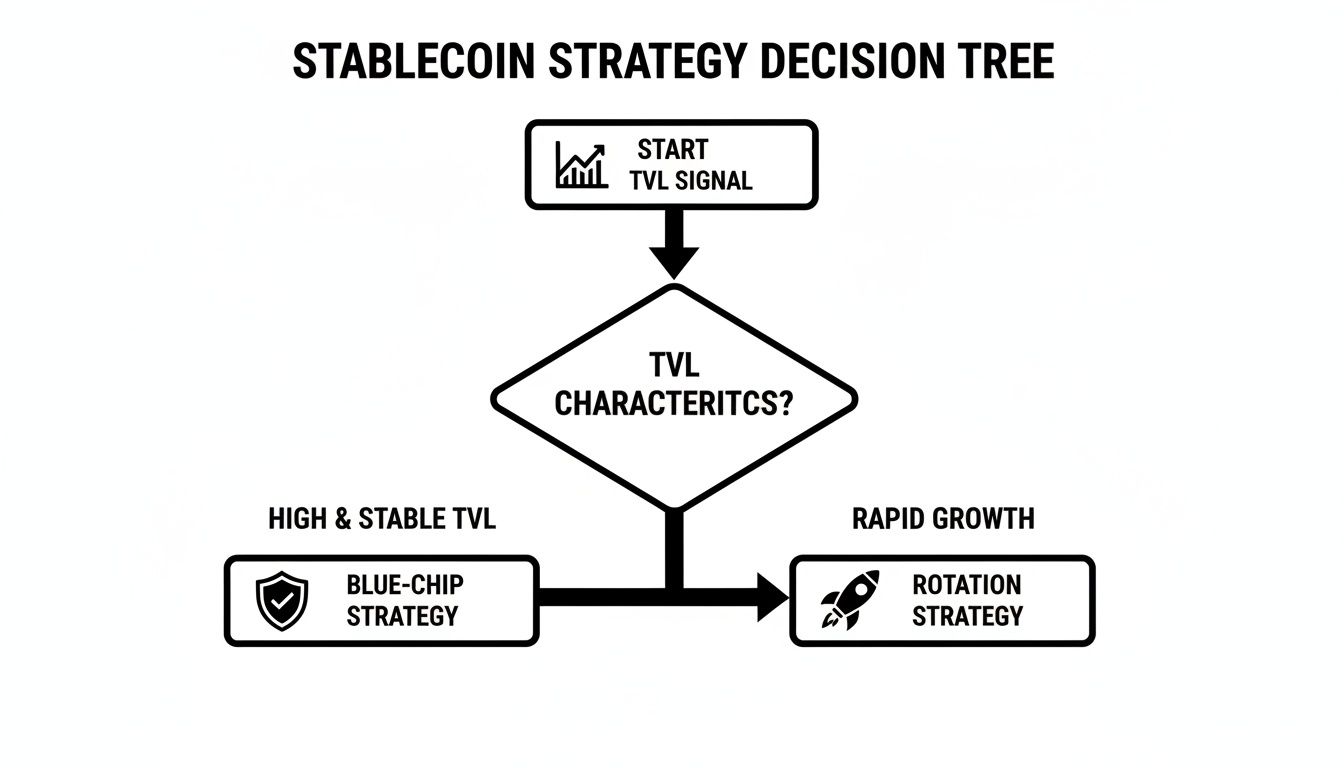
As you can see, a high and stable TVL suggests a lower-risk, blue-chip strategy might be best. On the other hand, rapid growth could mean a more active capital rotation approach is a better fit.
The Complexity Behind Automation
Let's be honest: doing this kind of multi-layered analysis for every potential opportunity is a ton of work. It demands constant monitoring and a real knack for understanding on-chain data.
This is exactly where automation comes in.
An AI-powered tool like Yield Seeker doesn't just track TVL. It's constantly crunching these interconnected metrics for you, 24/7. It cross-references TVL growth with revenue streams, user data, and risk factors to make smart, data-driven decisions on your behalf.
This ensures your stablecoin strategy is built on a foundation of genuine protocol health, not just a single number that could easily be misleading.
Watch Out: Common Traps in TVL Analysis
Using TVL tracking signals can give you a real edge, but leaning on them too heavily is a recipe for disaster. The numbers can lie, and if you don't know the common traps, you're putting your capital at risk.
One of the biggest mistakes is assuming a high TVL automatically means a protocol is safe. Sure, a fat TVL suggests a lot of people trust the platform, but it tells you absolutely nothing about its security under the hood. We've seen protocols with billions locked up get completely drained by smart contract bugs or governance attacks.
High TVL means high liquidity. It doesn't mean it's bulletproof.
The Problem with "Vanity TVL"
Another trap to watch out for is "vanity TVL." This is when a protocol’s value gets juiced up to make it look way healthier than it actually is. One classic move is double-counting, where assets are looped between lending and borrowing protocols in the same ecosystem just to pump the total value locked number.
A protocol might also dangle some crazy, short-term rewards to lure in a flood of mercenary capital. As soon as those incentives disappear, the TVL evaporates, leaving anyone who thought the growth was real holding the bag.
How do you avoid this? Always ask where the TVL is coming from. Is it spread out among thousands of real users, or is it just a handful of whale wallets? A broad user base is a sign of genuine adoption. A protocol dominated by a few whales could see its TVL vanish overnight.
Looking Beyond the Big Number
The best way to sidestep these issues is to stop treating TVL as the only metric that matters. Instead, think of it as a starting point for a much deeper dive.
Here are three simple things you can do to sharpen your analysis:
Follow the Money (Protocol Revenue): A huge TVL should go hand-in-hand with real usage and fees. If a protocol has billions locked but is barely earning any revenue, that’s a massive red flag. It suggests the value is all hype, no substance.
Check the User Growth: Take a look at the number of active daily or weekly users. Slow, steady, organic growth in user count is a much healthier sign than a sudden TVL spike from a few big players.
Cross-Reference with Audits: This one is non-negotiable. Always, always check if the protocol has been audited by reputable security firms. No amount of TVL will save your funds from a critical smart contract flaw.
By weaving TVL signals together with these other data points, you'll get a far more complete and honest picture of a protocol's health. It's the difference between investing in real value and just chasing impressive-looking numbers.
Automating Your Strategy with Yield Seeker

Manually keeping tabs on TVL signals and cross-referencing all those metrics is a powerful way to find an edge, but let's be honest—it's also a massive time sink. To execute a sophisticated strategy properly, you need to be watching the market constantly.
This is where automation becomes a total game-changer, and it's precisely what we built Yield Seeker to do.
Our platform puts everything we've talked about into practice. It uses an AI agent to do all the heavy lifting for you, continuously monitoring TVL tracking signals across countless protocols on the Base chain, 24/7. The agent doesn't just see the raw numbers; it digs deeper, analyzing the rate of change, protocol revenue, and other critical risk factors in real-time.
Effortless Execution and Risk Management
Think of Yield Seeker’s AI as your own personal analyst and portfolio manager, working tirelessly in the background. It pinpoints the most promising stablecoin yield opportunities the moment they pop up and automatically puts your capital to work based on the risk level you're comfortable with.
This approach brings some huge advantages:
Time Savings: Forget about staring at dashboards all day. The AI handles the research burden for you.
Emotional Discipline: The agent operates on pure data. It's immune to the FOMO and fear that can wreck a perfectly good strategy.
Optimal Performance: By reacting instantly to market shifts, it makes sure your capital is always in the most efficient spot, chasing competitive, risk-aware yields.
Yield Seeker isn’t a replacement for knowledge but a tool for execution. It empowers you to apply a data-driven strategy effortlessly, making it ideal for busy professionals and crypto natives alike who value both performance and peace of mind.
If you're curious about bringing automation into your own trading, resources like the Scalping Algo User Guide can offer some great insights into implementing algorithmic tools.
You can also get a deeper look at how our platform works by checking out our guide on real-time APY optimization.
Got Questions? We've Got Answers
How Often Should I Be Checking TVL?
If you're trading manually, popping in for a daily check on TVL signals is a solid baseline. It’s especially smart when the markets are going wild, helping you catch big capital rotations or spot a protocol that's suddenly in trouble.
But let's be real—major shifts can happen in the blink of an eye. That's where an automated platform really shines. It keeps an eye on things 24/7 in real-time, making sure your capital is always in the best possible spot without you having to stare at charts all day.
Can TVL Be Faked or Manipulated?
Oh, absolutely. TVL can definitely be gamed. One of the classic tricks is "double counting," where assets get looped between friendly protocols to pump up the numbers. Think of it like this: someone deposits an asset, borrows against it, and then redeposits those borrowed funds right back into the ecosystem.
This is exactly why you can't just take the headline number at face value. A truly healthy protocol isn't just about a big TVL; it's about a growing base of real users and generating actual revenue. The inflated metrics just don't have that substance, and good analytical tools are great at sniffing out the difference.
So, A High TVL Means It's Safe, Right?
Not necessarily. A high TVL isn't an ironclad guarantee of safety. While it’s a great sign of user trust and means there’s plenty of liquidity, it won't save a protocol from a smart contract bug, a clever hack, or just plain bad governance.
We've seen protocols with billions in TVL get hit hard in the past. Always treat TVL as just one piece of the puzzle. You still need to do your homework: check for security audits from well-known firms, look into the team's history, and get a feel for their overall security setup before you put any funds in.
Ready to put all this into practice without the grind? Yield Seeker uses a personalized AI Agent to chew through these signals for you, automatically finding the best risk-aware yields for your stablecoins. Start earning smarter today.