
You're staring at a stablecoin balance, a dozen tabs are open, and every pool claims to be the one with the cleanest yield. One dashboard says the APY is exciting, another says the risk is tolerable, and by the time you've bridged, swapped, and checked the math, the opportunity has shifted. That's the core DeFi problem: the market rewards speed, but manual research makes speed expensive.
A better answer is what is optimal strategy in practical terms, not the one with the flashiest headline return, but the one that still works after fees, slippage, and market conditions change. In technical strategy work, the best workflows treat the optimal strategy as an action policy that maximizes an objective under explicit constraints, while trading research insists on out-of-sample validation and sensitivity checks because backtests can break once reality introduces transaction costs or regime shifts (ScienceDirect on optimal strategy). That framing fits DeFi perfectly.
The Hidden Trap of Chasing High APY
The first mistake is treating a high APY like a finish line. In DeFi, that number is usually a snapshot, not a promise, and it tells you almost nothing about whether the strategy survives the next pool shift, incentive change, or gas spike. If you've ever rotated capital into a shiny farm only to watch the return compress before you could even compound, you've already met the trap.
Why manual yield hunting breaks down
Manual hunting creates a hidden tax. You spend time scanning pools, comparing incentives, watching token emissions, and moving funds, and every one of those actions introduces friction. Even if the position looks good on paper, the actual outcome depends on whether you can enter and exit cleanly, keep costs under control, and avoid getting trapped in a thin market.
That's why risk-awareness matters more than headline yield. The practical danger isn't just lower return, it's the mismatch between the strategy you thought you bought and the strategy you held once the market moved. If you want a deeper breakdown of the risks that tend to show up first, the yield farming risk guide is a useful companion read.
Practical rule: if a strategy only looks good when everything stays static, it isn't optimal, it's fragile.
What the smarter alternative looks like
The smarter move is to define success before you chase yield. In practice, that means deciding what you're optimizing for, whether that's steadier returns, lower drawdown, better capital access, or a cleaner balance between those goals. Once that target is clear, you can stop asking, “What's the highest APY today?” and start asking, “What allocation still makes sense after costs and risk?”
That shift changes the whole workflow. Instead of reacting to every new pool, you filter for strategies that match your constraints and let the rest go. In DeFi, that discipline matters because the best-looking opportunity often disappears before a manual operator can finish comparing it with three other tabs.
Unpacking Optimal Strategy Beyond Returns
A DeFi trader opens a pool because the APY looks strong, then realizes the position is hard to exit, the fees are eating the edge, and the reward stream changes before the position can compound. That is the practical problem with calling a strategy “optimal” based on return alone. The best-looking number is not always the best allocation once execution risk, capital lockup, and changing conditions enter the picture.

A More Precise Definition
Optimal strategy means the action policy that maximizes an objective function under explicit constraints, not the one that merely looks best in sample data.
That definition matters because it forces precision. The objective may be risk-adjusted yield instead of raw APY. The constraints may include available capital, maximum tolerated drawdown, withdrawal flexibility, or the specific protocols you trust. In technical strategy optimization, the better process does not chase the prettiest historical outcome, it optimizes against risk-adjusted metrics such as Sharpe ratio and drawdown, and it checks whether the result still holds when conditions change (ScienceDirect on optimal strategy).
Why “best return” is the wrong question
“Best return” sounds simple, but it hides the trade-offs that decide whether a strategy is effective. A strategy with strong headline yield can still fail if it is too sensitive to fees, too dependent on a single incentive program, or too brittle across different market states.
The ultimate test is fit. A treasury manager with strict liquidity needs is solving a different problem from a long-term stablecoin holder who can tolerate more variance. The strategy has to match the user, not just the market.
The Metrics That Truly Define a Good Strategy
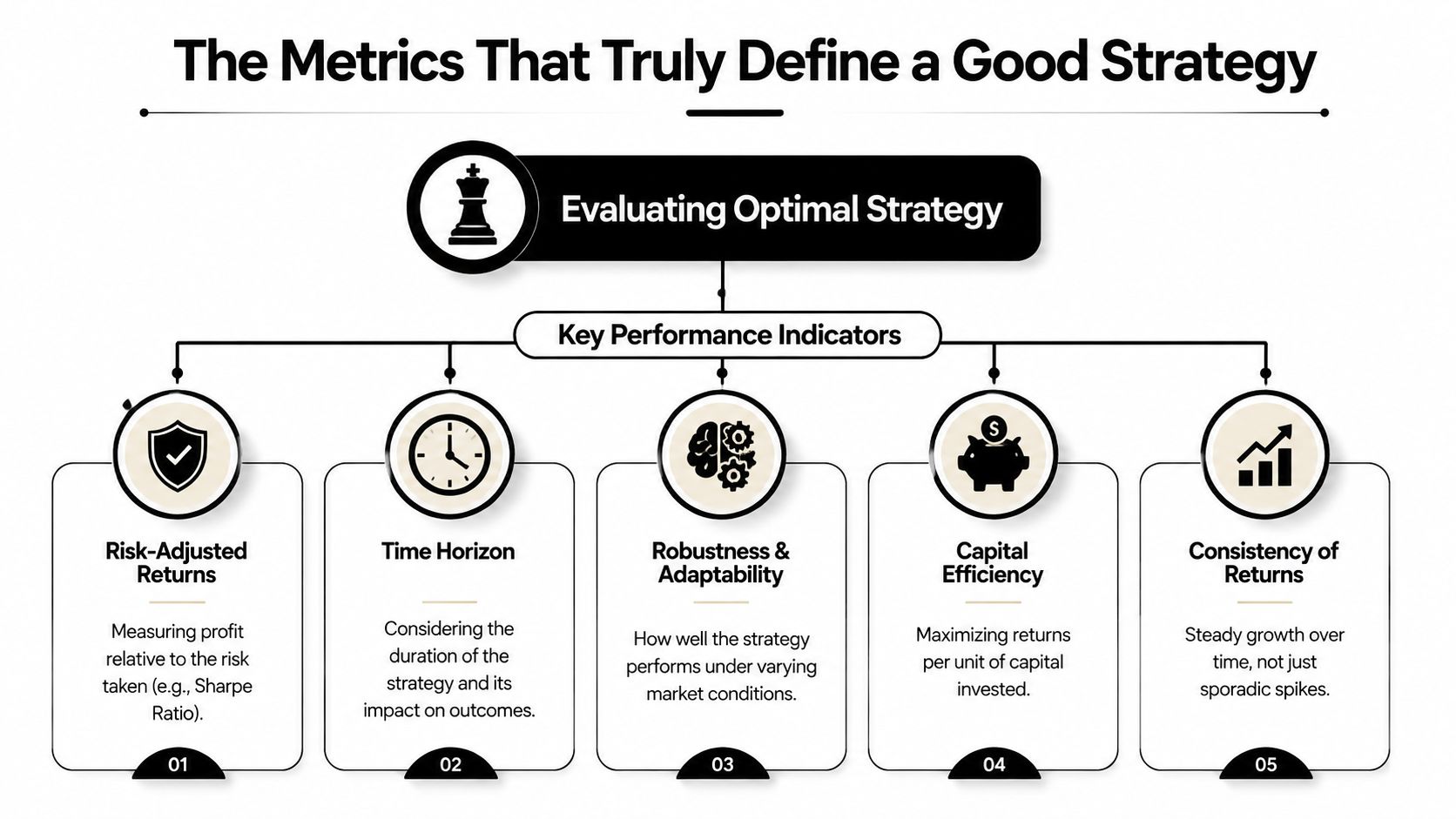
Headline APY is the first number people notice, but it's rarely the number that decides whether a strategy is worth using. A good DeFi allocation behaves more like a system than a lottery ticket, and systems need multiple checks. That's why practitioners look at the shape of returns, the cost of accessing them, and how the strategy behaves when conditions get ugly.
The metrics that matter in practice
Risk-adjusted return comes first. It asks whether the yield is worth the risk taken, which is exactly why tools like the Sharpe ratio matter more than raw return alone. If one pool offers slightly lower yield but far less volatility, the better strategy may be the calmer one, especially for capital that needs to stay productive without constant intervention.
Drawdown matters because losses are not abstract. A deep peak-to-trough drop changes how long you stay committed, whether you rebalance too early, and whether you can keep using the strategy at all. For DeFi users, the practical issue is not just “How much can I earn?” but “How much pain can this position absorb before I have to exit?”
Liquidity is the hidden operational metric. If the pool is hard to unwind or only exits cleanly under ideal conditions, the yield isn't fully real because your capital can't respond when the market changes. Fees and slippage are part of the same story, since a strategy that pays well on paper can lose its edge once you include execution costs.
For a plain-language look at how return metrics can be framed outside crypto, Fintrack's overview of rate of return is a helpful reference point, especially if you want to compare raw return language with risk-aware thinking.
Rule of thumb: if you can't explain how a strategy earns, exits, and survives a rough week, you don't understand its real return.
The same logic applies to stablecoin yield stacks. A pool with modest yield but strong liquidity and cleaner execution may be the more optimal choice because it preserves optionality. If you want a DeFi-specific lens on that trade-off, the risk-adjusted APY guide connects the metric to actual allocation decisions.
A Framework for Finding Your Optimal Path
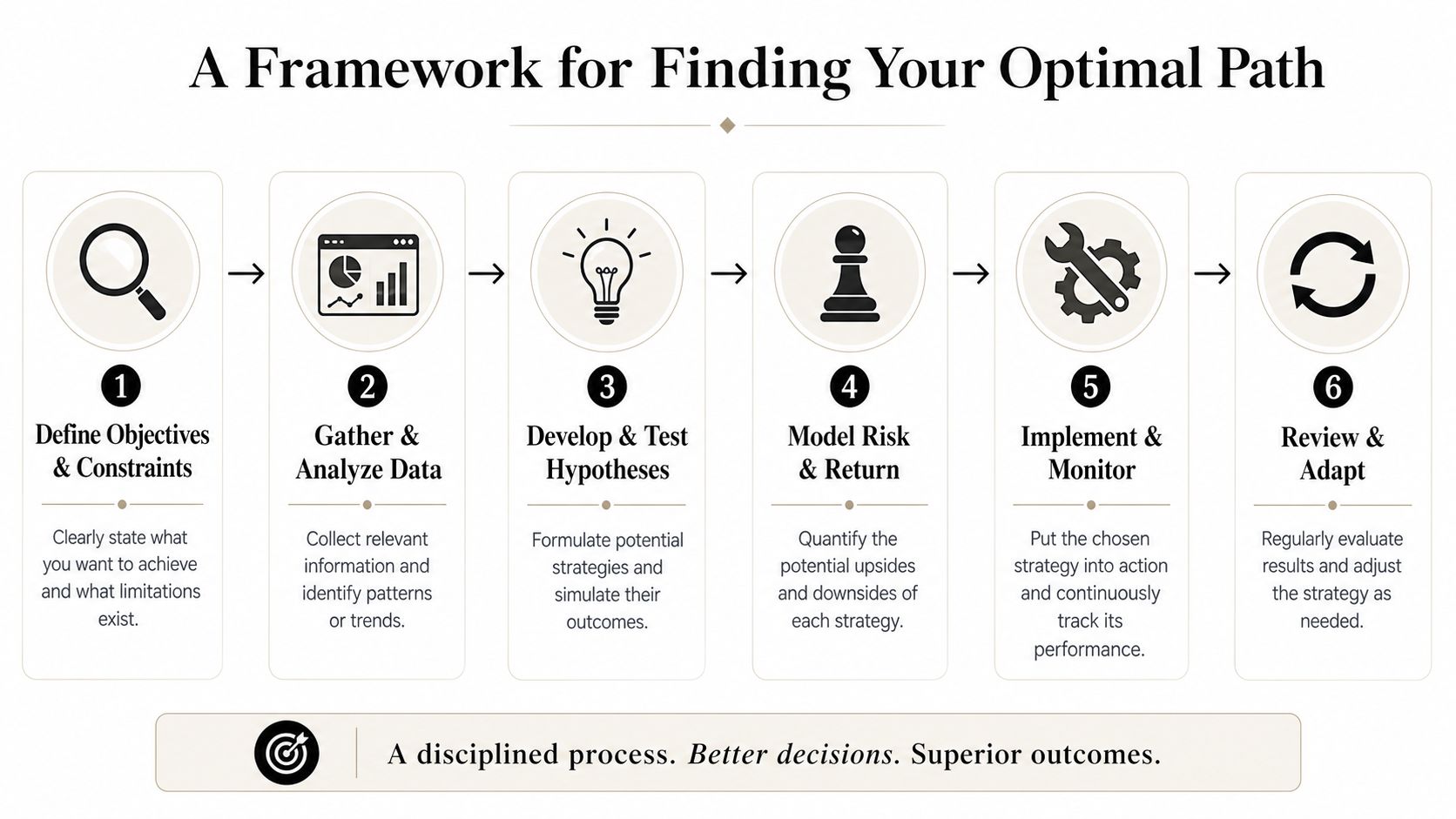
The search for an optimal strategy gets simpler when you treat it like a workflow instead of a guess. Professional strategy design starts with a goal, narrows the field, tests what survives, and rejects anything that only works in hindsight. In DeFi, that same logic helps separate durable yield systems from temporary incentive chases.
A practical decision path
Start with the objective and constraints. Decide whether you care most about steadiness, liquidity, upside, or some blend of the three. The strategy can't be optimal if the target keeps changing every time a new pool launches.
Limit the parameter space. One widely used technical framework recommends keeping signal indicator counts around 2–5 to avoid overfitting, then testing each parameter set through backtesting, demo testing, and live small-capital verification before scaling (Medium on developing a technical trading strategy). The reason is simple, fewer degrees of freedom plus cleaner data lowers model variance, which makes production behavior more stable.
Backtest, but don't worship the backtest. Historical data is useful, but only if you treat it as a filter, not a verdict. A strategy that looks excellent in one fitted period can fail the moment costs change or the market regime shifts, which is why sensitivity analysis matters.
Where the process usually breaks
Overfitting is the usual failure mode. People tweak too many knobs until past data looks perfect, then discover the live version is brittle. In DeFi, that happens when a user optimizes around a specific incentive window and ignores how quickly those conditions can disappear.
Stress testing is the part most manual operators skip, and it's the part that saves capital. A good framework asks what happens if liquidity thins, if gas rises, or if a pool stops being attractive faster than expected. The answer should not be a shrug.
Forward testing closes the loop. Small-scale live verification reveals the difference between a clean spreadsheet and a strategy that can run in production. If the strategy still behaves after that, it starts to deserve the word optimal.
Optimal Strategy in Action with Stablecoin Yield
Stablecoin yield is where this becomes concrete. A user wants capital to stay active, accessible, and reasonably safe, but the market keeps shifting across lending pools, incentives, and execution conditions. That's exactly the kind of problem an AI agent can handle better than a person trying to monitor everything by hand.
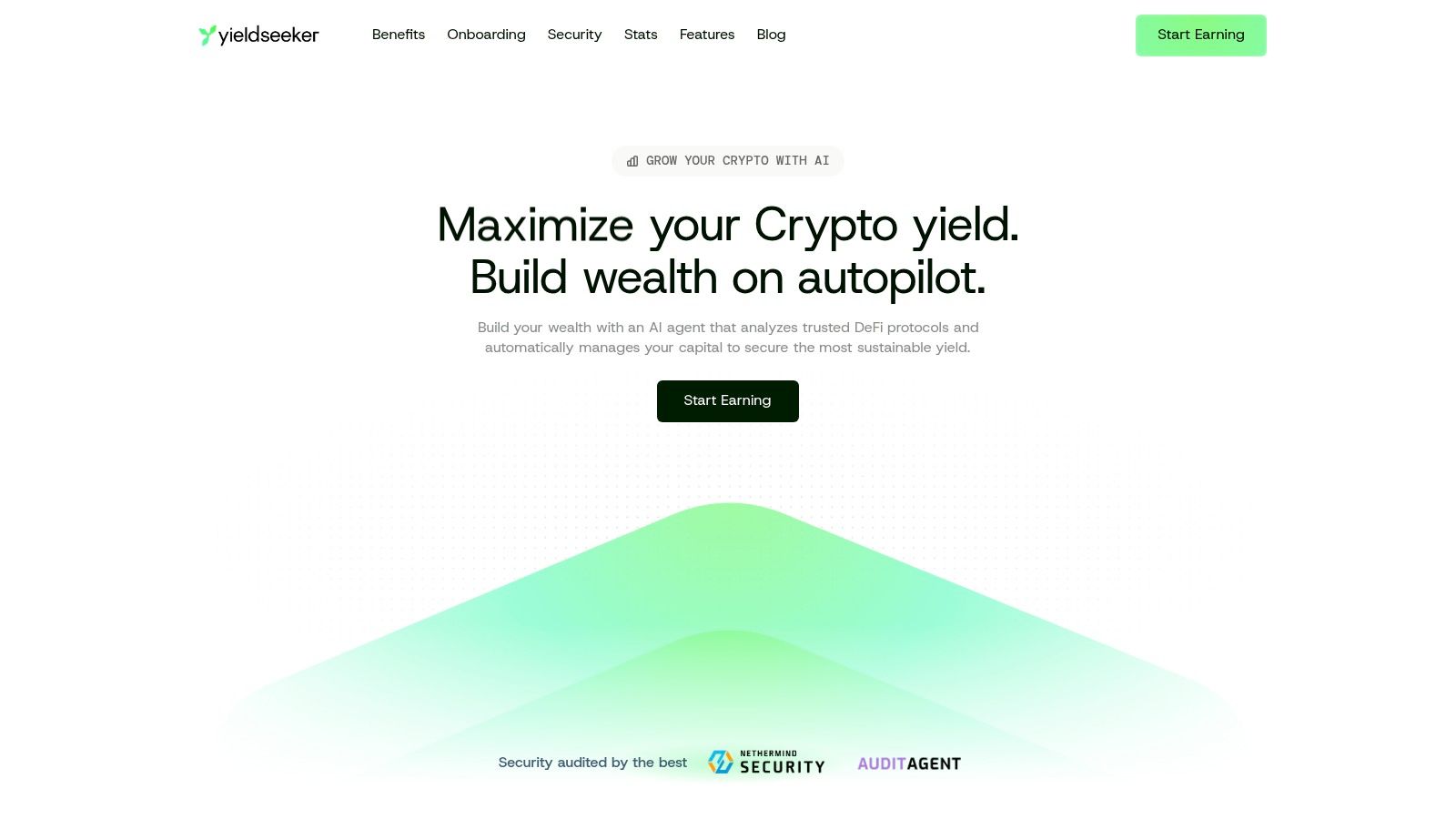
The screenshot below gives a sense of how an automated platform presents that workflow in practice.
How an AI agent makes the trade-offs
An AI agent evaluating stablecoin yield doesn't start with “What looks loudest today?” It starts with the constraints set by the user, then compares candidate pools on yield, liquidity depth, risk profile, and current market conditions. That's the right sequence because the answer changes depending on whether the user wants a hands-off allocation or a more active rotation strategy.
From there, the agent can choose between different protocol options, adjust financial exposure only when the trade-off makes sense, and rebalance when the allocation no longer fits the target profile. The key point is not that every move should be aggressive. The key point is that every move should be deliberate and tied to the same objective function.
Timing and execution are part of the strategy
Execution matters as much as selection. If a rebalance happens at the wrong time, fees can eat the edge. If the agent waits too long, the best pool may already be less attractive. The practical value of automation is that it keeps making these micro-decisions without needing a human to babysit every change in real time.
An AI agent also reduces the cognitive cost of comparison. A human sees five dashboards and three incentives and starts simplifying too early. An agent can keep the full context in view, which is where automation starts to beat manual management.
Here's the embedded walkthrough if you want a live example of how the system thinks.
That's the core DeFi advantage. The strategy doesn't have to be guessed once and forgotten. It can be continuously re-evaluated against new data, which is much closer to how an optimal policy should behave in a dynamic environment.
Automating Your Path to Optimal Yield
Manual yield hunting doesn't scale well because the work never really ends. You need to scan opportunities, validate risk, test behavior, watch execution costs, and then repeat the process when the market changes. In a fast-moving DeFi environment, that's a full-time job, and most users don't want another job.
That's where automation stops being a convenience and becomes the implementation layer for optimal strategy. A system like Yield Seeker continuously monitors opportunities and reallocates stablecoin capital based on current conditions, which is the kind of ongoing policy update the academic definition of optimal strategy implies. For a closer look at that mechanism, the automated APY discovery guide is worth reading.
The practical argument is straightforward. If the strategy has to stay aligned with your objective as markets move, then the logic has to keep running after you close the tab. AI agents are useful here because they don't just surface options, they execute the comparison, monitoring, and rebalancing loop on your behalf.
If you want a stablecoin strategy that's built around risk-aware yield, not just flashy APYs, visit Yield Seeker and see how an AI agent can monitor opportunities for you. It's a practical way to keep capital working while preserving access, control, and a clearer view of the trade-offs that matter.