Real-time monitoring means keeping the delay between something happening in production and your ability to see it, analyze it, and act on it short enough to matter, usually in seconds rather than minutes. In observability terms, many teams treat a system as real time when the combined delay stays within about five seconds, because that window is still fast enough to change the outcome.
If you hold stablecoins in DeFi right now, you already know the feeling. You open one dashboard and the yield still looks healthy. You open another and liquidity has already shifted, incentives have changed, or a pool has started to wobble. By the time the slower screen catches up, the only thing left to do is confirm that you were late.
I've watched protocols degrade like that in real time. Not always through dramatic hacks. Sometimes it's a quieter failure. A vault's return falls, a pricing feed drifts, liquidity leaves a pool, and users keep sitting in a position because the interface they trust is reporting the past. That's why the question isn't just what is real time monitoring. The useful question is: how tight is the latency budget between event, detection, and action?
That framing matters even more when an AI agent is managing stablecoin yield. An agent that sees stale data isn't automated intelligence. It's just a faster way to make old decisions. The monitoring layer is what turns automation into something operationally meaningful.
What Real Time Monitoring Actually Means
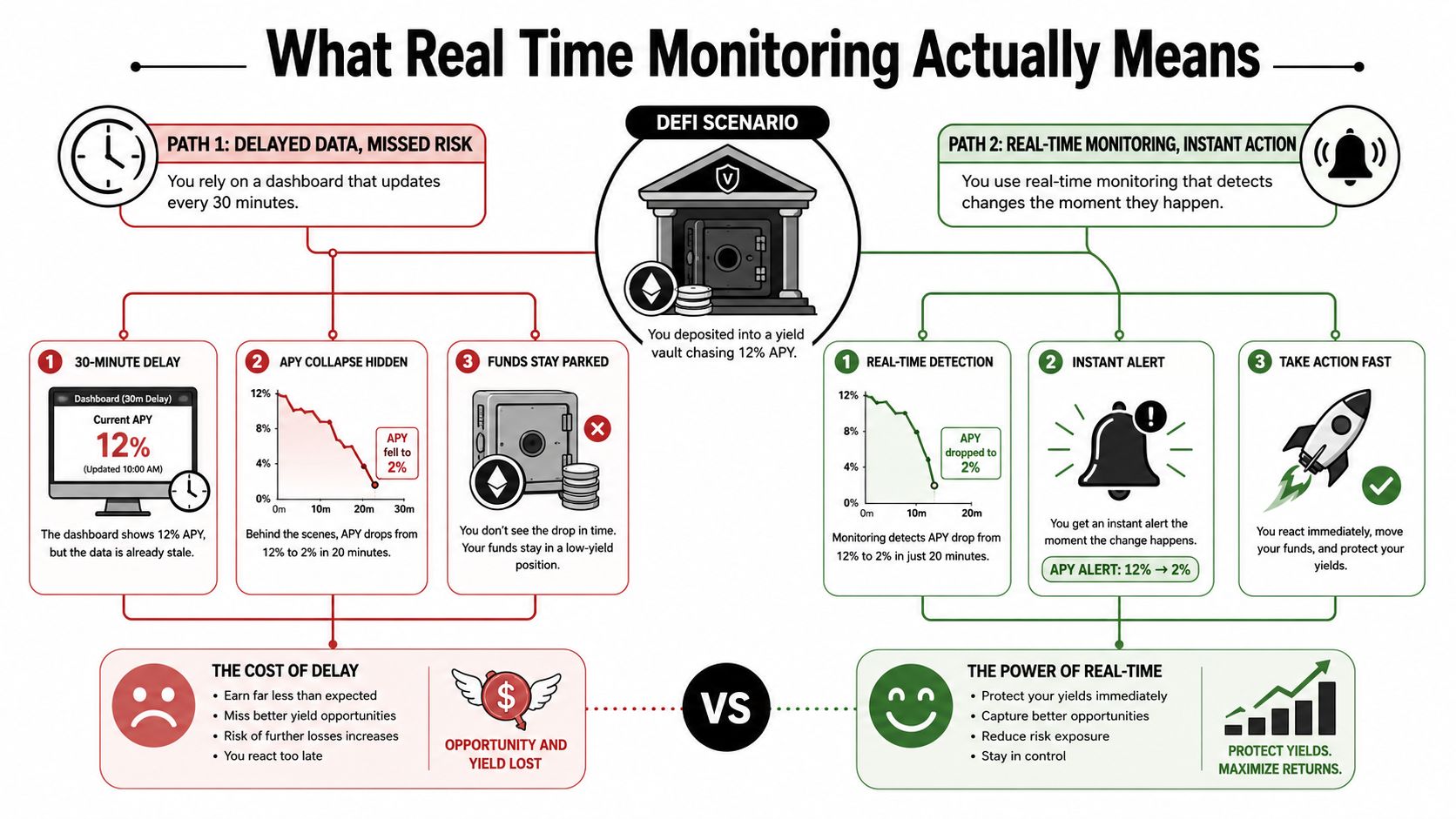
A simple DeFi failure looks like this. You deposit stablecoins into a vault because the displayed yield looks attractive. Over the next stretch of market activity, the opportunity deteriorates, but your dashboard refreshes too slowly, so your funds stay parked while better options appear elsewhere.
That's where confusion sets in. They hear “real time” and think it means a magical zero-delay feed. In practice, real-time monitoring is a latency budget. It's the total gap between an event occurring and a person or system doing something useful with it.
In DeFi, that budget is never zero. Blocks have to land. RPC infrastructure has to propagate updates. Indexers and analytics pipelines have to process them. A bot or human then has to decide whether the event matters. The point isn't to erase delay. The point is to compress it enough that the decision still changes the outcome.
Why the word real time causes confusion
A lot of product pages use the term loosely. They mean “updated often” or “fresh enough for charts.” That's not the same as a monitoring system designed for intervention.
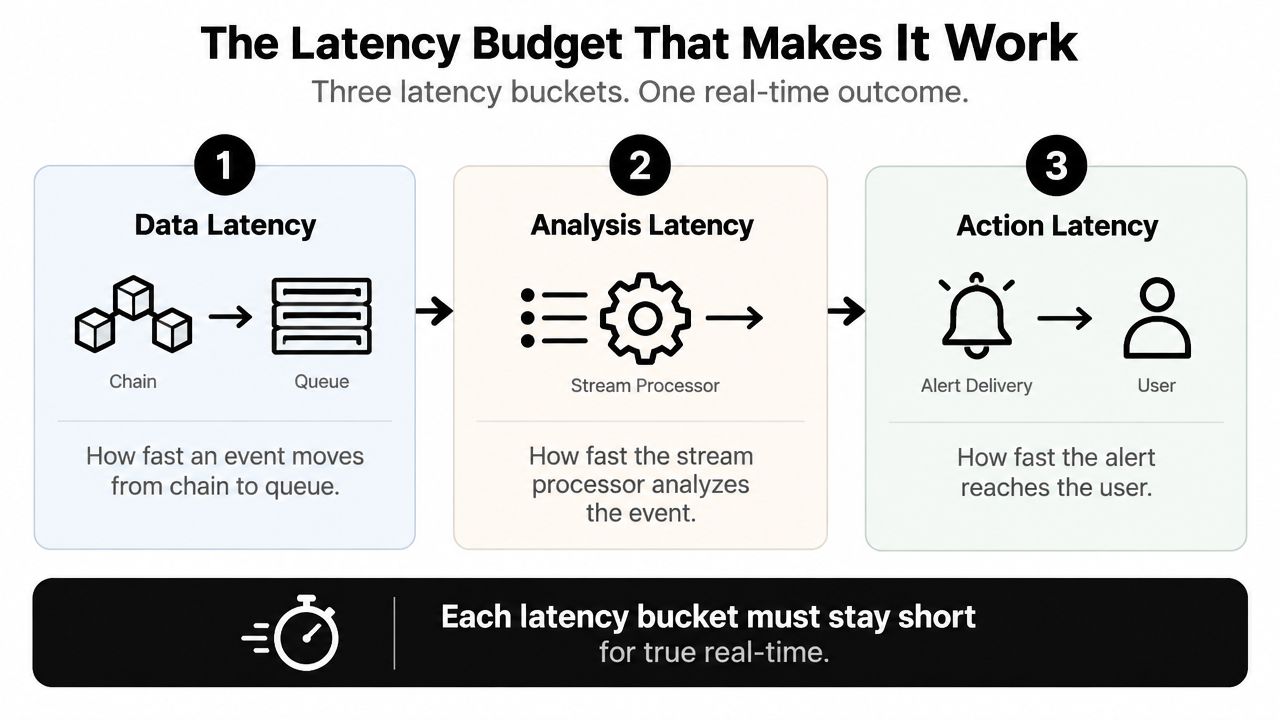
One observability guide puts the distinction clearly: the delay is the sum of data latency, analysis latency, and action latency, and if that combined window stays within about five seconds, many experts classify the system as real time rather than near-real-time, as explained in Azion's guide to real-time monitoring.
Practical rule: If your alert arrives after the pool imbalance, depeg, or APY collapse has already fully played out, you didn't have real-time monitoring. You had a historical notification.
What sits inside that budget
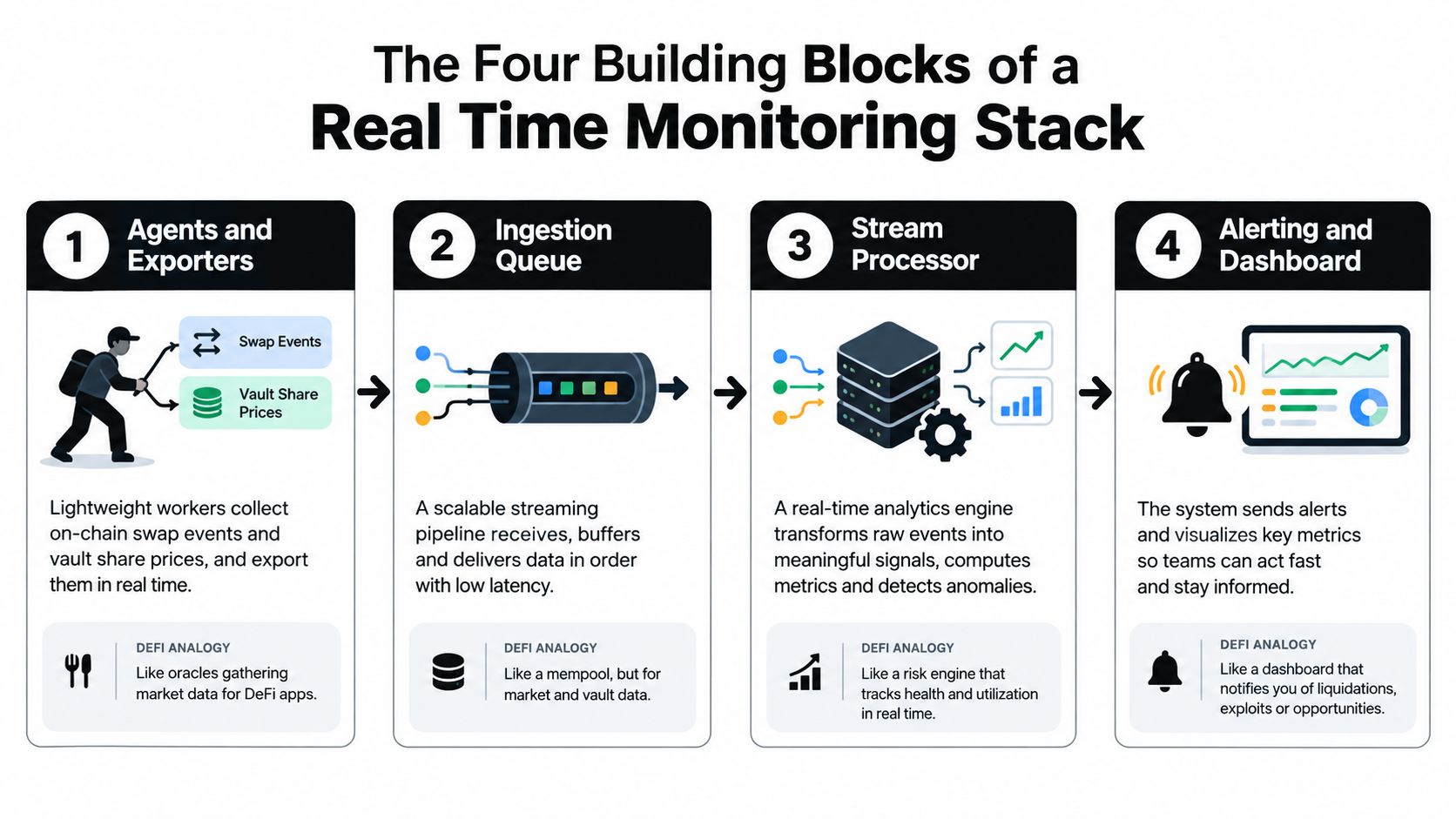
Most DeFi monitoring stacks rely on four moving parts:
Agents and exporters that collect events from chains, protocols, and market feeds
A stream layer that moves those events without waiting for batch jobs
Decision logic that figures out whether the signal matters
Alerts or actions that route the result to a human or execution system
If you want a broader view of how raw blockchain events become usable operating data, Yield Seeker's piece on on-chain data is a useful companion.
One more reason this topic matters now: continuous visibility isn't a niche anymore. An independent market estimate says the global end user experience monitoring market reached USD 3.90 billion in 2024 and is projected to grow at a 15.7% CAGR from 2025 to 2030, which reflects how central continuous observation has become across digital operations, according to Grand View Research's market report.
The Four Building Blocks of a Real Time Monitoring Stack
Picture monitoring as a dashboard. The dashboard is the last step, not the system. The stack starts much earlier, where data is first collected and moved.
Agents and exporters
These are the lightweight workers that sit near the source of truth. In DeFi, that can mean listeners attached to protocol contracts, RPC nodes, or indexers that watch swap events, reserve changes, reward emissions, oracle pushes, and vault share price updates.
Think of them like a teller counting cash at the register. If the count starts late or skips transactions, everything downstream is compromised.
Modern observability systems were built around continuous, machine-readable measurement rather than occasional manual inspection. Prometheus documentation reflects that shift with a model centered on collecting, storing, and querying metrics for alerting and dashboards.
Stream processing
Once an event is captured, it has to move. This layer is the conveyor belt. Teams often use tools like Kafka, Redis Streams, or WebSocket fan-out to keep events flowing between services without waiting for slow batch windows.
A lot of confusion comes from assuming the collector is the bottleneck. In reality, the queue and processing path often add more delay than people expect. If the pipeline backs up during volatility, your “live” feed starts behaving like replay.
For readers who want a simple infrastructure-side analogy, this bmon command guide for Linux is useful because it shows what watching a fast-changing system looks like when you care about current state, not yesterday's report.
The execution path looks like this in practice:
Collection happens first. Agents pull or receive events from chains and protocol surfaces.
Transport comes next. The stream layer fans those events out to the services that need them.
Ordering matters. If messages arrive late or out of sequence, the analysis can misread what's happening.
Threshold logic and anomaly detection
This is the brain of the stack. It decides whether a change is noise or a reason to act. In DeFi, that might be a drop in reward rate, a sudden liquidity outflow, unusual borrowing behavior, or a growing gap between an on-chain price and a reference feed.
Monitoring without decision logic gives you motion, not judgment.
Some teams use simple thresholds. Others layer in anomaly models. Either way, every rule has a cost. Tight thresholds catch problems sooner but can flood operators with false alarms. Loose thresholds feel calmer but arrive too late.
Dashboards and alerts
This is the voice of the system. It can be a Telegram bot, a Discord webhook, an internal terminal, or a dashboard tile that turns red when a strategy crosses a risk boundary.
A strong benchmark described by observability specialists is one-second collection plus one-second visualization latency, which yields under two seconds from event to insight at scale, as outlined in Dokploy's real-time monitoring overview. That target matters because it preserves a real opportunity to intervene, while traditional polling intervals of five to fifteen minutes can miss short-lived failures entirely in the same source.
Real Time Monitoring vs Polling and Near Real Time
The easiest way to understand what real time monitoring is is to compare it with the two things people often mistake for it.
Polling checks state on a schedule. Near-real-time systems update more frequently but still rely on short delays and batching. Real time keeps the end-to-end loop tight enough that the first detection can still shape the result.
Three cadences, three very different outcomes
If you're managing stablecoin yield, a polling system might be enough for a weekly portfolio review. It's not enough for moments when a pool starts to empty, an oracle update changes risk, or an incentive change makes a once-good vault no longer worth the exposure.
Near-real-time setups are often fine for portfolio overviews. You can see the broad direction. You just can't reliably beat the first wave of market reaction. By the time the update lands, searchers, arbitrage bots, and more attentive allocators may already have moved.
Cheap monitoring tells you what happened. Useful monitoring gets there while you still have a choice.
Monitoring Cadence Comparison in DeFi
Cadence | Typical Latency | Cost | Best Use Case |
|---|---|---|---|
Polling | Often minutes between checks | Lower | Long-term tracking, reporting, passive dashboards |
Near real time | Usually short batched delays | Medium | Portfolio views, general market awareness |
Real time | End-to-end delay kept within a few seconds | Higher | Yield routing, fast risk detection, automated rebalancing |
There's no moral victory in choosing the fastest possible system. If the decision itself isn't time-sensitive, then high-speed monitoring may be wasteful. A buy-and-hold treasury position doesn't need the same cadence as an active stablecoin strategy rotating across farms, lending venues, and DEX pools.
The mistake is buying a dashboard cadence when you need an intervention cadence.
The Latency Budget That Makes It Work
Once you stop treating real-time monitoring as a buzzword, the engineering problem becomes clearer. You're managing three different delays, and each one can ruin the whole loop.
Data latency
This is the time it takes for an event to move from chain activity into your monitoring pipeline. In DeFi, that includes block production, RPC propagation, event indexing, and ingestion into your queue or metric store.
If a Curve pool parameter changes or a DEX price starts drifting, data latency determines how quickly that state becomes visible outside the chain itself. A slow collector means every later stage starts behind.
Analysis latency
Once the event arrives, the system still has to score it. Is the price move noise, or the start of a depeg? Is the liquidity drop ordinary rotation, or a real exit risk? Analysis latency includes stream processing, rule evaluation, anomaly checks, and rendering the result into something a system can use.
This is also where teams often overspend. One guide on the topic notes that “true real time (sub second) is expensive” and argues that teams should define real time by use case rather than assume faster is always better, as discussed in Monitor.us on real-time monitoring. That same tradeoff shows up hard in DeFi, where over-collecting and over-processing can make a pipeline both expensive and fragile.
Action latency
Seeing the event isn't enough. You still need a response. That response might be a bot execution, a route to a safer venue, a pause in new deposits, or a high-priority alert to a treasury operator.
A lot of teams undercount this stage because they mentally stop the clock at the dashboard. But if the alert lands and no one reads it for a while, or a downstream bot waits in a queue, the system has blown the budget anyway.
Here's the operational version:
Data latency asks whether the event became visible quickly.
Analysis latency asks whether the system interpreted it quickly.
Action latency asks whether anyone or anything responded quickly.
If you're evaluating execution environments where speed and transaction costs influence this final step, Yield Seeker's article on Layer 2 networks helps connect monitoring to actual on-chain response design.
A monitoring pipeline is only as real time as its slowest stage. Fast charts cannot rescue slow action.
For DeFi yield management, the practical goal is usually to keep the combined delay short enough that a stablecoin strategy can still reroute before the adverse condition fully propagates. That's why the latency-budget view is so much more useful than asking whether a dashboard “feels live.”
How Yield Seeker's AI Agent Uses Real Time Monitoring
An AI agent that manages stablecoin yield has one core job. It needs to watch changing opportunities and risks across protocols closely enough that it can make allocation decisions before the edge disappears.
That's where the monitoring loop becomes operational rather than theoretical.
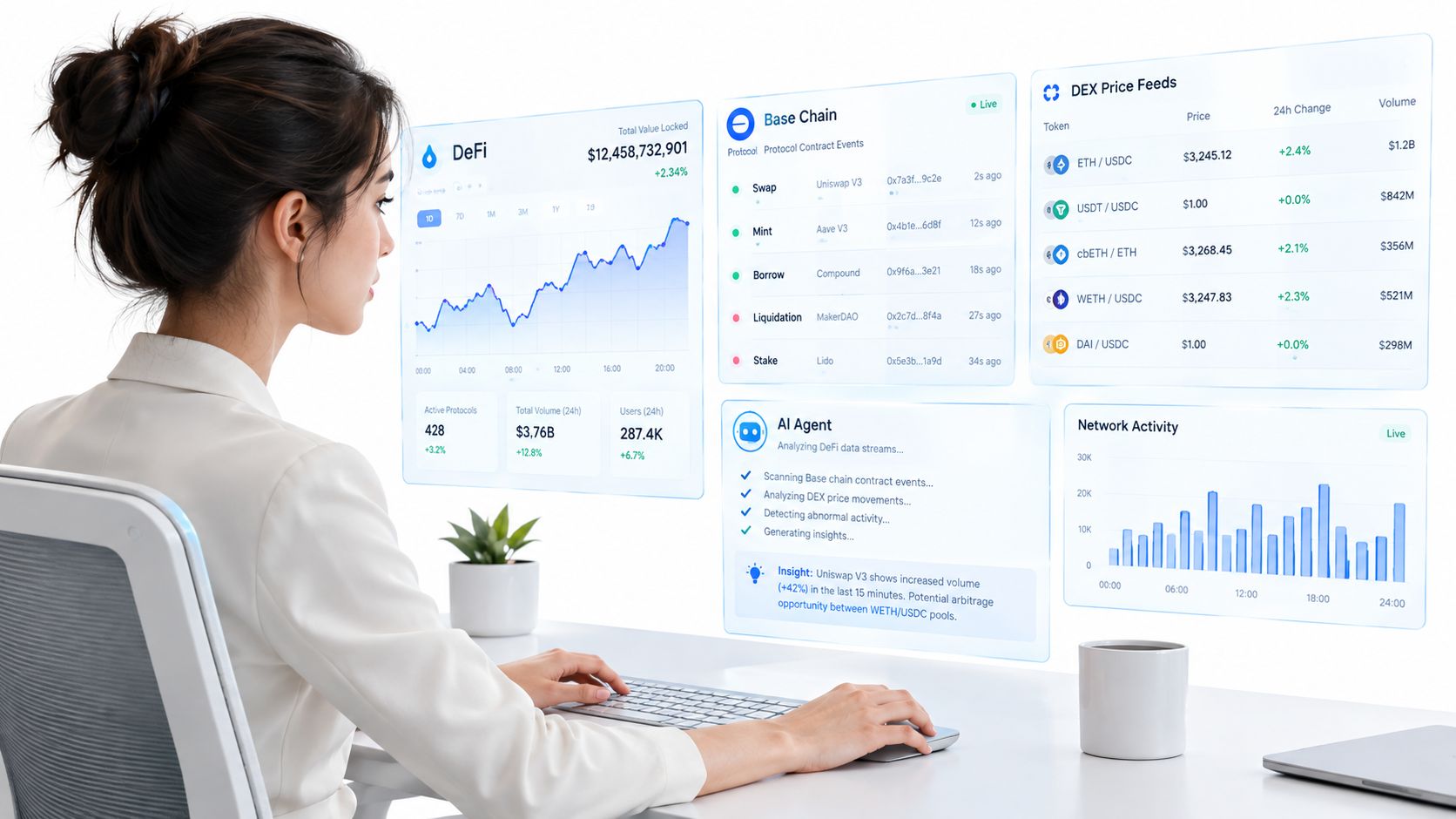
Event capture and scoring
Start with the incoming telemetry. A stablecoin agent watches protocol contracts, vault states, DEX pricing, reward changes, and liquidity conditions across the venues it cares about. Each event enters a scoring layer that asks a simple question: does this improve expected yield, worsen risk, or both?
That's the moment where “AI agent” either becomes real or collapses into branding. If the model is scoring stale data, its intelligence is cosmetic. If it's scoring current telemetry inside the same operating window in which a human could still react, then the automation has substance.
Some teams looking at broader orchestration patterns may also find a Donely unified AI platform useful as a reference point for how agents coordinate data, tools, and actions across a workflow rather than acting as one isolated script.
Decision logic and rebalancing
This is the part people usually notice last, even though it's what matters. The agent doesn't just watch. It compares available opportunities, reweights exposures as conditions change, and decides when a shift clears the threshold for action.
In a stablecoin context, that often means a few recurring decisions:
Stay put when yield remains competitive and the risk profile is unchanged.
Reduce exposure when telemetry points to weakening liquidity, worsening market structure, or changing protocol conditions.
Reallocate when another venue offers a better risk-adjusted outcome.
The value isn't just speed. It's consistency. A human sees a noisy market and hesitates, second-guesses, or gets distracted. A monitoring-driven agent runs the same loop every time.
Why the monitoring layer matters more than the interface
A clean dashboard helps, but the dashboard isn't the moat. The asset is the event-to-decision loop under the surface. In practical terms, that's what lets a system rank changing APYs, surface risk shifts, and trigger a rebalance while the information is still actionable.
If you want to understand that model in a DeFi-specific context, Yield Seeker's article on the AI-driven DeFi agent gives the product-side view of how automated strategy management fits together.
The agent is only as good as the monitoring loop behind it. Remove the telemetry discipline, and all you have left is a nice interface attached to delayed judgment.
This is also why DeFi users should ask a tougher question than “does it automate?” Ask whether the automation is fed by current enough data to matter. If the answer is no, then the system may still be convenient, but it's not protective.
Risk Detection Use Cases in DeFi Yield Management
The best use cases for real-time monitoring aren't abstract. They're the exact categories of failure that stablecoin allocators run into repeatedly.
Oracle deviations
Lending markets and collateralized strategies depend on prices that stay aligned with reality. When an oracle drifts or updates in a way the market hasn't fully absorbed yet, a position can move from healthy to dangerous fast.
The telemetry signal is usually a widening gap between an on-chain feed and a trusted market reference, plus unusual downstream borrowing or repayment behavior. The response might be to reduce exposure, pause new allocations, or flag a venue for manual review.
Liquidity drops and exit risk
Stablecoin strategies often look safe until everyone heads for the same door. A pool can still show an attractive headline yield while its depth weakens underneath it. Then the exit itself becomes expensive.
The monitoring system watches reserve changes, pool composition shifts, and slippage-sensitive conditions. The goal isn't just to know liquidity is falling. It's to catch the drop before exiting becomes the costly part of the trade.
Exploit signatures and abnormal transaction patterns
Not every exploit announces itself clearly. Sometimes the first visible clue is a transaction pattern that doesn't fit ordinary user behavior. Large flash-loan-style movements, tightly clustered state changes, or unusual sequences around a vault can all be early warning signs.
In these cases, the monitoring layer acts less like a charting tool and more like a tripwire. It doesn't need perfect certainty. It needs enough confidence to trigger a defensive response while there's still time to reduce exposure.
Fast risk detection isn't about predicting every exploit. It's about shortening the gap between the first abnormal signal and your first protective move.
Governance and parameter changes
A stablecoin strategy can deteriorate without any hack at all. A governance action changes emissions, fees, collateral settings, or pool parameters. Suddenly the strategy that looked clean yesterday is no longer the same product today.
The signal here is more administrative than market-based. Queued proposals, executed changes, and updated reward logic all matter. Monitoring catches them early enough that a strategy manager can reassess before passive capital sits through the change.
APY collapses
This is the most familiar failure mode for ordinary depositors. A farm loses incentives, mercenary capital exits, or too much money chases the same pool. The yield drops, but the user sees the old number and assumes nothing has changed.
Risk Signals and Real Time Detection Windows
Risk Category | Telemetry Signal | Real Time Detection Window | Agent Response |
|---|---|---|---|
Oracle deviation | Price gap between on-chain feed and reference market | Seconds to a short operational window | Reduce exposure or pause routing |
Liquidity drop | Falling reserves, skewed pool composition, worsening exit conditions | Seconds to a short operational window | Exit early or avoid new deposits |
Exploit signature | Abnormal transaction sequence, flash-loan-like behavior, unusual vault interaction | Immediate operational window | Trigger defensive alert or move capital away |
Governance change | Queued or executed parameter updates, fee or emissions changes | Short action window before impact spreads | Reassess venue and adjust allocations |
APY collapse | Falling reward rate, rapid outflows, deteriorating yield ranking | Seconds to minutes depending on strategy | Rebalance toward stronger risk-adjusted yield |
Stablecoin portfolios especially benefit from this because they often concentrate across a relatively small set of protocols. If one major venue weakens, the effect on realized return can be material. Monitoring doesn't remove that risk. It gives you a chance to act before the damage becomes the settled state.
Key Takeaways for Choosing Real Time Monitoring in DeFi
Most DeFi monitoring tools are easier to market than to evaluate. The cleanest way to judge them is to ignore the word “instant” and look for evidence that the system was built around a real latency budget.
What to demand
If a tool claims to be real time, ask for the operational path between event, analysis, and action. “Live dashboard” is not the same thing as a system that can detect and respond while the condition still matters.
Use this checklist:
Ask for latency definitions. You want a documented view of how the system handles data arrival, evaluation, and action timing, not a vague promise of live updates.
Check DeFi-specific coverage. Oracle feeds, pool reserves, reward changes, and exploit-like transaction patterns matter more than generic uptime graphs.
Separate alerting from execution. Some tools surface signals well but still leave the user doing all the time-sensitive work manually.
Prefer clear logic over flashy UI. A plain system with understandable triggers is safer than a beautiful interface with opaque decision-making.
When real time is worth it
Real-time monitoring earns its keep when your strategy changes meaningfully with short delays. That includes active stablecoin routing, treasury oversight across multiple venues, and automated systems that need to decide whether to stay, reduce, or rotate.
It's less necessary when you're holding a long-term position and making infrequent decisions. In that case, near-real-time visibility may be enough, and the added cost and complexity of tighter monitoring may not pay back.
The practical filter
What is real time monitoring in DeFi, then? It's not an aesthetic. It's a commitment to keeping the event-to-action loop tight enough that your next decision still has force.
That's the filter I'd use on any platform, agent, or dashboard. If it can't explain its monitoring loop in operational terms, treat “real time” as marketing language until proven otherwise.
And if the system can detect problems but can't help you act on them quickly, it may still be informative. It just won't protect you when speed is part of the risk model.
If you want to see this idea applied to stablecoin yield management, Yield Seeker offers an AI-powered workflow that monitors opportunities and risk conditions across DeFi so users can allocate capital with less manual dashboard juggling. It's built for the exact problem in this article: shortening the gap between changing on-chain conditions and a useful response, especially when minutes of delay can turn a good position into a stale one.