
Treasury management is the strategic process of managing an organization's financial resources to optimize liquidity, mitigate risk, and support its core objectives. In practice, a modern Treasury Management System with real-time integration can reduce the cash conversion cycle by 15-20% and cut unnecessary borrowing by 30%, which is why treasury stops being “finance admin” the moment real money starts sitting idle.
If you run a startup, DAO, creator business, or on-chain fund, you've probably hit the moment where the balance grows faster than the process around it. Revenue lands in USDC. A raise closes. Protocol incentives accumulate. The wallet looks healthy, but the operating question gets harder: what should this capital do between now and the next payroll, grant round, token release, or market drawdown?
That's where people start asking what is treasury management and usually get an answer built for bank accounts, sweep vehicles, and money market funds. The traditional definition matters. It gives you the operating principles that have kept companies solvent for decades. But if your “cash” is stablecoins in a multi-sig and your yield options live across protocols, bridges, and vaults, you need a translation layer.
The useful way to think about treasury is simple. It's the discipline of making sure your organization can pay what it owes, protect what it has, and put surplus capital to work without taking hidden risks. The details change in Web3. The job doesn't.
Your Growing Crypto Balance Needs a Strategy
Your treasury problem usually starts before anyone calls it treasury.
A startup closes a round, fees begin landing in USDC, or a DAO accumulates stablecoin reserves faster than contributors can decide what to do with them. The balance looks healthy. The operating risk sits underneath it. Money needed next month gets mixed with money that could sit for six months, and both end up in the same wallet.
Traditional finance has dealt with this problem for a long time. Treasury management, as described by the Association for Financial Professionals, is the function responsible for managing liquidity, funding, and financial risk so the organization can meet its obligations and use capital deliberately. In a startup context, that means deciding what stays liquid for operations, what remains untouched as a reserve, and what can be deployed without creating a new point of failure.
The Web3 version uses different rails, but the judgment calls are familiar. A bank account becomes a multi-sig. A sweep account becomes a vault or lending market. Counterparty risk shifts from banks and brokers to protocols, bridges, governance, and smart contracts. The principle stays the same. Capital needs a job description.
Founders usually make the same two mistakes.
First, they treat the wallet balance as one pool. It is rarely one pool in practice. Some of that money is already spoken for, even if it has not left the wallet yet.
Operating cash: Payroll, contractors, tax payments, vendor bills, grants, and other near-term obligations.
Reserve capital: A buffer for revenue delays, market stress, token volatility, or governance bottlenecks.
Deployable surplus: Funds that can earn yield if access, reporting, and risk limits are clear.
Second, they chase headline yield before setting treasury rules. I have seen teams move stablecoins into a protocol because the rate looked attractive, then struggle to explain lockups, withdrawal queues, or exposure paths when they needed cash quickly. A position can be profitable and still be wrong for treasury if it puts payroll timing at risk.
Good treasury management starts with separation and timing. What must remain liquid this week? What can move with a 24-hour delay? What can tolerate protocol risk because the business will not need it soon? That is standard corporate treasury logic applied to on-chain assets.
If you want a practical way to frame near-term needs, the 13-week cash forecast is still one of the best operating tools. Allied Tax cash flow advice is rooted in traditional cash planning, but the same discipline works for stablecoin treasuries. Forecast obligations, match them to liquidity tiers, then decide what surplus capital can do.
Idle balances are not neutral. On-chain, they create a constant temptation to deploy funds without enough policy, visibility, or accountability. Treasury management gives that capital structure before growth turns a healthy wallet into an operating risk.
The Core Goals of Treasury Management
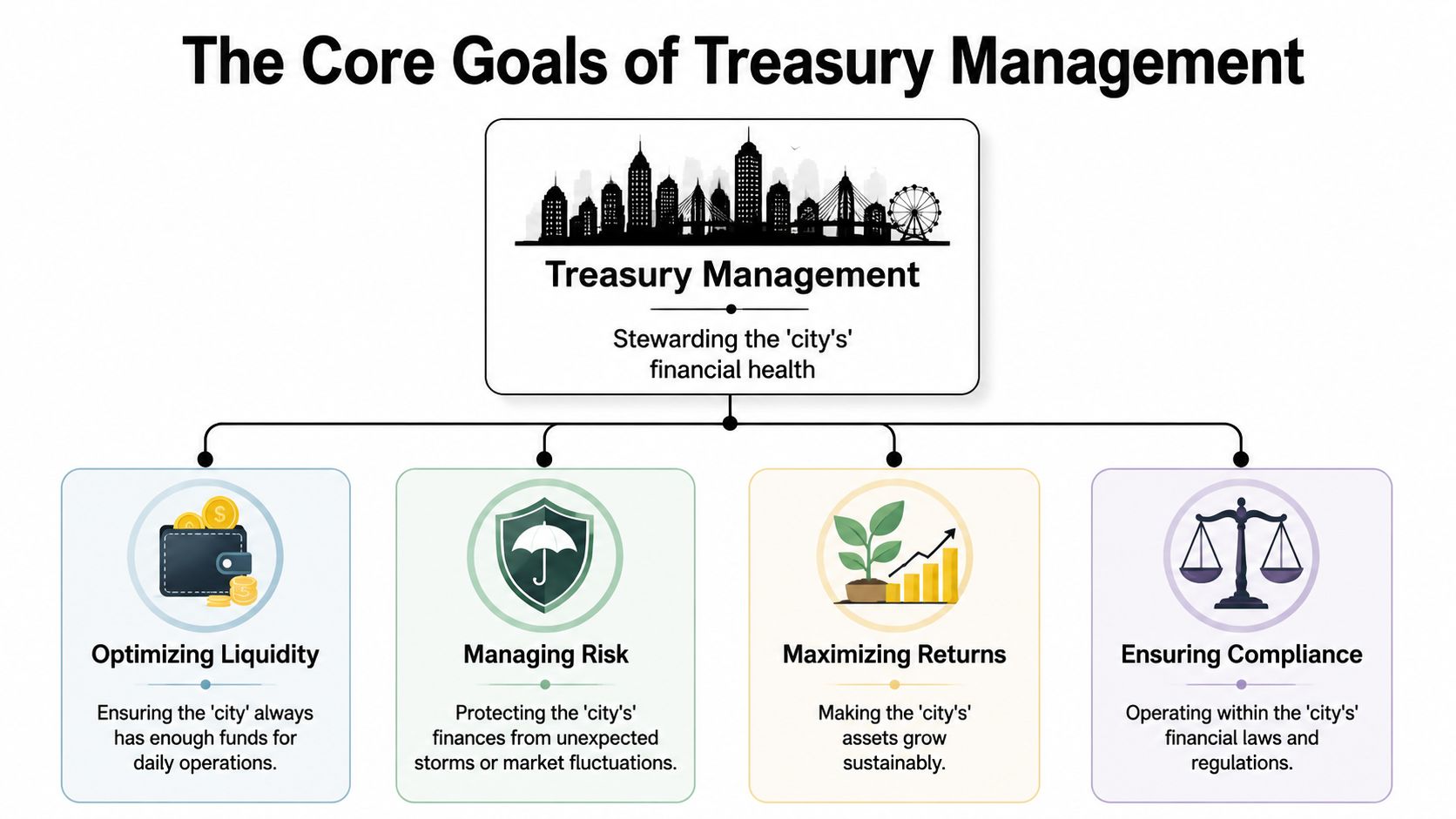
Treasury management exists to keep a business solvent, controlled, and flexible. In traditional finance, that means making sure cash is available when obligations come due, exposures stay within policy, and excess capital is placed deliberately. The same goals apply on-chain. The instruments change. The discipline does not.
Liquidity comes first
A treasury team's first job is to make sure the company can pay what it owes on time. Founders often understand this in theory, then undermine it in practice by treating all cash or stablecoins as equally available. They are not. Funds in an operating account, funds sitting on an exchange, and funds locked in a protocol may all show up in the same balance view, but they do not offer the same access at the moment you need to move them.
That is why liquidity planning starts with timing and access, not yield.
For a startup founder, that usually means three simple checks:
Near-term obligations: Know what must be paid soon and where those funds sit.
Access matching: Keep short-term obligations in venues and assets you can move without delay or operational friction.
Short-range visibility: Review a rolling forecast often enough to catch gaps before they become incidents.
A rolling forecast remains one of the most useful operating tools here. The framework behind Allied Tax cash flow advice comes from traditional cash planning, but it maps cleanly to a stablecoin treasury. Forecast the next stretch of inflows and outflows, then match each bucket to an appropriate liquidity tier.
Risk is broader than price moves
Treasury risk includes market risk, but market risk is only one part of the job. In practice, failures usually come from structure, concentration, and process.
A startup treasury has to answer a harder set of questions. Can funds be accessed quickly, or are they subject to withdrawal limits, governance delays, or banking cutoffs? Is too much cash sitting with one bank, custodian, exchange, or protocol? Who can move funds, and what approvals exist before money leaves the treasury? Can the finance team reconcile positions cleanly at month end, or does every transfer require manual explanation?
Those questions matter in both TradFi and Web3. The difference is where the failure shows up. In traditional treasury, the weak point might be trapped cash, a broken payment workflow, or too much reliance on one banking partner. In DeFi, it might be smart contract exposure, a bridge dependency, wallet key risk, or stablecoin issuer concentration. Different rails. Same treasury logic.
Practical rule: If a treasury position cannot be explained in one minute to your controller and one sentence to your board, it is probably too complex for operating cash.
Surplus cash should earn, but only within clear limits
Once operating liquidity and reserve capital are covered, treasury should decide how to use surplus funds. Leaving everything idle has a cost. Reaching for the highest headline yield has a different cost, and founders usually discover it at the worst moment, when cash is needed quickly and the money is harder to retrieve than expected.
Good treasury policy sets the order of decisions. Start with how much capital must remain liquid. Then define acceptable exposure, counterparties, custody arrangements, reporting requirements, and exit conditions. After that, compare return opportunities.
The bridge between corporate treasury and DeFi proves useful. A traditional team might place surplus cash in instruments with known liquidity, clear controls, and board-approved limits. A Web3 team should apply the same filter to on-chain opportunities. Yield only counts if the business can still meet payroll, taxes, vendor payments, and redemptions without stress.
Returns matter. They come after liquidity, risk control, and clear policy.
Key Functions in a Traditional Treasury
The classic treasury playbook has lasted because it solves recurring business problems. Whether the company sells software, industrial equipment, or consumer products, treasury sits between operations and capital.

A useful baseline comes from bank and corporate finance practice. Treasury is broader than cash management. It includes long-term financial planning, investment strategy, capital structure optimization, and extensive risk management, as explained in this FloQast guide to treasury management in banks.
Daily cash control
This is commonly the first work observed. Treasury tracks cash in and cash out, monitors balances, and makes sure obligations can be met without last-minute scrambling.
For a company with multiple accounts, entities, or business lines, this means consolidating visibility. A founder often thinks the company has “enough cash” when what they really have is cash trapped in the wrong place or committed to the wrong purpose.
Traditional teams care a lot about cash positioning because timing mistakes are expensive. A missed payroll is an operations crisis. An overdraft is avoidable damage. Idle balances are a waste if they pile up for no reason.
Risk management and hedging
Traditional treasury also manages exposures that operating teams create but may not notice.
A few examples:
Function | What treasury watches | Why it matters |
|---|---|---|
Foreign exchange | Currency mismatches between revenue and costs | Margin can move even if the business performs well |
Interest rate exposure | Borrowing costs and yield on cash | Financing gets more expensive quickly |
Counterparty exposure | Bank and partner concentration | One weak institution can disrupt liquidity |
Process controls | Payment approvals and segregation of duties | Internal mistakes can become losses |
Treasury begins to resemble infrastructure more than bookkeeping. Controls matter because companies don't fail only from bad strategy. They also fail from poor process around money.
Investment of excess funds
Traditional treasury rarely leaves all surplus cash idle. It places excess funds into low-risk, liquid instruments so money remains available while generating some return.
The operating trade-off is always the same. The more yield you seek, the more restrictions, complexity, or risk you often accept. Good treasury teams don't just ask, “What does this earn?” They ask, “Can we get it back when we need it, and under what conditions?”
A treasury portfolio should reflect the company's obligations, not the team's optimism.
Capital structure and funding access
Treasury also deals with the bigger balance sheet questions. How much debt is appropriate? When should a business raise equity versus borrow? How should financing be staged so the company preserves flexibility?
Founders often underappreciate this part because it feels strategic rather than operational. In practice, it shapes everything else. A treasury team that has reliable access to funding, clear debt terms, and well-managed reserves can operate calmly. One that doesn't gets forced into bad decisions under pressure.
Treasury Management in Web3 and DeFi
The principles of treasury haven't changed. The operating environment has.
In Web3, “cash” often means stablecoins held on-chain. The account structure might be a multi-sig instead of a bank portal. Yield comes from protocols, vaults, and lending markets rather than money market funds. Counterparty exposure shifts from banks and custodians to smart contracts, bridges, governance systems, and stablecoin issuers.
That gap matters because the market has already moved. In the last 12 months, over $40 billion in stablecoin liquidity shifted to DeFi yield protocols, while 92% of treasury management resources still reference only traditional banking systems, and DeFi now represents 35% of treasury counterparty exposure in Web3 firms, according to Nomentia's treasury management analysis.
The translation from TradFi to on-chain treasury
Here's the simplest way to map old concepts to new ones.
Concept | Traditional Treasury (TradFi) | Web3 & DeFi Treasury |
|---|---|---|
Cash storage | Bank accounts | Stablecoins in wallets or multi-sigs |
Liquidity reserve | Operating cash in checking or sweep accounts | Stablecoins kept immediately accessible on-chain |
Counterparty risk | Bank solvency, money market exposure | Protocol risk, smart contract risk, stablecoin issuer risk |
Yield vehicle | Money market funds, short-term instruments | Lending markets, vaults, automated strategies |
Controls | Bank permissions, approval workflows | Multi-sig policies, signer design, on-chain permissions |
Reconciliation | ERP and bank statement matching | Wallet, protocol, and accounting reconciliation |
Funding | Credit lines, loans, equity raises | Token sales, venture capital, protocol revenue, on-chain borrowing |
The point isn't that Web3 replaces traditional treasury. It's that the same job now requires a new risk vocabulary.
What changes in practice
Three differences hit founders fast.
First, settlement is faster but less forgiving. On-chain transfers don't wait for banking hours, and mistakes are harder to reverse. Treasury has to be operationally tighter.
Second, yield is more accessible but more fragmented. A team can deploy stablecoins across many venues without asking a bank for access. That's powerful, but it also means someone has to monitor protocol health, liquidity conditions, and concentration.
Third, reporting gets harder before it gets easier. Traditional finance systems were built around bank accounts and custodians. Web3 teams often bolt on spreadsheets, explorer links, and manual exports until they can't.
The legal and contractual layer still matters
Founders sometimes swing too far toward the “code is law” mindset. It's a mistake.
Even in crypto-native operations, treasury still intersects with legal agreements, vendor commitments, and borrowing terms. If your organization uses debt, revenue advances, or structured financing, understanding basic contract mechanics matters. A practical primer like this guide to loan contracts for businesses helps because treasury problems often start when teams accept obligations without mapping how repayment and liquidity will work together.
In Web3, the wallet is visible. The real risk often isn't. It sits in the protocol logic, governance process, or redemption path behind the asset.
For startup founders, the operating lesson is clear. Don't treat on-chain treasury as an investing side project. Treat it as finance operations with new rails.
Modern Tools for Automated Treasury Management
At some point, manual treasury breaks.
The old version of this was spreadsheets, email approvals, and bank portals. The new version is spreadsheet tabs mixed with wallet dashboards, explorers, and a half-dozen protocol interfaces. Neither scales well once money moves across systems.
A modern Treasury Management System gives finance teams centralized visibility, forecasting, and execution support. According to ION's treasury management guide, deploying a TMS with real-time API integration can reduce the cash conversion cycle by 15-20% and minimize unnecessary borrowing by 30% through AI-driven forecast updates.

What a Web3 treasury stack needs
On-chain teams need the same outcomes as traditional treasury teams, but the stack looks different.
Security layer: Multi-sig wallets such as Safe establish approval controls and reduce single-key risk.
Visibility layer: Portfolio dashboards and analytics tools help teams see wallet balances, deployed positions, and changes across protocols.
Execution layer: Yield and allocation tools reduce manual switching between venues.
Monitoring layer: Alerts, policy checks, and review workflows help teams react before small issues become treasury problems.
The important shift is from fragmented access to coordinated oversight. If one person understands the wallet setup, another person tracks protocol positions manually, and no one owns policy, the stack isn't solving treasury. It's hiding it.
One practical resource for this transition is Yield Seeker's overview of institutional-grade DeFi tools, which gives a useful lens on how teams can combine monitoring, allocation, and operational controls rather than treating yield as a standalone task.
Automation is useful when policy comes first
Automation doesn't replace treasury judgment. It enforces it.
A good setup asks for rules before execution. What assets are approved? What venues are acceptable for operating reserves versus surplus capital? Who signs? How often are positions reviewed? What triggers a move back to cash?
Once those rules exist, automation starts saving real time.
This walkthrough gives a visual sense of how treasury tooling can support that process:
Without that policy layer, automation can create a different failure mode. The team moves faster, but nobody can explain why capital is where it is.
A Practical Guide to Setting Up Your Treasury
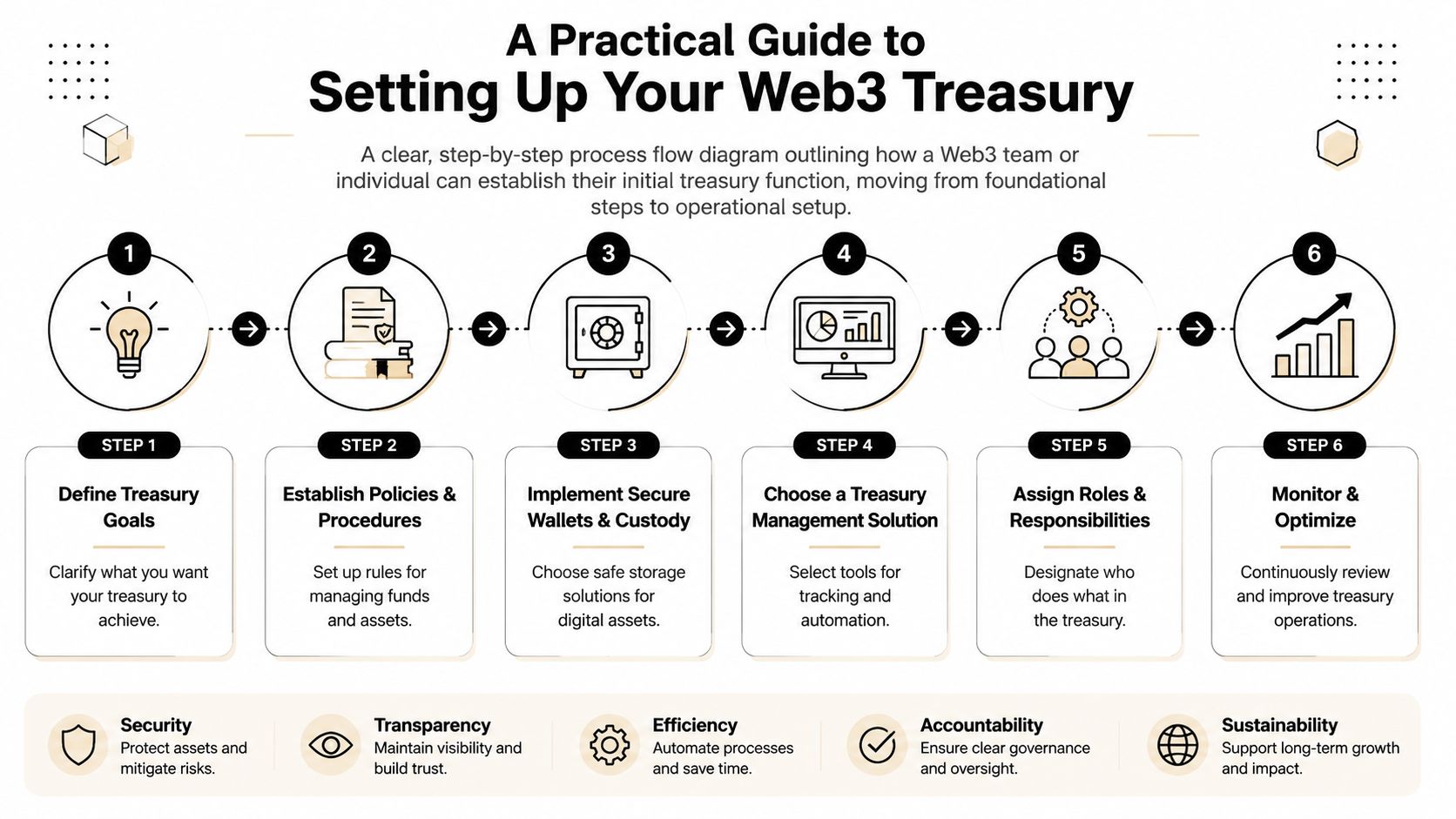
Most early-stage teams don't need a complex treasury committee. They need a working operating system.
Start with purpose, not product
Before choosing wallets, dashboards, or strategies, write down what the treasury exists to do.
A simple founder-level treasury brief should answer:
What must always remain liquid for operations and emergency use.
What amount can be deployed for yield without stressing the business.
What kinds of risk are off-limits, even if the return is attractive.
If a team skips this, every later decision becomes reactive. Someone shares a protocol. Someone else worries about safety. Nobody knows what “acceptable” means because it was never defined.
Put lightweight governance in place
Small teams can keep this lean. What matters is clarity.
Signer rules: Decide who can approve transfers and how many approvals are required.
Role ownership: One person should own reporting, another should review, and leadership should approve policy.
Movement categories: Separate operating transfers from strategy deployments so not every transaction gets treated the same way.
Review rhythm: Pick a schedule for checking balances, positions, and upcoming obligations.
A lot of treasury failures aren't investment failures. They're governance failures. Funds sit in the wrong wallet. One signer is unavailable. A protocol withdrawal is needed, but no one knows who is authorized to make the call.
Build a simple allocation policy
You don't need a dense investment policy statement to get started. You need a few plain-English rules.
For example:
Core reserve: Keep enough stablecoins immediately accessible for near-term obligations.
Managed surplus: Deploy only the portion that doesn't need instant access.
Venue discipline: Use a short approved list of protocols, tools, and custody setups.
Exit rules: Define what would make you reduce exposure or move fully defensive.
For teams that want cleaner monitoring once positions are live, a portfolio visibility layer matters as much as the initial deployment. Yield Seeker's article on portfolio tracking for DeFi users is a useful reference for how to consolidate that view instead of relying on scattered tabs and manual checks.
Good treasury policy should feel boring to write and calming to follow.
Keep implementation smaller than your ambition
This is the part founders usually resist. They want a full strategy on day one. Treasury works better when you phase it.
Start with one secure custody setup. One reserve policy. One reporting routine. A short approved venue list. Then expand only when the team can monitor what it already has.
The objective isn't to build the most complex treasury. It's to build one your team can run.
Best Practices for Sustainable Treasury Growth
Sustainable treasury management comes down to a handful of habits.
Use more than one venue when appropriate, but don't fragment capital so widely that oversight gets weak. Keep a clear separation between operating liquidity and deployable surplus. Review exposures regularly, especially when positions depend on smart contracts, token wrappers, or off-chain redemption assumptions. Document decisions so finance, ops, and leadership can all explain the same treasury posture.
For Web3 teams, automation becomes more valuable as complexity increases. Not because it removes judgment, but because it keeps monitoring and execution consistent when humans get busy. That's especially true once funds sit across chains, protocols, and wallets.
If you're managing on-chain assets, risk work can't be occasional. It has to be part of the operating loop. This breakdown of DeFi risk management is worth reading if you want a clearer framework for reviewing protocol, asset, and process exposure over time.
The core lesson is simple. The tools have changed. The treasury job hasn't. Protect liquidity, control risk, and make surplus capital useful without giving up operational flexibility.
If you're holding stablecoins and want a more structured way to manage treasury on-chain, Yield Seeker offers an AI-powered workflow for monitoring and allocating stablecoin capital across DeFi protocols while keeping funds accessible. It's a practical option for founders, operators, and individual holders who want less manual searching and a clearer process for putting idle balances to work.