

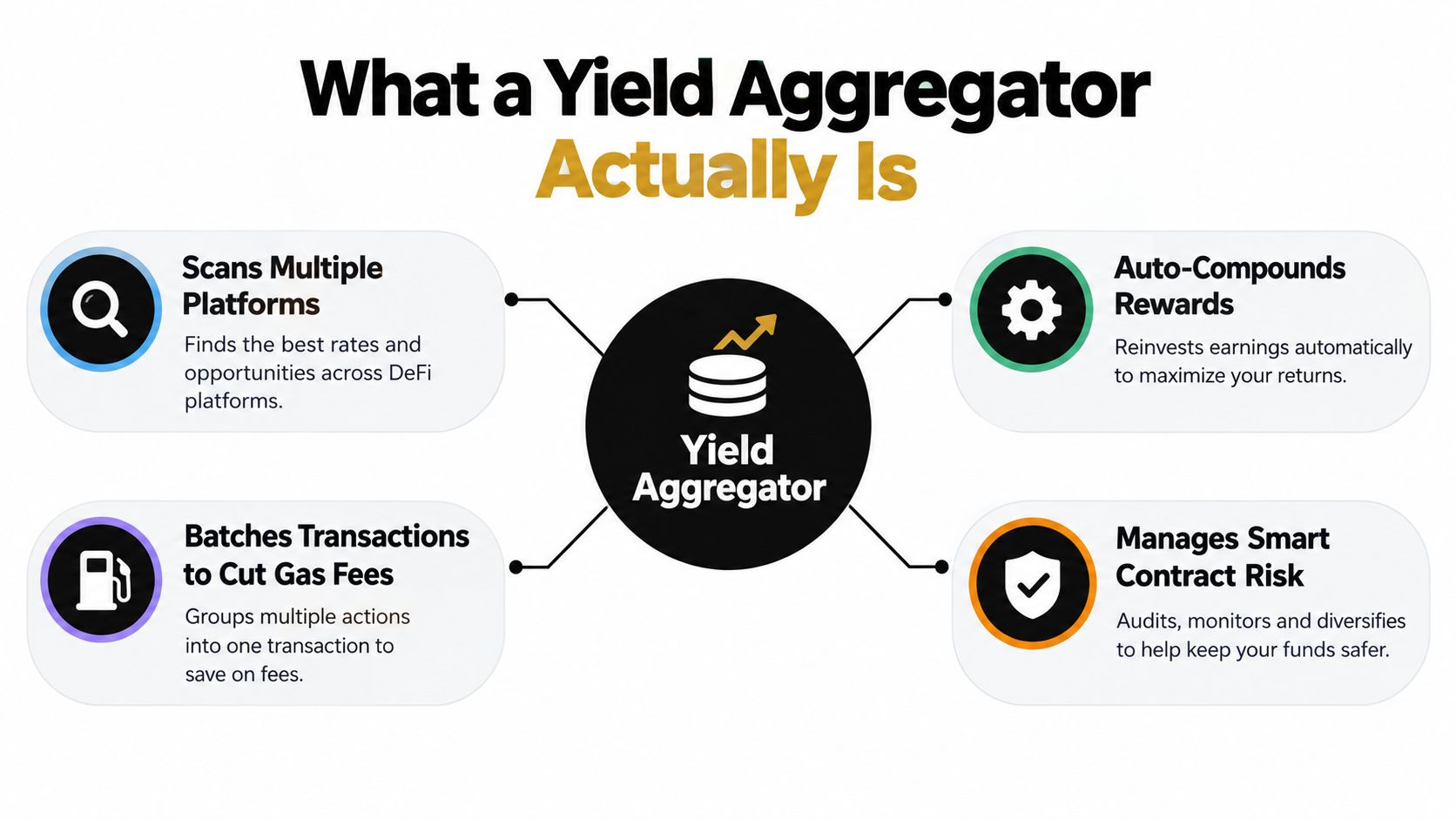
A yield aggregator is a smart contract system that automatically moves deposited capital across lending markets, liquidity pools, and other DeFi protocols to pursue the best available returns. The modern model was defined in 2020 with Yearn Finance, and it solved a problem most users still know too well, manually chasing rates while gas fees and timing eat the upside.
You've probably seen the same pattern, a dashboard flashes a tempting APY, then the substantive work begins, checking other venues, comparing risks, and deciding whether the extra yield is worth the friction. In DeFi, that friction isn't just annoying, it's often the difference between a clean return and a net loss.
What a Yield Aggregator Is
The problem it solves
If you've ever bounced between Aave, Curve, and a staking dashboard just to see whether a small rate difference is worth another approval transaction, you already know why this category exists. Manual DeFi yield hunting punishes small balances, and it punishes anyone who does not want to spend the day rebalancing.
A yield aggregator sits above those venues and handles the routing for you. You deposit once, then the protocol manages strategy execution, rebalancing, and compounding across the underlying opportunities it supports. That is the core idea behind the category that took shape with Yearn Finance in 2020, when automated vaults gave users a single interface for deposits, withdrawals, and strategy execution across lending and liquidity protocols such as Aave, Compound, Curve, and Uniswap. Yearn's launch and vault model
What you're buying
A good aggregator is not just a prettier front end. It is a layer of smart contracts that behaves like an automated treasury manager, deciding where capital should sit, when rewards should be harvested, and when capital should shift to a different venue.
Practical rule: if a product only shows a rate and doesn't clearly explain how it earns that rate, it's probably hiding the trade-offs you'll actually bear.
That distinction matters because a true aggregator absorbs complexity while a simple staking portal usually just forwards your deposit into one place. The first is built to search across strategies, the second is mostly a wrapper around a single venue. That is why users often describe aggregators as the crypto version of a managed portfolio, except the underlying exposure can change more quickly and with less warning than in traditional finance.
How Yield Aggregators Work Under the Hood
The vault, the strategy, and the payout layer
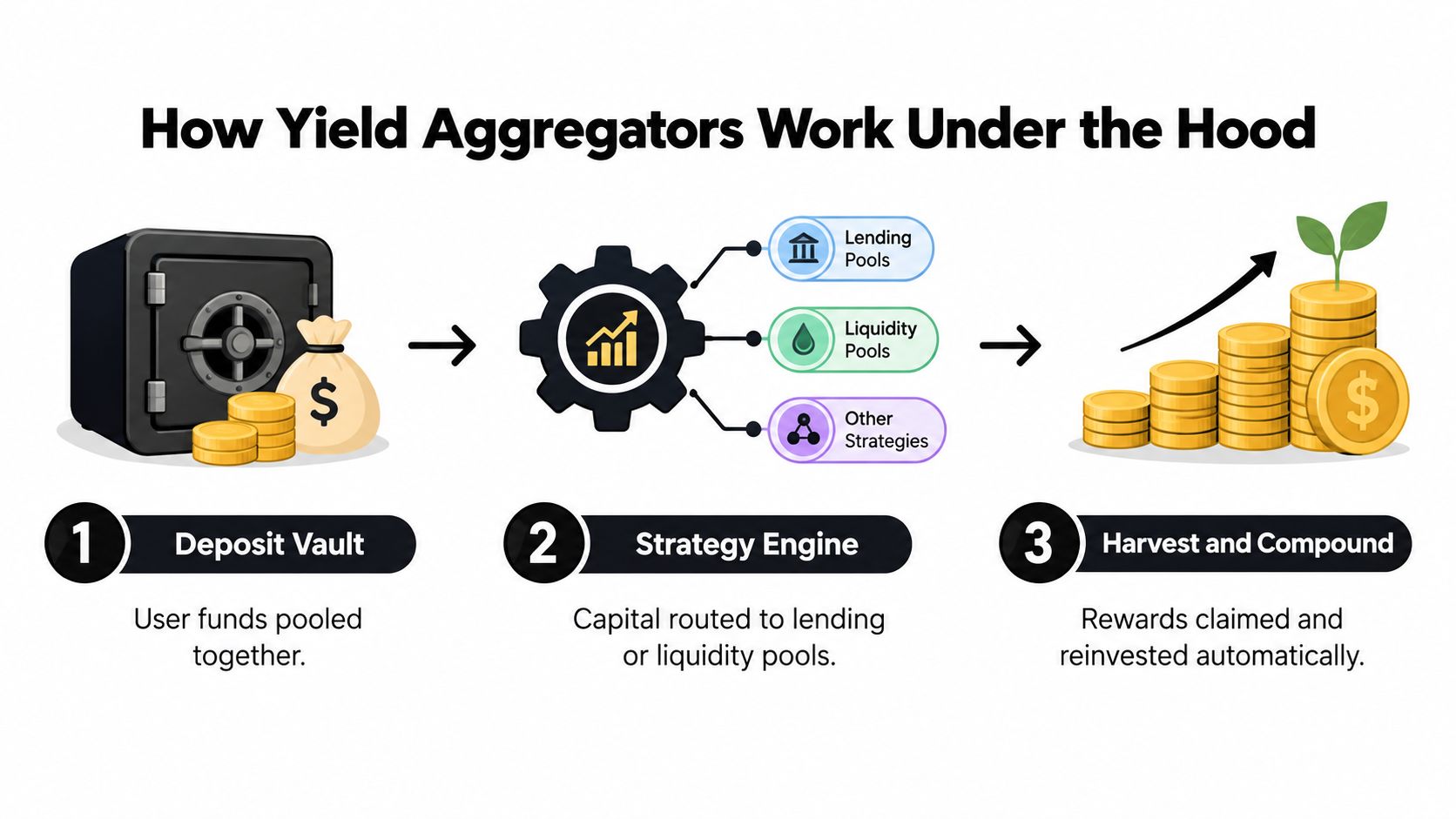
Most users only see the deposit screen, but the important machinery sits underneath it. A vault pools user funds, a strategy layer decides where that capital should go, and a harvesting process claims rewards and reinvests them so returns can compound without you manually clicking through each protocol.
That setup is useful because it turns fragmented DeFi into one action. You deposit once, and the system can distribute funds across lending markets, automated market makers, liquid-staking systems, or other protocols depending on the strategy rules it has been given. In practice, that means the aggregator is constantly balancing yield, gas cost, and risk, not just hunting the highest advertised number.
Why automation changes the risk profile
The same automation that saves time also broadens the blast radius. A yield aggregator is a composable risk stack, not an isolated return engine, so its loss surface includes its own contracts and every dependency below it. The technical failure modes include smart-contract exploits, oracle manipulation, validator slashing conditions, stablecoin or liquid-token depegs, liquidation cascades, and delayed exits. Composable risk in yield aggregation
That's the part beginners usually miss. They assume they're only trusting the aggregator, but they're really trusting the aggregator plus every protocol it routes into, plus the assumptions those protocols depend on.
A useful mental model
Think of the vault as the container, the strategy engine as the allocator, and the reward distributor as the part that keeps compounding from going stale. If any one of those layers is brittle, the headline yield stops being the full story.
Read more about yield optimization protocol design
The Rise of Automated Vaults in DeFi
Yearn's TVL grew 11-fold in 2021, but seven vaults held over 76% of it. That concentration matters because a protocol can look broad on paper while most of the capital sits in a handful of strategies.
Yearn did help show why automated vaults had a place in DeFi. Before them, users had to move capital by hand, chase rewards across protocols, and pay gas every time they wanted to rebalance. That workflow might work for large balances and obsessive users. For everyone else, it was slow, expensive, and easy to get wrong.
Why Yearn mattered
The early value proposition was simple, deposit once, let the vault handle the rest. That solved two structural problems in early DeFi, fragmented opportunities and high transaction costs. Users got one place for deposits, withdrawals, and strategy execution, which was a real improvement over juggling spreadsheets and too many browser tabs. Yearn's automated vault model
The growth came fast. Messari reported that Yearn's total value locked increased 11-fold from the beginning of 2021, with more than $4 billion added between March and May 2021. About 68% of that increase came from the newer V2 Vaults. Yearn TVL and V2 Vault growth
Why big TVL can still hide concentration
The headline growth looked broad, but the capital base was tight. Seven vaults each held more than $100 million and together made up over 76% of V2 Vault TVL. About $2.0 billion of that combined TVL came from only 30 addresses that each deposited more than $10 million. Yearn TVL and V2 Vault growth
That is the part many newcomers miss. Aggregate TVL can make a protocol look deep and widely used while actual exposure sits with a few strategies and a small set of large depositors.
A big number on a homepage does not tell you whether the protocol has real depth or just a few whales leaning on it.
The lesson still holds. If you judge a vault by TVL alone, you are looking at the wrong metric.
Why Headline APY Is a Dangerous Metric
A vault advertising 42% APY from token emissions can show a negative net return within a quarter once emissions decay and slippage are counted. That is the problem with headline APY; it reads like a promise, but the actual outcome depends on how the strategy behaves under stress.
What the rate is hiding
Impermanent loss is the classic trap. When pooled assets move away from each other, the provider can end up with less value than if they had held the assets outside the pool, and fee income or farming rewards may not make up the difference. The same source also treats liquidation, depeg risk, and slippage as core DeFi risks. Impermanent loss and core DeFi risks
Two vaults can show similar APY and still behave very differently. One may sit on organic borrowing demand, while the other depends on emissions that fade fast and leave late depositors carrying the downside.
What to measure instead
For stablecoin strategies, the right question is not “what's the APY?” It is “what do I keep after fees, slippage, emissions decay, withdrawal costs, and any loss versus holding the deposited stablecoin are counted?” That is the difference between a quoted rate and a usable return. Why APY and yield are not the same thing
A higher rate can still be the worse trade if it comes from fragile incentives or assets that drift from the peg. A yield aggregator can still help users compare options, but it should steer them toward durable net yield, not a temporary number that looks good on a dashboard and fails in practice.
How to Evaluate a Yield Aggregator Safely
Start with the contracts, not the marketing
Safety starts with the code path, not the homepage. Since a yield aggregator is a composable risk stack, you need to look at the audit history of the aggregator and the protocols it touches, then check that the deployed contract versions still match the reviewed code.
You also want to know who can change the rules. Admin keys, upgrade permissions, and withdrawal controls matter because a neat interface can still hide messy governance. If a team can alter strategy behavior without strong safeguards, your exposure is bigger than the dashboard suggests.
Test the liquidity under stress
The key question isn't whether you can withdraw in a calm market. It's whether you can withdraw the full amount, in the asset you deposited, when everyone else is trying to exit too. In Q1 2025, reported DeFi losses exceeded $2.05 billion across 37 incidents, and yield aggregators alone lost about $863,000 in three attacks, often tied to malfunctioning third-party integrations. Q1 2025 DeFi loss report
That doesn't mean every aggregator is unsafe. It does mean that “no lockup” is not the same thing as guaranteed liquidity under stress.
A practical checklist
Review audits carefully: Confirm the contracts were reviewed by reputable firms and that the live deployment matches the audited version.
Trace the yield source: Separate organic yield, like borrower interest or real fees, from incentive emissions that can fade quickly.
Check withdrawal behavior: Look for queues, delays, emergency pauses, and any dependency on bridge or oracle health.
Size the first deposit small: A small test deposit tells you more than a polished interface ever will.
Ask who absorbs losses first: In stressed systems, structure matters more than branding.
Get outside help when needed: If the governance or compliance side looks opaque, assessing outside regulatory help can clarify what controls are needed before committing treasury funds.
If you want a simple heuristic, use this one, if the answer to “how does this hold up during a rush?” is vague, the yield is probably being sold too aggressively.
Yield Seeker and the Future of AI-Powered Aggregation
The next wave of yield aggregation is about reducing decision fatigue without pretending risk disappears. That's where AI-powered systems fit, they can watch rates, route capital across approved venues, and keep users from doing repetitive manual work that leads to bad timing.
What a modern allocator changes
Yield Seeker is one example of that direction. It uses a personalized AI Agent to monitor and allocate capital across DeFi protocols in real time, and it lets users deposit as little as $10 USDC on Base while keeping withdrawals accessible without lockups or withdrawal fees. For users who want fewer dashboards and more clarity, that kind of setup is a practical answer to the fragmentation problem that created aggregators in the first place. Yield Seeker AI yield aggregator
The useful shift here isn't hype, it's reduction of operational burden. A built-in terminal and visual walkthroughs can help users understand what's happening without forcing them to become protocol archaeologists.
Why automation still needs judgment
A smarter allocator is only useful if it stays transparent about what it's doing. That's true in DeFi and outside it, whether you're routing stablecoin yield or directing an autonomous SEO system that has to decide what to prioritize without human micromanagement.
The point is not to remove the user from the loop. The point is to keep the user informed while the system handles the mechanical parts of strategy execution.
Key Takeaways for Safe Yield Farming
A yield aggregator is useful because it saves time, reduces friction, and opens access to strategies most users would never run manually. It's dangerous when people confuse automation with safety or treat headline APY as a complete answer.
The strongest habit is to compare risk-adjusted net yield, not just rate. Look at where the return comes from, how durable that source is, and what happens when liquidity tightens or incentives fade.
Concentration also matters. Yearn's early history showed that big TVL can sit inside a few vaults and a small set of large depositors, which is exactly why users should study strategy concentration as closely as the rate itself. If a platform can't explain its dependencies clearly, assume the risk is higher than advertised.
Automation should help you earn consistently, not trap you in a bad position when markets turn. Choose tools that make the yield source transparent, the withdrawal path clear, and the exposure easy to understand.
If you want a cleaner way to earn stablecoin yield without juggling dashboards, Yield Seeker gives you an AI-driven allocator, real-time strategy monitoring, and withdrawals without lockups or withdrawal fees. It's built for people who want the automation benefits of a yield aggregator without giving up control over their capital.