
For professionals, getting into stablecoin yield optimization isn't just about chasing the highest advertised APY. It's about turning idle capital into a steady, passive income stream without it becoming a full-time job. This is where advanced tools, often powered by AI, come in to automate the heavy lifting—from risk management to capitalizing on flash opportunities across DeFi.
It's about getting smart, sustainable, risk-adjusted returns.
The Professional's Playbook for Modern Yield Optimization
Let's jump straight into the deep end. This guide is for the busy professional who hears about the crazy yields in DeFi but doesn't have the time to sit glued to dashboards all day. We're skipping the "What is DeFi?" lecture and focusing on how things look in 2026, where smart automation has completely replaced the old-school, manual 'apeing' into farms.
This is about making your capital work for you, intelligently and efficiently.
We'll look at how AI-driven platforms, like an example tool we'll call 'Yield Seeker,' act as a force multiplier. They handle the complex tasks, manage risk, and pounce on opportunities you'd almost certainly miss otherwise.
Think of this as your playbook for turning idle stablecoins into a consistent, passive income stream. The goal is no longer just chasing the highest APY, but achieving solid, risk-adjusted returns with minimal effort.
The whole process is designed to be hands-off. You deposit your funds, and the platform takes it from there.
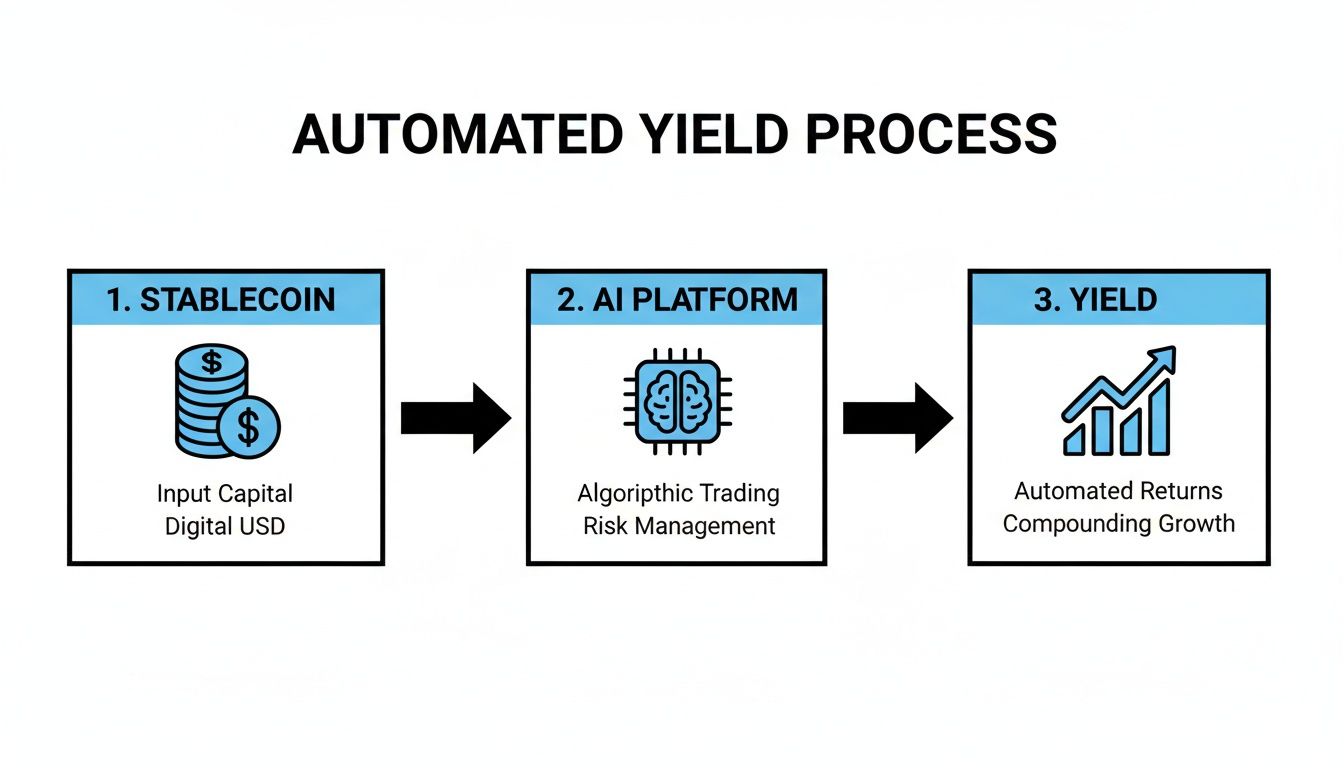
This loop is powerful in its simplicity: deposit capital, let the AI platform allocate and optimize, and collect the returns. It's a model built for maximum efficiency.
Understanding the Market Opportunity
The scale of this space is hard to overstate. By 2026, the stablecoin market has ballooned to a massive $311 billion in total capitalization. It’s the undisputed backbone of DeFi liquidity and yield.
This isn't just hot air; we’ve seen a 68% year-over-year growth in liquid staking adoption alone, mostly driven by professionals who want to stack yields without locking up their capital. Take a platform like Curve Finance, which offers USDC yields anywhere from 5-20% APY and has over $2.73 billion in total value locked (TVL). It's become a go-to spot for lower-risk farming. You can explore additional metrics on the growing stablecoin market to get the full picture.
From Manual Effort to Smart Automation
The old way of yield farming was a grind. You were constantly checking dashboards, manually moving funds between protocols, and probably losing sleep over sudden market shifts. The professional approach today is all about automation.
To give you a clearer picture, here’s how the two methods stack up.
Manual Farming vs AI-Powered Yield Optimization
Attribute | Manual Yield Farming | AI-Powered Optimization (e.g., Yield Seeker) |
|---|---|---|
Time Commitment | High; requires constant monitoring (hours per day) | Low; set it up and let it run (minutes per week) |
Strategy | Reactive; chasing the highest APY, often with high risk | Proactive; diversifies across vetted protocols based on risk parameters |
Compounding | Manual; you have to claim and reinvest earnings yourself | Automated; earnings are auto-compounded for maximum growth |
Risk Management | Relies on personal research and gut feeling | Data-driven; uses real-time monitoring and pre-set rules to protect capital |
Opportunity Discovery | Limited to what you can find and analyze on your own | 24/7 scanning of the market for new, vetted yield opportunities |
Expertise Required | Deep DeFi knowledge needed to navigate protocols and risks | Beginner-friendly; the platform handles the complexity |
This shift from manual to automated isn't just about saving time; it's about getting better, more consistent results. The AI just does a better job at the repetitive, data-heavy tasks.
Think about a professional managing a company treasury. Instead of assigning someone to manually hunt for yield, they can simply deposit funds and let an AI agent consistently chase baseline yields of 3-10% across multiple vetted protocols. That’s a task that would be next to impossible to manage by hand.
This new approach means busy investors are no longer digging for bits of information. Instead, they’re tapping into a deep pool of programmable money for risk-aware, hands-off returns that compound on their own.
Matching Stablecoin Strategies to Your Risk Profile
Chasing the highest APY is a rookie move. Real professional yield optimization is all about a disciplined, practical framework that matches your capital to your actual risk tolerance. Every dollar you put to work should be a calculated decision, not a gamble on a flashy number.
Let's make this concrete and walk through two very different professional scenarios.

First up, imagine you're a corporate treasury manager. Your absolute number one priority is capital preservation. Losing a single dollar of principal is simply not on the table. For this kind of profile, the strategy is all about low-risk, battle-tested protocols.
Strategy: Supplying stablecoins like USDC or DAI to blue-chip lending markets.
Protocols: Think platforms like Aave or Morpho. These guys have billions in total value locked (TVL), a library of smart contract audits, and have proven their security over time.
Expected Return: The yields are going to be conservative, typically in the 3-7% APY range. But they are reliable and come with a risk profile that lets you sleep at night. You’re choosing predictable income over a moonshot.
Now, let's contrast that with a solo professional—maybe a consultant or entrepreneur—who's managing their own funds. They have a bigger appetite for calculated risk because their goal is capital growth, and they can stomach some volatility to get there.
Strategy: Providing liquidity to a stablecoin/blue-chip asset pair, like a USDC/ETH pool.
Protocols: This means getting your hands dirty with an Automated Market Maker (AMM) like Uniswap V3 or a concentrated liquidity manager built on top of it.
Expected Return: Here, the potential yields are way more attractive, often hitting 10-25% APY or even higher. This is driven by trading fees and liquidity incentives, but it brings extra complexities like impermanent loss into the picture.
A Professional's Approach to Vetting Risk
Getting a feel for these scenarios is step one. The real work is building a repeatable process to vet any new opportunity that comes across your desk. A pro doesn't just "ape in"; they do their homework.
The core of professional yield farming is a deep respect for risk. It’s about understanding the potential downsides—smart contract flaws, de-pegging events, and impermanent loss—without needing a PhD in math. The goal is to make informed decisions, not to pretend you can eliminate risk entirely, because you can't.
This due diligence can be boiled down to a straightforward checklist. Before you deploy a cent into a new protocol, run through these questions:
Has the smart contract been audited? Look for audits from reputable security firms like Trail of Bits, OpenZeppelin, or CertiK. Multiple audits are always better than one.
What's the protocol's history? How long has it been running without a major hack or exploit? A project that has survived a few market cycles is generally a better bet.
Who is behind the project? Are the founders public, and do they have a solid track record? An anonymous team is a huge red flag in my book.
What is the Total Value Locked (TVL)? A high TVL (say, over $100 million) shows a degree of market trust and means there's deeper liquidity, which adds a layer of stability.
Demystifying Core Stablecoin Risks
Beyond checking out individual protocols, you need to be comfortable with the inherent risks of stablecoin strategies. Two of the big ones you'll hear about are de-pegging and impermanent loss.
A de-pegging event is exactly what it sounds like: a stablecoin loses its 1:1 peg to its underlying asset (like the US dollar). For fully collateralized stables like USDC, this risk is low, but never zero. Algorithmic stablecoins, on the other hand, carry a much higher de-peg risk. To really get into the weeds, it's worth exploring the landscape of stablecoin interest rates and what holds them up.
Impermanent Loss (IL) is a unique risk you face when providing liquidity in AMMs. It’s the potential difference in value between holding two assets in a liquidity pool versus just holding them in your wallet. If the price of one asset swings wildly against the other, you can end up with IL. Concentrated liquidity strategies can juice your returns from fees, but they can also magnify this risk.
By methodically sizing up protocols and truly understanding these fundamental risks, you can build a stablecoin strategy that actually fits your financial goals. That disciplined approach is what separates professional yield optimization from just gambling.
Once you’ve got your strategies picked out, the real work begins: execution. But let's be honest, manually managing these moving parts is a full-time gig. This is where modern yield farming really gets interesting for professionals—it’s all about automation.
Automated vaults and AI agents are your secret weapon for generating serious DeFi yield without dedicating your entire life to watching charts. Don't think of them as a scary black box; they're more like a hyper-efficient assistant, executing complex strategies that used to be the exclusive domain of full-time traders.
How Effortless Yield Actually Works
When you deposit your USDC into an automated platform, you’re not just throwing it into the void. You’re telling an AI agent to execute a very specific, pre-vetted strategy on your behalf. This is the heart of smart yield generation.
These agents are designed to handle highly specific, repetitive tasks with a precision no human can consistently match.
Auto-Compounding: The agent takes your yield earnings and immediately reinvests them. This puts the power of compounding to work for you, 24/7, without you ever lifting a finger or signing a transaction.
Position Rebalancing: If your strategy uses multiple assets, the agent works around the clock to maintain your target allocation. It sells a little high here, buys a little low there, and keeps your position perfectly balanced.
Protocol Health Monitoring: The AI is constantly scanning the underlying protocols for red flags. Think sudden drops in Total Value Locked (TVL) or weird transaction patterns. It’s an essential layer of risk management running in the background.
By taking over these tasks, these tools can jump on fleeting yield opportunities and react to market shifts way faster than any of us could manually. You can get a deeper look at how these systems operate in our guide on using AI agents for yield.
A Quick Look at the Big Players
The market has clearly spoken: automated solutions are the new standard. By 2026, DeFi vaults have become the go-to for professional yield farming. Just look at Morpho, which is leading the pack with $5.8 billion in TVL. That's a massive 3.5 times the entire classic aggregator space—Yearn and Beefy—which sits at a combined $1.6 billion.
This isn't just retail money. The trend points to growing institutional trust. For example, Apollo Global Management, a giant managing $940 billion in assets, committed to buying up to 9% of Morpho's token supply over four years. This proves that vaults are now the core infrastructure for automating complex strategies, often pulling in net returns between 10-25% APY on the right opportunities. You can find more data on this shift by reading about DeFi yield farming strategies on blog.portals.fi.
It's not just Morpho, either. Platforms like Kamino on Solana now oversee over $2.36 billion, while Pendle's unique yield tokenization has ballooned to $3.5 billion across 11 different chains. For a stablecoin holder, this means you can simply deposit USDC into a vault and let it handle the sophisticated strategies for you.
Putting It Into Practice: A 'Yield Seeker' Agent
Imagine you put your USDC into a "Yield Seeker" vault that runs a delta-neutral strategy on Ethena's sUSDe. The AI agent gets to work instantly:
It acquires the assets needed for the strategy.
It stakes them to start earning, aiming for a 7-12% APY.
It constantly monitors the position to keep it delta-neutral, shielding you from market swings.
It harvests rewards daily and auto-compounds them, pushing your APY even higher.
And the best part? This all happens in the background. You just get to watch your balance grow on a simple, clean dashboard.
This Is Your Competitive Edge
Using automated vaults isn't just about saving a few hours; it's about gaining a massive competitive advantage. DeFi moves at machine speed, and AI agents are what let you keep pace.
For professionals running Web3 treasuries, the appeal is obvious: on-chain enforcement and curated risk. These vaults slash the risk of common headaches like impermanent loss and the liquidation risks that come with those crazy leveraged positions promising 50%+ APY.
For the rest of us who are short on time, it’s all about capital efficiency. Sure, you can park your stablecoins on Aave or Morpho for a safe 3-6%, but an AI agent can take that same capital and effortlessly scale it by constantly hunting for the best real-time opportunities. It turns idle cash into a productive, income-generating asset with almost zero hands-on effort from you.
Your Professional DeFi Operations: Security and Logistics
Treating your DeFi activity like a professional operation isn't just a good idea; it's non-negotiable. Sloppy operations are a surefire way to make costly mistakes or, worse, open the door to security breaches. Even the most brilliant yield strategy can be completely undermined by poor operational security.
Let's walk through the practical logistics and security measures you need to nail down to run your yield optimization like a pro.
It all starts with getting your capital on-chain securely. This is your foundation. A common and reliable path is to buy a regulated stablecoin like USDC on a major, compliant exchange. From there, you can bridge those funds over to a cost-effective Layer 2 (L2) network like Base, where transaction fees won't chip away at your principal.
Getting this on-ramping process right from the very beginning sets a professional tone and ensures your capital starts its journey in a secure, transparent, and auditable way.
Mastering Custody and Access
Once your funds are on-chain, the next critical question is how you store and access them. A one-size-fits-all approach to custody is a rookie mistake. What you really need is a segmented approach that matches the right wallet to the right job.
Hardware Wallets (e.g., Ledger): Think of this as your cold storage vault. Your core capital—the funds you don't plan on touching frequently—should live here. It stays offline, giving you the highest level of security against any online threats.
Smart Contract Wallets: These are your "hot wallets" for your active positions. They come with features like social recovery, daily transaction limits, and address whitelisting, which are absolute lifesavers for managing funds deployed across different protocols.
It’s just like a traditional business: you have a main bank vault for the bulk of your cash (your hardware wallet) and a smaller, more accessible cash register for daily operations (your smart contract wallet). Separating your funds this way dramatically lowers your risk. If your active wallet is ever compromised, your core capital remains safe and sound.
If you want to go deeper on vetting the platforms these wallets interact with, our guide on due diligence for automated vaults is an essential read.
Building Your Contingency Plan
Markets are unpredictable. Protocols get exploited. A true professional is always prepared for the worst-case scenario. As you start using external platforms like automated vaults and AI agents, effective third-party risk management becomes a crucial piece of your operational security. A massive part of this is simply having a clear, actionable plan for when things go wrong.
Your goal during a crisis isn't to think; it's to execute a pre-defined protocol. Panic leads to poor decisions. A checklist ensures you act swiftly and correctly, even under extreme pressure.
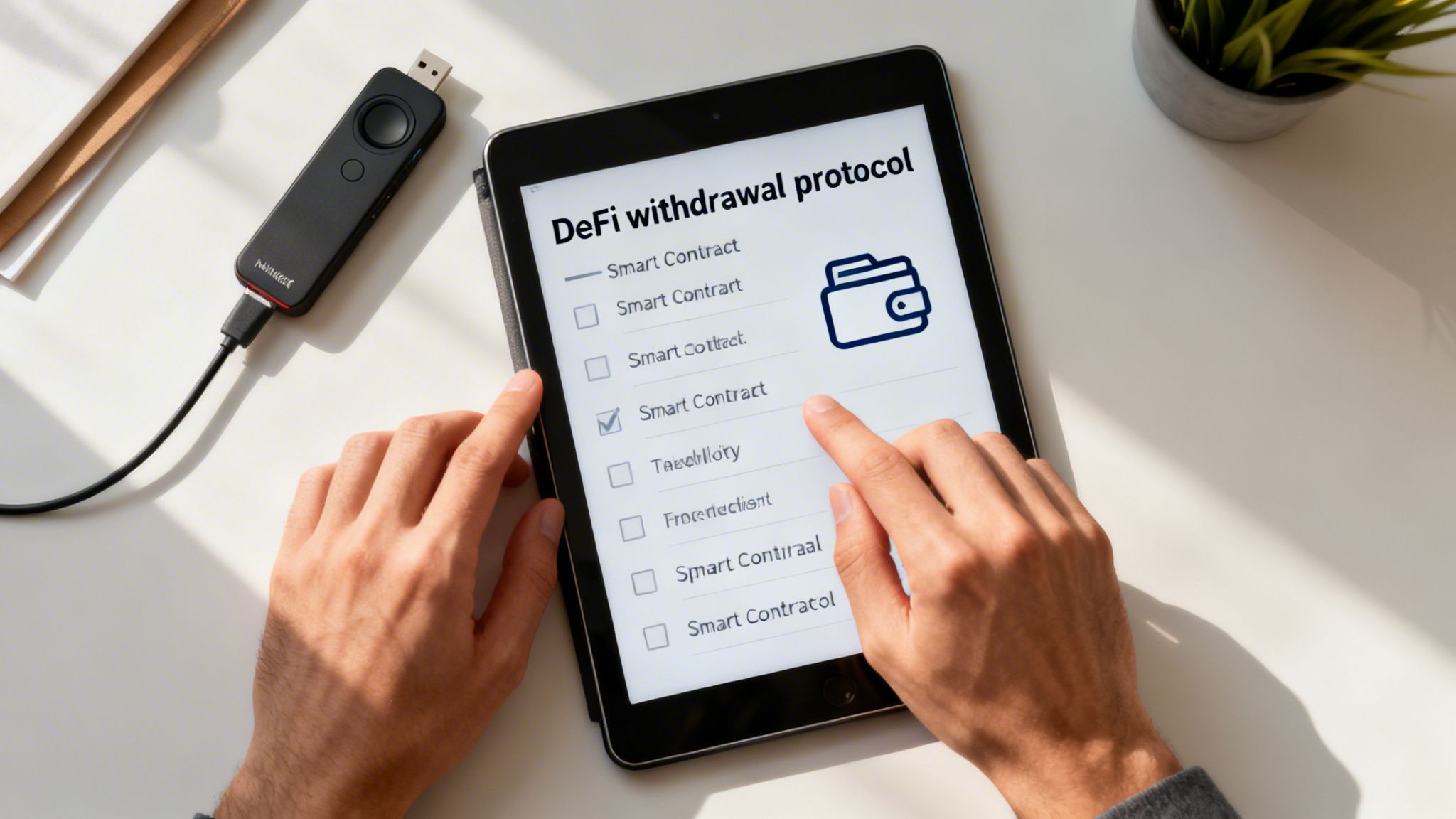
Your "DeFi Withdrawal Protocol" should be a simple checklist you can blast through in minutes. It doesn’t have to be complicated, but it absolutely must be written down and easily accessible.

Emergency Withdrawal Checklist
Revoke Approvals: Your first move, always. Immediately use a tool like Revoke.cash to cut off all smart contract connections to the wallet in question. This is your most critical defensive action.
Assess and Prioritize: Quickly figure out which of your positions are at immediate risk versus those that are relatively safe for now.
Withdraw Highest-Risk Assets: Start pulling funds, beginning with the most vulnerable or volatile assets first. Transfer them directly to your secure hardware wallet.
Consolidate to a Safe Haven: As you withdraw, move all funds into a trusted stablecoin (like USDC) inside your cold storage.
Notify and Document: If you're managing funds for others, communicate what's happening clearly. Make sure to document every single action you take for a later review.
Finally, get your alerts in order. Use a portfolio tracker or an on-chain monitoring service to send you notifications for large transactions, new contract approvals, or any significant dips in a protocol's key health metrics. This simple step transforms you from being a reactive participant into a proactive manager who is always informed and never caught by surprise.
How to Monitor Performance and Adjust Your Strategy
Let's get one thing straight: even with the smartest AI agent on your side, professional yield farming is never a “set-and-forget” game. It’s more of a “set-and-monitor” discipline. You’re the manager here, and your job is to keep an eye on the data, oversee the strategy, and step in to make smart adjustments when needed.
The good news is you don’t need to be wrestling with a dozen spreadsheets to do this. Modern platforms like Yield Seeker are built to give you a clean, simple dashboard. You get a clear snapshot of your performance without getting bogged down in raw transaction data.
Focusing on the Metrics That Matter
It’s easy to get lost in a sea of data. The pro move is to ignore the noise and zero in on the key performance indicators (KPIs) that actually tell you what’s going on with your money.
These are the core metrics I always keep on my radar:
Net APY: This is your real return. It’s what you’re actually pocketing after all the pesky fees—platform fees, gas costs, and protocol fees—are subtracted. That flashy headline APY is just marketing; your Net APY is the bottom line.
Risk-Adjusted Return: A high APY is totally meaningless if it’s coming from a source that could implode tomorrow. This metric gives you context. A solid 10% APY from blue-chip lending protocols is way better than a shaky 15% from some brand-new, unaudited farm.
Allocation Percentages: You need to know where your capital is at all times. If you set up a conservative portfolio but see your agent has shifted 40% of your funds into higher-risk liquidity pools, it’s probably time to tighten up those parameters.
Protocol TVL and Health: The Total Value Locked (TVL) in a protocol is a great gauge of market trust. If you see TVL start to steadily drop, that’s an early warning sign. It could mean trouble is brewing and it's time to move your funds elsewhere.
By focusing on these specific data points, you can quickly get a read on your strategy’s health without getting analysis paralysis.
Knowing When to Intervene
Honestly, the hardest part of monitoring is knowing when to step in and when to let your automated agent do its thing. It’s a delicate balance. Micromanaging your strategy can be just as damaging as completely ignoring it.
A pro intervenes with a scalpel, not a sledgehammer. The goal is to make small, calculated tweaks to guide the strategy, not to tear it all down and start from scratch every time the market has a bad day.
So, when should you actually take action? Here are a few clear triggers that should get your attention:
Consistent Underperformance: If a particular vault or protocol is consistently missing its target APY for a few weeks, it's time to look closer. The opportunity cost of leaving funds in an underperforming asset is real.
Major Security Alert: If you hear news about a security vulnerability in a protocol you’re using—even if it hasn’t been exploited yet—get your capital out. It’s always better to be safe than sorry in DeFi.
A Shift in Your Personal Goals: Life happens. Maybe your risk tolerance has changed, or you suddenly need to free up some capital. That’s a perfect reason to go in and adjust your strategy’s parameters or make a withdrawal.
Sustained TVL Decline: A one-day dip in TVL is just market noise. But a steady, week-over-week drop of 20% or more? That’s a big red flag. It often signals a loss of confidence in the protocol, and you should probably follow the money out the door.
Active monitoring keeps you in the driver’s seat. You’re working alongside your automated tools, making sure your capital is always working as hard—and as safely—as possible.
Answering Your Top Questions on Yield Optimization
Even with the best playbook, diving into automated yield farming is going to bring up questions. It's only natural. Let's cut through the noise and tackle the big ones I hear all the time from other professionals in the space.
How Much Money Do I Actually Need to Start?
There's this old myth floating around that you need a huge bankroll to do anything meaningful in DeFi. Maybe that was true back in the day, but with Layer 2 chains, that's ancient history.
Honestly, on a platform running on an L2 like Base, you can get your feet wet with as little as $10 or $20 in USDC. The gas fees are so cheap that your first deposit won't get vaporized just by showing up.
The real key for a professional isn't the starting number. It's about the process. I always recommend starting with a small amount you're comfortable with, just to learn the ropes of a new platform. Once you understand the mechanics and see it working, you can scale up. It's always better to learn and grow your position than to ape in big from day one.
What Are the Real Risks of Using an AI Platform?
Let's be crystal clear: AI agents are incredible for executing strategies and cutting down on manual errors, but they do not magically erase risk. Anyone who tells you otherwise is selling you a fantasy. You have to know what you're dealing with.
I typically break the risks down into three buckets:
Smart Contract Risk: Your AI agent is interacting with DeFi protocols. Even with audits, these protocols can have bugs. A solid platform will only integrate with battle-tested protocols that have a high Total Value Locked (TVL) and a long history of security.
Platform Risk: This is the risk tied to the automation platform itself. Before you put in serious capital, you need to do your homework on the team. What's their track record? What security measures do they have in place?
Strategy Risk: The AI is just the executor; the underlying strategy still has its own risks. We're talking about things like a stablecoin losing its peg or impermanent loss if you're in a liquidity pool. A trustworthy platform gives you full transparency and lets you tune the risk parameters so the agent acts within your comfort zone.
A professional approach to yield optimization isn't about finding a "zero-risk" unicorn. It's about intelligently managing and minimizing the known risks. If a platform promises zero risk, that's a massive red flag. Run, don't walk.
Understanding these risks is the first step. Managing them is what separates the pros from the rest.
How Do Taxes on Yield Farming Earnings Work?
This is a huge one, and something people often forget until it's too late. In most places, like the U.S., any rewards you get from yield farming are taxed as ordinary income. The kicker is, they're valued at the exact moment you receive them.
Trying to track hundreds of tiny transactions manually is a complete logistical nightmare. This is where a professional-grade platform really proves its worth.
The best platforms give you a clean dashboard of your earnings and, more importantly, a one-click CSV export of your entire transaction history. These files are usually formatted to plug right into crypto tax software like Koinly or CoinTracker, turning an accounting headache into a five-minute job.
Of course, tax laws are a maze and different everywhere. I always tell people to chat with a qualified tax pro to get advice for their specific situation.
Is It Possible to Lose My Initial Deposit in a Stablecoin Strategy?
Yes. It's absolutely possible, and anyone who pretends it's not is being dishonest. The whole point of a professional strategy is to understand how you could lose money and do everything possible to prevent it.
The two main ways your principal could be at risk are:
Stablecoin De-Pegging: This is when a stablecoin like USDC, which is meant to be worth $1, loses its value. It's rare for highly-collateralized stablecoins, but the risk is never zero.
Smart Contract Exploits: Your funds are put to work in different DeFi protocols. If one of those underlying protocols gets hacked, you could lose your funds.
This is exactly why risk management is everything. A pro isn't chasing the highest possible APY on some brand-new, unaudited protocol. They're building sustainable returns by using vetted platforms, sticking to audited, high-TVL protocols, and spreading their capital across different strategies.
Ready to put your stablecoins to work without the constant manual effort? Yield Seeker offers an AI-powered solution to automate your yield generation securely and transparently. Start with as little as $10 and see what smarter yield farming looks like. Discover your potential with Yield Seeker.