

At its core, a yield rebalancing engine is like a smart financial advisor for your crypto, but one that works around the clock to sniff out the best returns in DeFi. It’s designed to do one thing really well: remove the endless manual work of chasing yields across dozens of different protocols.
Unlocking Smarter Passive Income
In the wild west of DeFi, the best yield opportunities can pop up and vanish in a matter of hours. Trying to manually move your funds between lending protocols, liquidity pools, and staking platforms to catch the highest APY is basically a full-time job.
This isn’t just time-consuming; it's a minefield of complexity. You're juggling transaction fees, trying to understand protocol risks, and fighting the urge to make emotional decisions when the market gets choppy.
This is precisely the problem a yield rebalancing engine is built to solve. Think of it as an autonomous system that takes over the heavy lifting of managing your stablecoin investments. Instead of you having to research, compare, and execute trades, the engine handles it all for you, 24/7.
From Manual Hassle to Automated Ease
So, how does it actually work? The engine's main job is to shift capital intelligently based on a set of rules and real-time data. It's constantly scanning the DeFi ecosystem, looking at factors that go way beyond just the advertised APY.
This approach completely frees you from the stress and complexity of active management, turning what could be a demanding chore into a genuine source of passive income. For a platform like Yield Seeker, this engine is the heart of the whole experience, allowing anyone to:
Save time: No more staring at dashboards for hours on end, comparing rates.
Reduce errors: Automation prevents those costly manual mistakes or simply missing a great opportunity because you were asleep.
Optimize returns: The engine’s logic is built to pounce on those fleeting yield spikes that a human would almost certainly miss.
By automating the rebalancing process, investors can sidestep the emotional biases that often lead to bad financial decisions—like chasing crazy, unsustainable yields or panic-selling during a dip. The engine operates purely on data and strategy.
Essentially, a yield rebalancing engine acts as your personal DeFi strategist. It’s working tirelessly behind the scenes to make sure your capital is always in the best possible position for solid, risk-adjusted returns. It transforms yield farming from a complex, hands-on task into a simple, automated process you can manage in just a few clicks. This is the tech that makes earning smarter, not just harder, a reality.
To really see the difference, it helps to put the old way and the new way side-by-side.
Manual vs Automated Yield Farming
Here’s a quick breakdown of how using an automated engine stacks up against the traditional, hands-on approach to yield farming.
Feature | Manual Yield Farming | Automated Yield Rebalancing |
|---|---|---|
Time Commitment | High; requires constant monitoring and research. | Low; a true "set it and forget it" approach. |
Decision Making | Emotional and prone to human error or bias. | Data-driven, based on predefined strategies and logic. |
Speed & Efficiency | Slow; manual transactions can miss fleeting opportunities. | Instantaneous; executes trades 24/7 to capture optimal yields. |
Complexity | High; requires deep knowledge of multiple protocols. | Low; abstracts away the underlying complexity for the user. |
Cost Management | Inefficient; can rack up high gas fees with frequent moves. | Optimized; batches transactions and considers fees in its logic. |
Risk Management | Subjective; relies on individual user's assessment. | Systematic; incorporates protocol risk scores and diversification. |
As you can see, the shift is pretty dramatic. Automation takes a process that was once reserved for full-time DeFi experts and makes it accessible to anyone looking to put their assets to work.
How the Engine Maximizes Your Returns
A yield rebalancing engine isn't some black box—it’s a smart, systematic machine built to take the emotion out of DeFi investing. Instead of gut feelings and FOMO, it runs on pure, data-driven logic to protect and grow your capital. Let's pull back the curtain and look at the five core pieces that make this technology tick.
This flow shows how investing has evolved from tedious manual research to a completely hands-off experience powered by a rebalancing engine.
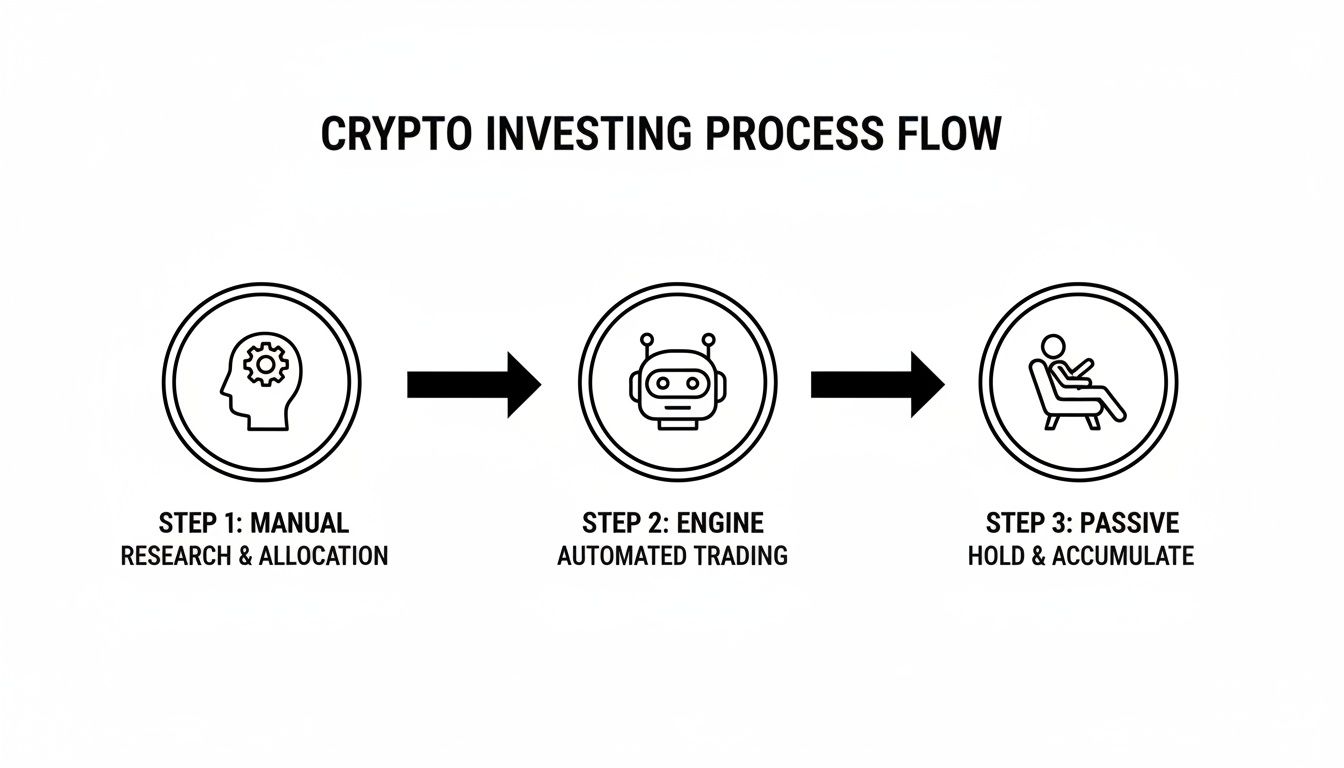
As you can see, the engine strikes a perfect balance. It’s not the stressful, active management of day trading, but it’s also smarter than just passively holding. It automates all the hard work to get you the best possible returns.
Real-Time Market Monitoring
First up are the engine's eyes and ears: its real-time monitoring. Think of it as a radar system that never sleeps, constantly scanning the entire DeFi landscape. It’s not just checking APYs once a day; it’s watching yield fluctuations across hundreds of protocols, second by second.
This 24/7 vigilance is key because the best opportunities in DeFi are often gone in a flash. A lending platform might see its yield spike for a few hours due to a temporary liquidity crunch. A human would almost certainly miss it, but the engine is built to spot these fleeting moments instantly.
Intelligent Allocation Logic
Once a juicy opportunity is flagged, the engine's "brain" kicks in—the intelligent allocation logic. This is where the real decision-making happens. It figures out where your capital should go and exactly how much to send, all based on a sophisticated set of rules that weigh potential rewards against the risks involved.
It’s not just about chasing the biggest APY. The logic asks smarter questions, like:
Is This Yield Legit? Is the high APY coming from real protocol activity, or is it just a risky incentive that's about to disappear?
What's the Right Amount? It calculates the perfect amount of capital to move to capture the upside without putting your whole portfolio on the line.
Will It Be Profitable? The engine crunches the numbers on gas fees to make sure a rebalance actually makes you money after costs.
This analytical process ensures every single move is strategic. To really get a feel for how powerful this is, it helps to understand the data behind real-time APY optimization.
Dynamic Risk Scoring
High yields often go hand-in-hand with high risks, which is why dynamic risk scoring is absolutely essential. Before moving a single dollar, the engine performs a lightning-fast risk assessment on the target protocol. It's like an instant financial health check.
This process looks at tons of data points—a protocol’s total value locked (TVL), its smart contract audit history, on-chain transaction volume, and its general reputation in the market. Every protocol gets a risk score, which directly influences the allocation logic.
A yield rebalancing engine is designed to avoid catastrophic losses by filtering out opportunities that are "too good to be true." It prioritizes consistent, risk-adjusted returns over chasing dangerously high, unsustainable yields.
For example, a brand-new, unaudited protocol shouting about a 500% APY would get flagged as high-risk and skipped. But a well-known, audited protocol with a temporary yield spike to 12%? That’s a prime candidate.
Automated Execution
The fourth piece of the puzzle is automated execution. After the engine has monitored the market, applied its logic, and scored the risk, it’s time to act. This component is the hands of the system, carrying out all the necessary on-chain transactions to move your funds without a hitch.
This is where the engine gets its incredible speed advantage. It can pull off a complex, multi-step transaction—like withdrawing from one pool, swapping assets, and depositing into a new one—in a fraction of the time it would take you or me. That speed is crucial for catching opportunities that only last for a few minutes.
Seamless Liquidity Management
Finally, the engine is a master of liquidity management. One of the biggest headaches in DeFi is getting your funds stuck. A top-tier rebalancing engine makes sure your capital stays liquid and accessible, steering clear of protocols with long withdrawal times.
This means your money is always in the most optimal spot, but you can still get to it when you need it. The engine is programmed to favor protocols that offer instant or near-instant withdrawals, giving you high performance without sacrificing control. It’s a core principle behind platforms like Yield Seeker—you should never have to trade access for returns.
The Role of AI in Your Rebalancing Strategy
While a rules-based system is a massive step up from manually chasing yields, artificial intelligence is what really takes things to the next level. AI turns a standard rebalancing system into a smart, predictive, and personalized wealth-building tool that adapts not just to the market, but to you.
Traditional automated systems are pretty rigid. They follow a simple script: "If yield on Protocol A is higher than Protocol B by X%, move funds." A yield rebalancing engine powered by AI, on the other hand, thinks far beyond a fixed set of instructions. It learns, it predicts, and it personalizes every move based on huge amounts of data.
Platforms like Yield Seeker give each user an AI agent that acts like their own personal portfolio manager. These agents are constantly digging through historical yield data, current market sentiment, and on-chain activity to spot patterns and predict where the best opportunities will pop up next. This means the engine can be proactive, not just reactive.
Moving from Reactive to Predictive Decisions
The magic of AI is its ability to see both the forest and the trees at the same time. A human investor might spot a high APY on a single protocol, but an AI can crunch thousands of data points across the entire DeFi ecosystem in milliseconds. This predictive power is a complete game-changer.
Instead of just reacting after a yield has already spiked, the AI can pick up on the early signals that a protocol's returns are about to climb. This could be anything from:
Growing Transaction Volume: A sudden jump in activity often signals that demand for a protocol's services is on the rise.
Shifts in Liquidity: The AI can see when big money is flowing into or out of a protocol, which is a strong predictor of future yield changes.
Market Sentiment Analysis: By scanning social media and news, the AI gets a feel for the market's confidence in different platforms.
This gives the engine the ability to position your funds before a high yield becomes common knowledge, letting you capture more of the upside. It’s the difference between hearing about a great opportunity and being one of the first people in the door.
An AI-powered yield rebalancing engine doesn't just find the highest yield today; it anticipates the most profitable and sustainable yield for tomorrow. It turns market data into forward-looking strategy.
Personalization at Scale
Maybe the biggest win from adding AI is the deep personalization it makes possible. It gets that every investor is different. Your financial goals and how comfortable you are with risk are totally unique, and your strategy should be too.
You can set up an AI agent to match your exact preferences. For instance:
Conservative Profile: If you want to play it safe and protect your capital, you can tell your agent to stick to only the top-tier, most audited protocols, even if it means slightly lower returns.
Balanced Profile: Someone else might want a mix—some funds in stable, established protocols and a small slice in newer, higher-yield opportunities.
Aggressive Profile: A DeFi power user could set their agent to hunt for the absolute highest yields out there, accepting a bit more smart contract risk along the way.
This creates a custom-fit experience where the engine isn't just finding a high yield; it's finding the right yield for you. You can learn more about how this tech works in our guide to the AI yield aggregator. This approach ensures your strategy aligns perfectly with your own financial journey.
For a broader look at the concepts behind these smart systems, discussions on AI-powered tools and machine learning technologies can provide some useful context. Ultimately, AI makes your yield rebalancing engine less of an automated tool and more of a true partner in hitting your financial goals.
See the Yield Rebalancing Engine in Action
Talking about a yield rebalancing engine is one thing, but seeing it work its magic really brings the concept to life. Let's walk through what happens from the moment you deposit funds to how the engine snaps into action when a new opportunity pops up. This is the real story behind that clean, simple interface.
Imagine you just dropped $100 USDC into your Yield Seeker account. The second it lands, your personalized AI Agent is on the job. It doesn't just stick your money in one place. Instead, it scans the landscape of vetted DeFi protocols and smartly spreads your deposit across a few top-performing, low-risk options to get you a solid baseline return right away.
A Sudden Yield Spike Appears
Okay, now for the fun part. Let's say a well-known lending protocol, we'll call it Protocol-A, suddenly needs more liquidity. To attract it, they crank their APY on USDC from a steady 6% up to a juicy 11%.
If you were managing your funds manually, you’d probably miss this. You could be asleep, stuck in a meeting, or just not glued to your screen at that exact moment. But for the yield rebalancing engine, this spike is a signal—a trigger that kicks off a precise, automated chain of events.
Here’s a simple way to picture how the Yield Seeker dashboard shows these automatic moves, keeping you in the loop on where your funds are working.
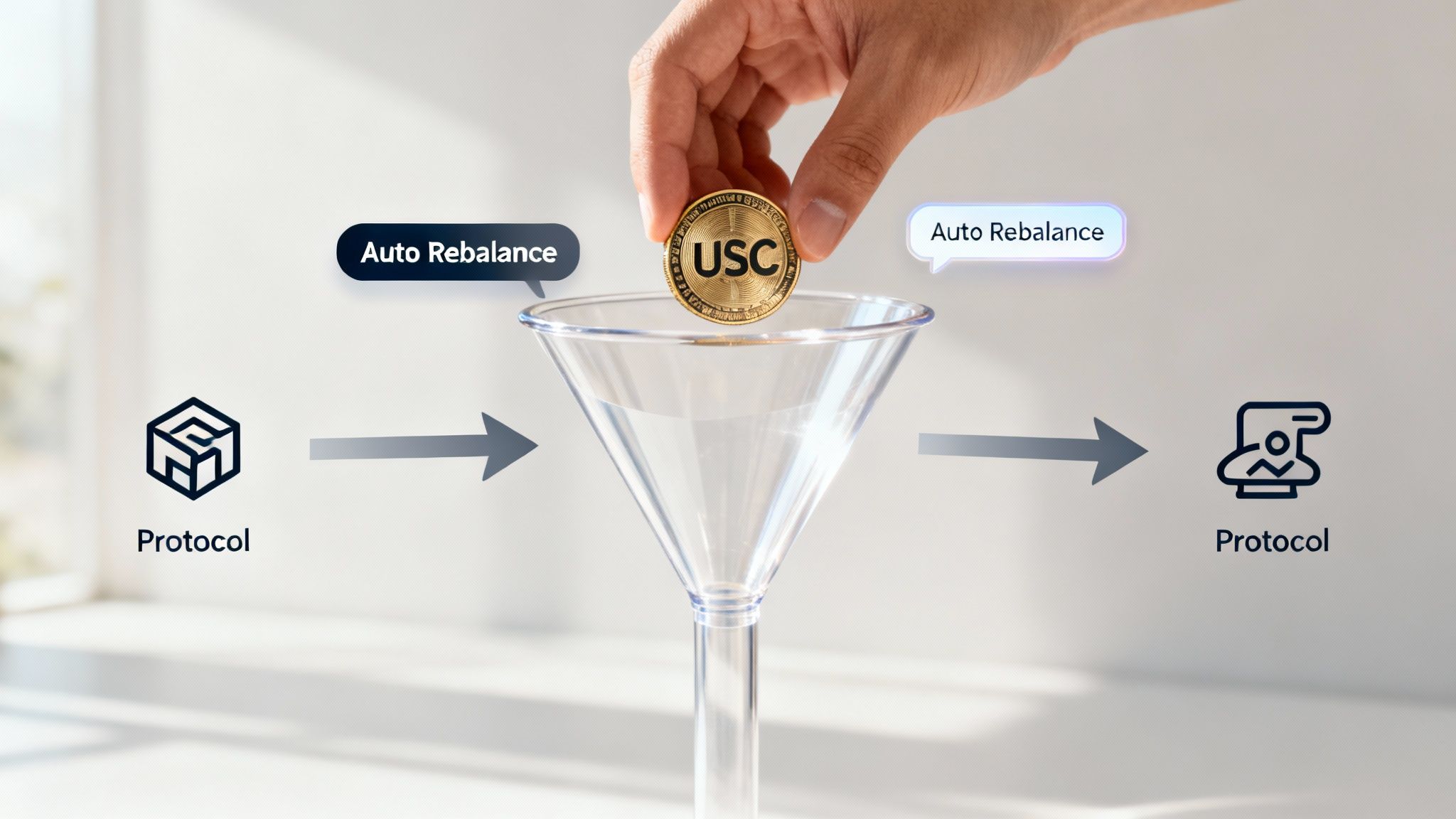
This image nails the core idea: the engine is constantly redirecting your capital to the best spot on the map, without you having to lift a finger.
The Engine's Decision-Making Workflow
Now, the engine doesn't just chase the highest number blindly. That would be reckless. Instead, it runs through a multi-step check in seconds to make sure the move is both smart and profitable.
Opportunity Evaluation: The monitoring system instantly flags that 11% APY. It immediately pulls data on Protocol-A and stacks it up against the returns your funds are getting right now.
Risk Assessment: Next up, a risk check. Has anything changed with Protocol-A’s security? Are there any new smart contract red flags? Since Protocol-A is already on our pre-vetted list, it passes this test with a low-risk score. No problem there.
Profitability Calculation: This is the make-or-break step. The engine calculates the gas fees needed to pull your funds from where they are and move them into Protocol-A. It then figures out the extra earnings from the higher yield. The math has to make sense: the gains from that 5% APY difference need to be way bigger than the transaction costs.
Automated Execution: With all the lights green, the engine pulls the trigger. It automatically reallocates a portion of your USDC to Protocol-A to capture that better yield, while still keeping your funds diversified.
This whole dance—from spotting the chance to cashing in on it—happens on its own, grabbing value that would otherwise just slip away. This isn't some crazy new idea; systematic rebalancing has been a pillar of smart investing in traditional finance for ages.
The real power of a yield rebalancing engine is its ability to follow a disciplined strategy without emotion or hesitation. It turns market volatility from something to fear into a consistent source of opportunity.
The data backs this up. An analysis of old-school 50/50 stock-bond portfolios from 1926 to 2020 showed that rebalancing quarterly produced average annual real returns of 5.8%. A static, untouched portfolio? Just 4.9%. That history of outperformance is the same core principle platforms like Yield Seeker are now bringing to the fast-paced world of DeFi. To see how other platforms are tackling automation, you can discover other innovative applications that are building similar tech.
Making Advanced Technology User-Friendly
While the engine under the hood is seriously complex, we designed the experience to be dead simple. You shouldn't have to be a DeFi degen to benefit. Your dashboard gives you everything you need to know, clearly and concisely:
Your total balance and earnings, right at the top.
Exactly which protocols hold your funds and the APY they're pulling in.
A full history of every rebalancing move your AI Agent has made.
We also build in educational tooltips and visual guides to help you understand what your AI is doing and why. It's all about building trust and transparency, so you feel in control even when the hard work is automated. This is how we make sophisticated DeFi strategies something anyone can use, whether you're a busy professional or just getting started in crypto.
Key Considerations for a Secure Strategy
Automation is incredibly powerful, but in the world of DeFi, trust and security are everything. Before you deposit a single dollar into any automated platform, it's crucial to understand what makes a yield rebalancing engine truly safe. A rock-solid strategy is built on a foundation of transparency, user control, and rigorous technical safeguards.

Think of this section as a practical checklist. It's designed to help you pick a platform that isn't just effective but also genuinely secure, so you can make smarter decisions about where to put your capital.
Smart Contract Audits and Protocol Vetting
The bedrock of security in DeFi is the smart contract audit. You can think of this as a deep, independent inspection of a platform's code by a team of expert security researchers. Their entire job is to hunt for vulnerabilities, bugs, or potential exploits that could put user funds at risk.
Before jumping into any yield rebalancing engine, you absolutely must verify that its smart contracts have been audited by a reputable firm. But it doesn't stop there. The engine also interacts with dozens of other DeFi protocols, and a secure platform will have a strict vetting process for every single one it integrates, ensuring it only allocates your funds to projects that are themselves audited and have a proven track record.
Your Keys, Your Crypto: Non-Custodial Management
One of the most important concepts to get your head around is non-custodial fund management. This is a non-negotiable feature that ensures you—and only you—maintain ownership and control of your assets at all times.
In a non-custodial model, the platform never takes direct possession of your funds. The yield rebalancing engine is given permission to move your assets between vetted protocols on your behalf, but it can never withdraw them to an external wallet. This fundamentally protects you from platform-level risks.
This model is a core principle for any trustworthy DeFi platform. It means that even if the platform's website went down tomorrow, your funds would remain safe on the blockchain, accessible directly from your personal wallet.
Evaluating Engine Effectiveness and Transparency
Beyond just security audits, you need to know if the engine is actually any good at its job. A black box that simply promises high returns isn't good enough. You should be looking for platforms that offer clear metrics and transparent reporting on their performance.
Here are a few key things I always look for:
Risk-Adjusted Returns: Don't just get blinded by a high APY. A great engine delivers strong returns relative to the level of risk it takes on. A 10% return from blue-chip protocols is far more impressive than a risky 20% return from unaudited farms.
Rebalancing Frequency: How often does the engine actually make a move? A good system is active enough to capture opportunities but smart enough not to over-trade and burn all your profits on gas fees.
Historical Performance: Look for a clear and honest track record. The platform should provide transparent data on past returns and show you how the engine performed through different market conditions, both good and bad.
Understanding these factors is a key part of building confidence in an automated strategy. For a deeper dive into this topic, our guide on the best practices for risk management is a great resource.
Navigating Technical Challenges Like Gas Fees
Finally, a truly advanced yield rebalancing engine is built to handle the practical headaches of the blockchain, especially high gas fees and network congestion. An inefficient engine can easily watch its profits get eaten alive by transaction costs.
An intelligent engine tackles this by building a profitability calculation right into its logic. Before making a move, it analyzes the potential gain from a rebalance against the estimated gas cost. If the move isn't profitable enough to justify the fee, the engine will patiently wait for a better opportunity or a time when the network is less congested. This cost-aware approach is essential for actually maximizing your net returns over the long term.
Why Rebalancing Beats Holding in DeFi
In a market as wild as DeFi, a "set-it-and-forget-it" strategy just doesn't cut it. You’re almost guaranteed to leave money on the table. This is where a yield rebalancing engine comes in, and the idea behind it is simple but incredibly powerful: making dynamic adjustments almost always beats a passive, hold-and-pray approach over the long run. This isn't some new, crazy DeFi concept—it’s a principle that’s been proven for decades in traditional finance.
Think about it. When you just hold a fixed portfolio, you’re completely exposed to missed opportunities and pointless risks. If one protocol or asset is doing really well, it can quickly become a huge chunk of your holdings, which means your risk is all piled up in one place. Rebalancing makes you systematically sell high and buy low, locking in those gains and moving capital to other opportunities that might be undervalued.
Bringing a Proven Strategy to DeFi
In the old world of finance, the advantages of rebalancing your portfolio every so often are crystal clear. Study after study shows that portfolios rebalanced at set intervals—like quarterly or annually—tend to deliver much better risk-adjusted returns than ones that are just left alone. It’s a disciplined process that takes emotion out of the picture, stopping you from clinging to winners for too long or panic-selling when things dip.
This same idea is even more crucial in DeFi, where the best yield opportunities can shift not just every quarter, but every single hour. A yield on a stablecoin protocol can rocket from 5% to 12% and then crash back down in a single day. A static holding strategy misses all of these short-lived, but very lucrative, chances. A yield rebalancing engine brings that time-tested discipline of rebalancing but operates at the speed of DeFi, making sure your capital is always working its hardest for you.
A yield rebalancing engine isn't just about convenience; it's a fundamentally smarter way to chase consistent, optimized returns. It turns the market's volatility into your friend, not your enemy.
This isn’t just theory. One detailed study that simulated over 1,000 portfolios found that quarterly rebalancing beat a simple buy-and-hold strategy 68% of the time. The rebalanced portfolios pulled in average annualized returns between 8-10%, while the hands-off portfolios only managed 6-7%. You can dig into more of the data on rebalancing performance here. For DeFi users, this means your stablecoins like USDC can achieve much better and more stable APYs than you could ever manage by hand.
Ultimately, using a platform like Yield Seeker puts this superior strategy on autopilot. You get all the benefits of disciplined rebalancing without having to stare at charts all day and manually move funds around. It’s a proactive approach built for a market that truly never sleeps.
Common Questions
Diving into any new bit of financial tech is bound to bring up a few questions. Let's tackle some of the most common ones about how a yield rebalancing engine actually works, especially around safety, costs, and getting started.
Are My Funds Safe with an Automated Engine?
Yes, and this is the most important part. Any platform worth its salt makes security priority number one. A good yield rebalancing engine is non-custodial.
This is a huge deal. It means you, and only you, have control over your funds. The engine is just given permission to move your funds between different DeFi protocols that have been heavily vetted and audited. It does this on your behalf, but it can never run off with your money.
Before you put a dime in, always check that the platform has been through multiple security audits from well-known firms.
How Does the Engine Deal with High Gas Fees on the Network?
A smart engine isn't just a yield-chasing machine. It’s built to be efficient. Before it even thinks about making a move, it runs a quick calculation to see if it's actually worth it. The logic is simple: will the extra yield from this new opportunity cover the cost of the gas fees to get there?
If the expected gains don't blow the transaction costs out of the water, the engine just waits. It'll hang back until gas fees come down or a much better opportunity pops up. This stops your returns from getting eaten up by network fees.
This ensures every single move it makes is genuinely putting more money in your pocket. It's what makes the automation smart, not just fast.
Can I Start with a Small Amount of Money?
Absolutely. DeFi today is built for everyone, not just the whales. Many platforms, for example, let you get your foot in the door with as little as $10 USDC.
The AI-powered yield rebalancing engine is a game-changer, especially for smaller portfolios. It gives you access to the kind of complex strategies that used to take hours of research to figure out, effectively leveling the playing field for investors of all sizes.
Ready to put your stablecoins to work? Get started with Yield Seeker and let our AI-powered engine find the best yields for you, automatically. Start earning today at https://yieldseeker.xyz.