
The worst advice about AI is to treat it like a magical brain. That sounds neat, but it leads people to trust systems they haven't defined clearly, especially when those systems are touching capital. If an AI agent is moving your USDC, the key question isn't whether it sounds smart, it's what kind of system it is, what data it reads, and who still has the final say.
A useful definition starts there. AI can be defined as software that perceives an environment, reasons over data, and chooses actions toward a goal. That framing matches the practical descriptions used by institutions that treat AI as a family of methods, not a single mind, and it fits the way modern tools are built around data ingestion, inference, and action selection. For a stablecoin holder, that matters because a yield tool is only as trustworthy as the logic behind its choices.
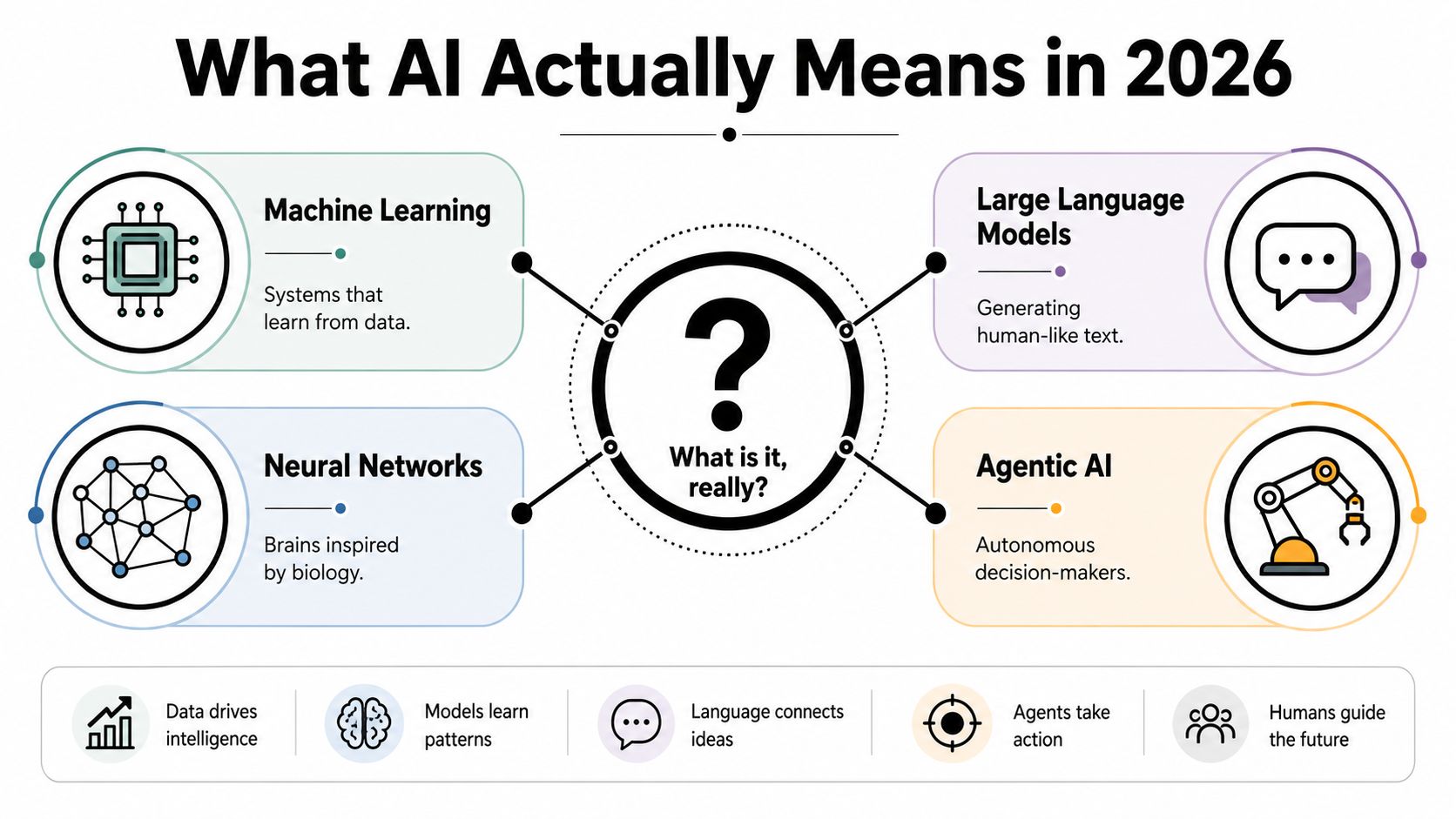
What AI Actually Means in 2026
The cleanest way to think about AI is as a system that can observe input, work through patterns, and take an action that serves a defined objective. That is why the term covers very different tools, from text mining to computer vision to speech recognition and machine learning, as listed in Eurostat's glossary in the source material. It also explains why people can use the same word for a chatbot, a fraud model, or an automated trading agent, even though those systems behave very differently. Bridge Global on what AI is gives a helpful public-facing overview if you want a second explanation that stays close to the everyday meaning.
The definition that actually helps
A smart thermostat and a chess grandmaster are both useful comparisons, but they point to different sides of the same idea. The thermostat senses temperature and acts toward a goal with limited autonomy. The chess engine reasons over board states and makes recommendations or moves, but it still does only what its designers allowed it to do.
That difference matters in crypto. A stablecoin user doesn't need a system that “thinks like a person.” They need a system that can perceive changing conditions, compare options, and act within a rule set. That's why the definition of AI is less about human-like intelligence and more about decision-making under constraints.
Practical rule: if a product can't explain what it sees, how it decides, and what action it takes next, it's not useful to call it AI in any serious sense.
For that reason, the phrase ai can be defined as should never stay abstract. It should point to a workflow. Read the wording in the context of AI vs. AGI, and you'll see the difference between a marketing label and a real capability boundary.
Why this framing beats the usual one-liner
Most short definitions stop at “machines that mimic human intelligence.” That's too vague for finance, because it hides the important part, the system's objective. A yield router doesn't need consciousness, language, or emotion. It needs data, a decision policy, and execution rails that match the user's goals.
That's also why the phrase “AI” now covers more than a lab concept. Recent industry research in the source material says more than 70% of organizations use some type of AI technology, and 65% regularly use generative AI, which shows how far these systems have moved into mainstream operations. Those figures don't tell you how every product works, but they do show that AI now sits inside ordinary business workflows rather than on the edge of research.
How AI Got From Theory to Your Wallet
AI began as a computer science effort to build systems that could solve problems in structured ways. It changed as data, compute, and model design improved. For a stablecoin holder, the useful shift is not academic trivia. It is the point where the same family of methods that once lived in research settings starts showing up in tools that can monitor yield, compare options, and execute transactions on your behalf.
From rules to learned patterns
Early systems depended heavily on fixed rules. If this happens, do that. That approach still has a place, but it breaks down quickly when markets change shape. Machine learning changed the method by letting models learn from examples instead of relying only on hand-written branches. Deep learning pushed that further by using layered neural networks for harder data problems, especially when the input is messy or high-dimensional.
That progression explains why the modern definition of AI is so broad. A system can be built from algorithms and data, trained on large datasets, and deployed to generalize on new inputs. Industry summaries in the source material place the global AI market at $208 billion in 2023 and $638.23 billion in 2024, with forecasts above $1.8 trillion by 2030. Those figures show why AI is now treated as infrastructure rather than a novelty.
Why DeFi got the timing right
DeFi creates the kind of fragmented environment where AI becomes useful. Protocols change, rates move, risk profiles shift, and users do not want to watch every dashboard all day. An automated agent fits that setting because it can keep checking conditions and acting within limits.
The old internet gave you information pages. The AI stack gives you decision support. In DeFi, decision support can become execution support when the user authorizes an agent to move capital within predefined rules.
AI became useful in finance when the input stopped being static. Once rates, liquidity, and risk changed in real time, a system that could read the environment and act on it became more than a demo.
For Yield Seeker-style products, that means the system is not being asked to invent new money logic. It is being asked to handle repetitive evaluation, compare options faster than a human could, and react when conditions change. That is a narrower, more realistic use case than the hype around general-purpose intelligence.
From Narrow Tools to Human-Level Systems
A lot of confusion starts when people talk about AI as if every system were trying to become human-like. That's not how the field works. The practical spectrum has three levels, and most products in the wild sit at the bottom level even when the marketing sounds grander.
ANI, AGI, and ASI, without the fog
Artificial Narrow Intelligence (ANI) is task-specific. It can be excellent at one job, like search ranking, fraud detection, or routing yield, while remaining narrow everywhere else. Artificial General Intelligence (AGI) is the hypothetical idea of a system that can learn and reason across domains the way a human can. Artificial Superintelligence (ASI) goes further and describes something that would surpass human ability across most or all domains. Only ANI exists today in deployed form.
That distinction is central for trust. If a tool is labeled like a future human-like mind but functions like a task-specific optimizer, buyers can overestimate what it knows. The safer assumption is that current AI yield tools belong in the ANI bucket. They can be useful because they're narrow, not despite it.
A simple comparison
Level | What it actually means | Trust implication |
|---|---|---|
ANI | Built for a specific task or domain | Useful when the task is clear and the data is solid |
AGI | Human-level versatility, still hypothetical | Should not be assumed in any live product |
ASI | Beyond human capability, theoretical | Not a basis for current product decisions |
The reason this matters in DeFi is obvious. A yield agent does not need to understand the universe. It needs to compare protocol conditions, follow a decision policy, and respect the user's boundaries. That's enough. The user should judge the product by whether it does that well, not by whether it sounds futuristic.
The same caution applies when a vendor's language drifts toward “autonomous intelligence.” That phrase can hide a lot of ordinary automation. If you want a useful benchmark, the internal discussion in Yield Seeker's comparison of AI, AGI, and ASI helps separate the actual capability from the headline word.
How AI, Machine Learning, and Deep Learning Fit Together
People often use AI, machine learning, and deep learning like they're competing labels. They're not. They fit inside one another, and once you see that nesting, product claims get much easier to evaluate. The broadest term is AI. Machine learning is one major way to build AI. Deep learning is one specialized kind of machine learning.
The nesting that clears up the jargon
Think of AI as the full sports category. Machine learning is one training style inside that category. Deep learning is a more specialized training style inside machine learning, usually built with neural networks that learn from lots of data.
That nesting lines up with the source material's technical framing. Eurostat's glossary lists text mining, computer vision, speech recognition, natural language generation, machine learning, and deep learning as core AI methods. So when a vendor says a product “uses AI,” that alone tells you very little. The primary question is which method it uses, how it learns, and whether it adapts from data or just follows prewritten rules.
Term | What It Actually Does | Typical Data Need | Example Use Case |
|---|---|---|---|
AI | Perceives, reasons, and chooses actions toward a goal | Varies by method | Yield routing, search ranking, fraud flags |
Machine Learning | Learns patterns from examples and improves predictions | Structured or unstructured training data | Risk scoring, protocol selection |
Deep Learning | Uses layered neural networks to learn complex patterns | Large datasets with strong signal | Language generation, image recognition |
What this means when someone sells you a product
A tool can be AI without being machine learning. A rules engine with a decision tree still counts as software that acts toward a goal, but it doesn't learn from new examples in the same way. A machine learning model can also be narrow, even if it sounds advanced. And a deep learning system can still be brittle if the training data is narrow or noisy.
That's why the best questions are blunt. Does it learn from historical behavior, or just apply fixed logic? Does it update based on new inputs, or only on manual edits? If the answer is unclear, the term “AI” may be doing more sales work than technical work.
For a deeper look at the learning side of these terms, Yield Seeker's note on machine learning trading algorithms is useful because it keeps the focus on how models behave, not on buzzwords.
AI in the Wild From Spam Filters to Yield Agents
You already use AI if your email filters spam before you see it. You use it again when a feed recommends content, or when a voice assistant turns speech into text and back into a response. These systems all follow the same loop, they observe input, weigh patterns, and select an action. The output looks different in each case, but the underlying structure is the same.
The everyday examples that make the loop visible
Spam filters are the easiest example because the goal is obvious. The system reads incoming messages, compares them against learned patterns, and decides whether to move them. Recommendation feeds do something similar, except the action is ranking rather than deletion. Voice assistants sit one layer higher, because they need to interpret speech, map it to a likely intent, and produce a response that fits the request.
Those use cases matter because they remove the mystery from AI. None of them require human-level understanding. None of them need consciousness. They just need enough pattern recognition and enough consistency to be helpful.
What a DeFi yield agent is actually doing
A yield agent on Base follows the same logic, only the action is capital allocation instead of email sorting. It watches multiple protocols, reads market data, scores risk-adjusted opportunities, and reallocates USDC when its policy says a change is warranted. That is a practical instance of the definition from the opening section, not a metaphor.
The important detail is not that the agent “knows” DeFi. It's that it can continuously ingest data, apply a decision policy, and execute within the scope the user allowed.
If you want a concrete example of that design, Yield Seeker describes a setup where a personalized AI Agent monitors and allocates stablecoin capital across DeFi protocols in real time on Base. That kind of system is useful precisely because it reduces manual dashboard-hopping, not because it pretends to be human. For anyone thinking about security and automation in the same breath, the AI hacking era crypto safety guide from NomadCards is a worthwhile read alongside any platform review.
The key point is simple. A yield agent is AI in the strict sense when it senses the market, reasons over data, and acts toward a goal under human-defined constraints. That's a technical description, not a marketing slogan.
What AI Still Cannot Do And Why That Matters for Yield
A precise definition matters because it keeps expectations tied to reality. Current AI is powerful, but it still fails in ways that matter when money is involved. If you use a yield tool, those limits are not abstract. They affect routing decisions, risk scores, and whether capital lands where you expect it to land.
Four limits that shape real outcomes
First, AI learns patterns, not meaning. It can perform well in familiar conditions, then drift when the market changes in a way its training did not capture. Second, it inherits bias from training data, so conditions that appear less often can distort what the model treats as normal. Third, it is highly sensitive to data quality. A missing or stale price feed can weaken the whole decision chain. Fourth, it has no internal values. The objective function acts as the moral compass, which means humans define what good looks like.
These limits are why a neat-sounding definition is not enough. A model that looks smart in a demo can still fail when inputs are messy or objectives are poorly set. In DeFi, those failures show up as bad timing, weak risk awareness, or automation that sounds confident but misses the point.
What users should assume instead
Do not assume the system understands your intent the way a person would. Assume it is optimizing within a defined frame. Do not assume it will rescue you from bad data. The quality of the input pipeline matters as much as the model itself. And do not assume autonomy means judgment. It usually means the software can keep acting until a stopping condition is met.
Practical rule: if the objective is vague, the agent will optimize the wrong thing very efficiently.
That is why a narrow definition protects yield users. It keeps you from overtrusting a system that can only be as good as the data, instructions, and oversight behind it. If you want a broader product-level discussion of this risk boundary, Yield Seeker's AI-driven DeFi agent guide is a useful companion because it stays close to the mechanics of automated capital movement.
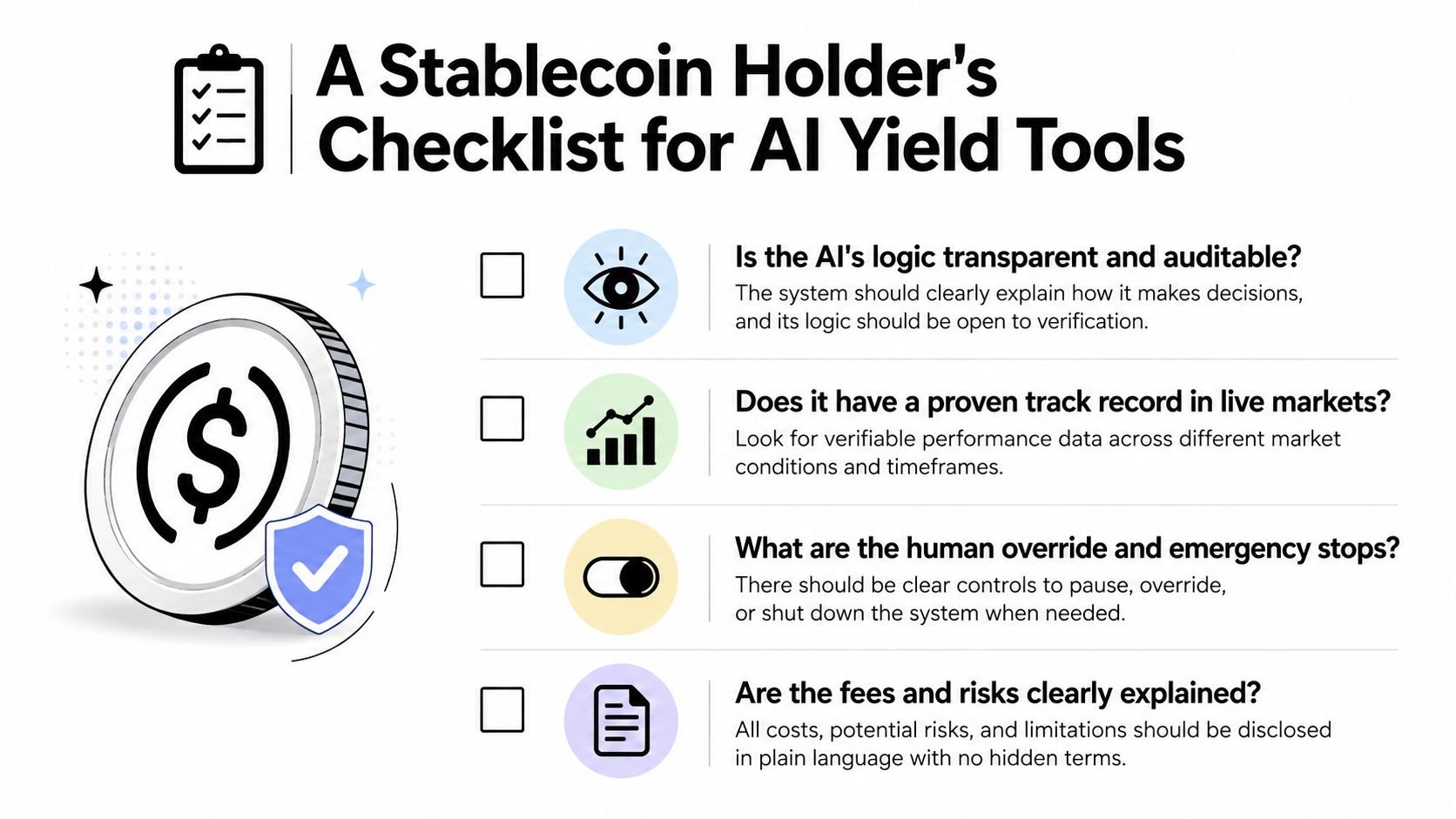
A Stablecoin Holder's Checklist for AI Yield Tools
A stablecoin holder doesn't need a philosophy seminar. They need a filter they can use before depositing. The right questions tell you whether an AI tool is acting like a transparent assistant or a black box with your funds inside it.
Questions that expose the real design
Is the logic transparent and auditable? If the platform can't explain what data it uses and how it decides, you're trusting vibes, not software.
Does it show how risk is handled in live conditions? A model can be impressive in theory and still be useless if it doesn't surface risk clearly.
What human override exists? A good system should make it obvious how a user can intervene when conditions change or the model behaves badly.
Are fees, access, and withdrawals clear? If funds are locked or exit terms are hidden, the product has already failed a basic trust test.
Those questions map cleanly to the definition of AI. A system that perceives, reasons, and acts should also be legible enough for the user to inspect its assumptions. That's especially true in DeFi, where capital moves fast and mistakes show up immediately.
Yield Seeker is one example of a product designed around those concerns. It runs an AI agent on Base, accepts USDC, avoids lockups, and presents balances and earnings in a way users can inspect. The point isn't that every tool should copy that exact layout. The point is that a serious AI yield tool should make its decision process, access model, and risk handling visible enough for a stablecoin holder to judge.
Defining AI by What You Do Next
AI can be defined as software that perceives an environment, reasons over data, and chooses actions toward a goal. For a DeFi user, the better test is even simpler, does the tool watch fragmented markets, compare opportunities against your risk tolerance, and rebalance capital without taking control away from you.
That's the definition worth keeping. It separates ANI from AGI, it puts the objective function back in human hands, and it makes the product easier to evaluate before you deposit. If a yield tool can't show its logic, surface its risk, and keep your funds accessible, the label “AI” doesn't matter much.
If you're ready to judge a tool by transparency instead of hype, try Yield Seeker and see how an AI agent can organize stablecoin yield without forcing you to juggle dashboards or surrender control.