

You open one dashboard and see stablecoin yields moving across Aave, Compound, Pendle, new vaults, and whatever strategy Twitter is obsessing over this week. Then you open X, Telegram, and your wallet history and realize the same problem keeps repeating. The market doesn't slow down, but your attention does.
That's where the promise of an AI crypto exchange starts to make sense.
Not as a magic box that prints returns. Not as a chatbot with a trading tab. And definitely not as a substitute for risk controls. The useful version is simpler. It's software that watches more data than a human can track, reacts faster than a human can click, and helps turn messy market inputs into decisions you can use.
The hard part is that the term gets stretched too far. Some platforms call themselves AI because they added a signal feed. Others bolt a language model onto a normal exchange UI and treat that as product differentiation. Meanwhile, the safety questions that matter most often get buried. How does the system cap downside? Can you verify why it moved funds? What happens when volatility breaks the assumptions the model was trained on?
Those questions matter more than the pitch deck.
Introduction Unlocking Crypto with AI
Most crypto users don't need more opportunities. They need help filtering them.
The problem isn't access anymore. You can trade spot, perps, prediction markets, and on-chain yield from one laptop. You can bridge between chains in minutes. You can deploy stablecoins into multiple protocols before breakfast. The bottleneck is judgment. Which signal matters, which venue has real liquidity, and which “automated” strategy is just hidden risk with a cleaner interface.
An AI crypto exchange is supposed to reduce that burden. Done well, it acts like a co-pilot for market structure, execution, and monitoring. It watches order books, on-chain flows, sentiment shifts, and portfolio exposure together, then turns that into actions or recommendations.
Done badly, it turns complexity into mystery.
Practical rule: If a platform talks more about upside than about failure modes, treat that as a product warning.
That's why the interesting conversation isn't “can AI trade crypto?” Of course it can. The better question is whether the platform uses AI in a way that is inspectable, bounded, and aligned with the user's risk tolerance.
For traders, that means asking whether the model improves execution and risk control. For stablecoin holders, it means asking whether the system can move capital across DeFi without exposing funds to avoidable contract or liquidity risk. For builders, it means designing guardrails between model output and money movement.
The platforms worth your time usually look less flashy than the ones doing the loudest marketing. They explain the workflow. They show where automation stops. They make it clear when a human must approve a trade. That's what separates infrastructure from hype.
What Is an AI Crypto Exchange
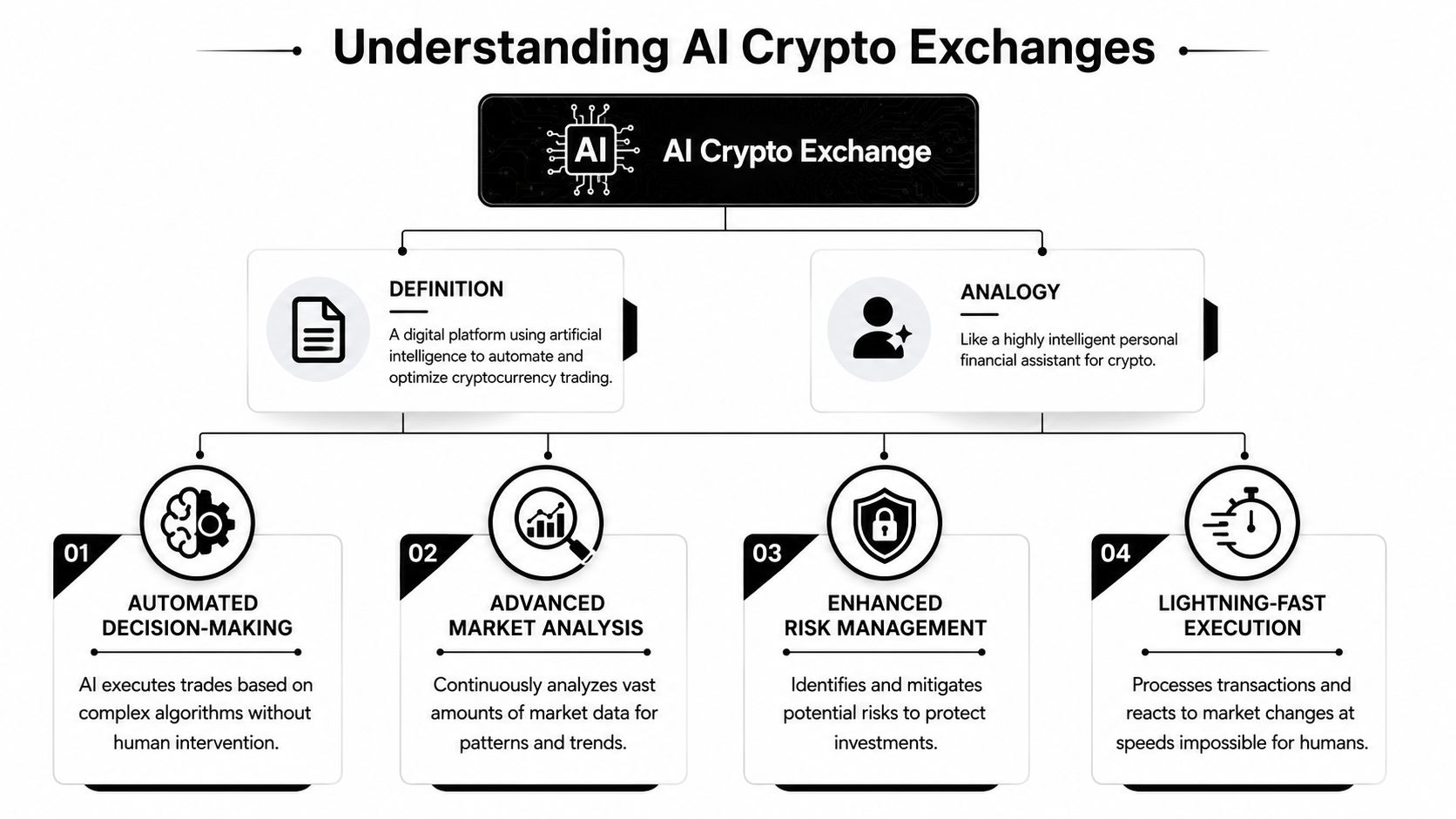
An AI crypto exchange is a trading platform where artificial intelligence isn't an accessory. It's part of how the exchange analyzes markets, routes orders, detects fraud, manages compliance, or assists users with portfolio decisions.
By August 2025, the AI cryptocurrency sector reached $31.9 billion in total market capitalization, or 0.80% of the global crypto market, with over 200 active AI tokens and $4.27 billion in combined daily trading volume, according to AllAboutAI's AI crypto market data. That scale matters because it shows the category has moved past novelty.
The simplest mental model
Think of a regular exchange as the venue. It holds the trading engine, wallet rails, matching system, and account controls.
Think of the AI layer as a team of specialists sitting on top of that venue:
A market analyst watching price action, order flow, and sentiment
An execution trader deciding where and how to route orders
A risk officer flagging suspicious behavior or dangerous exposure
A support layer helping users turn plain-language intent into structured actions
That doesn't mean the exchange is fully autonomous. In many cases, it isn't. The AI may only handle one layer of the stack, such as fraud scoring, smart routing, or signal generation.
Not all AI exchanges are built the same way
The label covers a wide range of products. In practice, there are a few common setups:
Type | What AI does | What the user sees |
|---|---|---|
Execution-focused exchange | Improves routing, slippage handling, and timing | Better fills, faster response |
Risk-focused exchange | Flags anomalies, suspicious flows, and account abuse | Stronger security and fewer bad transfers |
Assistant-driven platform | Converts user prompts into strategies or alerts | Easier workflow for non-coders |
Agent-based platform | Monitors portfolios and can rebalance or deploy capital | More hands-off automation |
A useful way to judge the difference is to ask where the model sits. If it only produces a dashboard insight, that's lightweight AI. If it affects order routing, risk decisions, or capital allocation, that's a deeper integration.
A trading bot plugged into an exchange API isn't automatically an AI crypto exchange. Depth of integration matters.
What actually makes it worth using
The best implementations do four things well:
They reduce cognitive load. You don't have to manually scan every venue and feed.
They tighten execution. The model can act on market conditions faster than a human workflow can.
They add controls. Fraud detection and exposure checks can run continuously.
They make complexity usable. Plain-language interfaces can lower the barrier to advanced strategy building.
The term gets abused, but the concept is real. When the exchange, data pipeline, and model layer are designed together, AI stops being a label and starts being infrastructure.
How AI Algorithms Power Modern Trading
The useful part of AI in crypto isn't that it sounds advanced. It's that it can sit inside the parts of trading where humans are slow, inconsistent, or overloaded.
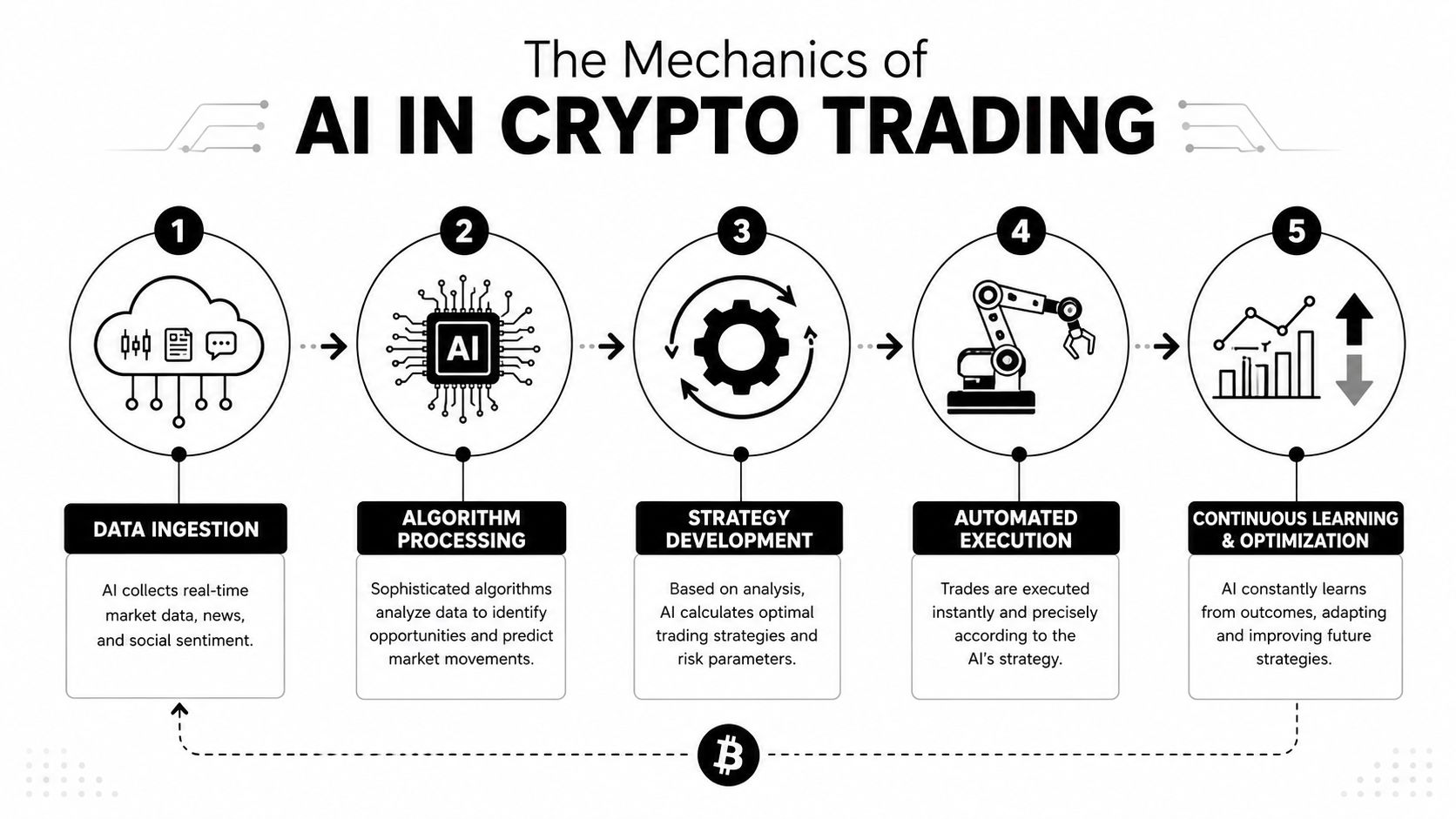
According to Nadcab's AI crypto exchange development guide, AI crypto exchanges can reduce manual operational overhead by up to 70% by automating trading execution, KYC and AML workflows, and user acquisition. That same guide describes a practical stack where LSTM neural networks handle price prediction while gradient-boosted models flag suspicious transaction patterns.
Predictive market making
Before AI, many desks relied on fixed rules. Spread this far, quote that size, widen during volatility.
AI systems can be more adaptive. They ingest order book snapshots, recent trades, and changing momentum, then adjust quotes or positioning in a way that reflects current conditions rather than a static script. That matters when liquidity thins fast and old assumptions become expensive.
Smart order routing
Execution quality often comes down to where the trade lands. A human can compare a few venues. A model can compare many at once.
In modern stacks, real-time on-chain and social inputs can feed into NLP pipelines that produce confidence-scored signals, while the routing engine uses those signals to choose liquidity sources and reduce slippage. For an active trader, that means the system isn't just deciding whether to trade. It's deciding how to get the trade done with less friction.
If you trade event-driven markets, the mechanics overlap with prediction market workflows too. This guide for Polymarket AI traders is a useful reference because it shows how automation becomes practical when speed, signal interpretation, and market structure all collide.
Fraud detection and risk scoring
This is one of the most valuable uses of AI, and one of the least glamorous.
Gradient-boosted tree models can scan transaction histories and behavior patterns for anomalies long before a human reviewer would notice anything odd. That's especially useful on platforms handling rapid inflows, bot traffic, or account behavior that changes suddenly.
A good system doesn't wait for the fraud event to finish. It scores risk while activity is unfolding.
Recommendation engines and signal layers
Not every user wants full automation. Some want a ranked list of setups, alerts, or suggested allocations.
That middle layer matters. It gives users leverage without forcing blind trust. A recommendation engine can process more data than a human and still leave final approval with the user. That's often the right product decision for newer traders or treasury managers.
For a closer look at how these systems are typically structured, this piece on machine learning trading algorithms is a solid companion.
Sentiment analysis and continuous adaptation
Crypto price action often reacts to information before it settles into chart structure. Social chatter, headlines, governance discussions, and on-chain narratives can all matter.
That's where NLP becomes useful. The model turns messy text into directional signals, confidence scores, or anomaly flags. Then the exchange decides whether that signal should influence execution, risk limits, or user-facing recommendations.
The best AI trading systems don't replace the trading engine. They sit beside it, feeding it cleaner signals and better constraints.
When this architecture works, AI feels less like a prediction oracle and more like a high-speed decision layer attached to exchange infrastructure.
The Real Benefits and Hidden Risks of AI Trading
You wake up to a 6% drawdown and a dashboard that says the bot is still "optimizing." That is the moment AI trading stops feeling smart and starts feeling expensive.
AI trading offers clear advantages, but it also creates a visibility problem. A fast model can improve execution and still hide bad assumptions, weak risk limits, or incentives that favor platform volume over user returns. In practice, the edge is rarely raw prediction alone. It comes from tighter process, better controls, and fewer avoidable mistakes.
Where AI trading helps
The strongest benefit is consistency.
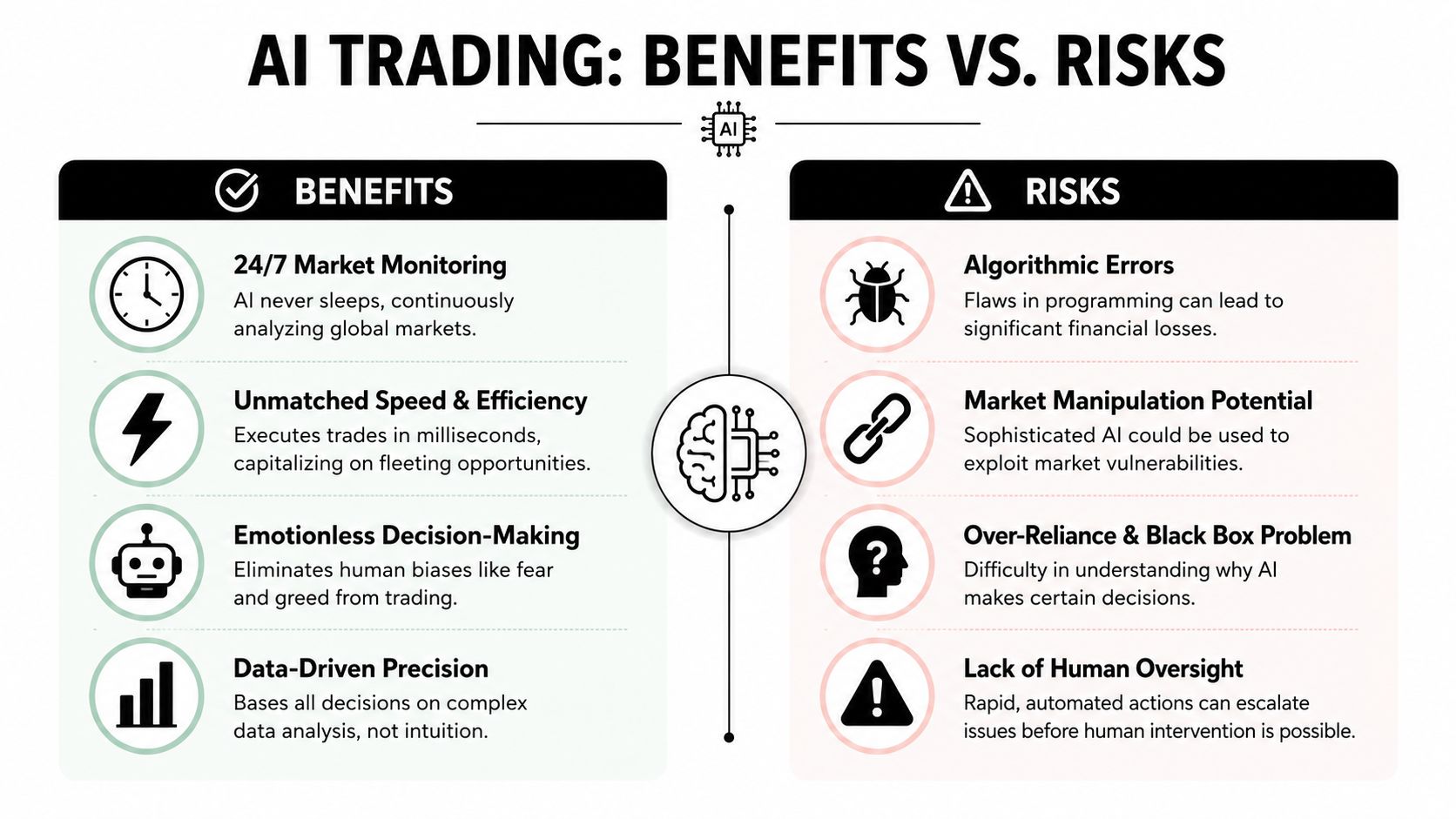
Markets move 24/7, and human operators do not. An AI system can keep watching funding rates, liquidity shifts, wallet flows, and sentiment changes long after a trader gets tired or distracted. That matters more in crypto than in equities because weekends, overnight sessions, and thin-liquidity hours often produce the ugliest moves.
A good system also follows its rules under stress. It does not chase candles after a liquidation event or freeze because volatility spikes. Used well, AI improves the boring parts of trading that protect capital.
The practical gains usually show up in a few places:
Always-on coverage: Strategies keep running through off-hours and cross-market volatility.
Faster filtering: Models can rank thousands of signals and ignore low-quality setups.
More consistent execution: Entries, exits, and rebalancing happen by rule instead of mood.
Better workload split: The machine handles monitoring and pattern detection while the user keeps control over approvals or risk limits.
If you are comparing products, this list of best AI trading platforms for crypto is a useful starting point. The useful differences are usually in controls and transparency, not in marketing claims.
Where people get hurt
Losses usually come from hidden risk, not from the word "AI."
The Street's report on AI crypto trading agent losses found that 62.2% of participants in AI crypto trading agent platforms realized losses, with collective losses of $191.7 million. That gap matters. A product can show attractive backtests, screenshots, or paper performance while users absorb the drawdown in live conditions.
Four failure modes come up again and again:
Risk | What it looks like in practice |
|---|---|
Black box logic | You can see trades and PnL, but not the reason for a position, the confidence level, or the trigger that changed |
Overfitting | The model was tuned to old conditions and falls apart when liquidity, volatility, or narratives shift |
Latency mismatch | Signals arrive in time, but execution lands late enough to turn an edge into slippage |
Weak guardrails | Position sizing, protocol selection, or re-entry logic allows small losses to snowball |
The trade-off is simple. More automation can reduce hesitation, but it can also reduce user oversight exactly when oversight matters most.
That is why I put decision transparency ahead of advertised returns. If a platform cannot show position limits, kill switches, approval settings, and a clear audit trail, it is asking users to trust branding instead of process.
If you want a practical framework for drawdown control, position sizing, and downside discipline, Rize Trade on protecting capital is worth reading. Those rules still apply when an AI system is making the trade.
How to Choose the Right AI Crypto Platform
Most platforms look good in a rising market. The useful differences show up in how they explain risk, permissions, and failure handling.
One of the clearest gaps in this category is transparency. Outlook India's discussion of AI and crypto platform trust points out that users often aren't told how to verify an AI's logic when it allocates capital across DeFi protocols. Many products talk about fraud detection, but not about real-time auditability or how the system avoids compromised protocols.
Start with the risk envelope
Before looking at returns, ask what the platform is allowed to do with your funds.
A serious product should make these boundaries obvious:
Position limits: Can the system cap exposure per trade, strategy, or protocol?
Exit rules: Does it use stop-loss logic, de-risking thresholds, or manual kill switches?
Permission scope: Can the platform move capital freely, or does it require user approval?
Liquidity filters: Does it avoid thin pools, unstable venues, or sudden slippage spikes?
If those answers are vague, the platform is asking you to trust the brand instead of the process.
Demand decision visibility
You don't need every model weight. You do need an audit trail.
Good platforms show enough information for a user to reconstruct what happened:
Question | What a strong answer sounds like |
|---|---|
Why was capital moved? | The platform shows the trigger, threshold, or signal class |
Where did it go? | The destination protocol, venue, or asset is clearly listed |
What risks were checked? | Exposure, liquidity, contract, or volatility checks are documented |
Can I override it? | The user can pause, modify, or reject decisions |
A lot of teams skip this because explanation is hard. That's not your problem. If money is moving, clarity is part of the product.
A platform doesn't need to reveal its secret sauce. It does need to show the user the recipe for risk.
Look beyond the model
Many failures come from the boring parts. Legal structure, jurisdiction, custody model, and compliance workflow all shape your real risk.
If a platform operates across multiple regions or touches fiat rails, it's worth understanding how local rules apply. For teams evaluating cross-border setup questions, this overview of navigating Israel's financial regulations is useful context for how fintech and crypto products can sit inside a regulated environment.
There's also a practical product filter here. If you want a market map before choosing, this roundup of best AI trading platforms helps frame what to compare.
The checklist that matters
Use this before depositing anything material:
Check the custody model. If funds leave your control, know exactly who holds them and under what permissions.
Read the fee logic. Performance fees, spreads, withdrawal rules, and hidden routing costs can change the outcome more than the signal engine.
Stress-test the claims. Ask how the platform behaved during sharp drawdowns, not just clean trending periods.
Inspect the interface. If the dashboard hides risk while highlighting earnings, that's not an accident.
Test small first. The safest due diligence still starts with a limited amount and a full withdrawal test.
The right AI crypto platform doesn't just automate decisions. It makes those decisions inspectable.
A Practical Guide to AI for Stablecoin Yield
Stablecoin holders usually face a different problem than active traders. They aren't trying to catch every move. They're trying to keep idle capital productive without spending their week rotating between dashboards, vaults, and Discord threads.
That's where AI can be useful.
A realistic user flow
Say you hold USDC and want yield, but you don't want to manually compare lending markets, looping strategies, and fixed-yield products every day. The fragmented part of DeFi is effectively the tax here. Even when the opportunities are visible, the operating burden is annoying.
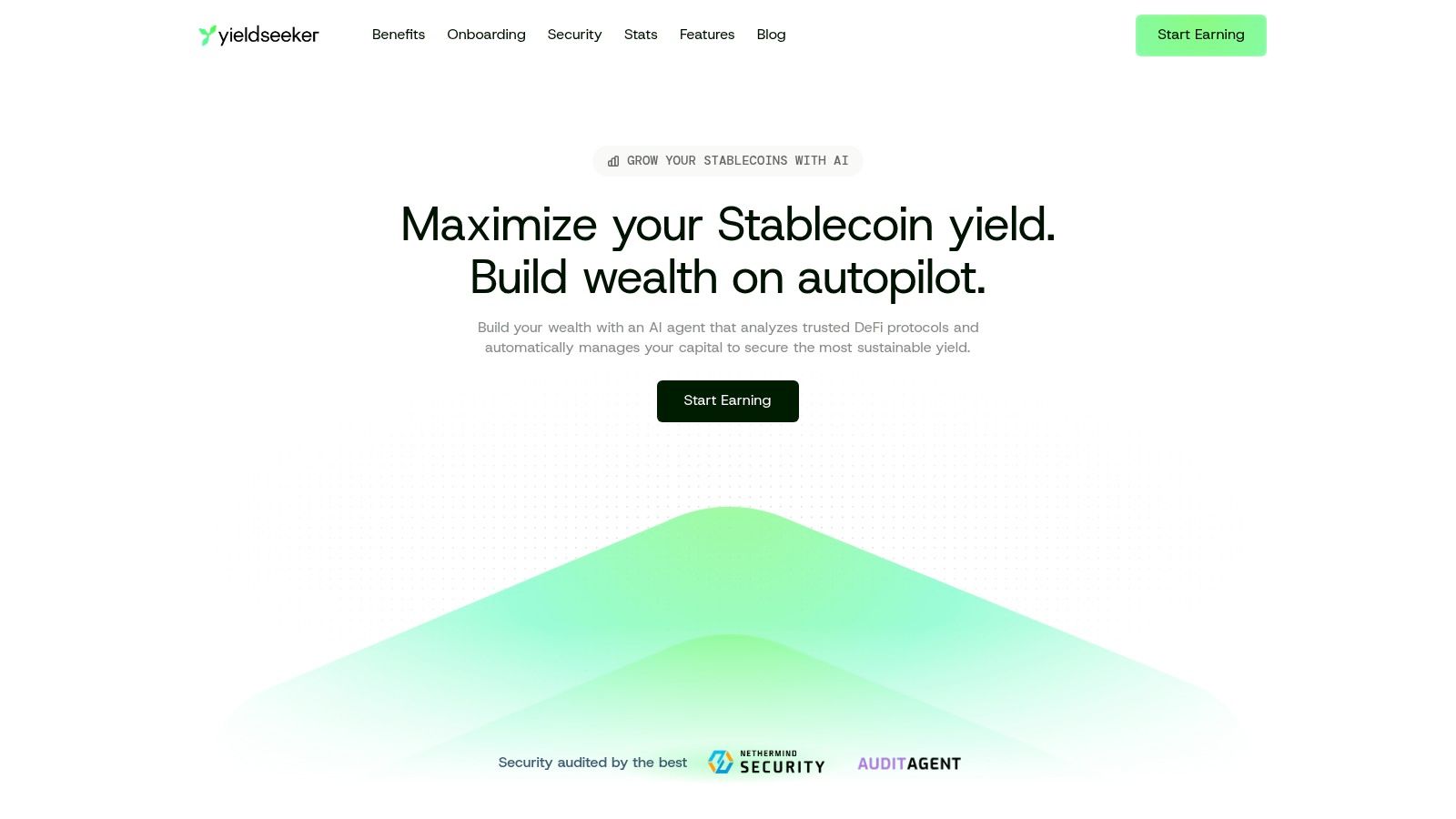
An AI-driven yield workflow usually follows a simple pattern. The user deposits stablecoins, defines preferences, and lets the system monitor opportunities. The model then scores possible allocations based on risk, liquidity, and expected return, while the interface keeps the user updated on where funds sit and why.
That's the key distinction from generic “auto earn” products. A good AI layer doesn't just chase the highest number on the screen. It filters for conditions that fit the user's risk profile.
What a strong product should include
For stablecoin automation, the platform matters less than the controls around allocation.
Look for these traits:
Non-custodial or tightly scoped permissions: The fewer broad permissions you grant, the better.
No forced lockups: If conditions change, you want the option to move.
Clear allocation views: You should be able to see where funds are deployed and how the strategy changed.
Risk-aware routing: The system should consider protocol quality, liquidity conditions, and concentration risk.
Usable reporting: Earnings are useful, but exposure and strategy history matter just as much.
A lot of users don't need a fully autonomous agent. They need an assistant that removes research overhead and surfaces better choices.
For stablecoin yield, the best AI doesn't feel aggressive. It feels selective.
That same idea shows up in education and onboarding too. If you want a plain-English walkthrough of how these systems are typically introduced to users, this guide on how to use AI for investing is a practical starting point.
Here's a product walkthrough that helps make the user experience more concrete:
Where AI helps most in yield
The biggest gains aren't always about squeezing out the absolute top rate. They come from consistency.
A human user might rebalance too late, ignore changing protocol conditions, or leave funds idle while deciding what to do next. An AI-assisted system can keep monitoring without fatigue. It can also apply the same risk rules every time, which matters when markets get noisy and users start improvising.
For treasury managers, creators, and busy professionals holding stablecoins, that can be enough of an edge. The win is less time spent hunting and less chance of making rushed allocation decisions.
The Future of AI in Decentralized Finance
A year from now, a user may deposit stablecoins, set a drawdown limit, approve a few allowed protocols, and let software handle the routing. Product difference will not be who promises the highest return. It will be who shows the logic, the constraints, and the failure path before funds move.
That is where DeFi is heading. AI is shifting from a trading add-on into operating infrastructure for capital allocation, risk checks, governance review, and on-chain monitoring. Some of that stack will stay inside exchanges and custodial apps. Some of it will run through decentralized networks where models, data feeds, and execution venues interact on-chain with visible rules.
For everyday users, the biggest change is not more automation by itself. It is more policy-driven automation.
A useful system will let a user say: keep 40 percent liquid, avoid protocols below my minimum TVL threshold, exit if a vault changes collateral parameters, and require approval for anything outside those rules. That is a better future than a black-box agent chasing yield across every new venue it finds. In practice, the winners will be platforms that treat AI like a risk engine with an interface, not a mascot on top of a trading dashboard.
What changes for everyday users
Three shifts are likely.
Interfaces become intent-based. Users describe goals, limits, and preferences in plain language, then review the machine-readable policy before it executes.
Risk controls become visible. Good products will expose approval flows, audit logs, simulation results, and clear explanations for why the system entered or exited a position.
Strategies become composable. Trading, hedging, cash management, and stablecoin yield will sit in one workflow, with shared guardrails instead of disconnected tools.
That last point matters more than it sounds. Risk usually slips in the gaps between products. One app opens exposure, another app holds idle collateral, and a third app sends alerts too late. AI can reduce that fragmentation, but only if the platform makes positions, permissions, and model decisions easy to verify.
What still won't change
DeFi keeps the same hard rule. Automation shifts risk. It does not erase it.
Model error, bad data, weak incentives, governance attacks, oracle failures, and smart contract exploits still exist. AI can even add a new layer of failure if users cannot inspect why the system made a move. A fast agent with poor controls can lose money faster than a human making occasional mistakes.
The best AI crypto exchange products will make automation legible. Users should be able to see what the system is allowed to do, what data it used, what assumptions it made, and where human approval still applies. That standard will matter more than flashy return claims once the market goes through another stress cycle.
Frequently Asked Questions
Is an AI crypto exchange the same as a normal exchange with bots
Not usually. A normal exchange with third-party bots gives users API access and lets outside software trade on top of the venue. An AI crypto exchange has AI integrated deeper into the product itself. That can include order routing, fraud detection, compliance review, portfolio suggestions, or plain-language strategy building.
The difference is control and visibility. If the AI is part of the exchange workflow, it can influence execution and risk handling directly. If it's just an external bot, the exchange is still mostly neutral infrastructure.
What should I check about privacy and data use
Start with the platform's permissions and policy language.
Check what wallet data, trading history, and behavioral data the system collects. Then check what it does with that data. A solid platform should explain whether data is used only for your account experience, whether prompts are stored, and whether model outputs are reviewed or retained. If the product uses AI for recommendations or execution, it should also say how user data feeds those systems.
Don't ignore the account side either. Look for session controls, withdrawal approvals, device management, and suspicious activity alerts. Privacy and account safety usually fail together.
Do I need coding skills to use AI trading or AI yield tools
No. The category is moving toward no-code workflows, cleaner dashboards, and guided setup.
That said, easy to use doesn't mean easy to evaluate. You don't need to code a strategy from scratch, but you do need to understand what the platform is allowed to do, how it handles downside, and whether you can inspect its decisions after the fact. The safer products lower the technical barrier without hiding the important mechanics.
If a platform makes everything feel effortless but never explains the decision logic, that's not simplicity. That's opacity.
If you want a simpler way to put stablecoins to work without manually tracking every DeFi venue, Yield Seeker is built for that job. It uses AI-powered automation for stablecoin yield, keeps the experience approachable, and focuses on the controls that matter most: accessibility, transparency, and risk-aware allocation.