

You open your wallet, check your stablecoin position, and see yield trickling in around the clock. It feels clean compared with trading. No frantic chart watching. No constant decision-making. Just capital parked in USDC and earning.
Then tax season gets close and the easy money stops feeling easy.
A lot of people assume all “passive” income is taxed the same way. It isn't. In crypto, that mistake gets expensive fast because the label you use matters. Yield can look like bank interest, token rewards can create separate income events, and a later disposal can trigger capital gain or loss treatment on top of the original income recognition. If you're earning through DeFi, the old tax buckets still apply, but the path from on-chain activity to tax reporting is much messier than most traditional finance articles admit.
That gap gets wider for anyone earning across borders. Most writing on passive income taxes skips the distinction between source-country taxation and residence-country taxation, even though treaties often assign primary taxing rights to the residence country while source countries may still impose withholding first, as discussed in this Oxford Academic treatment of cross-border passive income taxation. For a stablecoin holder using global protocols, that's not an academic detail. It can change what you owe, when you owe it, and whether you need to chase a foreign tax credit.
The Hidden Cost of Earning While You Sleep
The cleanest version of passive income is psychological, not tax-based. You deposit stablecoins, the protocol does the work, and your balance rises while you're in meetings, asleep, or nowhere near your phone. That part is real. The tax simplicity people expect from it usually isn't.
In practice, passive income creates two separate questions. First, what kind of income is this. Second, which tax system gets first claim on it. Traditional tax rules were built around things like interest, dividends, rental income, and capital gains. DeFi didn't replace those concepts. It dropped new wrappers around them.
A busy professional usually runs into the problem the same way. They export wallet activity and find dozens or hundreds of entries that don't map neatly to plain-English tax categories. A stablecoin deposit generated yield. A protocol paid a reward token. That token later changed in value before being sold or swapped. What looked like one passive strategy now contains multiple taxable events.
Practical rule: If your strategy feels automated, your record-keeping has to be manual or software-driven. The blockchain won't translate tax character for you.
The other hidden cost is false confidence. Many people think “passive income tax rate” means there's one rate for all income that feels hands-off. There isn't. Tax law cares less about how little effort you spent and more about the legal character of the income. Interest-like income is often treated differently from long-term capital gains. Passive activity rules are different again. Cross-border withholding can add another layer.
For DeFi users, the safest starting point is simple: assume your yield has tax consequences the moment it hits your control, and assume the label matters.
Decoding Passive Income and Its Tax Rates
The phrase passive income tax rate sounds singular. In reality, it's a bundle of different rules applied to different income types. For crypto investors, the cleanest way to think about it is by sorting income into three buckets: active income, passive activity income, and portfolio income.
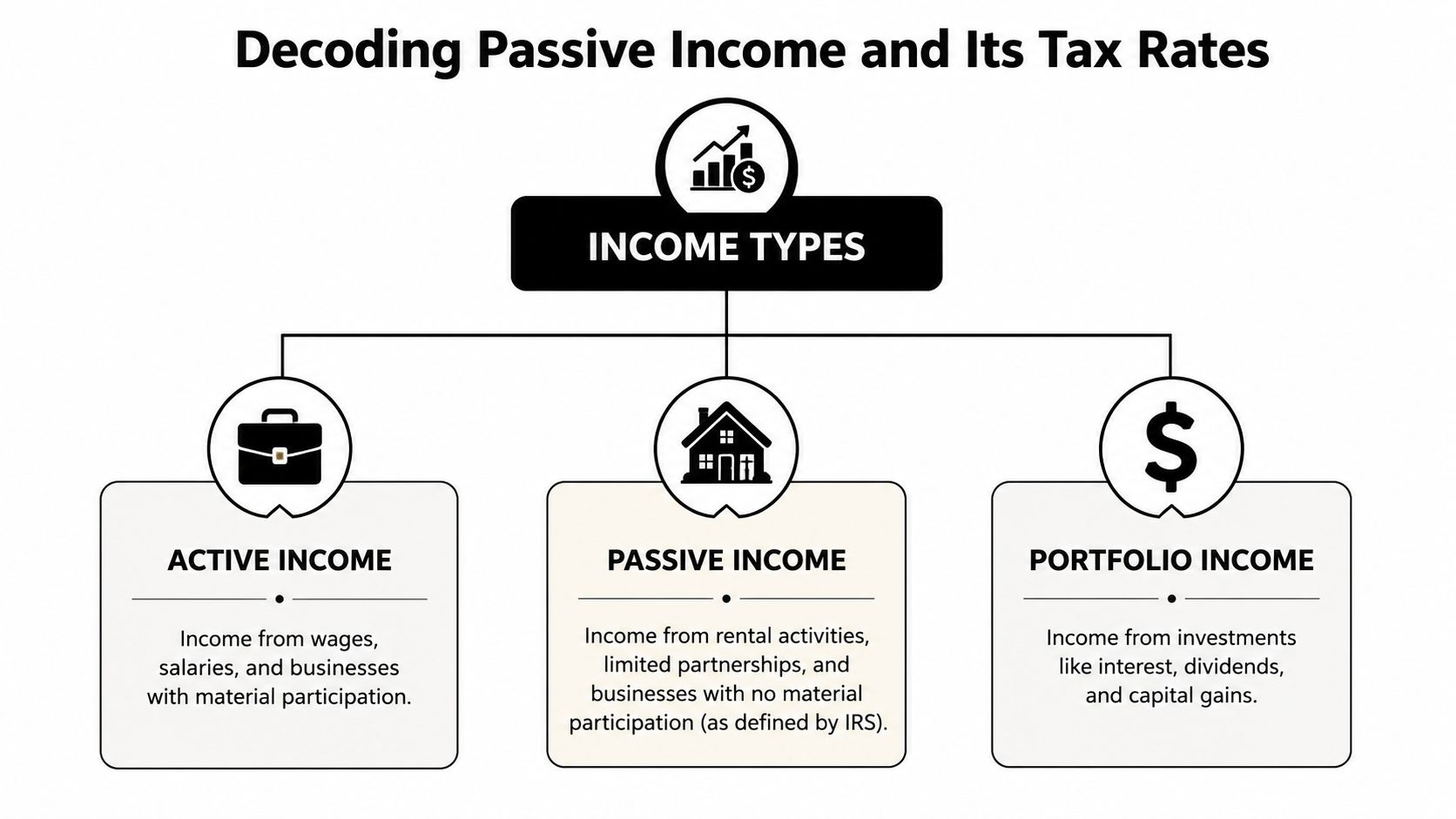
The three buckets that matter
Active income is what you earn from work. Salary, consulting income, and business income where you materially participate usually land here.
Passive activity income is a technical IRS category. It usually applies to activities where you don't materially participate, such as certain rental or limited-partnership arrangements.
Portfolio income covers investment returns like interest, dividends, and capital gains. For most DeFi users, stablecoin yield is usually analyzed closer to this bucket than to passive activity rules.
That distinction matters because tax treatment changes with the bucket. In the United States, the top ordinary income rate has fluctuated to 37% in recent years, while the long-term capital gains rate for most taxpayers remains 15%. For taxpayers in the highest bracket, long-term capital gains can reach 20% plus a 3.8% Net Investment Income Tax, for a combined 23.8%, according to the OECD explanatory annex on personal income tax rates here.
Why DeFi confuses the issue
People often call all hands-off crypto earnings “passive income.” That's fine conversationally, but it's weak tax analysis. A stablecoin yield payment may resemble interest. A gain from selling an appreciated token is a capital gain. Those are not the same recipe.
Here's the practical shortcut:
Income Source | Tax Treatment | Typical Federal Rate |
|---|---|---|
Stablecoin yield | Often treated like ordinary income, similar to interest | Can be taxed at ordinary income rates, up to 37% in recent years for top-bracket U.S. taxpayers |
Long-term investment gains | Preferential capital gains treatment | 15% for most taxpayers, up to 20% plus 3.8% NIIT for the highest bracket |
Dividends or similar portfolio income | Depends on characterization under applicable rules | May follow portfolio-income rules rather than passive activity rules |
The table is intentionally simple because the classification step comes first. If you misclassify the income, the rate discussion is already off track.
What works in real life
The best approach is to classify each on-chain event by what it economically resembles, then confirm reporting treatment with crypto-aware tax software or an advisor. Don't start with “this was passive for me.” Start with “was this yield, a reward, or a later disposition.”
If you're also dealing with staking, this companion guide on how staking rewards are taxed helps separate ordinary income events from later gain-or-loss events.
The tax rate follows the income type. It doesn't follow how relaxed you felt while earning it.
Global comparisons make this even clearer. The same OECD annex notes that Bulgaria applies a flat 10% personal income tax rate, while Canada's federal top rate is 33%, with provincial additions pushing total top marginal rates above 50% in some places, and capital gains there are only 50% included in taxable income. That's why broad internet advice about the passive income tax rate often fails. Jurisdiction and income character both matter.
Understanding The IRS Passive Activity Rules
A lot of people hear “passive income” and assume the IRS uses the word the same way they do. It doesn't. The IRS has a narrower, technical framework called the passive activity rules, and those rules focus on material participation.
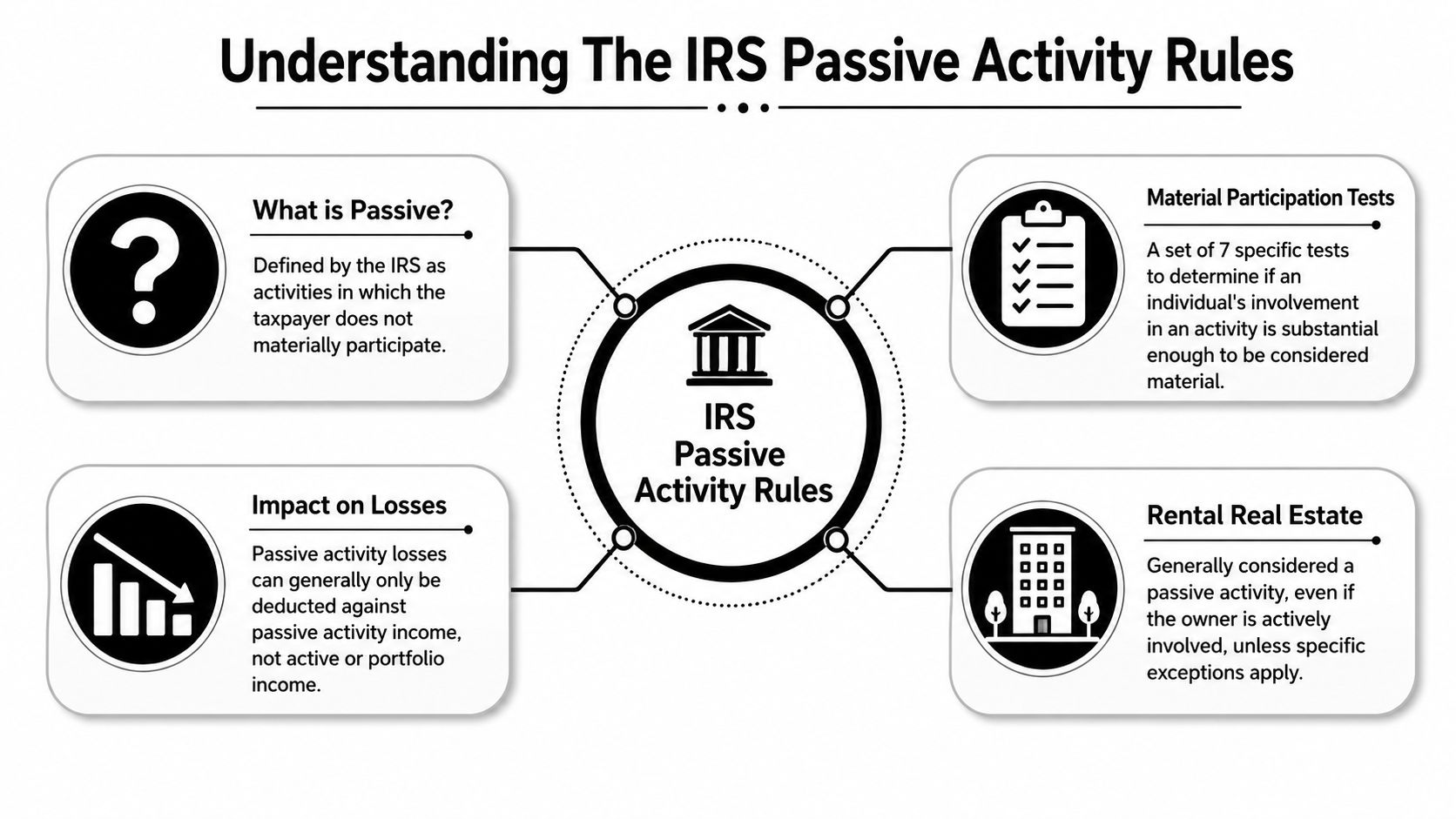
Think silent partner versus operator
If you help fund a restaurant but don't run it, that looks passive. If you're in the kitchen, managing staff, ordering supplies, and making day-to-day decisions, that's active participation. The IRS uses that same basic logic across business and rental contexts.
For crypto investors, this matters because not every investment return belongs in the passive activity bucket. In many cases, wallet-based investing and yield generation are better understood as portfolio income mechanics, not passive activity income in the IRS loss-limitation sense.
Why the distinction matters
The biggest consequence is the passive loss limitation. In general, losses from passive activities can only offset passive activity income. They usually can't be used freely against wages or other active income.
That's where taxpayers make avoidable mistakes. They assume “it's all investment-related, so it all mixes together.” It often doesn't.
A clean way to think about the buckets:
Salary bucket: Your job income and similar earned income.
Passive activity bucket: Activities where you don't materially participate.
Portfolio bucket: Interest, dividends, and gains from investment property.
The IRS doesn't let you casually pour losses from one bucket into another just because all three feel financial.
Where crypto users trip up
The confusion usually starts when someone uses “passive” as a plain-English label and then imports passive activity assumptions into tax reporting. If your DeFi strategy generated income, that does not automatically mean passive activity loss rules apply. If a token later drops in value, that does not automatically create a loss that offsets any kind of income you want.
Keep two questions separate: “Was this income passive in everyday language?” and “Is this a passive activity under IRS rules?” Those answers often aren't the same.
That separation keeps you from forcing DeFi earnings into the wrong forms, the wrong schedules, or the wrong expectations about deductibility.
Beyond The Basics Additional Tax Considerations
Focusing solely on the base rate is a common starting point. That's not enough. The actual after-tax result often depends on add-on taxes, state rules, and cross-border withholding that sit on top of the headline rate.
The add-ons people miss
In the United States, one important extra layer is the 3.8% Net Investment Income Tax for taxpayers who fall into the relevant income range. This is one reason a capital gain rate that looks attractive on paper can end up higher in practice for high earners.
State taxation can complicate things further. Even when federal treatment seems settled, your state may treat investment income differently, and crypto reporting at the state level often lags behind the way users interact with protocols.
If you have freelance income, consulting income, or side-business revenue alongside your investment returns, it also helps to separate business deductions from investment reporting. A practical primer on boosting your 1099 tax deductions is useful for that line-drawing exercise.
Cross-border withholding changes the math
Outside a single-country tax lens, passive income often faces a first layer of tax before your home country even gets involved. The OECD notes that global tax systems frequently use withholding taxes on dividends and interest, often in the 15% to 30% range depending on treaties, and that personal income tax schedules in Asia and the Pacific commonly have around five brackets with top rates around 35% to 40% in many jurisdictions, as outlined in the OECD's personal income taxation report for Asia and the Pacific.
For DeFi users, the practical issue isn't memorizing treaty tables. It's recognizing that the same yield stream may trigger more than one tax conversation:
Local reporting: How your residence country classifies the income
Foreign withholding: Whether another jurisdiction takes tax first
Credit mechanics: Whether you can claim relief and document it properly
A headline tax rate is only step one. Your net result depends on what got withheld, where it got withheld, and whether your home country gives you credit for it.
That's why spreadsheet-only tax prep starts to break down once your wallet activity touches global protocols, wrappers, or entities.
Tax Scenarios for Stablecoin Yield Earners
The easiest way to understand the passive income tax rate in DeFi is to walk through actual scenarios. Stablecoin users usually don't need more theory. They need a way to label what happened in their wallet.

Scenario one, plain stablecoin yield
You deposit USDC into a yield strategy. Over time, your position earns additional value. In most practical tax analyses, that new yield is treated more like interest-like ordinary income than like a preferential capital gain.
That means the tax pain point usually arrives before you ever cash out to your bank. If the protocol credited you with new value and you had control over it, you may already have a taxable event.
What works here is boring but effective:
Track receipt dates: You need a timestamp or at least a defensible date record for when income hit your wallet or account.
Capture fair market value at receipt: That value often becomes the amount recognized as income and later forms your basis.
Separate income from disposal events: If you later swap, sell, or spend the received asset, that's a second analysis.
Scenario two, reward tokens on top of yield
Now add a governance token or incentive token to the same strategy. Users then lose the plot. They treat the whole return stream as one blended yield number because the dashboard presented it that way.
Tax reporting usually can't stay that loose.
The reward token may create income when received. Then, if you hold it and it changes in value before disposal, a separate gain or loss question appears later. One dashboard line item can turn into multiple tax entries.
If a protocol pays you in a different token from the asset you deposited, don't assume one tax event. Assume at least two until proven otherwise.
A short visual explainer can help frame the moving parts:
Scenario three, offshore protocol exposure
DeFi starts intersecting with more advanced international tax rules. In the United States, passive income from Controlled Foreign Corporations, including dividends, interest, and royalties, is taxed immediately under Subpart F at the full 21% corporate rate, and unlike GILTI, Subpart F treats passive asset income as fully taxable, as explained by the Tax Policy Center's overview of current U.S. international taxation rules.
Most individual stablecoin users won't casually self-identify as dealing with a CFC issue. But if yield flows through certain offshore structures or entities, the international overlay can get serious quickly. This is not the place for guesswork.
The record-keeping standard that actually works
For stablecoin yield earners, the strongest habit is to keep a ledger with these fields:
Asset received
Date received
Value at receipt
Wallet or protocol source
Date disposed, if any
Value at disposal
That ledger turns confusing wallet activity into something an accountant can use. Without it, the passive income tax rate becomes impossible to apply with confidence because you never nailed down what kind of income you had in the first place.
Smart Tax Planning Strategies for Passive Income
Good tax planning doesn't mean chasing loopholes. It means making fewer unforced errors and shaping your decisions before the year closes. In crypto, that matters more because wallet activity compounds quickly and small classification mistakes multiply.

What actually improves net returns
Start with timing. If part of your return may qualify for capital treatment later, holding period discipline matters. Selling too early can convert a potentially better outcome into a worse one.
Next is tax-loss harvesting. Crypto volatility can work in your favor if you deliberately realize losses on positions that no longer fit your strategy. The point isn't to trade for tax reasons alone. The point is to avoid ignoring losses while paying full freight on gains elsewhere.
Then there's account location. Some investors explore tax-advantaged structures, including self-directed retirement accounts, for parts of their crypto exposure. That doesn't make every DeFi strategy suitable for those accounts, but it can be worth evaluating with a qualified advisor.
A practical checklist
Map the income character: Decide whether each return stream looks like yield income, a token reward, or a later gain on disposal.
Harvest selectively: Use losing positions to offset gains when it fits your portfolio, not as random year-end theater.
Watch holding periods: A rushed sale can be more expensive than a patient one.
Keep basis records clean: If you don't document basis, you'll overpay or create filing risk.
Review tooling early: Don't wait until filing season to discover your software can't reconcile bridges, LP tokens, or reward emissions.
If you're comparing systems to organize wallet data and generate more defensible records, this review of crypto tax software comparison tools is a useful starting point.
Smart tax planning isn't about predicting every rule change. It's about making sure each transaction has a purpose, a record, and a tax consequence you understand before you click confirm.
What doesn't work
Passive investors often make the same three mistakes. They wait until year-end, they trust a single dashboard number, and they assume “I didn't cash out” means “I didn't trigger tax.” In DeFi, those habits create messy reconciliations and weak audit support.
The better approach is continuous. Review transaction history during the year. Tag unusual events when they happen. Save notes while your memory is fresh. That's less glamorous than yield optimization, but it usually has a more reliable effect on what you keep.
Your Next Steps for Tax Compliance
The practical takeaway is simple. Passive describes how the income feels. Tax law cares about what the income is.
For DeFi users, that means sorting stablecoin yield, token rewards, and later disposals into the right categories instead of reaching for one blanket passive income tax rate. It also means respecting cross-border complexity. Globally, source countries often tax passive income through withholding while treaties may allocate primary taxing rights to the residence country. China, for example, applies a 20% proportional tax rate on passive income versus a 45% top marginal rate on active income, and the OECD's Pillar Two framework aims for a 15% effective minimum tax for multinationals, as summarized in this overview of global passive income taxation approaches.
Keep your next move simple
Use a short checklist:
Organize wallet records now: Waiting until filing season makes classification harder.
Identify the character of each income stream: Yield, rewards, and disposals often need different treatment.
Review foreign exposure: If a platform, entity, or protocol connection crosses borders, ask whether withholding or foreign reporting could apply.
Get software and human review aligned: Software helps with scale. A crypto-aware tax professional helps with judgment.
If you need a broader compliance checklist, this guide to crypto tax reporting requirements is worth reviewing before you file.
The investors who handle this well don't necessarily have simpler portfolios. They just document better, classify earlier, and avoid forcing DeFi into tax shortcuts that don't hold up.
If you want a simpler way to earn on stablecoins without manually chasing protocols all week, Yield Seeker gives you an AI-guided approach to finding and managing yield opportunities while keeping the experience clean and accessible. It won't replace tax advice, but it can reduce the operational chaos that makes tax tracking harder in the first place.