
You've probably seen this pattern up close. The product works. Users like it. The roadmap is full. Your team is shipping, posting, partnering, and tweaking pricing. Yet when someone asks, “What's the strategy?” the answer turns vague fast.
That's where a lot of founders get stuck. They confuse motion with direction. A full calendar can hide a missing logic for why the business should win.
That confusion gets worse in digital markets. In SaaS, fintech, AI, and DeFi, conditions change too quickly for a once-a-year planning doc to steer real decisions. If your market shifts weekly, or hourly, then strategy can't just be a slide deck. It has to act more like a decision system.
From Great Idea to Enduring Business
A founder launches a smart product and gets early traction. Customers ask for new features. Investors ask about expansion. The team wants clearer priorities. So the founder says yes to almost everything.
Three months later, the company is busy but scattered.
Engineering is building for one customer segment. Marketing is talking to another. Sales is chasing whatever closes fastest. Finance is cutting costs in places that product considers critical. Nothing is obviously broken, but nothing compounds either.
That's what a missing strategy looks like in practice. Not drama. Drift.
Busy isn't the same as aligned
A business without strategy often feels productive in the short term. People are moving. Meetings happen. Features ship. But the work doesn't reinforce itself.
A useful strategy works like both a map and a filter:
It sets direction so teams know what long-term result they're aiming for.
It forces trade-offs so leaders can say no to distractions.
It connects resources to priorities so money, talent, and time don't get spread thin.
It creates alignment so departments stop pulling in different directions.
That last part matters more than most founders expect. If one team thinks the goal is growth at all costs and another thinks the goal is operational efficiency, both can do “good work” while weakening the company.
Practical rule: If your team can list ten priorities, you probably don't have priorities. You have a backlog.
Strategy answers the question behind the work
A lot of operating pain comes from skipping one simple question: why this path, and not another?
That's true whether you're running a local service business or managing digital capital in fast-moving markets. Even personal planning follows the same logic. If you're trying to turn intentions into choices, this piece on setting financial goals with clear priorities is a useful example of how direction changes decisions.
Founders often think strategy is something they formalize later, after product-market fit. In reality, the absence of strategy shows up early, in hiring decisions, pricing choices, channel bets, and what the team stops doing.
A great idea can start a business. Strategy is what gives that business a chance to last.
What Business Strategy Actually Means
Business strategy isn't the same as ambition, planning, or a list of projects. It's the logic that connects a long-term goal to the actions and resources required to reach it.
The classic definition still holds. Alfred Chandler defined strategy in 1962 as “the determination of the basic long-term goals of an enterprise, and the adoption of courses of action and the allocation of resources necessary for carrying out these goals” in this strategy overview. That definition remains the benchmark because it's precise. Goals alone aren't strategy. Action without resource commitment isn't strategy either.

Think like a chess player, not a move collector
A chess grandmaster doesn't confuse a move with a strategy. Moving a knight is a tactic. Controlling the center, shaping the board, and setting up future advantages is strategy.
Business works the same way.
A discount campaign is a tactic. Hiring a growth team is a tactic. Launching on a new chain is a tactic. None of those tell you whether the business has a coherent way to win.
That's why people searching for strategies definition business often get bad answers. They find content that treats strategy as a slogan, or as a planning document. But strategy is better understood as a set of choices that shape how the company competes.
If you want a clean breakdown of that distinction, mastering strategy vs tactics is a useful companion read.
The three parts every real strategy needs
A real business strategy has three essential elements:
A destination
The company needs a long-term objective. Not “grow fast,” but something directional and meaningful.A chosen path
The business needs a specific course of action. Where will it compete? Which customer problem will it solve better than others?Resource allocation
Time, capital, talent, and leadership attention must follow the choice. If resources don't move, the strategy isn't real.
Here's a plain example from DeFi. A team could choose to focus on risk-aware stablecoin yield rather than chasing volatile token speculation. That choice shapes product design, treasury policy, user messaging, and risk controls. It also means declining other opportunities.
Strategy is choice under constraint
Many founders resist strategy because it feels limiting. That's exactly the point.
Strategy matters because resources are finite. You can't serve every user, pursue every market, or build every feature at once. The discipline is in deciding what deserves focus.
For a founder tracking fast-moving opportunities, this kind of thinking also sharpens market analysis. A practical next step is learning how to analyze market trends without chasing noise.
Good strategy doesn't remove uncertainty. It gives you a better basis for making choices inside uncertainty.
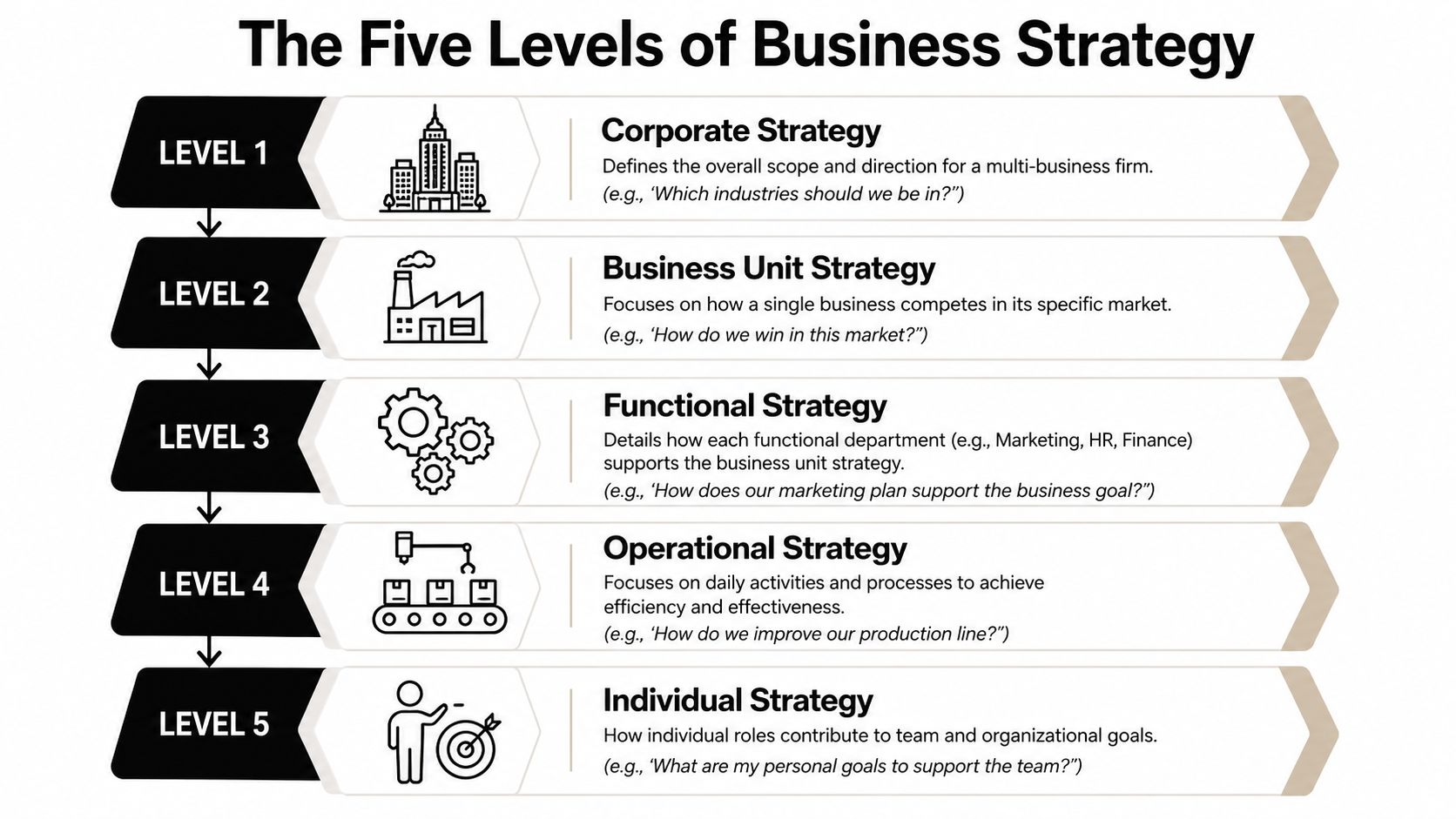
The Five Levels of Business Strategy
Most strategy confusion comes from mixing levels. A founder says “strategy” and means company direction. A product lead says “strategy” and means feature priorities. A growth lead means acquisition channels. All of them may be right, but they're talking about different layers.
Research summarized in this McGill strategy paper says successful strategy depends on aligning four elements across the business: strategic posture, competitive advantage, business concept, and value delivery system. That only works when each level supports the one above it.
Level one and level two
The top of the stack deals with scope and competition.
Level | Core question | Traditional example | Modern digital example |
|---|---|---|---|
Corporate strategy | What businesses should we be in? | A conglomerate chooses to focus on healthcare and logistics, not retail | A fintech holding company decides to concentrate on automated asset management rather than payments |
Business unit strategy | How do we win in this market? | A bank targets premium small-business clients through service quality | A DeFi product focuses on the niche of AI-assisted stablecoin yield instead of broad crypto investing |
Corporate strategy is the widest lens. It sets the boundaries of the game. If a firm owns multiple lines of business, this level decides where capital should go.
Business unit strategy is narrower. It answers the sharper question: given this market, how will this business compete?
Level three and level four
Once the direction is set, teams need operating logic.
Functional strategy
This translates business-level choices into department plans. Marketing may focus on education rather than hype. Engineering may optimize for reliability before feature breadth. Finance may preserve flexibility instead of maximizing short-term revenue.Operational strategy
This governs how daily processes support the larger plan. A manufacturer may redesign procurement. A software company may tighten release cycles. A DeFi team may define review rules for integrations, risk checks, and response protocols.
A useful way to test these levels is simple: can each team explain how its work reinforces the chosen way to win? If not, the stack is probably misaligned.
Before the next layer, here's a quick visual explainer:
Level five and why it gets ignored
The last level is personal.
Individual strategy sounds grand, but it's practical. It means each person knows what decisions, outputs, and habits matter most because of the larger strategy. A head of partnerships shouldn't chase every logo. A designer shouldn't optimize for novelty if the company wins through simplicity and trust.
Leadership test: Ask five people on different teams what the company is trying to become, how it plans to win, and what their role is in that. If you get five different answers, the strategy stack is leaking.
Why these levels matter in DeFi and tech
In fast markets, weak alignment gets expensive quickly. A protocol might say it values safety, while BD pushes aggressive integrations, product highlights headline APYs, and operations lacks a framework for rapid review. That's not a messaging problem. It's a strategy architecture problem.
The five levels help fix that. They turn “strategy” from a vague executive word into a chain of connected decisions, from portfolio scope down to individual actions.
Popular Frameworks for Strategic Planning
Frameworks don't create strategy on their own. They help you ask better questions. Think of them as tools in a workshop. A compass, a microscope, and a wrench don't do the same job. Neither do SWOT, Five Forces, and AFI.

SWOT for seeing the current reality
SWOT stands for strengths, weaknesses, opportunities, and threats. It's simple, which is why many teams misuse it. The value isn't in filling four boxes. The value is in forcing leaders to compare internal reality with external conditions.
For a coffee chain, that might mean strong local loyalty, weak margins, a chance to expand catering, and a threat from rising rents.
For a DeFi team, it might look different:
Strengths could include product clarity or a strong risk culture.
Weaknesses might be limited distribution or dependency on a small team.
Opportunities may come from underserved user segments.
Threats often include protocol risk, incentive shifts, and fragmented liquidity.
Five Forces for understanding the game
Porter's Five Forces helps you study the structure around the business. Not just direct competitors, but the pressure coming from substitutes, suppliers, buyers, and new entrants.
That matters because some markets look attractive from the outside but are structurally brutal. You may have a good product and still struggle if users switch easily, distribution is controlled by gatekeepers, or alternatives are abundant.
This tool is especially helpful when founders say, “We don't really have competitors.” Usually that means they haven't mapped the full set of substitutes or power dynamics yet.
A framework is useful when it changes a decision. If it only produces a prettier slide, it's paperwork.
AFI for turning analysis into action
The AFI framework stands for Analyze, Formulate, Implement. It's useful because it treats strategy as a process rather than a brainstorming session.
The Analyze phase matters more than many teams admit. According to the AFI overview at Hyper Island, this phase requires a quantitative SWOT assessment that benchmarks internal capabilities against industry standards, and unaddressed gaps can reduce strategic execution success by 30 to 40 percent.
That point is easy to overlook. Teams often rush to formulation because analysis feels slower. But if your diagnosis is weak, your strategic choices will be weak too.
Which tool fits which problem
Use a framework based on the question in front of you:
Use SWOT when your team needs a shared picture of internal capability and external pressure.
Use Five Forces when you need to understand whether the market structure supports attractive economics.
Use AFI when the bigger issue is sequencing, from diagnosis to decisions to execution.
None of these frameworks should become a ritual. Their job is to sharpen judgment. That's it.
How to Craft Your Business Strategy
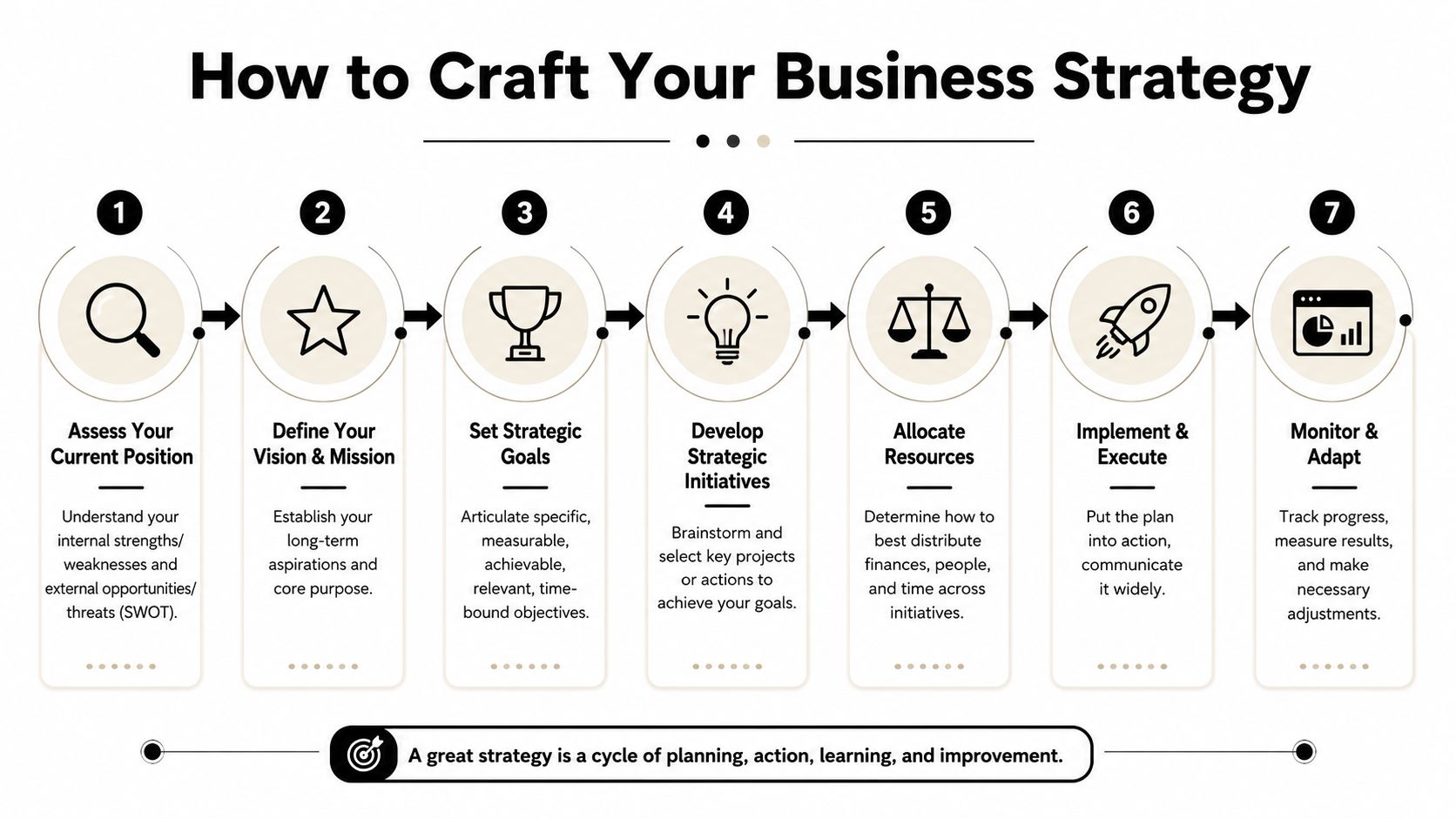
Most founders don't need a thick strategy binder. They need a sharp operating logic that helps people make better choices. That means moving from analysis to decisions, then from decisions to execution.
A practical way to think about it is this: strategy isn't a document you finish. It's a discipline you run.
Start with diagnosis, not declarations
Founders love vision statements because they're energizing. But the best strategy work starts with uncomfortable reality.
Look at your market, your capabilities, your customer behavior, and the constraints you can't wish away. Then ask a more demanding question: given this reality, what must be true for us to win?
That means collecting evidence, not just opinions. Customer interviews. Product usage. Retention patterns. Margin pressure. Team capability gaps. Capital limits. If you're making investment or treasury decisions, it also helps to sharpen your process for evaluating investment opportunities with better discipline.
Make the hard choices
Michael Porter's view is still useful here. In this summary of his 1980 strategy framing, strategy combines ends and means, and firms that follow that discipline show 25% higher sustainable growth rates. The practical message is simple. Strategy works when goals and policies fit together.
Here's a compact way to write those choices:
Where will we play?
Pick the market, segment, or use case where you have a plausible edge.How will we win?
Define the advantage. Lower cost, better trust, sharper focus, faster execution, stronger product experience, or another real difference.What won't we do?
Most strategies reveal their honesty through this. Refusing certain customers, channels, features, or markets protects coherence.
For founders raising capital or expanding internationally, external context matters too. If your strategy includes investor outreach in Latin America, this guide to Brazil's investor landscape can help you think more concretely about capital networks and market entry choices.
Turn strategy into a live operating system
After the choices are made, the work shifts from design to translation.
A strong strategy becomes visible in a few places:
Resource allocation
Budget, hiring, and leadership attention move toward the chosen priorities.Team-level goals
Every function can explain how its work supports the strategy.Decision rules
People know how to choose when trade-offs appear.Feedback loops
Leaders review results often enough to adjust course before drift becomes expensive.
A simple strategy memo often works better than a polished deck. Keep it short enough that people can remember it and specific enough that it changes behavior.
Useful constraint: If your strategy can't guide a decision on hiring, roadmap priority, pricing, or partnerships, it's still too abstract.
Conclusion Strategy as a Living Process
The biggest mistake in business strategy isn't picking the wrong framework. It's treating strategy like a yearly artifact instead of a living process.
That mindset gap is now visible in the data. Research summarized here says 78% of organizations define strategy as annual planning, yet only 12% report that their strategy adapts effectively to market changes within the same year. That gap matters in any market. In tech, AI, and DeFi, it becomes dangerous.
A living strategy works more like a tested hypothesis. You choose where to play and how to win. Then you watch reality closely. Customer behavior changes. Distribution shifts. Costs move. New competitors appear. Risk changes shape. Leaders who treat strategy as fixed fall behind while still believing they're “following the plan.”
That's why the modern view of strategies definition business needs an update. The classic foundations still matter. Long-term goals, clear actions, and real resource allocation remain critical. But the operating model around them has changed. Strategy now has to function as a feedback loop.
If you work in software, this same adaptive mindset shows up in product thinking too. This piece on discovering your SaaS product strategy is worth reading because it pushes strategy closer to market learning, not just planning.
The companies that endure aren't the ones with the fanciest strategy documents. They're the ones that keep converting strategic intent into better decisions, then revising those decisions when reality gives them new information.
If you want a simpler way to put that mindset into practice for stablecoin yield, Yield Seeker gives you an AI-powered way to monitor and allocate capital across DeFi protocols in real time. It's built for people who want smarter, risk-aware automation without spending their days jumping between dashboards, tracking incentives, or manually rebalancing every new opportunity.