

You've probably seen the pitch already. An AI bot scans the market all day, catches patterns no human can see, and sends perfect crypto entries while you sleep. The screenshots look clean. The claims sound inevitable. In a market that never closes, that story is hard to ignore.
The problem is that “AI in crypto” gets collapsed into one idea though it constitutes two very different businesses. One is speculative trading, where AI crypto signals try to predict short-term price movement and turn that into entries, exits, stop-losses, and take-profit targets. The other is capital allocation, where AI helps move stablecoins across DeFi opportunities to pursue risk-aware yield without needing to guess whether Bitcoin or Solana will rip tomorrow.
Those are not small differences. They lead to different risk profiles, different user behavior, and different ways people lose money.
The AI Crypto Hype and Your Money
A familiar pattern plays out every cycle. Someone joins a Telegram group, subscribes to a signals service, or connects an automated bot because the promise sounds efficient. No staring at charts. No emotional trades. Just machine-generated decisions.
That appeal is real. Crypto is fragmented, noisy, and fast. Humans get tired. Models don't. If you're juggling work, family, and a portfolio spread across exchanges and wallets, AI sounds like a way to amplify your attention.
But in practice, AI crypto usually takes one of two forms:
Speculative signal generation for volatile assets like BTC, ETH, SOL, XRP, TRX, or ADA.
Yield automation for assets like stablecoins, where the job is allocation and monitoring rather than directional prediction.
The first path attracts people chasing upside. The second tends to attract people protecting treasury, preserving purchasing power, or trying to earn on idle stablecoin balances.
Practical rule: If the AI has to predict short-term price direction, your risk is tied to market behavior you don't control. If the AI is allocating stablecoins across yield sources, your risk is tied more to protocol selection, liquidity, and operational discipline.
That doesn't make yield automation “safe” in an absolute sense. DeFi still carries smart contract risk, platform risk, and liquidity risk. But it's a different category of problem. Forecasting whether a coin pumps in the next few hours is a much harder and less stable task than comparing available yield venues and rebalancing around risk constraints.
Most marketing pages blur that distinction because “AI” sells better when it sounds universal. It isn't. If you hold mostly volatile assets and enjoy active execution, signals may fit your style. If you mostly hold stablecoins and want less operational drag, AI belongs in a different seat.
What Exactly Are AI Crypto Signals
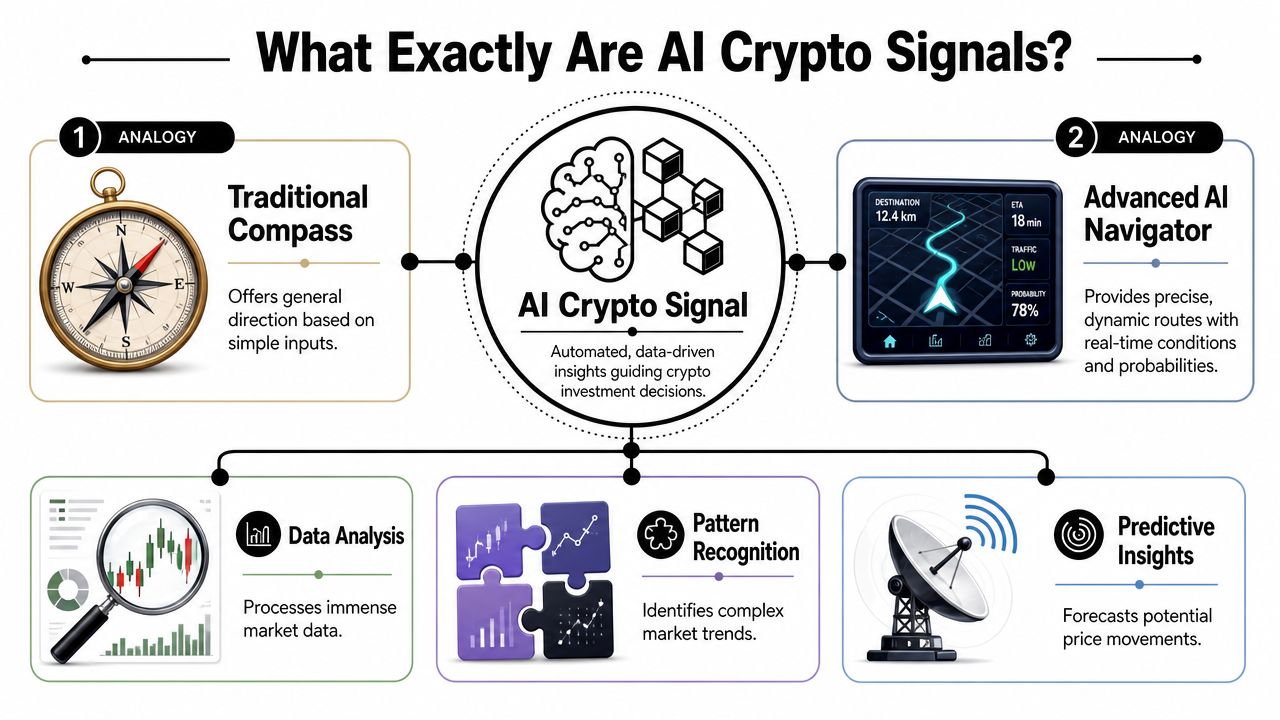
Think of an AI crypto signal like a hyper-advanced weather forecast for markets. A weather model ingests wind, pressure, temperature, and historical patterns, then gives you a probability-based view of what might happen next. It's better than guessing, but it's still not certainty. Markets work the same way.
An AI crypto signal is a machine-generated trade prompt. According to the product description for Crypto Signals AI Trading Bot, these prompts are derived from multi-source data including price, volume, derivatives metrics, order-book depth, labeled on-chain flows, and sentiment analysis, with outputs structured as entry or exit points, stop-loss, and take-profit targets.
The inputs behind the signal
The model usually starts by collecting market and blockchain data from several directions at once. The obvious inputs are price and volume. The better systems add derivatives data like funding rates and open interest, plus order-book depth, exchange inflows and outflows, and whale activity.
Some tools also pull in sentiment signals. That can mean parsing news, social chatter, or public commentary to detect shifts in tone before they fully show up in price. If you work with visual explainers or market education content, a tool like the LunaBloom AI video app can help turn dense signal concepts into short videos your team or community can absorb.
The model brain
The middle layer is the part people call “AI,” but it's really just the prediction engine. The verified description above references deep-learning models like CNN-LSTM and notes that some systems generate predictions across timeframes from 15-minute to 1-day windows.
That matters because a signal is only as useful as its operating context. A pattern that works on an hourly chart can fail badly on a daily one. The model isn't reading the future. It's ranking probabilities based on what it has seen before.
The output you actually receive
A usable signal turns all that hidden processing into something simple:
Entry point where the trade becomes valid
Exit point if the move reaches its target
Stop-loss if the setup fails
Take-profit target to define reward
That packaging is why signals feel powerful. The complexity is hidden. But the hidden part is also where most of the failure lives.
How AI Models Generate Trading Signals
Under the hood, signal systems follow a workflow that's more industrial than magical. They ingest a large stream of data, transform it into model-ready features, train prediction logic on historical examples, then simulate how those predictions would have performed.
Data aggregation and feature building
The first stage is collection. Systems pull exchange data, blockchain activity, derivatives metrics, and market structure inputs into one stream. Raw data is messy, so builders convert it into features that a model can work with. That can include volatility state, order-book imbalance, directional momentum, or changes in on-chain flow behavior.
Some teams build this stack themselves. Others assemble it from APIs and analytics providers. Either way, garbage in still means garbage out. If the data arrives late, omits thin-market conditions, or misses key liquidity shifts, the resulting signal can look precise while being structurally weak.
Training and backtesting
Once features are prepared, the model is trained on historical market behavior. It looks for recurring relationships between inputs and later price movement. Providers often present this stage as proof that the system works, because historical simulations can look very convincing.
That's where the headline claims come from. An industry analysis of top tools says the best AI crypto signals tools claim an annual trade success rate exceeding 80%, based on large datasets across trading volume, price movement, and real-time market information, as described by AlgosOne's overview of AI crypto signals.
The important word there is claim.
Why process sophistication doesn't guarantee edge
An advanced workflow can still produce fragile results. Many teams mistake complexity for resilience. More inputs, deeper models, and prettier dashboards don't automatically create tradable edge.
If you want a grounded look at how machine-led systems are built and where they break, this breakdown of machine learning trading algorithms in practice is worth reading alongside any provider's sales page.
Good signal infrastructure matters. But execution quality, slippage, latency, and market regime matter just as much, and marketing copy rarely dwells on any of those.
A serious practitioner treats model outputs as one layer in a trading process, not as a replacement for market structure awareness.
The Hard Truth About Signal Accuracy and Risks
The cleanest way to judge AI crypto signals is to compare what they do in backtests versus what they do when real money is on the line. That comparison is usually where the fantasy breaks.
One documented systematic approach to AI-driven crypto trading showed a model with 94% backtest accuracy that dropped to 51% live performance, with a 58% win rate and 11.3% maximum drawdown, according to this real-world trading breakdown shared on Reddit.
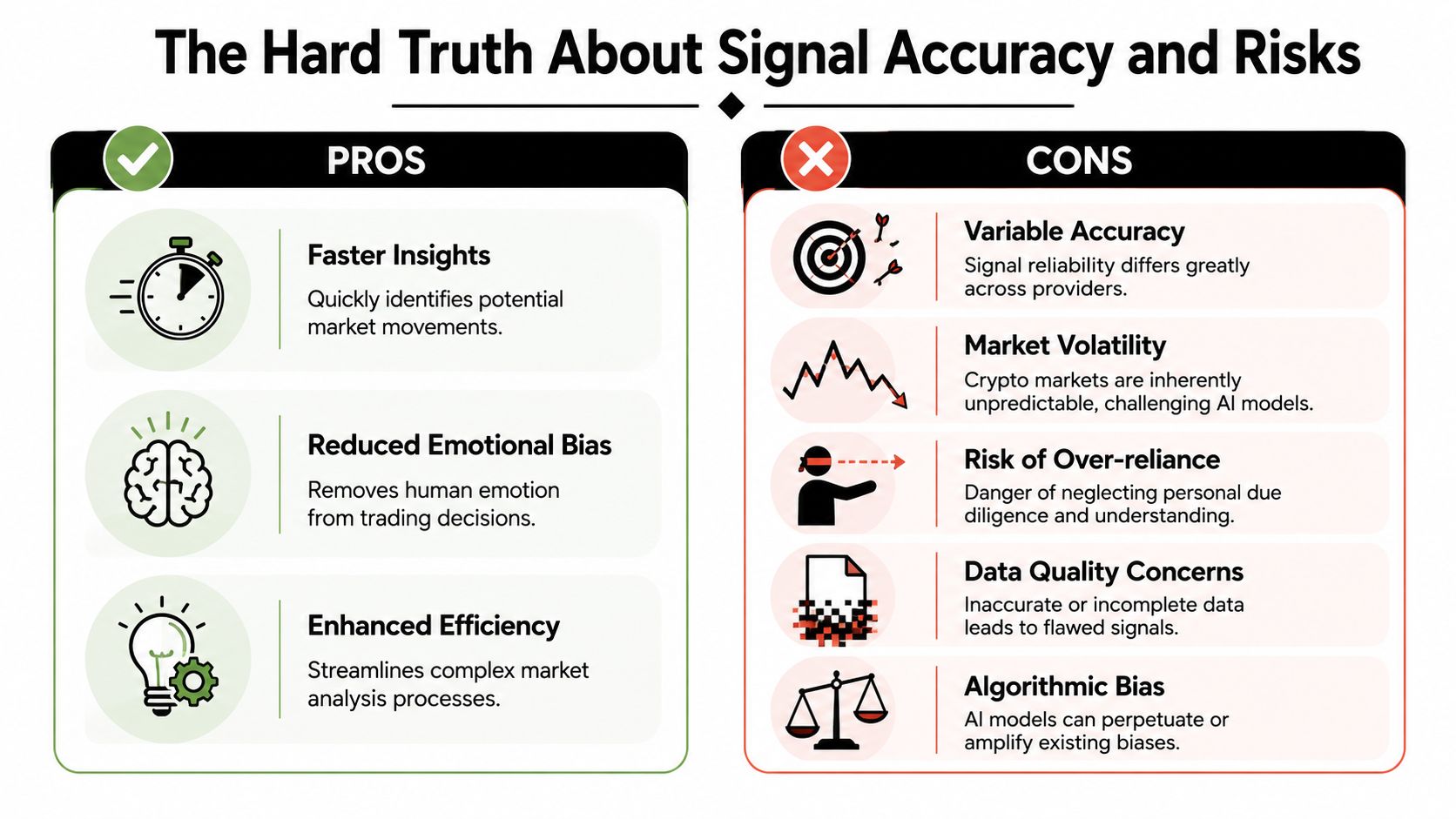
That gap is the whole game. A strategy can look surgical on historical candles and then become ordinary, or worse, once spreads widen, volatility shifts, liquidity thins out, or the market starts behaving in a way the model didn't learn.
Why backtests fail in live markets
The first culprit is overfitting. The model doesn't learn a durable market rule. It learns the quirks of the past dataset. That can produce impressive historical accuracy and disappointing live execution.
The second problem is regime change. Crypto doesn't move through one stable environment. It flips between trend, chop, panic, reflexive rallies, and liquidity vacuums. A model trained in one environment can degrade quickly in another.
Then there's the operational layer:
Latency changes the entry you realize.
Slippage damages the reward profile.
Liquidity disappears fastest when you most need it.
Smaller-cap pairs can invalidate otherwise good-looking signals.
What strong operators do differently
Serious systems don't rely on entries alone. Verified guidance from CoinSpot's AI crypto signals guide emphasizes fixed risk per trade of 0.5% to 1.0%, a global drawdown cap such as minus 10% to 15%, and a kill-switch for abnormal slippage or connectivity failures. The same guidance also stresses 30-day paper trading, stress-testing in stagnant markets, and regime classification using volatility percentiles, ADX trend strength, and liquidity conditions.
That's the part retail users skip because it isn't exciting.
If a provider spends more time selling entries than explaining risk controls, you're not buying a system. You're buying hope packaged as automation.
This is also where broader AI discipline matters. Teams building or using AI outputs need guardrails, validation, and failure-mode thinking. A useful non-crypto reference is Mava's article on practical steps for AI reliability. Different domain, same principle. Models need checks because confident output and correct output are not the same thing.
What works and what doesn't
What tends to work:
Narrow use cases where the model operates in a clearly defined market slice
Strict position sizing and enforced stop logic
Forward testing before capital is deployed
Regime filters that block trades in bad conditions
What usually fails:
Blind trust in headline accuracy
One-model-fits-all strategies
Ignoring execution friction
Treating AI signals as passive income
The harsh truth is simple. AI crypto signals can be useful, but they're fragile. They require supervision, skepticism, and risk discipline. Anyone selling them as a money printer is either inexperienced or dishonest.
How to Spot Scams and Perform Due Diligence
By the time many start asking hard questions, they've already paid for access. That's backwards. Due diligence has to happen before you join the channel, connect the bot, or hand over API permissions.
A big warning sign is performance that only exists in the past. One analysis of crypto trading signals highlights an underserved issue: models showing 78% accuracy on 2024 data can collapse to 52% on live 2026 data due to overfitting, while few platforms share transparent forward-testing results, as noted in TradeAlgo's guide to crypto trading signals.
Red flags that should stop you fast
Some warning signs are obvious, but people still rationalize them when greed is in the room.
Guaranteed returns. Real trading systems don't guarantee outcomes.
Anonymous operators with no accountability. Pseudonymous builders exist in crypto, but there should still be a public track record, community history, or verifiable reputation.
Screenshot-based proof. Screenshots are marketing assets, not evidence.
No explanation of risk controls. If they can't explain stop logic, drawdown handling, or market filters, they probably don't have them.
Pressure tactics. Countdown timers, “VIP seats,” and upsells for secret settings are usually there to close a sale, not improve your trading.
A practical diligence checklist
Don't ask whether the bot is “AI-powered.” Ask whether the operator behaves like someone managing real risk.
What to check | Why it matters |
|---|---|
Forward-tested results | Backtests only prove the model can fit history |
Current market logs | You need evidence the system functions in present conditions |
Risk parameters | Position sizing and stop logic often matter more than entries |
Execution assumptions | Slippage and liquidity can erase paper edge |
Community discussion | Users usually reveal weaknesses long before the homepage does |
Questions worth asking before you deposit
A serious provider should answer plain questions without hiding behind jargon:
How are signals validated in live conditions?
What market conditions cause the system to stop trading?
How often is the model retrained or adjusted?
How are thin-liquidity pairs handled?
What does a bad month look like operationally?
Don't outsource judgment just because the interface looks technical. A glossy dashboard can hide a weak strategy as easily as it can present a good one.
If the answers are vague, evasive, or entirely promotional, walk away. In crypto, “AI” is often used to make ordinary noise sound proprietary.
Trading Signals vs Automated Yield The Two Faces of AI
The biggest mistake in this market is treating every AI crypto product as if it solves the same problem. It doesn't. Trading signals and yield automation sit on opposite sides of the decision tree.
Signals try to answer a hard question: Where will price move next? Yield automation tries to answer a different one: Where should capital sit right now to earn without unnecessary operational waste?
Those are different tasks, with different failure modes.
The practical difference
Active signal users are effectively running a lightweight trading operation. They need to monitor entries, manage execution, respect stops, and understand when market conditions invalidate the model. Even if a bot automates part of it, the user still owns the consequences of directional risk.
Yield automation is closer to portfolio operations. The AI's job is not to predict a breakout on a volatile token. It's to monitor fragmented DeFi venues, compare opportunities, and help allocate stablecoin capital with consistency.
For a deeper look at this second category, this article on AI yield aggregators in DeFi lays out how automation changes the workload for stablecoin holders.
AI trading signals vs AI yield automation
Criterion | AI Trading Signals | AI Yield Automation |
|---|---|---|
Primary goal | Capital appreciation from price moves | Income generation from deployed capital |
Core task | Predict direction and timing | Allocate and rebalance across yield sources |
Typical assets | Volatile tokens | Stablecoins |
Risk profile | High, because price risk is central | Lower or moderate, depending on protocol and counterparty choices |
User effort | High, even with automation | Lower, because monitoring and allocation can be systematized |
Best fit | Active traders with tolerance for drawdowns | Busy investors, treasuries, and stablecoin holders seeking simpler yield capture |
Which one fits most people
Individuals don't truly want trading signals. They want outcomes that signals promise. There's a difference.
If someone enjoys market structure, accepts drawdowns, and can actively supervise execution, AI-assisted trading can be a tool. If someone mainly holds USDC or similar assets and wants less idle cash drag, directional speculation is often the wrong tool for the job.
That's why I'm skeptical when people describe AI trading bots as “passive income.” Trading is not passive when the edge depends on changing market regimes. Yield automation can be closer to passive, though even there, the right mindset is monitored delegation, not blind trust.
A Smarter AI Path for Stablecoin Holders
For stablecoin holders, the better AI use case usually isn't prediction. It's optimization.

If your capital sits in USDC and your goal is to earn without turning yourself into a full-time DeFi analyst, you don't need an AI that guesses tomorrow's candle. You need one that monitors venues, checks opportunities, and helps move capital with discipline.
That distinction matters because well-designed AI systems are defined less by flashy entries and more by control systems. Verified guidance from this explanation of using AI for investing aligns with a broader truth from the trading side: risk rules matter. In signal systems, that can mean fixed risk per trade in the 0.5% to 1.0% range and a global drawdown cap, as described earlier in verified industry guidance. In stablecoin automation, the spirit is similar even if the mechanics differ. The best systems constrain risk before they chase return.
Why this path is more sustainable
Stablecoin yield automation solves a more manageable problem. It doesn't need to forecast whether a market-wide narrative collapses by lunchtime. It needs to evaluate available DeFi options, monitor changing conditions, and keep capital productive without forcing the user to babysit multiple protocols.
That doesn't erase risk. Smart contract failures, liquidity issues, and platform design flaws still matter. But the operating model is saner for people who want consistency over adrenaline.
A short demo helps make the contrast concrete:
For most busy investors, creators, and treasury managers, this is the more rational lane. Use AI where it can reduce research burden and allocation friction. Don't force it into a high-variance trading role unless you want to run a trading system.
If you're holding stablecoins and want a simpler way to put them to work, Yield Seeker offers an AI-powered approach built for automated, risk-aware DeFi yield. It's a practical fit for people who want less dashboard juggling and more disciplined capital allocation.