

You've probably already done the obvious things with idle stablecoins. You moved funds off an exchange. You found a few DeFi venues that don't feel reckless. You learned to compare yield, smart contract risk, and liquidity. And now a new stream of chatter keeps showing up in your feed: AI tokens.
That can trigger two bad reactions. One is dismissing the whole category as another rotating narrative. The other is jumping in before you understand what you're buying. Neither helps if your real goal is practical: preserve optionality, keep friction low, and explore new sources of upside without turning portfolio management into a second job.
For stablecoin holders, AI crypto sits in an interesting middle ground. It's not just a speculative corner of the market, and it's not simple passive yield either. It's a set of networks where tokens often do something concrete: pay for compute, provide data access, coordinate agents, or reward contributors. That matters because utility changes how you evaluate risk.
The Next Frontier Beyond Stablecoin Yield
Stablecoin strategies teach useful habits. You learn to care about cash flow, protocol design, and downside before upside. Those habits transfer well to AI crypto tokens because the strongest projects aren't asking you to believe in a vague future. They're asking whether a token is necessary for a service people actually use.
That's the first mindset shift. With stablecoins, you usually start by asking where to park capital. With AI crypto tokens, you start by asking what economic function the token performs. If the answer is thin, the opportunity probably is too.
Many readers arrive here from a familiar position: yield is fine, but it feels bounded. You can optimize stablecoin allocations only so far before every additional basis point requires more dashboards, more wallet moves, and more attention. AI crypto introduces a different type of exposure, one tied to infrastructure and automation inside Web3. A useful companion read on that broader direction is Flaex's insights on AI transforming Web3, which frames why AI is becoming part of crypto product design rather than just a market theme.
The practical question isn't “Will AI be big?” It's “Which tokens are required for useful AI activity on-chain or around it?”
For a stablecoin holder, that leads to a low-friction path. You don't need to become an AI researcher. You need to understand which token models create real demand, how those tokens plug into DeFi, and how to experiment without abandoning the discipline that made stablecoins attractive in the first place.
What Are AI Crypto Tokens Really
The simplest definition is this: AI crypto tokens are utility assets used inside decentralized AI networks. Think of them as API keys for a permissionless machine. Instead of paying a company for compute, data, model output, or agent activity, users spend the network's token.
A well-designed AI token isn't just a chip in a casino. It's part payment rail, part incentive system, and sometimes part governance tool.
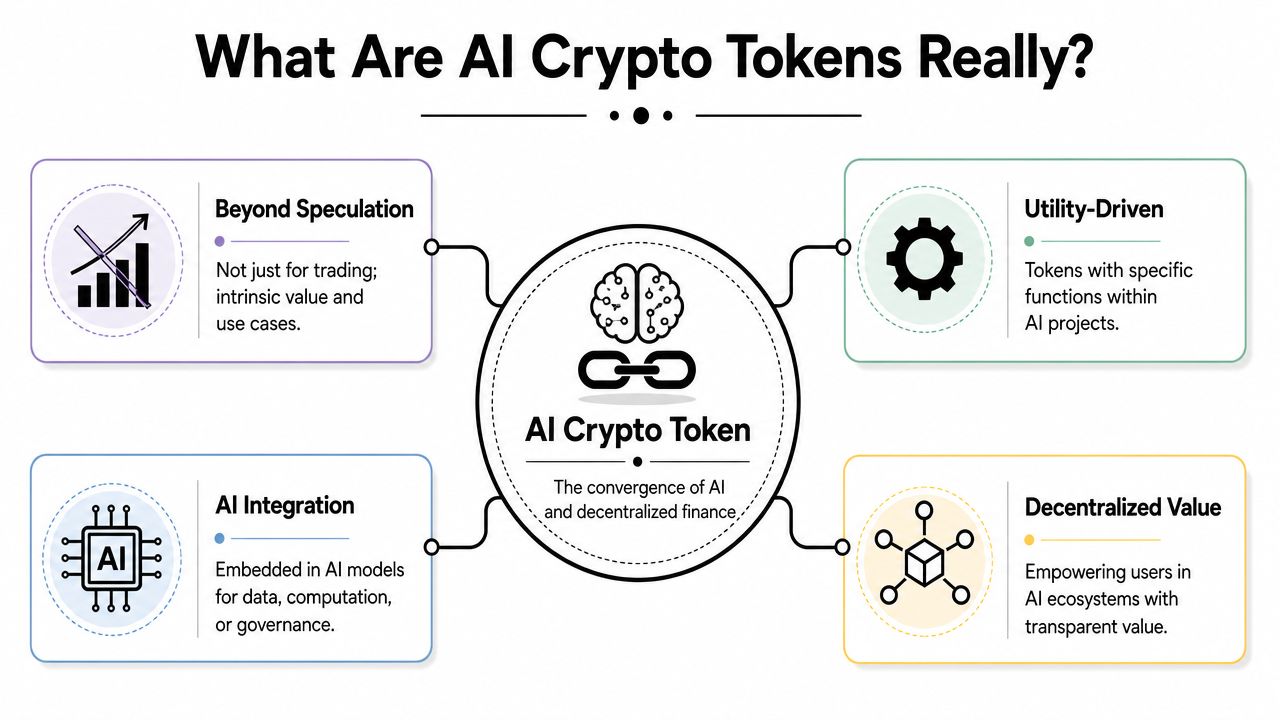
The fuel analogy works
If you've used an API from OpenAI, Anthropic, or a cloud provider, you already understand the basic idea. You don't buy the whole company. You pay for access to a service. AI crypto tokens aim to play a similar role in decentralized systems.
In that setup, different participants contribute different things:
Compute providers offer GPU or processing capacity.
Data contributors provide or curate useful datasets.
Model builders train or deploy AI systems.
Users request outputs such as inference, analysis, indexing, or automation.
The token coordinates payment among them. Blockchain handles accounting and settlement. AI handles the task itself.
A technical paper on decentralized AI token design describes this cleanly: AI crypto tokens function as the operational fuel for decentralized AI networks. In Render's case, the paper notes that its Proof-of-Render model requires clients to spend tokens for compute power, while providers earn tokens after successful on-chain verification of completed work. That creates a direct link between token movement and computational activity.
Why blockchain is even involved
Readers often get stuck here. If AI can run off-chain, why add a token and a blockchain at all?
The answer is coordination. Blockchains give these networks a neutral ledger for who contributed what, who gets paid, and how rules get enforced. Without that, you don't have a decentralized network. You just have another software company with a token attached.
That doesn't mean every project fully solves the decentralization problem. Some still rely heavily on off-chain computation or centralized infrastructure. That's why token utility matters more than branding.
A good mental model is:
Layer | Job |
|---|---|
AI layer | Produces the intelligent output |
Blockchain layer | Tracks ownership, payment, and rules |
Token layer | Aligns incentives across users and providers |
Later, when you evaluate projects, this structure helps you ask sharper questions. Is the token necessary? Is the blockchain doing real coordination work? Or is AI just a label attached to an otherwise ordinary crypto asset?
Before you move on, one adjacent planning topic is easy to overlook. As portfolios become more automated and more on-chain, basic crypto estate planning starts to matter too. PeerPush has a thoughtful piece on that in its featured crypto will.
A quick visual walkthrough can help anchor the concept before you start comparing projects.
How AI Token Models Create Value
Once you stop treating AI crypto tokens as a single bucket, the category gets easier to analyze. Different projects create value in different ways. Some monetize computation. Others monetize data access, model usage, or network governance. The key is to identify where demand for the token comes from.
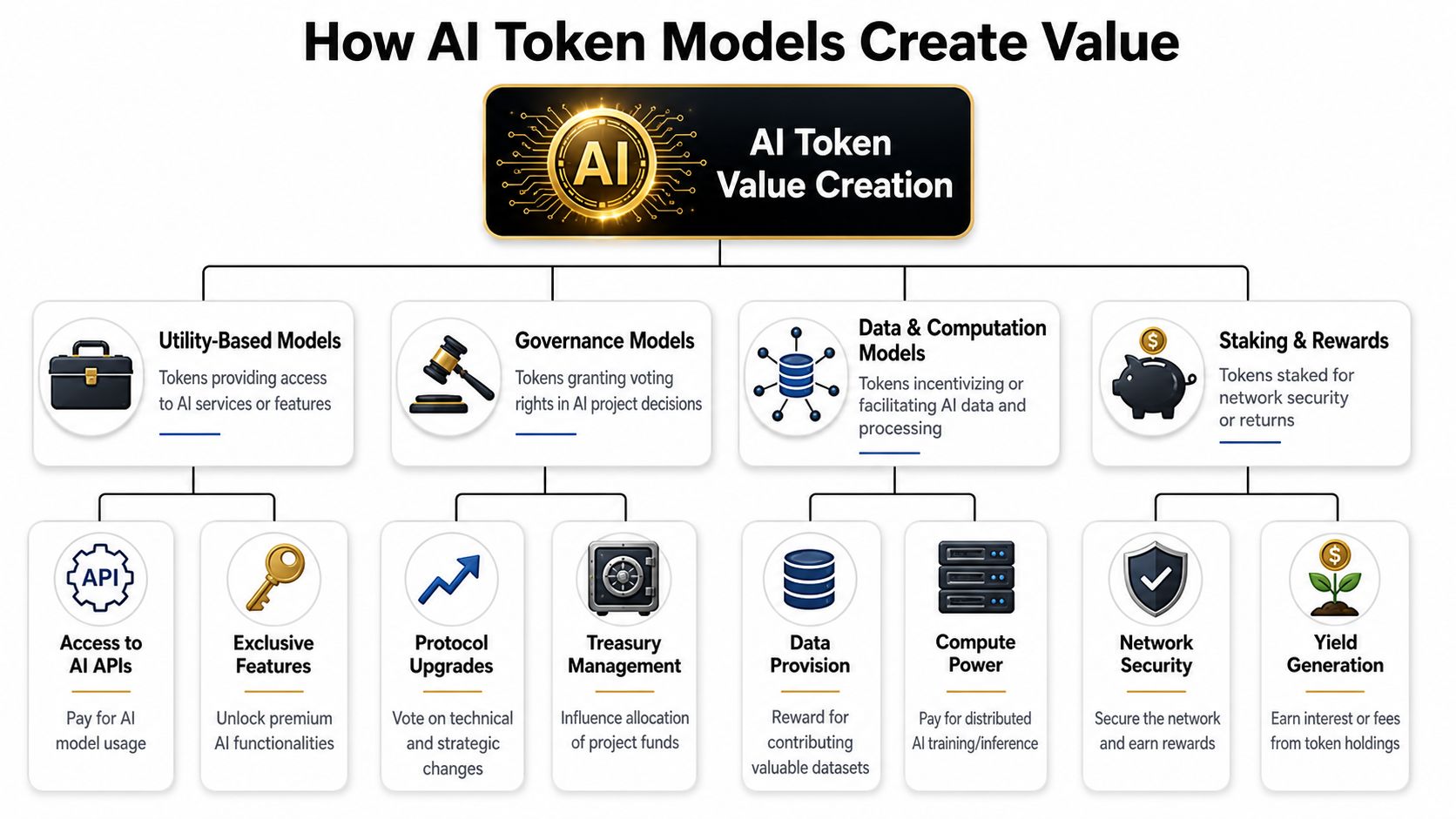
Payment models
This is the cleanest model. Users spend the token to buy an AI-related service.
That service could be compute, rendering, data access, model inference, or another machine-driven task. If usage rises, token demand can rise with it because the token is part of the payment path. This is the closest thing to a direct economic loop.
A useful test is whether the token sits in the critical path of the product. If users can bypass the token without friction, value capture gets weaker.
Staking and access models
Some AI networks require staking to secure participation, qualify as a provider, or access better economics within the platform. Here the token isn't only spent. It's also locked.
That matters because locked tokens can support network integrity and align participants with long-term service quality. In some cases, staking also creates an income stream tied to protocol rules rather than ad hoc speculation.
Practical rule: If a token offers staking, ask what the staking actually does. Security, access control, and work quality are stronger answers than “it boosts community engagement.”
Governance models
Governance tokens let holders vote on upgrades, treasury decisions, emissions, or technical parameters. In theory, that gives token holders influence over how the network evolves.
In practice, governance only creates durable value when protocol decisions materially affect the product. A governance token for a dead network isn't powerful. It's ceremonial.
Here's a fast way to compare the three common models:
Model | What drives demand | Main risk |
|---|---|---|
Payment | Users need the token to consume services | Service demand may not scale |
Staking | Participants lock tokens for access or rewards | Yield may exist without real utility |
Governance | Holders influence meaningful protocol decisions | Voting rights may be cosmetic |
Data and computation models
Some projects create token demand by rewarding contributors who provide something scarce. That might be computing power, specialized data, or successful model outputs. The token becomes both payroll and access credential.
This is often where the strongest designs live, because the token connects buyers and suppliers in one closed loop. Someone pays to get work done. Someone else earns for doing it. If the blockchain verifies enough of that flow, the token has a clearer reason to exist.
For stablecoin holders, this framework is useful because it changes what “value” means. You're not just scanning charts. You're looking for a system where the token is tied to a service, a bottleneck, or a governance right that users can't easily replicate elsewhere.
Notable Categories and Representative Projects
The AI token market is broad enough that a flat “top tokens” list doesn't teach much. It's better to group projects by job. Once you do that, the overall picture starts to look less like hype and more like infrastructure.
The overall category is already meaningful in size. CoinGecko's AI category shows the market exceeded $21.5 billion in 2024, with major projects such as Render, The Graph, and Artificial Superintelligence Alliance helping anchor the ecosystem. The same category page also notes utility examples, including users staking FET for around 10% APR and using GRT to pay for indexed blockchain data, which highlights that these assets are used inside their networks rather than held only for speculation in CoinGecko's AI token market overview.
Decentralized compute
This category focuses on raw processing power. Networks connect people who need compute with people who can supply it. Render is the clearest representative example because its token is tied to paying for rendering and related compute tasks.
For a stablecoin holder, the practical takeaway is simple: this bucket resembles infrastructure. You're not betting on a consumer app. You're evaluating whether decentralized compute can win share in workloads that need flexibility, transparency, or global supply.
Data and indexing
The Graph fits here. Its role is different from a compute marketplace. It helps users and applications access indexed blockchain data more efficiently, and the token is used in that data economy.
That's a good reminder that “AI crypto” doesn't always mean a token directly trains models. Sometimes it supports the data layer that intelligent systems and decentralized apps depend on.
AI models, agents, and service networks
Artificial Superintelligence Alliance represents a broader thesis. The token is tied to a network focused on AI services and agent-based activity. Instead of one narrow job, these projects aim to support a wider ecosystem of machine-driven interactions.
This is often the category that grabs headlines because the story is ambitious. It's also where investors need the most discipline, since broad visions can outpace product reality.
A simple way to think about the field:
Compute networks sell processing.
Data networks organize and expose information.
Agent and model networks coordinate intelligent services.
If you work in operations or customer support, the logic is familiar. Businesses already use AI to route requests, qualify leads, and automate repetitive tasks. A mainstream example outside crypto is Donely's AI support for WhatsApp, which shows how AI becomes most valuable when it is embedded in an actual workflow. AI crypto tokens try to do something similar in decentralized systems: tie automation to an economic rail.
How AI Tokens Interact with DeFi
If you already understand DeFi from the stablecoin side, AI tokens aren't a foreign country. They're another asset class entering familiar rails: staking, lending, liquidity provision, and automated strategy layers.
That matters because your existing DeFi habits still apply. Wallet hygiene still matters. Position sizing still matters. Exit liquidity still matters. What changes is the behavior of the underlying asset and the sources of yield around it.

The main interaction points
Some AI tokens offer native staking inside their own ecosystems. Others become tradable assets on DEXs and then enter DeFi like any other token pair. Once that happens, several paths open up:
Native staking
You lock the token in its home network to support participation, signal commitment, or earn protocol-defined rewards.DEX liquidity
You provide liquidity for an AI token pair and earn trading fees, while accepting price exposure and potential impermanent loss.Lending markets
When supported, holders can lend the token to earn interest or use it as collateral to borrow more stable assets.Strategy wrappers
Bots, vaults, or AI-driven systems can rebalance exposure, harvest rewards, and rotate between opportunities.
That last category is getting more interesting. Automation is becoming part of DeFi's interface layer, not just its back end. If you want a grounded primer on how this intersects with machine-assisted portfolio management, Yield Seeker's guide to the AI-driven DeFi agent is useful background.
Where stablecoin holders should be careful
The friction isn't technical understanding. It's behavioral mismatch.
Stablecoin holders usually like predictable dollar-denominated outcomes. AI tokens introduce directional exposure, narrative volatility, and token-specific risk. The DeFi wrapper doesn't remove that. In some cases, it amplifies it.
Adding an AI token to a DeFi strategy changes two variables at once: protocol risk and asset risk.
That means the right question isn't “What yield can I earn?” It's “What exactly am I being paid to hold, lock, or provide?” A high yield on an unstable token can still be a bad trade if the token's role in the network is weak.
A useful mental split
If your goal is... | Then focus on... |
|---|---|
Conservative experimentation | Small spot exposure or modest staking in established networks |
Active yield generation | Liquidity and lending opportunities with clear exit routes |
Hands-off management | Automated monitoring, rebalancing, and risk controls |
AI can simplify the market environment rather than complicate it. Not because it removes risk, but because it can reduce the manual burden of watching markets, comparing venues, and reacting to changing conditions.
An Evaluation Framework for AI Projects
Most mistakes in AI crypto happen before anyone clicks “buy.” They happen during evaluation. People hear “AI,” see a token chart, and skip the boring questions that protect capital.
That's a costly shortcut in a market that still feels early. One discussion of the category notes that some AI crypto projects already use AI for advanced financial functions such as analyzing real-time data to assess borrower creditworthiness and set dynamic interest rates, while also stressing that the market remains nascent and that strong use cases and fully on-chain model building are better signs of potential in this overview of AI crypto project use cases.
Start with token necessity
The first filter is brutal and simple: does the token need to exist?
If the product works the same with USDC, ETH, or a regular database entry, the token may be decorative. You want projects where the token handles payment, staking, coordination, or governance in a way that's hard to remove without damaging the network.
A practical companion to this mindset is Yield Seeker's explanation of what tokenomics means. It helps frame supply, incentives, and utility in plain terms.
Then test the operating model
Use a checklist, not vibes.
Real utility
Look for a token tied to tasks, access, or participation. If the use case sounds interchangeable, treat that as a warning.On-chain behavior
Check whether wallets, transactions, and participation patterns match the project's story. Thin activity undercuts grand claims.Team credibility
Builders don't need to be famous, but they should be identifiable, technically coherent, and consistent about what the product does.Data or compute moat
Ask what the network has that another project can't easily copy. A token without a moat competes mostly on attention.
Watch for specific red flags
A lot of weak projects share the same tells:
Good signal | Red flag |
|---|---|
Token tied to product usage | Token exists mainly for exchange listing |
Clear explanation of who pays and who earns | Vague “ecosystem” language |
Credible path to on-chain verification | Heavy dependence on unverifiable off-chain claims |
Focused product scope | Every AI buzzword in one pitch deck |
A strong AI crypto project should answer three questions quickly: who uses it, what they pay for, and why the token sits in the middle.
Keep risk in the foreground
Even solid projects can disappoint. Off-chain reliance can weaken the decentralization story. Governance can look distributed while control remains concentrated. Regulation can shift. And market enthusiasm can outrun actual usage for long stretches.
Stablecoin holders usually have one advantage here: they're used to thinking in terms of capital preservation first. Keep that instinct. In AI crypto, discipline beats novelty.
Your Next Steps as a Stablecoin Holder
The easiest mistake is treating AI crypto as an all-or-nothing decision. It isn't. You can stay rooted in stablecoins and still explore the category with a measured process.
Start with observation before allocation. Pick a small set of projects from different categories and study their token role, DeFi venues, and liquidity profile. If one network is about compute, another about data, and another about agents, you'll learn faster by comparing their economic design than by reading social media threads.
Then move to controlled exposure. For most stablecoin-first investors, that means a small experimental allocation, not a portfolio rewrite. Keep the majority of capital in the risk profile you already understand. Treat AI tokens as a research position until the product, token utility, and market structure make sense to you.
Here's a clean progression:
Stay anchored in stablecoins so your base strategy remains liquid and familiar.
Choose one category first instead of buying a mixed basket you can't explain.
Use DeFi selectively only where the token's role and the venue's liquidity are clear.
Automate the boring parts because monitoring narratives, rewards, and liquidity manually gets old fast.
The final step is operational, not theoretical. Once you expand beyond pure stablecoin yield, complexity rises quickly. You need to track more assets, more venues, more changing conditions, and more moments where doing nothing is the wrong choice. That's why automation matters. Not because it guarantees better outcomes, but because it gives busy investors a way to act consistently.
If you want a practical perspective on that transition, Yield Seeker's article on AI crypto investing is a useful next read. It connects portfolio experimentation with automation, which is where many stablecoin holders eventually land.
The best path is usually the least dramatic one. Keep your stablecoin discipline. Learn how a few AI crypto tokens work. Test small. Let tools handle more of the monitoring than your calendar can.
If you want a simpler way to put that discipline into practice, Yield Seeker helps stablecoin holders automate yield decisions with an AI-powered agent, so you can stay hands-off without losing visibility or control.