
Around the world, low vitamin D is common enough that a deficient lab result often says more about how human biology works than about any mistake you made. If you have been asking, “Why am I deficient in vitamin D?”, the answer is often a mix of factors rather than one obvious cause.
Vitamin D works a bit like a relay system. Your skin, diet, gut, liver, kidneys, daily routine, and even your genes all play a part in getting it from “exposed” or “eaten” to “usable.” If one handoff in that relay is weaker than expected, your level can drop.
That helps explain a frustrating pattern many people see. You can spend time outside, eat well, take a supplement, and still come back low on a blood test. Two people with similar habits can end up with very different results because vitamin D status is shaped by geography, skin tone, age, body composition, digestive health, certain medications, and genetic differences that affect how the body makes, transports, or activates it.
Low vitamin D is often less about doing something wrong and more about several small disadvantages adding up at the same time.
Emerging research has made this picture clearer, not simpler. The useful question is usually not, “What single thing caused this?” It is, “Which combination of biology, lifestyle, and environment is working against me?”
The Global Vitamin D Shortage
Vitamin D deficiency has become common partly because human biology has not changed much, while daily life has changed a lot.
For most of human history, regular daylight exposure was built into work, travel, and routine. Now many people spend the brightest hours of the day indoors, then move between homes, offices, schools, stores, and cars with very little direct sun on their skin. Even health-conscious habits can lower vitamin D production. Sunscreen protects against skin damage, clothing limits UVB exposure, and exercising early or late in the day may miss the strongest sunlight for vitamin D production.
That helps explain why low vitamin D can show up in someone who seems to be doing everything right. The issue is often not one bad habit. It is several small barriers lining up at the same time.
Why modern life changed the equation
Vitamin D works a little like a solar charging system with several built-in limits. Your skin needs the right kind of sunlight, at the right time of year, with enough skin uncovered, for long enough. Then your body still has to absorb, transport, and activate what it makes.
Modern routines often interrupt that process in quiet ways:
Indoor work reduces midday sun exposure, which is the period when vitamin D production is usually most efficient.
Urban living changes sun exposure patterns. Tall buildings, apartment living, long commutes, and air pollution can all reduce effective sunlight.
Sun protection lowers skin damage risk, but it can also lower vitamin D production when used consistently on all exposed skin.
Body and biology still matter. Age, skin tone, body fat, digestive health, and inherited differences can all affect how much vitamin D your body ends up using.
This is why broad advice can feel frustrating. “Get more sun” sounds simple, but in real life it depends on where you live, what your day looks like, what your skin is like, and how your body handles vitamin D after it is made.
Why this matters to regular people
If your lab result came back low, that result may reflect the way modern living and personal biology interact, not a lack of effort.
I often explain it to patients this way. Vitamin D status is less like a pass-fail test and more like a running total. A little less sun, a winter season, darker skin, an indoor job, extra body fat, or a medication that interferes with vitamin D can each subtract a small amount. Over time, those small subtractions add up.
That is also why two people with similar habits can get very different results. One person's body may produce or process vitamin D more efficiently. Another may need far more sun or a different supplement plan to reach the same blood level.
Low vitamin D often reflects a stack of small disadvantages, not a single obvious cause.
This wider view matters because it replaces self-blame with a more useful question. Which parts of your environment, routine, and biology are making vitamin D harder for your body to maintain?
What Vitamin D Does for Your Body
Vitamin D helps with much more than bones. I often describe it as a master key. It helps facilitate processes your body depends on every day, even if you don't notice them directly.
At the most basic level, vitamin D helps your body absorb calcium effectively. Without enough of it, your body has a harder time supporting strong bones and teeth. That's its most recognized role.
More than bone health
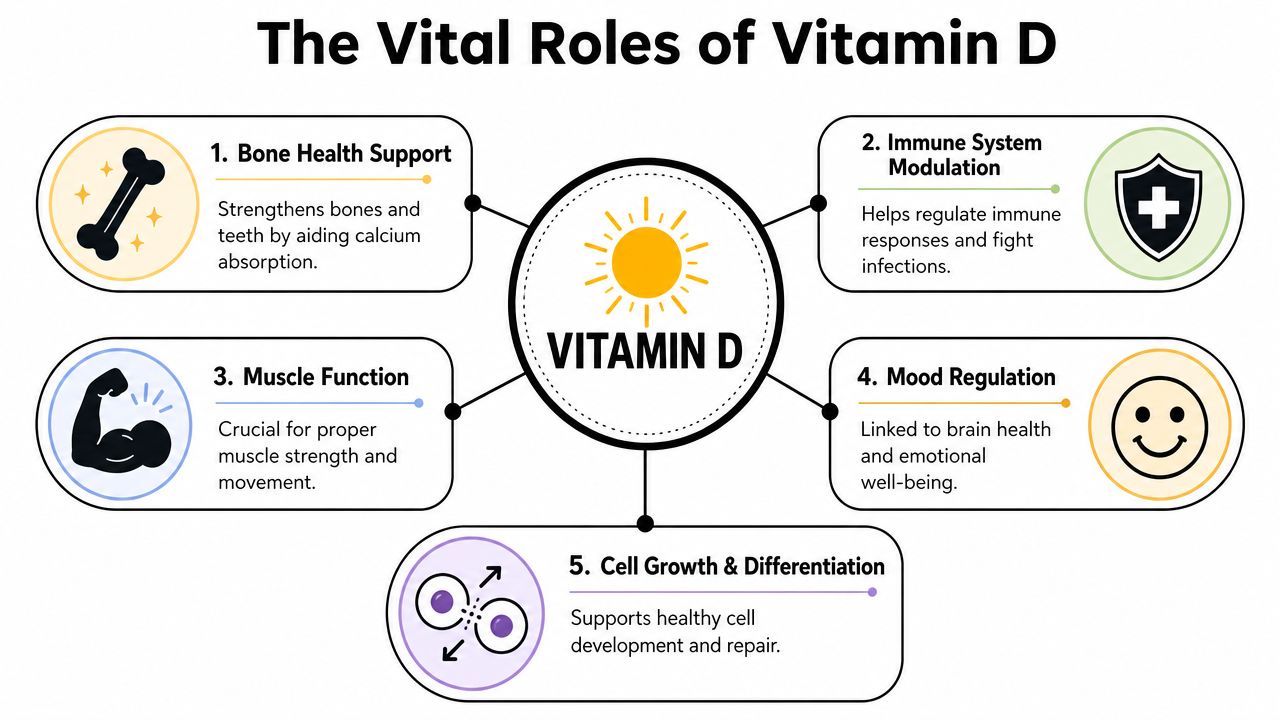
Vitamin D also helps regulate other systems that people care about every day, including muscle function, immune balance, and normal cell activity. That's why low levels can feel so vague. A person may not say, “I think my vitamin D is low.” They may say, “I just don't feel like myself.”
Think of it like a support system
A simple way to picture vitamin D is to think of it as support staff for several body systems:
Bone support helps your body use calcium properly.
Muscle support helps with strength and movement.
Immune support helps regulate how your body responds to threats.
Mood and brain support may affect how some people feel day to day.
Cell support helps with normal growth and repair.
Practical rule: When vitamin D is low, the symptoms often don't point neatly to one body part. They can show up as a general sense that energy, strength, or resilience isn't where it should be.
That broad role is part of why low vitamin D can be frustrating. It can contribute to diffuse symptoms, but it usually isn't the only factor. It's best understood as one important piece of the health puzzle.
The Main Reasons You Might Be Deficient
Vitamin D deficiency often works less like one obvious cause and more like several small leaks in the same bucket. One person may get little midday sun. Another may absorb vitamin D poorly. A third may have a mix of age, skin tone, indoor work, body size, medications, or genetics all pulling in the same direction.
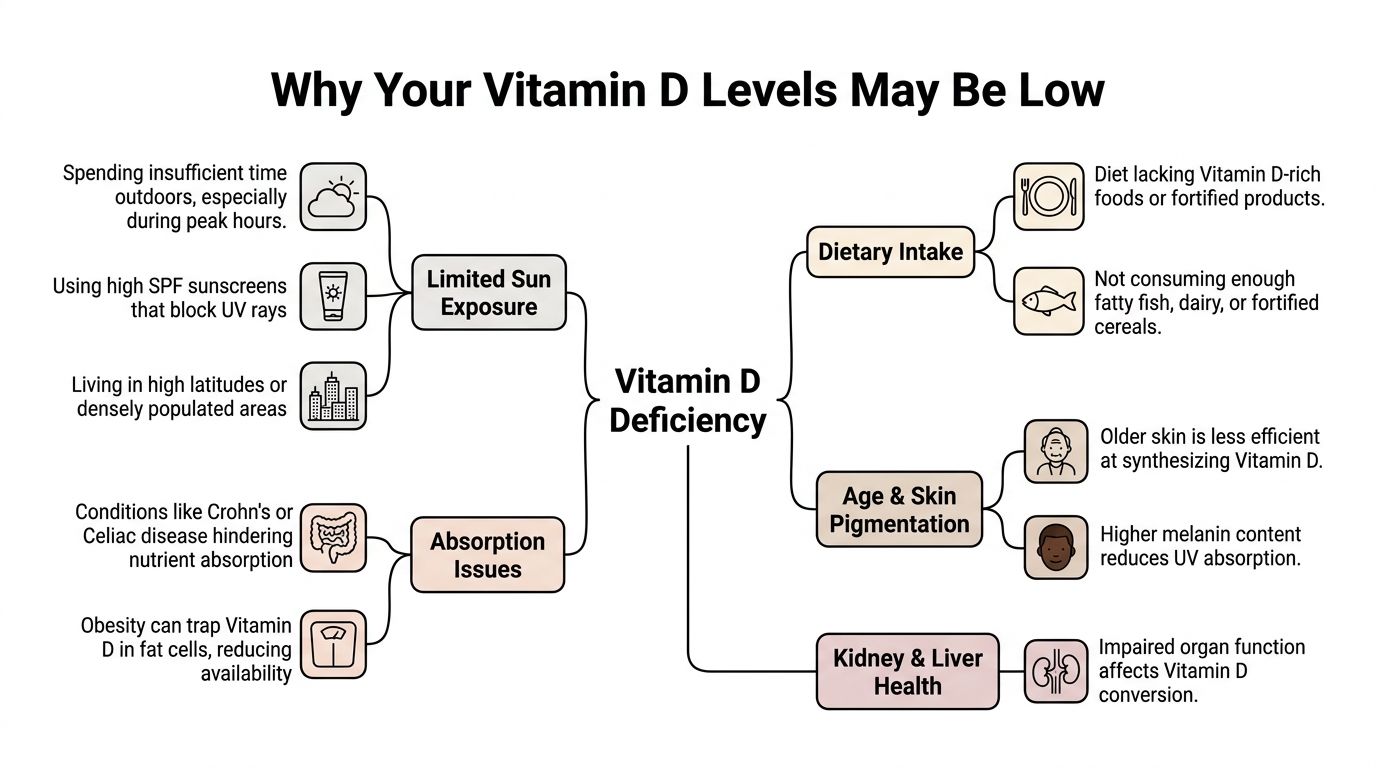
That layered effect explains a common frustration. Some people are careful about diet, spend time outside, even take a supplement, and their level still comes back low. In many cases, the issue is not effort. It is the combination of how much vitamin D you make, how much you absorb, and how your body processes and uses it.
Limited effective sunlight
Sun exposure is still the biggest reason many people fall short. But “being outside” and “making vitamin D” are not the same thing.
Your skin needs the right kind of sunlight, mainly UVB, and that depends on season, time of day, latitude, cloud cover, clothing, sunscreen use, and how much skin is uncovered. A short walk to the car or sitting by a sunny window usually does not do much. Glass blocks the UVB rays your skin needs to start vitamin D production.
A few common patterns make this easier to see:
Indoor schedules: Many adults leave home early, work inside, and get daylight mostly before or after the strongest sun hours.
Covered skin: Long sleeves, religious clothing, winter layers, or careful sun protection reduce the skin area available to make vitamin D.
Northern or southern latitudes in winter: Even with time outdoors, the sun may be too weak for much vitamin D production for part of the year.
Later in the day, it may help to hear a clinician explain the basics in a straightforward way:
Age, skin tone, and body chemistry
Your skin becomes less efficient at making vitamin D as you get older. Darker skin also produces less vitamin D from the same amount of sunlight because melanin reduces how much UVB reaches the deeper skin layers. Melanin protects the skin, but it can also mean longer or more consistent sun exposure is needed to produce a similar amount of vitamin D.
Body size can matter too. Vitamin D is fat-soluble, which means it can get distributed into body fat and become less available in the bloodstream. This helps explain why some people need more than expected to bring their level up.
Genetics may play a role as well. Emerging research suggests that some people differ in how they absorb, transport, activate, or respond to vitamin D. This is one reason two people with similar habits can have very different blood levels. If you have ever thought, “Why am I deficient in vitamin D when I'm doing the same things as everyone else?” this may be part of the answer.
Absorption problems and medical causes
Some people do not absorb vitamin D well, even with a good diet or regular supplements. Since vitamin D is absorbed along with fat in the small intestine, digestive conditions that disrupt fat absorption can lower vitamin D levels. Examples include celiac disease, Crohn's disease, some pancreatic or liver disorders, and certain weight-loss surgeries.
Medications can contribute too. Some drugs speed up the breakdown of vitamin D or interfere with how it is processed. If your levels stay low despite treatment, it is reasonable to review your medication list and medical history with your clinician instead of assuming you are doing something wrong.
Diet and supplements are only part of the picture
Food alone is often not enough to maintain healthy vitamin D levels, especially if sun exposure is low. And supplements are helpful, but they are not magic. The dose may be too low, the product may be taken inconsistently, or the body may not absorb or use it as expected.
This is why vitamin D deficiency can feel confusing. Good habits matter, but they do not cancel out every other factor.
The stack effect
Many people have more than one reason at the same time. A retired adult may go outside less and also make less vitamin D through aging skin. An office worker with darker skin may have limited effective sun exposure during the week. A person with digestive symptoms may be eating well but absorbing poorly.
Person | Likely factors |
|---|---|
Older adult who rarely goes outside | Reduced skin production, limited sun exposure |
Younger office worker with darker skin | Indoor lifestyle, lower skin production |
Person with celiac disease | Absorption problems, possible dietary limits |
If you want a broader look at nutrients that are commonly missed in daily life, these natural nutrition insights offer a useful overview.
Recognizing the Signs of Low Vitamin D
Low vitamin D often doesn't announce itself clearly. It tends to show up as symptoms people can easily dismiss. You might think you're run down from stress, sleeping poorly, working too much, or just getting older.

Subtle signs people often ignore
A common story sounds like this. Someone feels more tired than usual, their muscles feel heavy, and motivation is lower than normal. Nothing feels dramatic enough to call an emergency, but something feels off.
Possible signs that can overlap with low vitamin D include:
Fatigue that lingers even when you're trying to rest
Muscle aches or weakness that seem out of proportion to your activity
Low mood or a sense that your energy and resilience have dropped
General body discomfort that's hard to pinpoint
These symptoms are nonspecific. That means they can happen with many conditions, not just vitamin D deficiency. But they can still be a reason to ask for testing.
More concerning symptoms
Some people notice more classic bone-related complaints, such as deep aches or tenderness. Others feel weaker than expected when climbing stairs, getting up from a chair, or returning to exercise after a break.
If symptoms are persistent, the safest move is testing, not guessing.
That matters because self-diagnosis can go wrong in both directions. Some people blame every symptom on vitamin D when another issue is really driving the problem. Others ignore low vitamin D because the symptoms seem too vague to matter.
When the picture is blurry
Low vitamin D is one of those problems that can hide behind everyday life. If you've been trying to connect the dots between fatigue, aches, or general “not feeling right,” resources on recognizing critical nutritional gaps can help you think more clearly about patterns worth discussing with your clinician.
The key point is simple. Symptoms can suggest low vitamin D, but they can't confirm it. A blood test does that.
How Doctors Test and Interpret Your Levels
Doctors check vitamin D with a blood test called 25-hydroxyvitamin D, or 25(OH)D. This is the main test because it shows the body's vitamin D stores over time, not just what you ate yesterday or took that morning.
That distinction matters. Many people feel frustrated when they spend time in the sun, eat well, or take a supplement and still see a low result. The test helps explain that gap. Your level reflects the combined effect of sunlight, diet, absorption, body size, medications, skin tone, season, and sometimes genetics. In other words, vitamin D status is more like a running balance than a single-day snapshot.
Lab reports can also be confusing because they use two different units: ng/mL or nmol/L. Same test, different measuring system.
How to read the basic cutoffs
Doctors and labs may use slightly different reference ranges, but these are common guideposts:
Vitamin D status | Lab level |
|---|---|
Severe deficiency | Below 30 nmol/L (12 ng/mL) |
Low or suboptimal level | Below 50 nmol/L (20 ng/mL) |
If your number falls into one of these ranges, the next question is not just “How low is it?” It is also “Why is it low in this particular person?” That is where interpretation becomes more useful than the number alone.
What can make a “good effort” still lead to a low result
Patients often assume a low test means they failed to do something right. That is not always true.
A supplement may be too low for your needs. Your body may not absorb vitamin D well because of a gut condition or prior surgery. Extra body fat can also change how vitamin D is stored and made available. Some medicines interfere with vitamin D handling. If you follow a plant-based diet, it can be harder to get enough from food alone, which is why practical guidance on addressing vegan vitamin D deficiency can be useful.
Genes may play a role too. Emerging research suggests that some people process, transport, or activate vitamin D differently. That does not mean genetics is destiny. It does help explain why two people with similar habits can end up with very different lab results.
Common misunderstandings
A few points trip people up again and again:
A mildly low result still counts. You do not need to have the lowest possible number for it to matter.
Feeling fine does not rule it out. Some people with low levels have few or no obvious symptoms.
Taking vitamin D does not guarantee a normal test. Dose, consistency, absorption, and your own biology all affect the outcome.
One test result is not the whole story. Doctors interpret it alongside symptoms, risk factors, medications, and medical history.
Your lab result is a clue, not a verdict.
Bring the actual report to your appointment if you can. Ask, “Is this deficiency or insufficiency?” and “When should we recheck it?” Those two questions usually lead to a clear, practical plan.
A Practical Plan to Restore Vitamin D Levels
Correcting low vitamin D usually comes down to three tools. Sunlight, food, and supplements. The right mix depends on why your level is low in the first place.

Use sunlight carefully
Sun exposure can help, but it isn't a perfect fix for everyone. If you live in a place with weak winter sunlight, spend most of your time indoors, or cover most of your skin, sun alone may not be enough.
A sensible approach is brief, regular exposure rather than overdoing it. The goal isn't sunburn. It's giving your body a reasonable chance to make vitamin D when conditions allow.
Build your diet around reliable sources
Food usually supports vitamin D status more than it fully corrects a deficiency. Still, it matters. Helpful options often include fatty fish, fortified dairy or plant milks, fortified cereals, egg yolks, and UV-exposed mushrooms.
If you avoid animal products, getting enough can be trickier. For people following plant-based diets, this guide to addressing vegan vitamin D deficiency is a practical place to start.
Use supplements with a plan
Supplements are often the most dependable tool, especially when sunlight is limited or absorption from food isn't enough. Many clinicians prefer vitamin D3 for routine supplementation, but the exact product and dose should fit the individual.
A practical plan usually includes:
Test first if possible so you know whether you're correcting deficiency or maintaining a level.
Take the supplement consistently rather than sporadically.
Review medications and medical conditions that could affect absorption or metabolism.
Retest after treatment so you know whether the plan is working.
When your plan needs adjustment
Sometimes the first plan doesn't work well enough. That doesn't mean you failed. It may mean the cause hasn't been addressed fully. A person with malabsorption, limited sun exposure, or a higher biological need may require a more individualized approach.
Small daily habits usually beat random bursts of effort.
Consistency matters more than enthusiasm for one week. If your clinician prescribes a higher-dose regimen, follow the schedule closely and ask when your level should be rechecked.
FAQs and When to Consult a Doctor
Why are my vitamin D levels still low even with supplements
This is a common and very understandable frustration. Some people take supplements regularly, spend time outside, and still see low lab results.
A good way to understand this is to picture vitamin D status as a chain with several links. You need to get enough vitamin D in, absorb it from the gut, convert it into usable forms, and keep enough of it circulating in the blood. If one link is weaker, your level may stay low even when your habits look good on paper.
Genetics may be part of that picture, as noted earlier in the article. Variations in genes involved in vitamin D transport and processing can influence how much shows up on a blood test. That helps explain why two people can follow the same plan and get different results.
Other reasons include missed doses, low supplement strength, poor absorption from digestive conditions, certain medications, higher body fat, or liver and kidney problems that affect vitamin D processing. Sometimes the issue is not effort. It is biology.
Can I take too much vitamin D
Yes.
Vitamin D is fat-soluble, which means your body stores it rather than clearing excess quickly. Large doses taken for long periods can raise calcium levels too much and lead to problems such as nausea, constipation, weakness, kidney stones, or confusion.
Routine supplementation is often safe when it matches your needs, but high-dose vitamin D should be guided by a clinician, especially if you are combining multiple products like multivitamins, calcium supplements, and standalone vitamin D.
When should I see a doctor
Contact a clinician if you have symptoms that do not go away, such as fatigue, muscle weakness, frequent aches, or bone pain.
It also makes sense to get medical advice if:
you have a digestive condition that may reduce absorption
you are pregnant, older, or managing several health conditions
you have been taking vitamin D consistently but your level stays low
you are planning to use high doses without a clear testing and follow-up plan
you have a history of kidney stones, high calcium, liver disease, or kidney disease
A blood test gives one piece of the answer. Your symptoms, medications, medical history, diet, sun exposure, body size, and family pattern help complete the picture.
If you feel like you are doing everything right and still not getting results, that is a reason to ask for help, not a reason to blame yourself.
If you like simple systems that do the heavy lifting for you, Yield Seeker takes a similar approach for stablecoin yield. It helps users deposit as little as $10 USDC on Base, then lets an AI Agent monitor and allocate across DeFi protocols in real time, with no lockups or withdrawal fees. For busy holders who want a cleaner, more guided way to put idle stablecoins to work, it's worth a look.