

You park stablecoins in one protocol before bed. By morning, the rate has dropped, incentives moved, and a safer pool on another chain is paying more. Manual DeFi management breaks for a simple reason. The market updates faster than a person can review it.
That pressure is why AI crypto trading keeps getting attention. Used well, it works like an always-on analyst and execution layer. It screens markets, compares routes, watches risk signals, and reacts within rules you set. Used poorly, it is just a dashboard with nicer marketing.
That gap gets missed in a lot of coverage. “AI trading” can mean a model generating signals, a bot executing preset rules, or a fully automated agent that reallocates capital on its own. Those are not the same product, and they do not carry the same risk. New users often lump them together, then assume every platform is more autonomous than it really is.
The better question is not “does it use AI?” It is “what decisions does the system make, what data does it use, and where does a human still need to approve or intervene?” Those answers tell you far more than the label.
Yield Seeker is a useful example because the scope is clear. It is not trying to be a black-box trader that promises to outsmart every market. It applies AI to a narrower job: finding and rotating into stronger yield opportunities while accounting for risk, exposure, and changing protocol conditions. That kind of focus is usually a better sign than broad claims about autonomous trading.
Readers who understand that distinction make better decisions. They ask whether the agent can move funds automatically, whether it only recommends actions, how strategy limits are enforced, and what happens when liquidity, oracle inputs, or smart contract risk changes. Those are the questions that separate real automation from sales copy.
The New Pace of Crypto Markets
At 11 p.m., a stablecoin pool looks safe, the yield is acceptable, and nothing appears urgent. By 7 a.m., incentives have shifted, liquidity has moved, borrow demand has changed, and the best risk-adjusted option may be somewhere else entirely. That is the operating reality in crypto.
Markets trade all the time, but the harder part is not price action alone. It is the number of variables that change underneath a position. A DeFi user managing capital manually has to compare lending rates, emissions, utilization, liquidity depth, smart contract exposure, and sometimes governance or oracle risk across multiple protocols. By the time that review is done, the setup may already be different.
Why manual investing hits a wall
The constraint is operational capacity.
A skilled operator can research thoroughly or react quickly. Doing both across many venues, every day, is difficult. Teams compensate with dashboards, alerts, spreadsheets, and playbooks, but those tools still depend on someone being available to interpret the signal and act before the edge disappears.
That is why automated systems gained traction. In practice, AI works like an analyst team paired with an execution layer. It watches more inputs than a person can track reliably, ranks options, and acts within predefined rules. For a closer breakdown of how AI trading systems actually operate in crypto, the useful question is always what the system can do on its own versus what still needs a human decision.
Practical rule: If a strategy requires constant monitoring across many protocols and conditions, it is already an automation problem.
That does not remove human judgment. It moves judgment to the front of the process. The work becomes setting limits, defining acceptable risk, choosing where automation is allowed, and understanding failure modes before capital is deployed.
Why demand keeps growing
Interest in AI trading has expanded quickly in recent years, and earlier reporting cited forecasts that place the market in the tens of billions of dollars with strong projected growth through the next decade. The exact number matters less than the reason behind it. Traders and allocators want systems that can process changing market conditions continuously instead of relying on periodic manual checks.
In crypto, that demand is often less glamorous than the marketing suggests. The useful applications are not always about an autonomous agent making aggressive directional bets on volatile tokens. Much of the actual value comes from repetitive portfolio work: rotating stablecoins into stronger yield, reducing idle balances, monitoring exposure, and responding faster when protocol conditions deteriorate.
That distinction matters. Many products marketed as AI trading platforms are still recommendation tools, alerting systems, or wrappers around fixed rules. Some are useful. Few are fully autonomous. Platforms such as Yield Seeker are easier to evaluate because the scope is narrower and more transparent. The job is yield seeking and allocation management, not a vague promise to outtrade the market under all conditions.
What Exactly Is AI Crypto Trading
Upon hearing “bot,” many initially think of a script with a few hardcoded rules. Buy when one indicator flips. Sell when another flips. That's automation, but it isn't necessarily intelligence.
AI crypto trading is better understood as a system that combines pattern detection, probabilistic decision-making, and execution. If a traditional bot is a calculator running a fixed formula, an AI trading system is closer to a small analyst team. One part watches markets, another reviews news and sentiment, another ranks possible actions, and another handles execution.
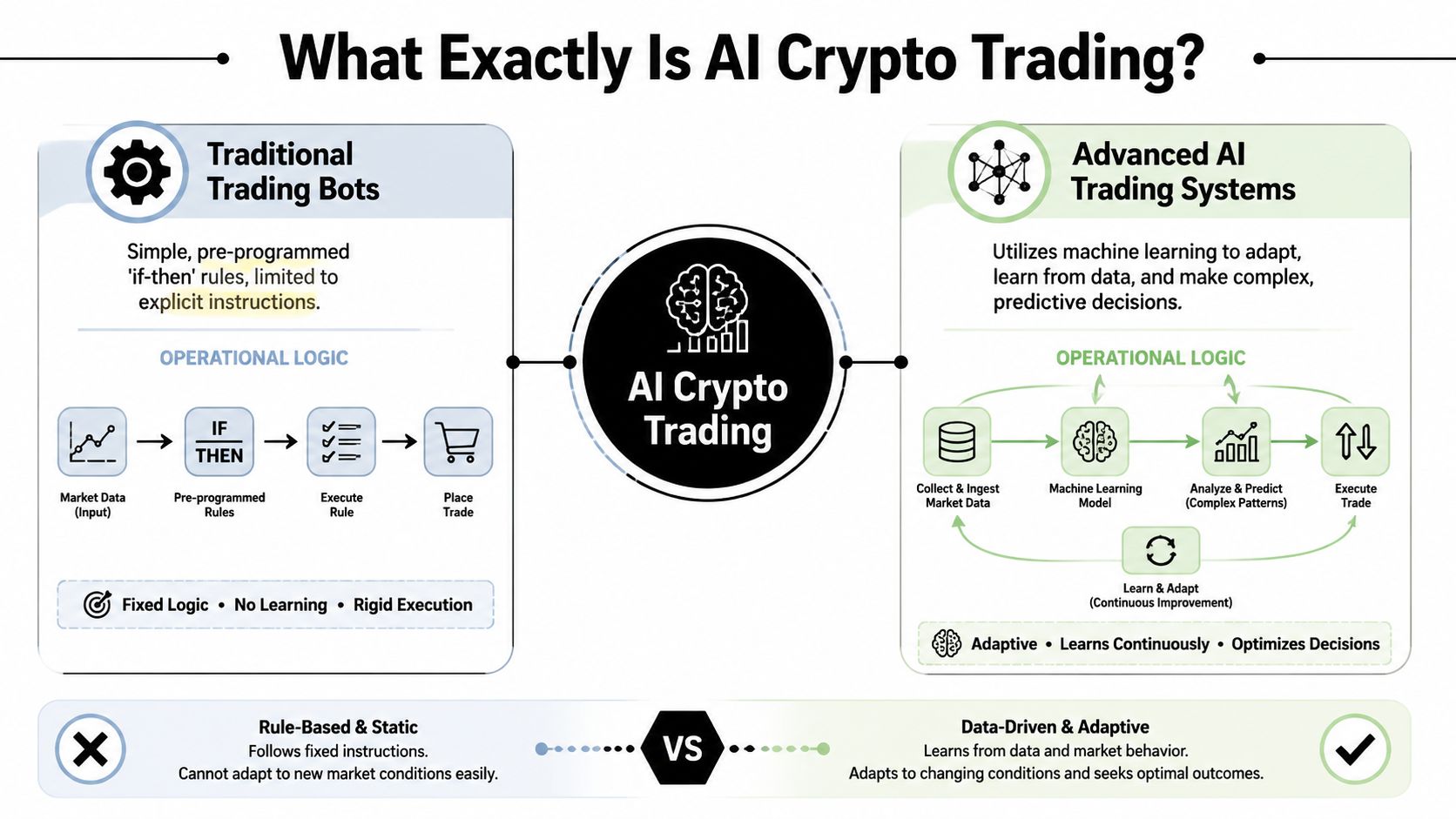
Traditional bots versus adaptive systems
A basic bot only does what you explicitly told it to do. That can still be useful. Fixed rules are often easier to audit, and in some situations they're safer because they're predictable.
AI systems aim for something broader. They ingest more inputs, compare current conditions to prior market behavior, and adjust how they score trade or allocation opportunities. That doesn't make them magical. It just makes them less rigid.
A quick way to frame the difference:
System type | Best description | Main limitation |
|---|---|---|
Traditional trading bot | Rule executor | Struggles when market conditions change outside its predefined logic |
AI trading system | Adaptive decision engine | Harder to evaluate if the platform doesn't explain how it behaves |
For a deeper conceptual breakdown, this explanation of what AI trading means in practice is a useful companion.
The three parts that matter
Most real systems combine three functions.
Analysis layer. The model pulls in market data, technical signals, and sometimes text-based inputs like news or social chatter.
Learning layer. It tests how patterns behaved historically and updates how it ranks opportunities when conditions shift.
Execution layer. It turns a scored idea into an action, whether that's placing a trade, rebalancing a position, or reallocating idle capital.
Good AI trading software doesn't just answer “what happened.” It tries to answer “what matters now” and “should anything be done about it.”
That last point is where a lot of marketing gets sloppy. Some products do the first two parts and stop there. They analyze and suggest. Others also execute. Users often treat those as the same category when they're not.
How AI Models Make Trading Decisions
A serious AI trading stack follows a pipeline. Raw data comes in, models evaluate it, signals get ranked, execution rules apply, and the system keeps monitoring what happened next. That sounds technical, but the flow is straightforward when you break it down.
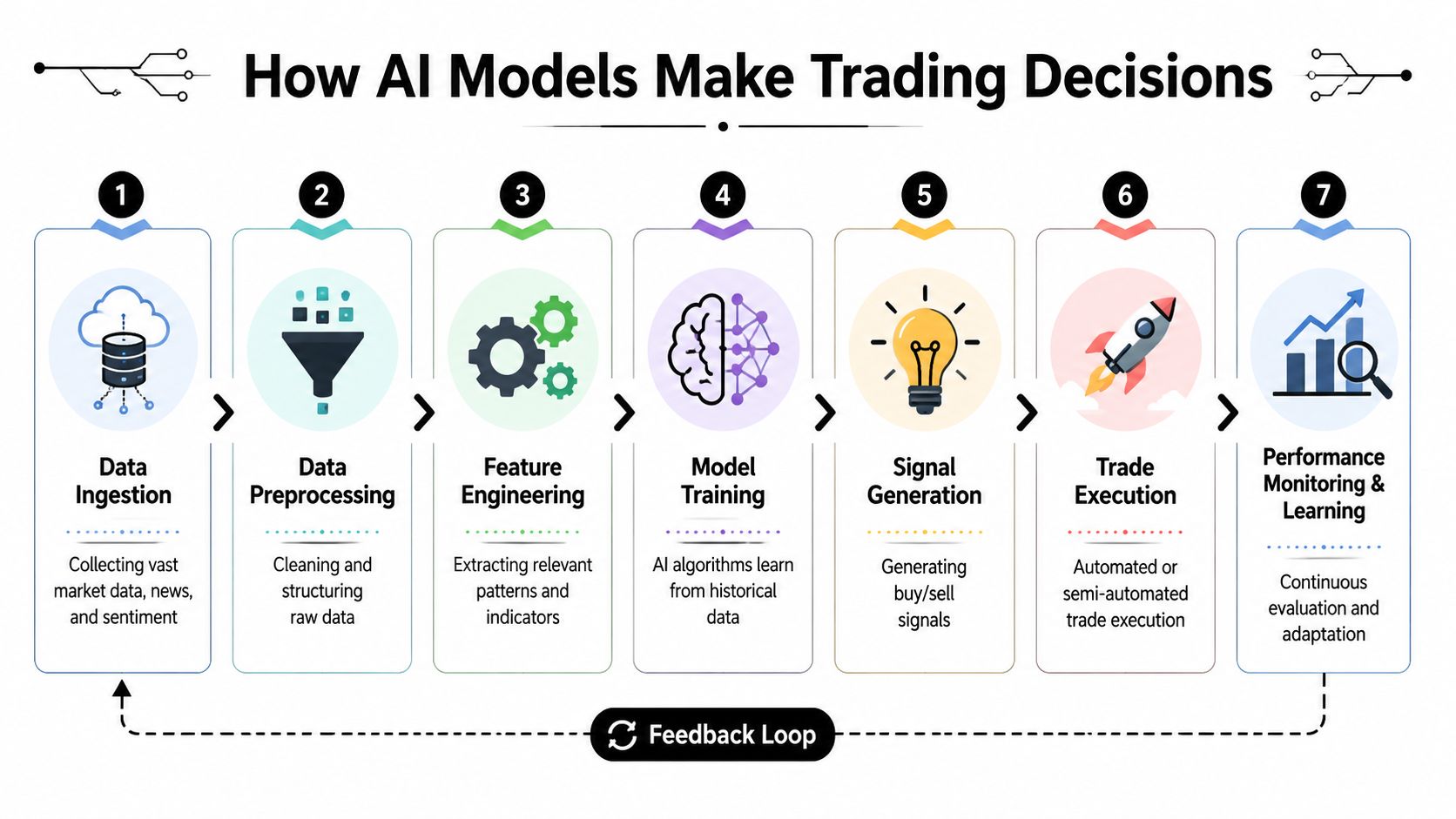
Data first, then structure
The first job is ingestion. Prices, liquidity changes, volume, funding conditions, social posts, headlines, and protocol data all arrive in messy formats. Before any model can use them, the system needs to clean and standardize them.
That preprocessing step is unglamorous, but it's where many weak products fail. If the input is noisy or stale, the model can still sound smart while making bad calls.
Pattern extraction and signal scoring
Once the data is usable, the system extracts features. In trading terms, features are the patterns or variables the model thinks matter. Some are technical, like momentum or volatility shifts. Others are contextual, like sudden changes in sentiment.
According to Kraken's overview of AI crypto trading bots, AI trading algorithms use machine learning to backtest strategies across massive historical price sequences, and these systems can integrate generative AI models to monitor large datasets, scan for setups, and execute trades with entry, stop, and take-profit levels in fractions of a second. That's a compact description of why AI systems can outperform manual monitoring on speed alone.
The text side matters too. Natural Language Processing, or NLP, lets models parse news and social media in real time. The goal isn't to “understand” the market like a human commentator. The goal is to classify tone, urgency, and possible impact, then compare that language pattern with prior price behavior.
For a technical look at where these systems fit, this guide to machine learning trading algorithms connects the modeling layer to actual trading workflows.
Execution is where theory becomes reality
This is the step users should care about most. Many systems can generate a signal. Fewer can convert that signal into a live order or live allocation change under clear constraints.
A professional architecture is often described as:
Data ingestion
Model analysis and scoring
Signal generation
Execution through an exchange or protocol API
Monitoring
Feedback loop
That structure matters because every layer adds a possible failure point. A model can score a setup correctly and still lose money if execution is slow, slippage is ignored, or position sizing is wrong.
The model isn't the whole product. In live markets, execution quality and risk controls often matter as much as prediction quality.
Why backtesting helps and where it misleads
Backtesting is useful because it shows how a strategy would have behaved on historical data. But bad backtests are easy to manufacture.
One common pitfall is look-ahead bias. A platform might accidentally let a model “see” information that wouldn't have been available in live trading. More careful systems prevent that by shifting data and only analyzing completed bars rather than future data points. That doesn't guarantee success. It just means the test is at least grounded in something closer to reality.
A lot of retail users never ask whether a platform handles this correctly. They should.
Common AI Crypto Trading Strategies
AI doesn't point to one strategy. It's a decision layer that can sit on top of very different objectives. The important question isn't “does it use AI?” It's “what is the system trying to optimize?”
Price-based strategies
Some setups focus on direct trading.
Arbitrage looks for price differences across venues and tries to capture the spread before it closes.
Market making places buy and sell orders around the current price to earn fees and spread, while managing inventory risk.
Predictive trading uses model outputs to estimate short-term directional moves, then enters positions with defined exits.
These strategies reward speed and infrastructure. They also get crowded fast. For most users, they're harder to evaluate because profitability depends on execution quality, fees, and market microstructure details that platforms often gloss over.
Yield-oriented strategies
Another class of AI crypto trading is less about direction and more about capital allocation. Instead of betting that an asset will rise, the system seeks better places to park stablecoins or other assets across lending, staking, and liquidity venues.
That's where AI can provide real value for regular users. DeFi yield opportunities are fragmented. Rates move, incentives rotate, and risk varies by protocol. A machine can monitor those moving parts continuously and re-rank options faster than a human checking dashboards.
Here's the practical distinction:
Strategy family | Core objective | Typical user concern |
|---|---|---|
Arbitrage and market making | Capture pricing inefficiencies | Infrastructure, fees, latency |
Predictive trading | Profit from directional moves | False signals, drawdowns |
Yield seeking | Improve passive returns on idle capital | Smart contract risk, allocation logic |
If you want to understand the hiring and skill stack behind sentiment-driven systems, this overview of NLP trading strategies role gives useful context on how firms think about combining language data and market models.
What works better for most people
For non-professional traders, narrow automation usually works better than broad claims. A system designed to optimize yield within a clear risk envelope is easier to understand than one claiming it can “beat the market” across every condition.
That's also why I'm skeptical of products that present AI as an all-purpose oracle. In crypto, focused systems usually age better than grand promises.
Evaluating AI Platforms and Avoiding Hype
The biggest mistake in this category is assuming “AI-powered” means autonomous execution. Often it doesn't.
According to TheStreet's reporting on a 2026 study of AI crypto platforms, only 3 of 10 surveyed platforms executed trades autonomously, while the rest gave advice, ran simulations, or required manual approval. The same report says users collectively lost $191.7 million while platforms held $34.3 million in paper gains. That gap is the part most marketing pages don't mention.

The first question to ask
Don't begin with returns. Begin with execution.
Ask the platform a plain question: Does the agent place trades or reallocations on my behalf, or does it only recommend actions? If the answer is fuzzy, that's already useful information.
A real product should be able to explain:
Who executes. Is it fully automated, user-approved, or hybrid?
What triggers action. Signals, thresholds, schedules, or operator discretion?
Where capital moves. Exchanges, lending protocols, vaults, or internal simulations only?
How risk is constrained. Position limits, stop conditions, allocation caps, or protocol filters?
A better due diligence checklist
A good evaluation process is less about believing the demo and more about narrowing ambiguity.
Use this checklist when reviewing any AI crypto trading platform:
Autonomy clarity. The product should tell you whether it executes live actions without manual approval.
Backtest realism. Ask how it prevents look-ahead bias and whether live performance is shown separately from simulations.
Risk controls. Check for stop-loss logic, allocation limits, protocol selection criteria, and asset scope.
Fee transparency. Subscription fees, performance fees, withdrawal rules, and any hidden execution costs should be obvious.
Operational focus. Narrow systems are easier to verify than “AI does everything” products.
User visibility. You should be able to see what the agent did, not just a final balance number.
If a platform explains the interface better than it explains the execution model, treat that as a warning.
Founders and operators evaluating AI vendors more broadly may also benefit from this guide to AI tools for organizations, especially as a framework for separating useful automation from polished demos.
Why focused products are easier to trust
The most credible AI products in crypto usually do one thing well. They don't claim universal market prediction. They define a job, expose the workflow, and let users inspect the result.
That's also why curated comparisons such as these best AI trading platforms for real use cases are useful. The practical difference isn't “good AI” versus “bad AI.” It's transparent automation versus theatrical automation.
Getting Started with an AI Agent
Most beginners make one of two errors. They either overcomplicate the setup, or they outsource too much trust too quickly.
The better path is to treat an AI agent like a new contractor handling capital. Start small. Watch behavior. Review decisions. Expand only after you understand what the system is doing.
Start with a contained test
Use a small amount of capital you're comfortable risking. The point of the first deposit isn't maximizing return. It's learning the product's behavior under live conditions.
Look for a clean interface that answers basic questions fast:
Where is capital allocated right now
What actions were taken recently
Can funds be accessed without friction
What settings can you adjust
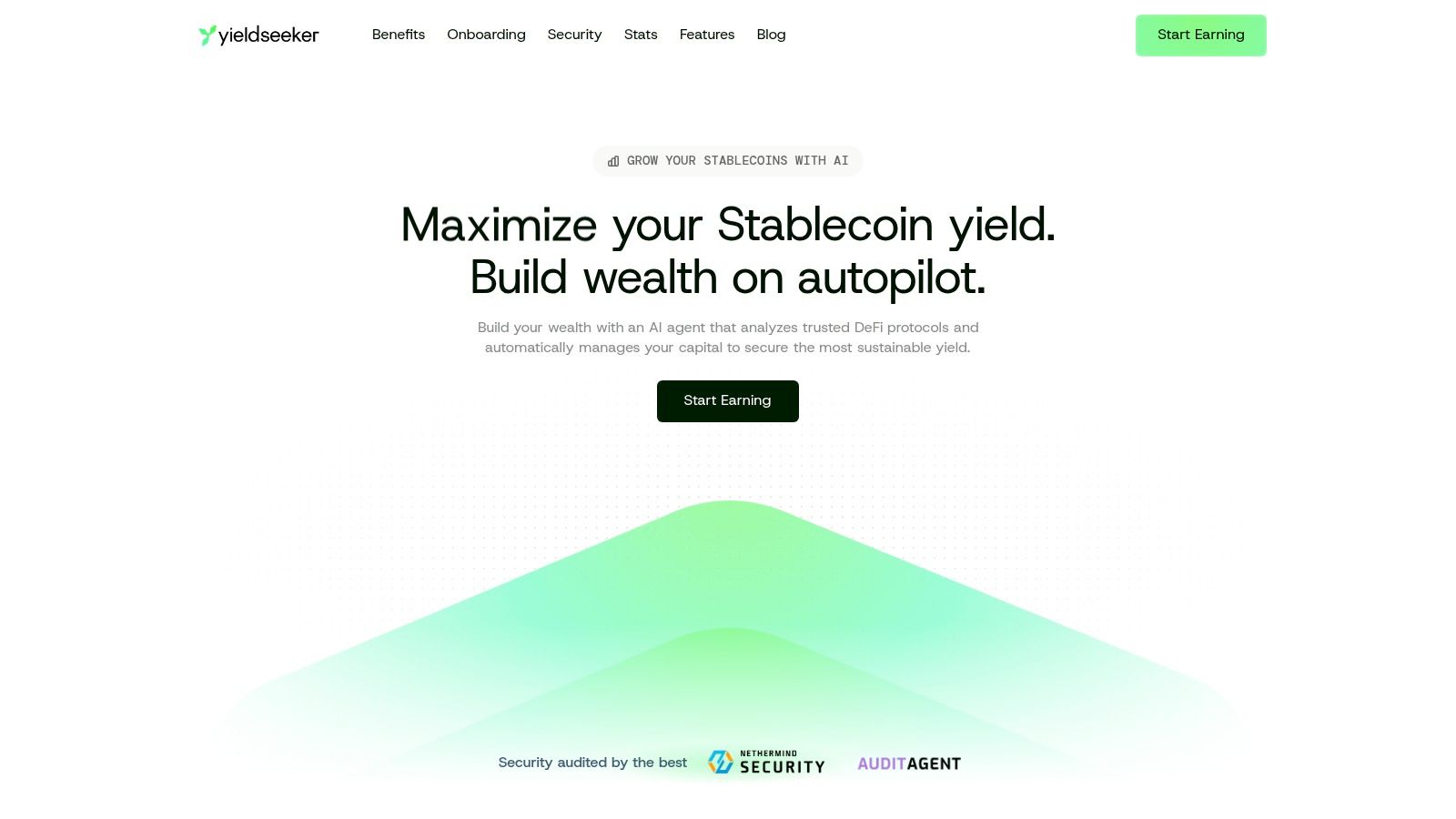
That sounds simple, but it matters. A confusing dashboard hides mistakes. A good one shortens the time between “something happened” and “I understand why.”
Read the behavior, not the branding
Ignore language like “next-generation intelligence” and focus on observable actions. Did the agent reallocate logically? Did it stay within the stated strategy scope? Did the platform make it easy to inspect the outcome?
A useful mental model comes from outside trading. If you've seen how products approach AI social media agent development, the same principle applies here. The agent is only as good as its task boundaries, feedback loops, and human oversight. An agent with a narrow, measurable job is usually more reliable than one pitched as fully general.
Keep expectations realistic
AI can reduce research burden, improve consistency, and react faster than a person. It can't repeal risk.
Use these rules early on:
Prefer narrow mandates. A yield agent with a defined universe is easier to understand than a black-box “market crusher.”
Monitor before scaling. Let the system build trust through behavior, not slogans.
Stay liquid when possible. Flexibility matters in crypto. Products with accessible funds are easier to manage.
Review changes. If an agent starts behaving differently, you need enough visibility to notice it.
The safest way to start is boring on purpose. Small capital, clear rules, visible actions, and no fantasy about guaranteed returns.
Frequently Asked Questions About AI Crypto Trading
Can AI guarantee profits
No. AI can automate analysis and execution, but it can't remove market risk, smart contract risk, liquidity risk, or platform risk. Any product that suggests guaranteed returns is giving you a reason to walk away.
Is AI crypto trading the same as a regular trading bot
Not always. A regular bot often follows fixed rules. An AI system usually adds pattern recognition, adaptive scoring, or language-based analysis. In practice, though, the boundary gets blurry because many platforms market basic automation as AI.
What's the difference between an AI trading agent and an AI yield agent
A trading agent usually aims to profit from price movement. A yield agent usually focuses on capital allocation across lending, staking, or other DeFi opportunities. The first is more speculative. The second is often more about optimization and monitoring.
Do I need technical skills to use one
Not necessarily. Good platforms abstract away the hard parts. You still need judgment, especially around platform selection, risk tolerance, and reading what the system is doing with your funds.
What should I verify before depositing
Check whether the platform executes autonomously or only recommends actions, how it handles risk controls, whether your funds remain accessible, and how clearly it reports activity. Those details matter more than polished AI copy.
Is full autonomy always better
No. Sometimes a constrained or semi-automated model is safer because it limits what the system can do. The best setup depends on the strategy, your risk tolerance, and how much transparency the platform provides.
If you want a practical way to put these ideas to work, Yield Seeker is built for a narrower and more transparent use case than the usual AI trading hype. It helps users automate stablecoin yield discovery across DeFi with accessible funds, no lockups, no withdrawal fees, and a product experience designed to show what's happening instead of hiding it behind vague “AI” branding.