

If you're holding stablecoins or rotating through DeFi positions, you probably know the routine. Check yields on one protocol, compare incentives on another, bridge funds, confirm gas, double check contract addresses, then repeat tomorrow because the opportunity moved again. Even experienced users get stuck doing spreadsheet work in a market that never sleeps.
That pressure is exactly why the AI crypto wallet conversation matters now. Not because wallets suddenly became magical, but because manual portfolio management has become the bottleneck. Crypto already gave us programmable money. The next step is programmable wallet behavior, with guardrails.
Beyond Manual Trading The Rise of Intelligent Wallets
You spot a better yield after dinner, start checking the destination protocol, compare bridge routes, review token approvals, then decide to wait until morning so you can verify everything properly. By then, the rate has dropped or the incentive pool is full. This represents the primary friction in DeFi today. Access is easy. Staying on top of fast-moving opportunities without making expensive mistakes is the hard part.
For traders, this sits inside a broader shift toward automated execution and signal-driven decision making. If you want that wider context, Coiner Blog's guide to AI crypto trading is a useful companion read. At the wallet level, the practical change is more grounded. Wallets are turning into the control surface for monitoring, rules, and approved execution.
Many early crypto adopters still treat a wallet as just a digital keyring. That view no longer fits how people use on-chain capital. An intelligent wallet is starting to act more like an operations layer: it watches positions, flags changes, and handles repeatable actions within limits you set.
That distinction matters in practice.
Why manual DeFi breaks down
Manual management works fine when you hold a few positions and have time to babysit them. It starts to fail when your workflow depends on speed, consistency, and memory.
Common failure points show up fast:
Fragmented opportunity tracking: Yields, points programs, and liquidity incentives shift across chains and protocols.
Bad timing: Good entries and exits often happen when you're asleep, working, or entirely offline.
Operational mistakes: A bad approval, wrong bridge path, or rushed contract check can erase weeks of yield.
Mental overload: Allocation targets, claim schedules, vesting dates, and risk limits are easy to lose track of.
This is the part that gets overstated in hype pieces. AI wallets do not give users some fully autonomous money machine today. What they do, when built well, is supervise routine work. They monitor wallet activity, watch for conditions you care about, and trigger or suggest predefined actions. That is useful. It is also much narrower than the marketing language implies.
A wallet with supervised intelligence reduces low-value repetition. It does not remove the need for judgment.
Practical rule: If you're spending more time checking positions than setting allocation limits, approval policies, and exit conditions, the workflow is a good candidate for wallet-level automation.
For a more technical view of how these systems fit into on-chain workflows, this overview of AI for crypto automation and wallet workflows is worth reading. The near-term opportunity is simple: fewer repetitive clicks, faster reactions, and tighter monitoring, without handing over unlimited control.
What Is an AI Crypto Wallet Really
The cleanest way to understand an AI crypto wallet is this: it's not a new kind of vault. It's a smarter control panel sitting on top of a vault you already understand.
A traditional wallet stores keys and signs transactions. An AI-powered wallet adds a software layer that watches wallet activity, interprets market and behavioral signals, and helps automate actions based on rules. It functions as a financial analyst attached to your wallet. The analyst doesn't become the bank vault. It studies information, flags risk, and carries out approved workflows.
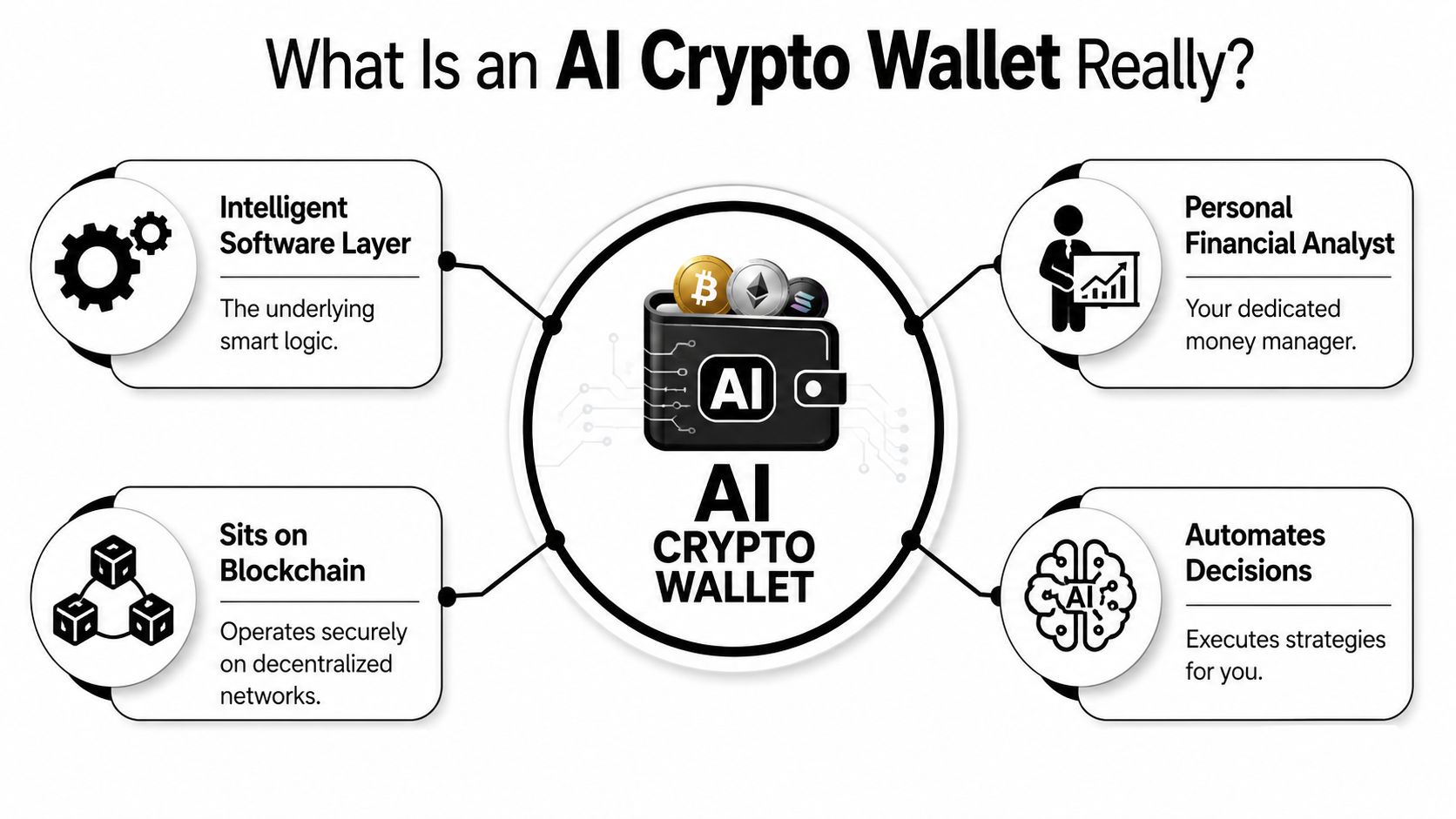
The application layer is the key idea
This distinction matters more than the marketing language. BitGo notes that AI-integrated crypto wallets operate specifically at the application layer, utilizing machine learning to process on-chain transaction data, behavioral metadata, and counterparty information for real-time risk scoring without modifying the underlying cryptographic custody infrastructure that protects private keys (BitGo on AI crypto wallet use cases).
That sentence is dense, but the takeaway is simple. The AI doesn't replace cryptography. It sits above it.
Here is the practical split:
Layer | What it does | What AI should do there |
|---|---|---|
Custody layer | Holds keys, signs transactions, enforces core ownership | Very little or nothing directly |
Application layer | Reads data, scores risk, triggers workflows, surfaces decisions | Most of the intelligence lives here |
What that means in plain English
If a wallet says it uses AI, ask what part is intelligent.
Good answer: It analyzes transaction patterns, wallet behavior, and counterparty risk.
Better answer: It can automate routine actions inside limits you set.
Bad answer: It implies the model itself should control key management or unrestricted signing.
A reliable AI crypto wallet acts more like an air traffic controller than a pilot with total control. It watches everything, warns early, and only acts within approved lanes.
That architecture is why the best products today feel less like science fiction and more like workflow software. They don't reinvent self-custody. They make self-custody usable at scale.
Core AI Features That Automate Your Portfolio
Open a wallet on a busy market day and the main problem shows up fast. The hard part is rarely placing one trade. It is keeping up with ten small decisions that pile up after it: rebalancing, claiming rewards, checking whether a contract is still safe, and deciding whether idle stablecoins should stay idle.

The useful AI features today solve that operational load. They do not replace judgment. They reduce repetitive work, watch for drift, and surface decisions before a small issue turns into an expensive one.
Intelligent automation
The first job is handling repeatable actions inside rules you set. That includes rebalancing back to target allocations, claiming and redeploying staking rewards, and executing routine buys or exits when conditions are already defined.
Good automation is boring in the best way. It runs checklists.
In practice, the difference between a weak product and a useful one is scope control. A solid wallet automates known workflows with clear guardrails. A weak one promises "autonomous investing" but gives users little visibility into what will be signed, when, and why.
Common examples include:
Portfolio rebalancing: Shift allocations back toward target weights after large market moves.
Reward harvesting: Claim and redeploy staking or protocol rewards on a schedule or threshold.
Routine execution: Deploy stablecoins, place recurring buys, or reduce exposure when preset conditions are met.
The time savings matter. Consistency matters more. Traders miss maintenance tasks all the time, especially when gas spikes or market volatility pulls attention elsewhere.
Personalized portfolio management
Automation only works if the wallet understands the owner's intent. A user parking capital in conservative stablecoin strategies should not get the same suggestions, alerts, or default actions as someone rotating through newer DeFi venues.
That does not require magic. It requires context.
A wallet can use transaction history, position sizes, asset preferences, and prior approvals to shape recommendations and decide which workflows to prioritize. The best systems treat personalization as policy matching, not mind reading. If behavior changes, the settings should be easy to inspect and update.
For readers who want the strategy side of that problem, this guide to AI crypto portfolio management goes deeper on portfolio logic and automation design.
Data quality sets the ceiling here. If the model reads stale protocol docs, incomplete vault data, or weak counterparty signals, the outputs degrade fast. Teams building these systems often use tools like a Web Scraping API for RAG to feed models fresher and more structured information.
Proactive threat detection
In many wallets, AI already earns its keep. Monitoring is less glamorous than automated execution, but it is usually the safer first deployment.
Wallet activity produces patterns. Normal transfer sizes, common counterparties, usual active hours, familiar devices, approved protocols. AI models are good at spotting when a new action breaks that pattern and deserves a second look.
That can mean:
Anomalous transfers: A transaction is much larger, later, or headed somewhere unfamiliar.
Counterparty screening: A destination wallet or contract shows risk signals the user would likely miss manually.
Behavioral mismatch: A session behaves differently from the account's normal operating profile.
My practical view is simple. Let AI watch everything. Let it act only inside narrow boundaries.
That trade-off reflects where the technology is today. Supervised automation and monitoring are useful right now. Broad autonomy is still where mistakes get expensive.
Real-World Use Cases From DeFi to Payments
The easiest place to see the value of an AI crypto wallet is stablecoin management. A user holds idle USDC. The wallet tracks available opportunities, checks whether the strategy still fits the user's risk settings, and handles the mechanics of moving into and out of positions without making the user babysit every step.
DeFi operations that benefit from supervised automation
The first wave of useful wallet automation is not exotic. It's operational.
A well-designed wallet can help with tasks like:
Stablecoin deployment: Move idle balances into approved yield venues based on preset constraints.
Position maintenance: Exit or reduce exposure when conditions move outside allowed parameters.
Workflow cleanup: Handle claims, redeployments, and routine transaction sequences that otherwise become manual chores.
DeFi doesn't just demand strategy; it demands maintenance. Most users eventually want to outsource that part.
Agent payments are already a serious use case
The second use case is broader than investing. AI agents need to pay for things. Data access, APIs, compute, subscriptions, and service calls all fit naturally with on-chain payments when the wallet can hold funds and sign transactions directly.
RebelFi argues that in 2026, AI agents have shifted stablecoin usage by requiring independent crypto wallets to bypass traditional financial identity constraints, enabling agents to hold USDC, sign transactions, and settle payments on-chain in seconds for fractions of a cent without bank accounts (RebelFi on AI agents, wallets, and payments in 2026).
That changes the role of the wallet. It isn't only where assets sit. It becomes the operating account for software.
A short walkthrough helps make that shift more concrete.
What works today and what still feels rough
What works today is narrow autonomy. Give an agent a defined goal, a limited set of allowed actions, and an approved asset universe, and it can be productive.
What still feels rough is broad delegation. If the wallet is expected to interpret vague instructions, discover new venues, judge legal risk, and execute freely, the error surface expands quickly.
A practical implementation looks more like this:
Use case | Works well when | Breaks down when |
|---|---|---|
Yield management | Rules are clear and approved venues are limited | The agent can chase any new protocol without review |
Treasury operations | Payment categories and spending limits are predefined | Permissions are open-ended |
Micropayments for agents | Settlement assets and policies are standardized | Funding and fee logic are inconsistent |
That's why the best current use cases look boring on paper. Boring is good. Boring systems are the ones that survive real money.
The Critical Trade-offs Security Versus Autonomy
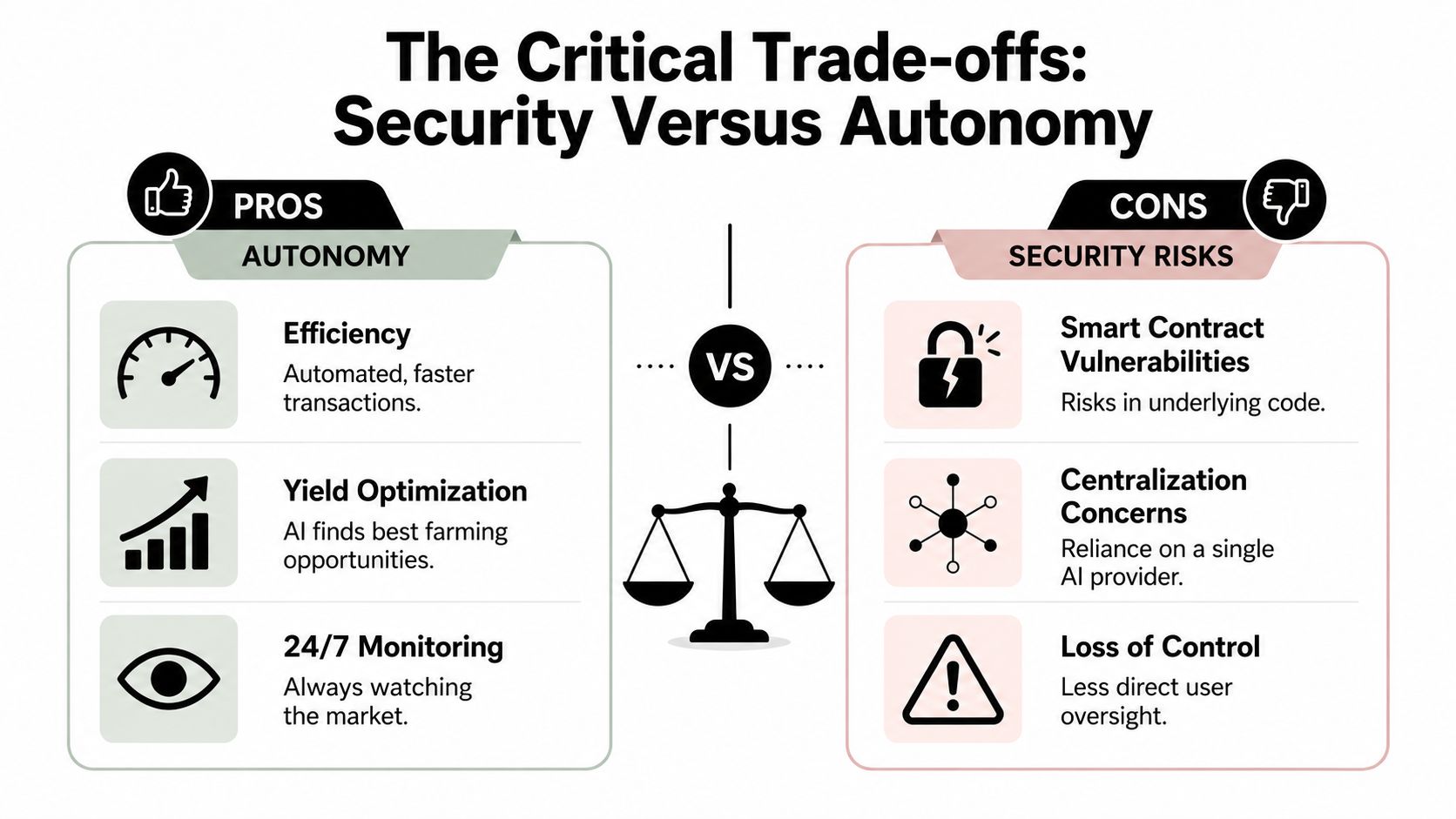
The core tension in every AI crypto wallet is simple. The more autonomy you give the system, the more carefully you need to define who is accountable when it does something wrong.
That issue is still badly underexplained in most wallet marketing. A wallet can let an agent hold assets and act on-chain, but that doesn't answer the legal or operational question that matters when something goes sideways. Who approved the action. Who set the policy. Who carries liability.
The trust problem is not solved by crypto rails
One of the most useful corrective points comes from the legal and compliance angle. According to coverage referencing a 2026 IC3 study, blockchain cannot verify content origin, meaning it cannot determine whether content came from a human or an AI, and investors are already warning that agentic wallets create new legal risks (DCENT Wallet on AI agents and crypto wallets).
That matters because people often confuse on-chain verification with real-world trust. A blockchain can prove that a wallet signed a transaction. It cannot prove whether the underlying decision was reasonable, manipulated, biased, or legally compliant.
The chain records action. It doesn't judge intent, competence, or liability.
So if an agent makes a bad trade, follows poisoned data, or triggers a fraudulent payment, the wallet doesn't magically settle the accountability question. It only leaves a record.
Where AI helps and where it should stay out
The industry requires greater discipline. AI is useful in wallets when it observes, scores, and flags. It becomes dangerous when teams let it drift into unrestricted authorization.
A practical security posture usually includes:
Strict policy engines: Spending caps, approved assets, approved protocols, and transaction categories.
Human review for critical moves: Especially for unusual transfers, new counterparties, or policy changes.
Separation of duties: Monitoring logic should not also hold the power to override core custody controls.
Cold storage for master control: Long-term authority should live outside the AI workflow.
For teams evaluating security vendors around these systems, external review still matters. Services like MSP Pentesting white-label services can be useful when you need a third party to test the stack around wallet automation, approval paths, and supporting infrastructure.
The custody myth
A lot of hype comes from blurring the line between smart wallet behavior and secure custody. Those are not the same thing.
If you want the strongest baseline for key ownership, study the trade-offs around best cold storage wallets. Cold storage is still the reference point for keeping master keys under user control. AI can sit on top of that in limited ways. It should not replace it.
Hard truth: The safest AI wallet is usually the one that feels slightly constrained.
That's not a flaw. That's the design principle.
How to Choose an AI-Powered Wallet or Platform
A smart evaluation starts with skepticism. Ignore the phrases about revolutionizing finance and ask how the system behaves when money moves.
Start with the custody model
The first question is basic. Who controls the keys, and under what conditions can transactions be signed?
Look for clear answers on whether the product is non-custodial, whether it uses MPC, and whether policy controls sit above signing authority or are bundled into it. If the product language is fuzzy here, walk away. A strong AI wallet explains the custody stack in plain English.
Check what the automation is allowed to do
Not all automation is equal. Some products only suggest actions. Others can execute within pre-approved limits. Others imply broader autonomy than they should.
A useful checklist:
Permission scope: Can the AI touch any asset, or only an approved list?
Protocol boundaries: Does it operate only on known venues, or can it explore freely?
Override controls: Can you pause, revoke, or narrow permissions quickly?
Audit trail: Can you review what the system did and why it did it?
Look for verifiability, not just slick UX
A polished dashboard is nice. It's not the main event.
What matters more is whether you can inspect strategy logic, understand where actions happened on-chain, and verify that the platform's behavior matches its claims. If the automation feels opaque, the convenience is not worth much.
A trustworthy wallet doesn't just show a result. It shows the path that produced it.
Assess the team and compliance posture
This part gets skipped too often. Ask who built it, how they discuss risk, and whether they acknowledge legal and operational limits. Teams that talk only about upside usually haven't done enough hard thinking about failure modes.
The strongest products don't promise perfect automation. They explain boundaries, failure handling, and user control.
Your Next Steps in Automated Crypto Management
The right way to approach an AI crypto wallet is not blind trust or blanket dismissal. It's controlled adoption. Use automation where it reduces repetitive work, keep tight boundaries around asset movement, and assume that oversight still matters.
That balanced view lines up with one of the clearest industry warnings. BitGo explicitly states that AI wallets add risk when institutions let AI influence decisions it should only observe, and that AI is practically useful for monitoring and anomaly detection rather than transaction execution. Hardware wallets remain the only way to ensure master keys stay with the user (Ideasoft on AI-driven crypto wallet benefits).
A practical way to start
If you're testing automated crypto management, keep the setup boring at first.
Use a small allocation: Start with an amount you can monitor comfortably.
Prefer narrow permissions: Let the system automate a specific workflow, not your entire treasury.
Keep key control separate: Use stronger custody for master authority and treat wallet AI as an operating layer.
Review logs regularly: Automation should reduce labor, not eliminate awareness.
Common questions that still matter
Is an AI wallet the same as a smart contract wallet
No. A smart contract wallet refers to the account architecture and how permissions or recovery can be programmed. An AI wallet refers to the intelligence layer that helps monitor or automate behavior. A product can include both, but they are different ideas.
Can an AI drain your funds
It can if you give it broad enough permissions, or if the surrounding controls are weak. That's why policy limits, approval flows, and separate custody matter so much.
Should beginners use one
Beginners can benefit from supervised automation, especially for reducing operational mistakes. But they should avoid any setup they don't understand at a basic level. If you can't explain what the wallet is allowed to do, you shouldn't fund it.
The practical takeaway is simple. AI in wallets is already useful, but mostly in the unglamorous places. Monitoring. Risk scoring. Repetitive execution under rules. That's plenty. Crypto doesn't need a reckless robot banker. It needs better operating software.
If you want a practical starting point for AI-assisted stablecoin yield, Yield Seeker offers a straightforward way to put supervised automation to work. You can start with a small USDC deposit on Base, keep funds accessible, and let an AI agent handle the research-heavy parts of DeFi yield management without turning over full control.