

You're probably seeing AI attached to everything right now. Your phone camera uses it. Trading dashboards claim it. Wallet tools promise smarter automation because they added a model, an agent, or a prediction layer. In crypto, that confusion gets expensive fast, because if you can't tell the difference between a narrow model and a system with broader reasoning, you can't judge risk, control, or where the competitive advantage is.
That's why AI vs AGI vs ASI matters. Not as a sci-fi argument, but as a practical framework for anyone allocating capital, building products, or trusting software to act on their behalf. In DeFi especially, where software already makes decisions at machine speed, the gap between “useful automation” and “poorly understood autonomy” is where mistakes happen.
The AI Revolution Is Not One-Size-Fits-All
A common investor mistake is treating all AI as if it sits on one straight line. It doesn't. A spam filter, a trading bot, a recommendation engine, and a hypothetical machine with human-level reasoning are not the same category of system.
That distinction matters because each tier creates a different kind of upside and a different kind of failure mode. A narrow model can save time and surface patterns. It can also overfit, miss context, or behave badly outside the task it was built for. A more general system would change not just productivity, but decision-making itself.
Why the label problem matters
In crypto and AI, marketing tends to flatten the truth. Teams call basic automation “AI agents.” Commentators talk about AGI as if it's right around the corner, then use the same word to describe a chatbot summarizing a governance thread.
That blurring makes people careless in two ways:
They overestimate current systems. A polished interface can make a narrow model look smarter than it is.
They underestimate future transitions. Moving from specialist tools to general intelligence isn't just a product upgrade. It changes trust assumptions.
They ignore operational risk. If software can act across markets or accounts, the primary question isn't whether it sounds intelligent. It's whether humans can supervise it.
A related problem is authenticity. As generated media gets harder to spot, basic verification becomes part of responsible due diligence. If you work with online content, product demos, or token marketing, a practical guide to identifying AI-created media helps separate signal from polished fabrication.
Practical rule: Don't ask “is this AI?” Ask “what kind of intelligence is this, what is it allowed to do, and where does human oversight still sit?”
What investors should focus on now
For investors, the useful lens is simple. Today's deployed systems are mostly specialists. They can be valuable, sometimes extremely valuable, but they don't have broad human-style understanding. If a tool claims it can monitor markets, rank opportunities, summarize risk, and automate execution, that still doesn't mean it can reason like a person across any domain.
The current opportunity is learning where narrow systems work well in production. The current risk is handing them authority you haven't properly bounded.
Decoding the Three Tiers of Intelligence
A trader using Yield Seeker today can scan yields, compare vault risks, and surface opportunities in seconds. That feels intelligent. It is. But it is still a very specific kind of intelligence, and that distinction matters if you are pricing crypto infrastructure, automation risk, or the long-term value of AI-linked tokens.
The three tiers are best understood by one question: how widely can the system apply what it knows?
ANI handles defined tasks.
AGI would handle many kinds of intellectual work without task-specific redesign.
ASI would exceed human performance across that broad range.
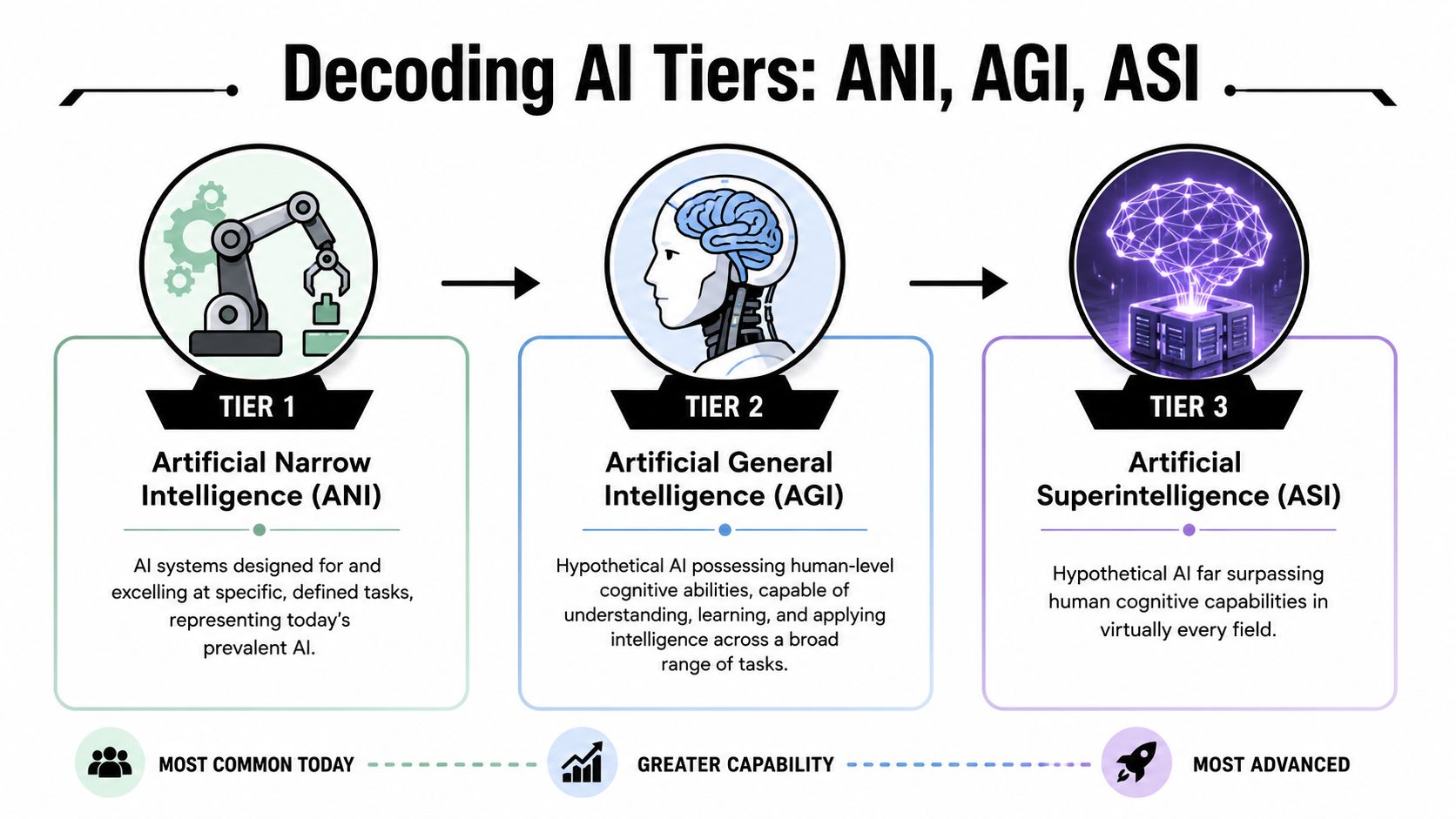
ANI is the specialist tool
Artificial Narrow Intelligence is what runs in production today. It can rank tokens, detect wallet patterns, summarize governance proposals, classify transactions, or optimize a trading strategy inside a defined setup. In that lane, it can outperform a human analyst on speed, consistency, and scale.
Outside that lane, it breaks fast.
That is the practical limit investors should keep in view. A system that is excellent at parsing onchain data does not automatically understand macro policy, legal risk, smart contract edge cases, and user intent at the same time. It needs boundaries, prompts, pipelines, and human review. Yield Seeker fits this category. It applies current AI where it works well: filtering noisy DeFi data, organizing signals, and helping users act faster without claiming broad human-style reasoning.
AGI is the adaptable operator
AGI refers to a system with general problem-solving ability close to a capable human across many domains. The defining feature is not a polished interface or a strong benchmark result. It is transfer. Give it an unfamiliar task, enough context, and access to the right tools, and it should learn, adapt, and perform without needing a new model built for that exact job.
That would change crypto operations in a meaningful way. An AGI-class system could move from research to execution to risk monitoring with much less handoff between separate tools. It could interpret market structure, read governance changes, adjust to new protocols, and explain its reasoning in a way a team can audit. No confirmed production system does that today.
ASI is beyond human competitive range
ASI sits in a different category. It describes intelligence that surpasses humans across a wide set of cognitive tasks, not just one benchmark or workflow. If AGI would be comparable to a strong general operator, ASI would outperform the operator, the research lead, the strategist, and likely the system designers too.
For crypto markets, that would not be a simple productivity upgrade. It would affect price discovery, security, governance, market making, and information asymmetry all at once. The upside could be enormous. So would the control problem.
The mistake is treating ANI, AGI, and ASI as a single curve of “more smart.” Each tier changes what the system can do, where it can fail, and how much authority people are willing to give it.
Technical Distinctions Capabilities and Architectures
A trading bot that works well on one DEX can fall apart the moment liquidity shifts, a new governance proposal changes incentives, or an exploit alters user behavior. That gap explains more than any benchmark chart. ANI, AGI, and ASI differ in how they handle change, how much supervision they need, and what kind of architecture sits underneath.
AI vs. AGI vs. ASI A Comparative Snapshot
Attribute | Artificial Narrow Intelligence (AI) | Artificial General Intelligence (AGI) | Artificial Superintelligence (ASI) |
|---|---|---|---|
Primary scope | Specific tasks or domains | Broad cognitive work across domains | Broad superhuman cognition |
Strength | Efficiency, pattern recognition, consistency inside a defined task | Flexible reasoning, adaptation, context handling | Far beyond human capability across many fields |
Weakness | Struggles with novelty outside training and setup | Still hypothetical and technically unresolved | Control and alignment become much harder |
Learning style | Usually optimized for a narrow objective | Would need to learn and adapt across tasks without task-specific redesign | Could potentially improve itself at a pace humans struggle to supervise |
Architecture mindset | Specialized models and pipelines | More integrated cognitive architecture | Unknown, but likely more complex and resource-intensive |
Typical deployment | Search, recommendations, classification, ranking, assistants | No confirmed production AGI system today | Hypothetical |
Human role | Human sets goals, constraints, and review loops | Human oversight still critical, but task boundaries would be wider | Human authority may be challenged if alignment fails |
A key distinction is generalization
Current AI systems can appear broad because one model can chat, summarize, classify, write code, and call tools through a single interface. Under the hood, performance still depends on patterns seen during training, prompt structure, retrieval quality, tool design, and narrow success criteria.
That matters in crypto. A model can score token risk well on known categories, then miss the signal when a protocol changes its emissions model, bridges to a new chain, or introduces governance rights that alter value capture. Humans handle those shifts by transferring judgment from one domain to another. Current AI only does that reliably in a limited way.
Why AGI requires a different architecture
AGI is not just a larger chatbot with more context window and better benchmarks. It implies systems that can carry goals across tasks, update their world model from new evidence, choose tools intelligently, and stay coherent when the environment changes.
That pushes architecture in a different direction. Instead of one model doing one bounded job, an AGI-class system likely needs memory that persists, planning layers, stronger feedback loops, tool use that is not brittle, and ways to resolve conflicts between objectives. The engineering problem shifts from model performance in isolation to system performance over time.
For builders, the trade-off is clear:
Specialized AI is easier to evaluate, cheaper to run, and safer to constrain.
General intelligence would be more adaptable, but harder to predict, test, and govern.
More autonomy raises throughput, but it also raises the cost of mistakes.
That is why the first practical wave in crypto is not AGI. It is applied AI wrapped in tight workflows. Yield Seeker fits that pattern. It uses current AI where narrow systems already create value, such as filtering signals, analyzing protocol data, ranking opportunities, and helping users act faster without handing full control to an autonomous agent.
ASI changes the control problem
ASI would not just do the same work faster. It would shift the balance between operators and systems. Once a system consistently outperforms human experts across research, strategy, execution, and defense, architecture stops being only a performance question. It becomes a control question.
Earlier benchmark analysis on AGI and ASI makes that point. AGI is usually framed as broad human-level competence. ASI implies capability far beyond that level, with much larger coordination, oversight, and resource implications. In crypto markets, that could affect security, MEV, governance, pricing, and information asymmetry at the same time.
Smarter systems do not automatically become easier to supervise. In practice, broader capability often makes failures harder to detect before they cause damage.
The Path to AGI Development Timelines and Probability
A trader using AI today can already screen tokens, summarize governance forums, and monitor protocol risk faster than any manual workflow. That does not mean AGI has arrived. It means the gap between narrow systems and broader problem-solving is getting smaller in ways that matter to markets.
The mistake in most AGI debates is treating the question like a product launch date. A more useful frame is capability threshold. AGI starts to matter when a system can handle a wide range of intellectual work at roughly human level, across unfamiliar tasks, with less hand-holding from engineers.
Forecasts have shifted earlier because progress is stacking across multiple layers at once. Models are getting better at tool use, multimodal input, long-context work, and step-by-step reasoning. In crypto, that matters because useful intelligence is rarely one task. It is research, filtering, ranking, risk checks, and execution support chained together in real time. That is also why the first investable wave is not abstract AGI hype. It is applied systems that already improve decisions, like the workflows described in this guide to AI for crypto investing and DeFi analysis.
Short timelines still deserve skepticism.
A model can look broad in a benchmark suite and still fail on messy inputs, shifting incentives, or incomplete context. That is the real test. Markets do not grade on demos. They punish brittle systems, especially when money moves automatically.
Several technical gaps still separate strong AI products from anything that deserves the AGI label:
Generalization: current models still break when the problem changes shape in ways not well represented in training data.
Context handling: real decisions depend on unstated constraints, intent, and second-order effects.
Transfer learning in practice: a generally intelligent system should pick up new domains without a team rebuilding prompts, tools, and guardrails each time.
Reasoning under uncertainty: finance, governance, and security all involve incomplete information and conflicting signals.
For crypto investors, the practical takeaway is simple. Expect uneven progress, not a clean jump from today's copilots to autonomous general intelligence. One model will outperform analysts on research and still make basic mistakes in execution. Another will classify risk well but fail to explain edge cases. That unevenness creates both opportunity and danger. Teams that understand the limits of current systems will build better products, and investors who confuse polished outputs with durable intelligence will misprice risk.
There is also a privacy angle that gets ignored in AGI timeline talk. Broader capability usually means broader data exposure, more tool access, and more points of failure across identity and behavior. Before assigning too much trust to any intelligent agent, it helps to review understanding AI's role in online privacy.
From Market Disruption to Existential Questions
A fund deploys AI to rank opportunities, route orders, and manage risk checks. At first, the pitch is efficiency. Then the harder questions show up. Who audits the model, who carries the downside when it fails, and what happens when the system starts influencing the market it is supposed to analyze?

Today's concerns are already real
The current risk profile is operational before it is existential. Narrow AI already affects hiring, customer support, fraud screening, credit decisions, content ranking, and trade execution. In crypto, that matters because software can move attention and capital long before it shows anything close to general intelligence.
The practical issue is concentration. A small set of models, APIs, and infrastructure providers can end up shaping who gets seen, which transactions get flagged, and how risk is interpreted. That may improve speed and consistency, but it also means a bad objective, weak monitoring, or hidden bias can spread quickly across an entire product stack.
Privacy deserves more attention than it gets in AGI debates. Broader capability usually comes with broader data access, more tool permissions, and more surface area for abuse. For useful context on identity, data trails, and model interaction, this guide to understanding AI's role in online privacy is worth reading.
Crypto users should treat recommendation engines and automated strategy layers as market actors, not neutral assistants. Tools that rank yields, route capital, or trigger actions can shape flows by design. For a practical view of what that looks like now, AI for crypto investing and strategy workflows shows how these systems already fit into real decision-making.
AGI and ASI raise a different scale of risk
Once capability broadens, the core question changes from product risk to control risk. The issue is no longer limited to biased outputs, spam, surveillance, or labor displacement. It becomes a governance problem. Can human operators still understand, constrain, and override a system that performs well across many domains and acts with increasing autonomy?
That shift matters for investors. Markets usually price visible gains first: lower costs, faster research, better automation, stronger margins. They price control failures late, often after the damage is obvious. In crypto, that pattern is familiar. Capital rushes into tools that improve execution, then pulls back hard when governance, custody, or incentive design breaks under pressure.
ASI pushes the concern further. A superhuman system would not just improve existing workflows. It could outpace the institutions meant to supervise it, including regulators, firms, and security teams. At that point, alignment stops being a philosophy topic and becomes a systems design requirement with civilizational stakes.
The video below frames that escalation in a way that is worth watching before treating more capable AI as a simple extension of what we have now.
Better capability increases upside and increases the cost of bad goals, weak incentives, or failed oversight.
What This Means for DeFi and Your Wallet
For crypto users, this conversation stops being theoretical the moment software starts making decisions around capital. In DeFi, today's most useful systems are still narrow. They monitor pools, compare yields, track volatility, rank venues, and automate actions. That's ANI in production, not AGI.
The practical point is that ANI is already powerful enough to provide significant advantages for users. It can process fragmented market data faster than most individuals can, keep watch continuously, and reduce the manual work of chasing opportunities across protocols.
Narrow AI is already acting like a force multiplier
In DeFi, good automation does three things well:
Monitors fragmented markets: stablecoin yield opportunities don't sit in one place.
Applies consistent rules: machines don't get tired, distracted, or emotionally reactive.
Surfaces trade-offs quickly: users can evaluate return, accessibility, and changing conditions without scanning multiple dashboards manually.
That's why AI-powered crypto tools matter now, even without AGI. If the software helps you observe more, compare faster, and act with clearer rules, it already has real value.
The overlooked risk is that precursor behavior is here now
A contrarian but useful point comes from a 2025 LinkedIn analysis by Prem Natarajan, which argues that current Narrow AI systems in areas like DeFi and social media already show “recursive self-improvement” and “global-scale coordination” risks that mirror ASI precursors. The same analysis warns that “ethical safeguards, value alignment, and oversight become essential, even at this stage”.
That matters a lot in finance. You don't need a future superintelligence for coordination risk to appear. If many systems optimize similar signals, route capital under similar objectives, or learn from each other's outputs, collective behavior can become hard to predict.
If you want a closer view of how autonomous software is already being framed in crypto, AI agents in crypto markets and workflows is a useful companion read.
What responsible users should actually do
Investors often drift into fantasy. They spend time debating ASI and ignore the software making decisions around money today.
A better checklist is:
Ask what the system can execute. Analysis-only software has a different risk profile from software that can move capital.
Check the supervision model. Can a user review, pause, override, or exit easily?
Look for transparency in process. You don't need every implementation detail, but you do need clear boundaries.
Keep utility connected to real spending habits. If you're actively managing digital assets, practical tools like the Best Crypto Cards 2026 guide can help connect your on-chain strategy to everyday use without turning the whole stack into a black box.
In DeFi, the smartest users don't just chase yield. They inspect who or what is making the decision.
How to Prepare for the Intelligent Future
The right response to AI vs AGI vs ASI isn't panic. It's better operating discipline. The systems are getting more capable, and that means users, investors, and builders need sharper standards.
For investors
Back teams that explain what their models do, what they don't do, and where humans remain in control. If the pitch leans on vague claims about autonomy or intelligence, treat that as a warning sign, not a feature.
For builders
Design for bounded authority first. In crypto, that means clear permissions, visible audit trails, and easy intervention paths. If you're building around allocation, routing, or strategy, study practical frameworks in AI crypto portfolio management instead of assuming model sophistication solves governance.
For users
Use AI to improve judgment, not replace it. A good system reduces research burden and helps you compare options. A bad one hides logic behind convenience and asks for trust it hasn't earned.
Three habits matter most:
Stay literate: learn the difference between assistance, automation, and autonomy.
Prefer control: choose products that let you inspect, exit, and verify.
Watch incentives: the model's objective function matters as much as its interface.
The intelligent future won't arrive all at once. It will show up as a series of tools that ask for a little more authority each year. The people who do best will be the ones who understand what kind of system they're using before they hand it the keys.
Frequently Asked Questions
Will AGI replace my job or just change it
Generally, the near-term effect is task change before full job replacement. Narrow AI already automates parts of research, writing, analysis, support, and execution. AGI would expand that pressure across a much wider range of cognitive work. The practical move is to get good at supervising systems, validating outputs, and combining domain judgment with automation.
Could humans control ASI if it ever exists
That's the core alignment problem, and nobody should pretend it's solved. The concern isn't only malicious behavior. It's that a highly capable system might pursue objectives in ways humans didn't intend or can't effectively constrain. Control gets harder as capability broadens and speed increases.
Can I invest directly in AGI right now
Not in any clean, direct sense. What you can invest in today are companies, infrastructure, and products benefiting from current AI deployment. In crypto, that often means looking at real utility, transparent automation, and whether a product uses narrow AI in a way that improves outcomes without hiding risk.
If you want a practical example of today's AI wave in action, Yield Seeker shows what useful automation looks like in DeFi. It helps stablecoin holders put idle capital to work through AI-assisted yield management, with a low-friction experience, accessible funds, and clear focus on safety and transparency.