
You probably know the routine. One tab for Aave. Another for Morpho. A portfolio tracker on the side. A wallet open in case you need to move fast. Then a social feed full of new pools, new incentives, new warnings, and fresh reasons to second-guess yesterday's allocation.
That works for a while. Then real life interrupts. You sleep, you work, you miss a governance change, a utilization spike, or a better stablecoin parking spot on another venue. Crypto keeps moving anyway.
That gap is why AI for crypto matters. Not because it can magically pick winners, but because it can keep watching when you can't. In a market that runs continuously, the primary edge is often disciplined monitoring, faster reaction time, and rules-based execution.
The Crypto Market Never Sleeps But You Have To
The hard part of crypto isn't only finding opportunity. It's staying on top of it without turning portfolio management into a full-time job.
A stablecoin holder might start with a simple goal: earn yield without taking reckless risk. Within a few days, that goal gets messy. One protocol offers a better rate, another looks safer, a third suddenly becomes interesting because liquidity shifts. None of this waits for office hours.
The backdrop is large enough that manual tracking breaks down quickly. In 2025, total crypto market capitalization crossed $4 trillion, while stablecoins handled an adjusted $9 trillion in annual transactions, with monthly volumes approaching $1.25 trillion, according to a16z crypto's 2025 market report. At that scale, automation stops being a convenience and starts looking like basic infrastructure.
Where manual management starts to fail
Most users don't lose focus because they're careless. They lose focus because the workflow is fragmented.
Too many moving parts: Yields change, protocol conditions change, and wallet-level decisions still require judgment.
Too much context switching: You end up juggling dashboards, chain explorers, analytics tools, and community chatter.
Too much timing pressure: The market doesn't pause while you verify whether a higher APY is worth the extra risk.
Crypto punishes delayed attention more often than it rewards heroic screen time.
That's also why the fantasy of “passive” crypto income usually falls apart. It isn't passive if you still need to babysit every position.
A better model is an automated system that acts like a tireless analyst. It monitors the inputs you'd check manually, applies rules you'd want enforced consistently, and only acts inside defined limits. That's closer to the promise behind earning while you sleep with automated yield workflows.
The important shift is psychological as much as technical. Instead of asking, “What should I check next?” you start asking, “What should my system be allowed to do on my behalf?”
What AI for Crypto Actually Means
Most conversations about AI for crypto go off the rails because they start with fantasy. People hear “AI” and think autonomous genius, secret signal, or machine oracle.
That's not how useful systems work.
Useful AI in crypto behaves more like a team of specialized analysts and operators connected to a fast execution layer. One part watches market data. Another compares on-chain flows. Another scores risk. Another handles execution. The model doesn't need to be mystical. It needs to be structured, fast, and constrained.
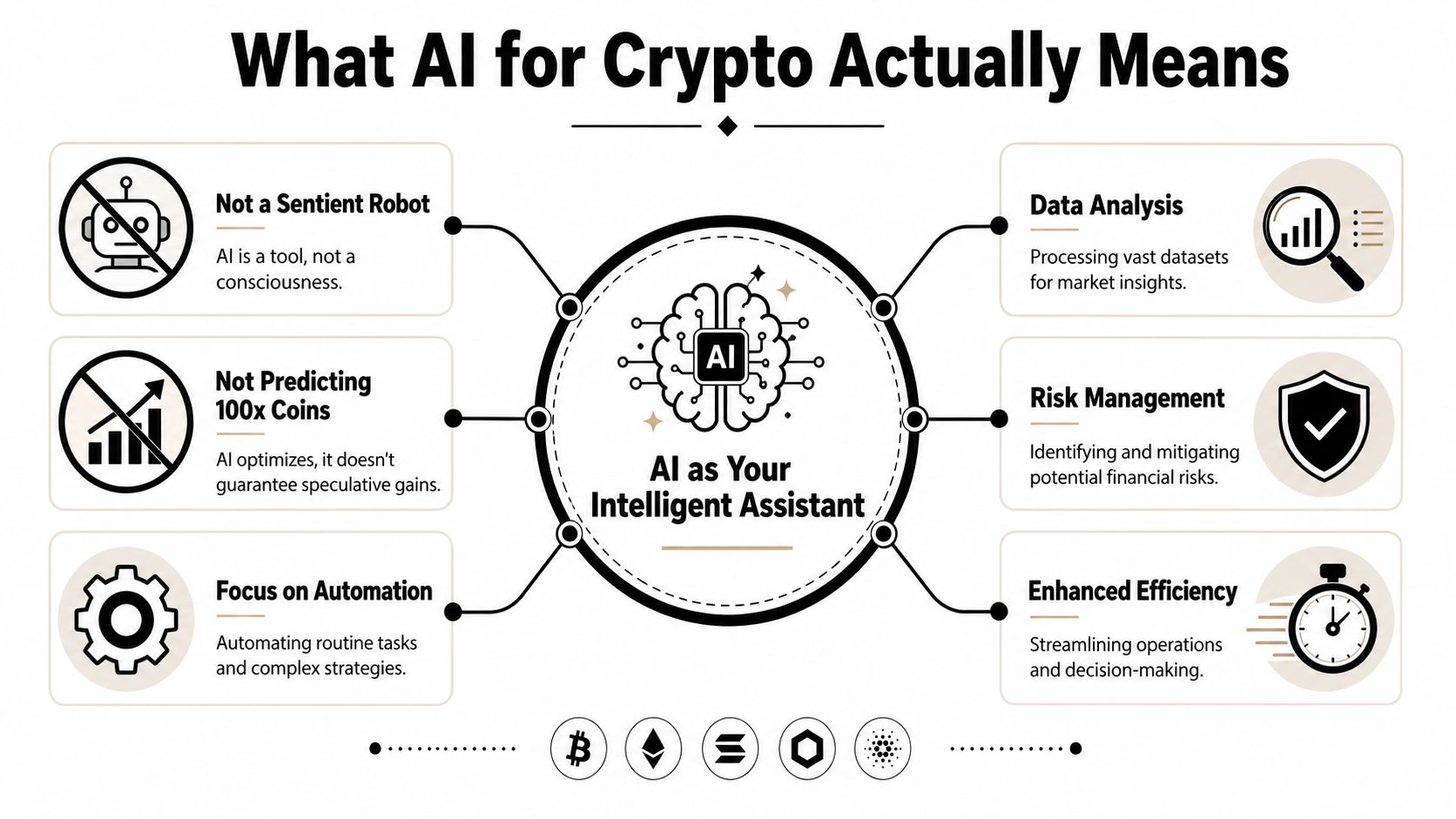
It's an analysis and execution engine
By 2025, industry coverage described AI tools in crypto as moving from simple automation to adaptive systems that process large datasets, detect market patterns, and execute in real time, as noted by Nansen's analysis of AI-driven crypto trading. That evolution matters because crypto data is fragmented across venues, chains, and off-chain sentiment streams.
A practical AI stack usually does three things.
Ingests data
It pulls in price feeds, order books, protocol metrics, wallet activity, news, and sentiment. For DeFi yield, that can also include utilization changes, liquidity depth, and shifts in protocol usage.
Finds patterns
It compares current conditions with historical behavior and cross-market context. Through this process, AI can spot that a high headline yield may not be attractive after adjusting for liquidity, concentration, or changing protocol conditions.
Executes predefined actions
This is the part people underestimate. Insight without action is just another dashboard. The useful system applies rules and executes only within those rules.
What AI for crypto is not
A lot of bad products hide weak logic behind a shiny AI label. A few red flags show up repeatedly:
Black-box coin picking: If a tool claims it can reliably surface the next explosive token without explaining inputs or risk logic, treat it as marketing.
Unbounded autonomy: If the system can move capital broadly without clear user controls, the problem isn't sophistication. It's governance.
Prediction theater: Fancy language around “forecasting the future” often distracts from the actual value, which is better monitoring and faster execution.
For builders, the primary work is operational. Data quality, routing logic, guardrails, alert thresholds, fallback behavior. That's the difference between a toy and a deployable system.
For a deeper technical look at this design mindset, machine learning in DeFi is a useful framing. The best systems don't pretend to know everything. They narrow the decision space and respond consistently inside it.
Practical rule: If an AI tool can't explain what data it watches, what actions it can take, and what limits stop it, it isn't ready to manage real money.
Key AI Applications Transforming Crypto
AI in crypto is broad now, but the useful applications cluster around a few repeatable jobs. They all come back to one advantage: processing more signals than a human can, then acting faster.
Coinbase notes that algorithmic crypto systems can process diverse inputs like price, order-book data, on-chain activity, and sentiment, then operate “several magnitudes faster” than manual trading and may execute “millions of transactions in a day” in suitable contexts, as described in Coinbase's guide to using AI for crypto trading. The same logic carries into yield systems, where speed matters for rebalancing and risk response.
Five use cases that actually matter
Some applications are infrastructure-level. Others are portfolio-level. The useful question is simple: what job is the AI taking over?
Application | Problem Solved | AI's Role |
|---|---|---|
Automated market making | Humans can't constantly reprice inventory across changing volatility and spread conditions | Recomputes pricing, inventory balance, and execution logic continuously |
Dynamic yield optimization | Headline APY alone doesn't tell you whether a venue still offers good risk-adjusted return | Monitors pool conditions, protocol signals, and reallocates when the trade-off worsens |
Proactive risk monitoring | Protocol risk can change before users manually react | Flags deteriorating conditions from on-chain and market inputs |
Deep on-chain analytics | Raw blockchain data is too dense for casual monitoring | Structures wallet, flow, and usage signals into decision-ready outputs |
Smart contract auditing support | Reviewing every contract pattern manually is slow and error-prone | Assists with pattern detection, anomaly surfacing, and prioritization for human review |
Where AI helps and where it doesn't
Automated market making and arbitrage are obvious fits because they are speed games. Humans can design the strategy, but they can't keep up with second-by-second changes in spreads and liquidity.
Yield optimization is more subtle. A decent system doesn't just chase the highest rate. It asks whether the extra yield justifies the extra exposure. Sometimes the right move is reallocation. Sometimes the right move is doing nothing.
Smart contract work is similar. AI can help surface patterns and suspicious code regions, but it shouldn't replace a careful review process. In security-sensitive settings, acceleration is valuable. Blind trust is dangerous.
The practical split between strong and weak systems
Good systems usually share a few traits:
They combine signal types: Market data alone is noisy. On-chain data alone is incomplete. The combination is more useful.
They use risk gates: Allocation logic should sit behind exposure caps, minimum liquidity checks, and clear no-go conditions.
They focus on narrow jobs: A tool built to optimize treasury stablecoin parking has a clearer mandate than one claiming to do everything in crypto.
Weak systems usually fail in the opposite direction. They overfit old conditions, chase visible yield without context, or expose users to actions that aren't clearly bounded.
A strong AI system doesn't need to be creative. It needs to be consistent when conditions get messy.
How an AI Agent Manages Your Stablecoin Yield
The easiest way to understand AI for crypto is to stop thinking about “intelligence” and walk through a single workflow.
Say you deposit USDC and want the system to manage stablecoin yield on your behalf. The agent's job isn't to speculate. Its job is to keep scanning available opportunities, compare return against risk, and move only when the trade-off improves.

What the agent watches
The first thing a competent agent needs is broad coverage. Some modern AI crypto tools analyze 300+ cryptocurrencies, while others evaluate 9,000+ coins across 11 markets, as summarized in this overview of AI crypto analysis coverage. The point isn't the headline count by itself. The point is that broad coverage improves comparison.
In yield management, the same principle applies. The system needs enough breadth to compare opportunities across venues and enough structure to normalize what it sees. It should look at:
Current yield conditions: Not just the visible APY, but whether it is stable or transient
Liquidity context: Whether capital can move in and out without getting trapped in thin conditions
On-chain health signals: Usage patterns, fund flows, and changes that may hint at a regime shift
Risk constraints: Protocol allowlists, exposure limits, and minimum safety thresholds
One tool like Yield Seeker finds its place in the market. It uses an AI agent to monitor stablecoin opportunities and allocate capital across DeFi protocols under predefined conditions. That kind of product is useful when the user wants automation but still expects a risk-aware framework rather than a blind APY chase.
A realistic rebalance cycle
Suppose the agent places part of your USDC into a stable lending venue because it currently offers an acceptable mix of return, liquidity, and protocol quality.
A few things can happen next. The rate can compress. Utilization can spike. A competing venue can become more attractive. The smart move isn't always to jump immediately. Sometimes switching costs or changing conditions make patience the better choice.
That's where an AI agent earns its keep. It keeps reevaluating, not once a day but continuously. If the expected risk-adjusted outcome degrades enough, it can rebalance inside the limits you approved.
For users trying to understand the details behind returns, it also helps to compare APY compounding periods, because two rates that look similar on the surface can behave differently once compounding assumptions enter the picture.
If you want to see the agent workflow in a product context, this walkthrough is useful:
The operational value is simple. You don't need to manually poll protocols, recalculate trade-offs, and move funds every time conditions shift. The agent does the legwork, and you retain the right to define the boundaries. That's the core promise behind using AI agents for DeFi workflows.
The Unspoken Risks Governance and Security
A useful AI agent in crypto does more than search for yield. It needs a rulebook.
If a system can suggest transactions, sign transactions, or route funds across protocols, the hard question is no longer whether the model is smart. The hard question is who controls it when conditions change, when the model is wrong, or when someone tries to exploit it. In crypto, governance is part of security because bad permissions and vague authority often fail before the model does.
Chainalysis makes this point clearly in its discussion of agentic payments. Safe autonomy depends on auditable autonomy, where actions stay inside pre-defined controls and operators can see who can override the system, what limits exist, and how those limits are enforced in real time, as discussed in Chainalysis's analysis of AI and agentic payments.
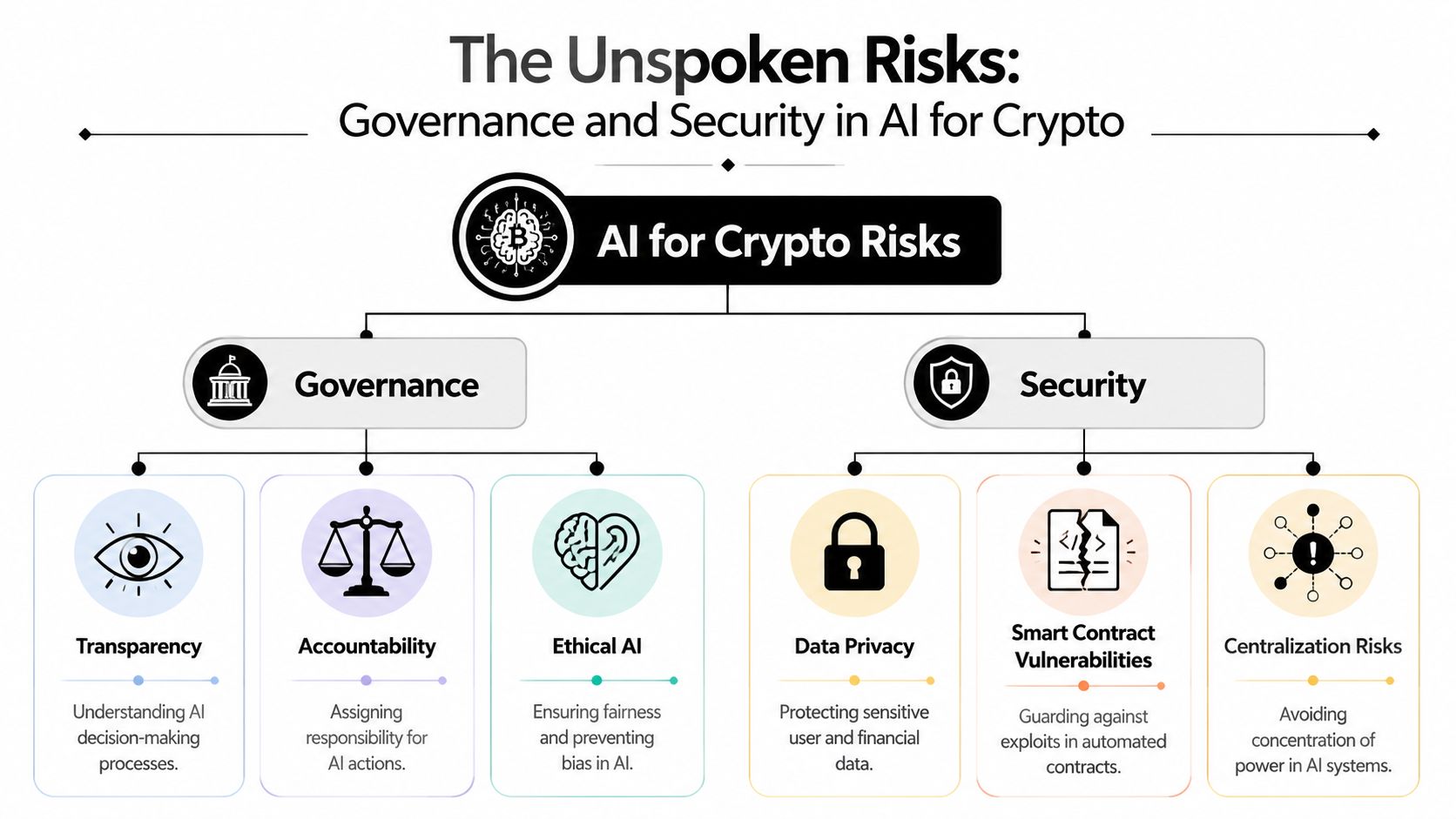
Governance is a product feature
Good governance shows up as constraints a user can inspect before depositing funds.
That means clear answers to basic operational questions. Which protocols are approved. Which chains are approved. How much capital can sit in one venue. Whether the agent can bridge funds. Whether it can interact only with an allowlist of contracts. Whether the user can pause it immediately and withdraw without asking the model for permission.
These controls shape outcomes. An agent with broad discretion might catch more short-term opportunities, but it also has more ways to fail. An agent with tight limits may leave some yield on the table, yet it reduces the chance of a single bad call turning into a portfolio event. That is the trade-off users should evaluate.
We learned this firsthand while building Yield Seeker. People did not ask only how the system finds better stablecoin allocations. They asked what it is allowed to touch, what happens if a venue depegs or freezes, and who can stop execution. Those are the right questions.
Security gets harder once AI is in the loop
Adding an AI layer does not remove normal crypto risk. It adds another decision-making surface that can be manipulated.
The weak points are rarely dramatic. A poisoned input feed. A prompt or instruction chain that pushes the agent toward the wrong action. A stale protocol risk model. An execution policy that allows interaction with a contract nobody meant to approve. Security teams already deal with phishing, wallet compromise, malicious contracts, and social engineering. An AI agent can become another path into the same capital if its permissions are too wide.
The practical defense is layered control:
Input controls
Market data, protocol data, and policy instructions need validation. Bad inputs produce bad actions.Execution limits
Position caps, venue caps, contract allowlists, and slippage thresholds should block dangerous behavior automatically.Human intervention
Users and operators need a fast pause path. Waiting for the model to correct itself is not a control.Audit trails
Every recommendation, approval, and transaction should be reviewable after the fact.
An AI agent works like a tireless analyst. It should not operate like an unchecked trader.
What breaks in practice
The first failure is often governance drift. Teams start with strict policies, then expand permissions to improve coverage, speed, or returns. Over time, the allowlist grows, exceptions pile up, and nobody can explain the full decision boundary. At that point, the agent may still look disciplined on the front end while carrying much more operational risk underneath.
The second failure is false confidence. A polished interface can make users assume the system is safer than it is. In reality, safety comes from narrow permissions, tested fallback paths, and clear operator accountability.
A safe AI crypto product is not one that promises perfect decisions. It is one that contains mistakes, records them, and lets a human shut things down before a bad decision becomes a loss.
How to Evaluate an AI Crypto Tool
Open two tabs. In one, an AI crypto app promises optimized yield and smart automation. In the other, your wallet holds capital you cannot afford to misroute. The gap between those two tabs is the evaluation job.
A polished dashboard proves almost nothing. Good evaluation starts with one question: what decisions is this system allowed to make with your money, and what stops it from making the wrong ones?
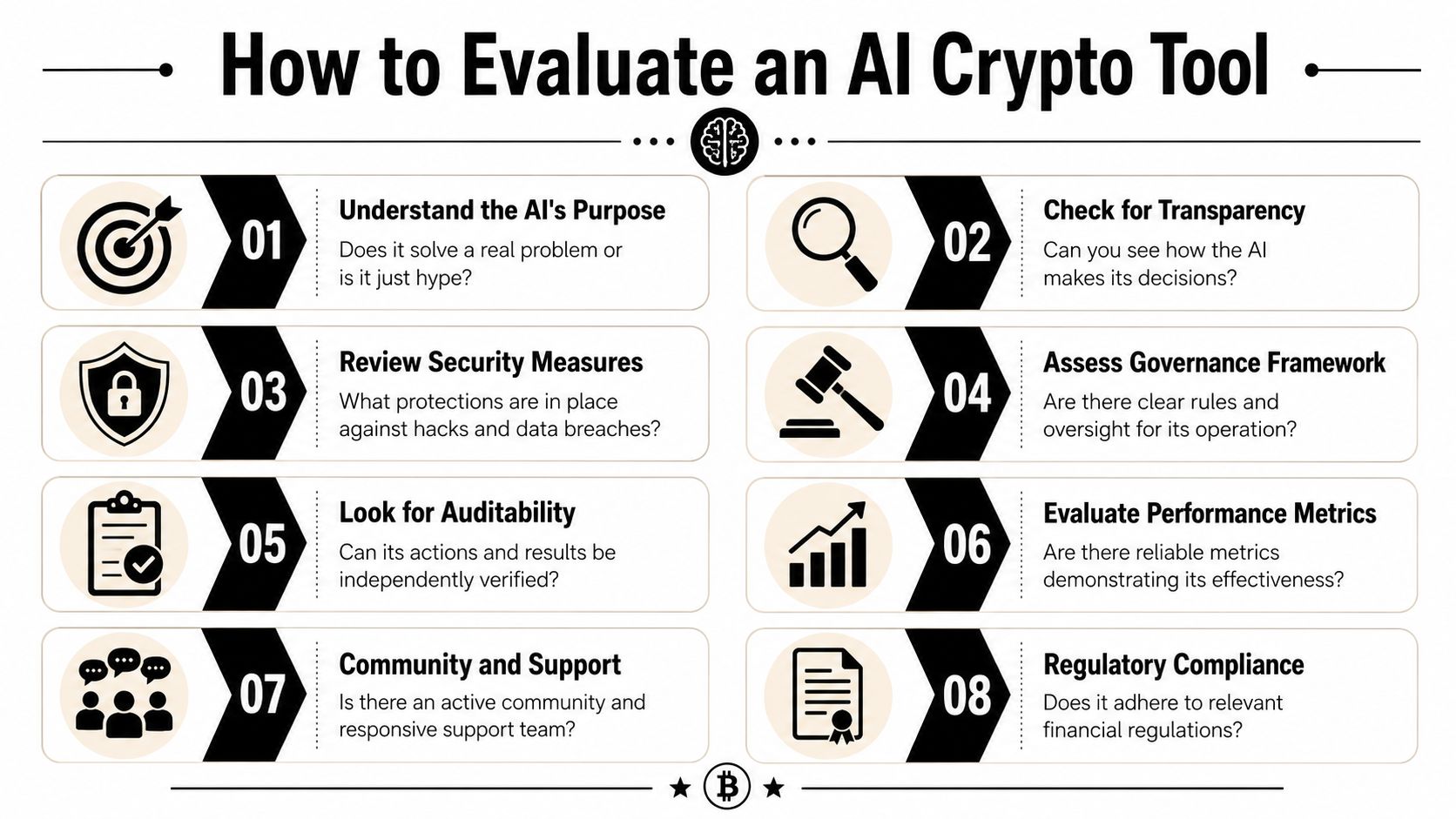
Questions worth asking before you deposit
Start with scope.
If a team says the product uses AI, ask what part is intelligent and what part is standard automation. There is a real difference between a tool that summarizes opportunities and one that can move funds across protocols. At Yield Seeker, that distinction matters because users are not buying a chatbot. They are trusting a system to monitor markets, compare on-chain yield options, and act within defined boundaries.
Then get specific:
What problem does the AI solve?
Yield allocation, signal generation, anomaly detection, execution routing, and scam filtering are different jobs. A serious product names the job clearly.What can it approve or execute?
Ask which transactions it can initiate, which chains and contracts it can touch, and whether those permissions are fixed or updated over time.What are the hard limits?
Look for exposure caps, protocol allowlists, slippage controls, cooldowns, and a clear pause function. If limits depend on operator judgment alone, the control system is weak.Can a human review the decision path?
You should be able to see why the tool suggested or executed an action, what inputs it used, and what policy approved it.What happens outside normal conditions?
Markets gap. Oracles fail. Liquidity disappears. The product should explain its fallback behavior before you ever deposit.
Security is part of product quality
The hard question is not whether the AI sounds smart. The hard question is whether the AI introduces new ways to lose money.
That usually shows up in four places: bad data feeds, prompt or policy manipulation, excessive wallet permissions, and weak operator controls. If the team cannot explain those risks in plain language, they probably have not contained them.
A few questions expose maturity fast:
What to ask | Why it matters |
|---|---|
How do you vet new protocols or pools? | A high quoted yield means little if the underlying venue is unsafe or thinly liquid |
What happens if the model produces a bad recommendation? | Safe systems degrade to restricted actions, alerts, or no action at all |
Who can change permissions or risk policy? | Governance decides whether controls survive pressure from growth or market hype |
How do you report performance? | Returns without fees, drawdowns, and idle periods distort the picture |
What wallet and key controls sit behind the agent? | Security depends on how signing authority is segmented, limited, and monitored |
One sentence from support can tell you a lot. If they can explain features but cannot explain approval logic, incident response, or permissioning, treat that as a warning.
Signs of a tool built for real capital
Good AI crypto products act like disciplined operations systems, not magic boxes. They define a narrow mandate, show their constraints, and make supervision easy.
Look for plain-language documentation, visible risk settings, stable definitions of what the agent can and cannot do, and records you can inspect after the fact. Look for restraint too. Teams that claim coverage across every chain, every opportunity, and every market regime usually expand risk faster than they improve controls.
Trust comes from governance you can understand and security boundaries you can verify. In practice, that matters more than model branding, marketing polish, or a screenshot of recent returns.
The Future of Automated Crypto Investing
The long-term shift isn't that AI will replace human judgment. It's that more of crypto's repetitive work will move into controlled software systems.
That's healthy. Most users shouldn't have to monitor every venue manually just to manage stablecoin exposure responsibly. The better model is human-directed automation. People set goals, limits, and preferences. Systems handle surveillance, comparison, and execution inside those boundaries.
The winners in AI for crypto won't be the loudest products. They'll be the ones that combine useful automation with clear governance, inspectable behavior, and conservative security design. That matters for individuals, and it matters even more for treasuries that need repeatable operating processes.
Crypto has spent years proving that value can move on-chain. The next phase is proving that on-chain capital can be managed with more discipline, less dashboard fatigue, and fewer preventable mistakes. AI is becoming one of the core building blocks for that shift.
If you want a practical example of this model, Yield Seeker offers an AI-driven way to manage stablecoin yield on Base with user-accessible funds, clear portfolio visibility, and automated allocation across DeFi opportunities. It's useful for people who want less manual protocol hunting and more structured, risk-aware automation.