
Reddit is usually where stablecoin yield farming starts and where confusion peaks. One thread says Aave is the “safe” move. Another insists Curve is the only place worth parking size. A third warns that anything above a modest yield is a trap, while someone else posts a screenshot of a farm paying far more and calls everyone else too conservative.
If you're reading stablecoin yield farming Reddit threads right now, you're probably trying to answer a simple question that somehow became messy: where can I earn on stablecoins without walking into a blow-up I didn't understand? That's the core problem. The issue isn't access. DeFi made access easy. The issue is filtering signal from noise.
I've seen the same pattern over and over. Newer users focus on the number first, then learn the mechanism later. Experienced users do the opposite. They ask where the yield comes from, what can break, how fast funds can exit, and whether the extra return is paying for a real risk or just baiting deposits. That mindset shift matters more than any single protocol recommendation.
The good news is that Reddit does contain useful wisdom. It's just scattered across arguments, screenshots, cautionary comments, and half-explained strategy posts. Used properly, it becomes a rough but valuable field report from people testing products in public. If you want deeper product-side context on how DeFi systems are designed and shipped, working through material from a defi development company can also help you think beyond hype and focus on protocol structure.
Decoding the Crypto Rabbit Hole
A typical Reddit session on stablecoin farms goes like this. You open one post asking for “best stablecoin yield.” Within minutes, you're reading about lending markets, LP pools, emissions, depegs, bridges, smart contract audits, and why somebody thinks “safe” is an illusion.
That chaos isn't random. Reddit compresses several different conversations into one keyword:
Income seekers want a better place to park USDC, DAI, or USDT.
DeFi natives compare base yield versus incentive yield.
Skeptics show up after every hack, exploit, or depeg.
Degens chase the highest number until it disappears.
Those groups talk past each other, which is why stablecoin yield farming Reddit searches feel so contradictory. They're often discussing entirely different risk profiles while using the same words.
What people are actually trying to figure out
Most users aren't asking for a theory lesson. They're trying to decide between a few practical options:
Lend and keep it simple. Deposit stablecoins into a lending market and earn variable yield.
Provide liquidity for more upside. Pair assets in a pool and earn fees, often with more moving parts.
Farm incentives for a while. Capture token rewards while they last, then leave before rewards dry up.
Avoid everything opaque. Skip any strategy that can't explain its yield source in plain language.
Reddit is useful when it shows how users behave under stress, not when it only shows what they say during a bull run.
That distinction matters. Bull markets make weak strategies look smart. Bear markets expose whether the product still works when incentives fade, liquidity thins, and users rush for the exit.
The useful way to read Reddit
Read Reddit like a due diligence feed, not a recommendation engine. The best comments usually aren't the loudest. They're the ones that explain mechanics, identify hidden risks, and separate “good for parking stables” from “good if you're actively managing positions every day.”
That's the lens for everything below. Not a hype list. A way to turn community chatter into an actionable framework.
What Is Stablecoin Yield Farming Anyway
Open any Reddit thread on stablecoin yield and the confusion shows up fast. One person is parking USDC on Aave and calling 4 percent “safe.” Another is in a new pool advertising 18 percent and using the same label. The phrase sounds simple, but it covers very different strategies, risk models, and reasons those yields exist.
At the simplest level, stablecoin yield farming means putting dollar-pegged crypto assets to work inside DeFi protocols so they generate a return instead of sitting idle in a wallet.

The stablecoin part matters because the asset is designed to hold a relatively steady price, usually around one U.S. dollar. The yield farming part means you deposit that asset into an onchain system that pays for capital, trading liquidity, or short-term incentives.
The basic exchange
You supply capital to a protocol. The protocol routes that capital into a defined use case. You receive part of the fees, interest, or rewards generated by that activity.
Most stablecoin strategies fit into two buckets:
Method | What you do | Where the yield comes from |
|---|---|---|
Lending | Deposit stablecoins into a lending market | Borrowers pay interest |
Liquidity providing | Deposit assets into a trading pool | Traders pay fees, and some protocols add rewards |
That sounds straightforward, but the trade-offs are different. Lending is usually easier to monitor and easier to explain. Liquidity providing can pay more, but the payout depends on pool design, trading volume, token incentives, and whether both assets in the pool stay stable.
If you have only used centralized crypto apps before, the key difference is custody. In DeFi, your wallet interacts with smart contracts directly. You can inspect positions, flows, and contract behavior with the right tools, which is why an onchain yield dashboard and research workflow matters more here than polished marketing pages.
Why stablecoins became the gateway strategy
Stablecoins changed who could participate in DeFi. Users no longer needed a strong view on ETH, SOL, or a small-cap token just to earn something onchain. They could stay in dollar terms and focus on one question: is this yield coming from real usage, or from emissions that disappear the moment attention moves elsewhere?
That shift made stablecoin farming easier to discuss, but also easier to misunderstand. A stable asset removes a lot of visible price volatility. It does not remove smart contract failures, governance mistakes, liquidity crunches, stablecoin depegs, or bad incentive design.
Reddit gets this part right more often than blog posts do. The useful threads are rarely arguing about whether yield exists. They are arguing about whether the source of that yield is durable.
What people usually mean by “good yield”
On Reddit, “good yield” usually means one of three things, and mixing them together creates half the confusion:
Base lending yield. You deposit USDC or USDT into a lending market and earn from borrower demand.
Fee-based pool yield. You provide stable liquidity and earn from swaps.
Incentivized yield. You earn protocol token rewards on top of the base rate, often for a limited period.
Practical rule: If the yield source cannot be explained in one sentence, the position is not ready for capital.
That filter saves time. It also cuts through the social noise that builds up in large online communities. Teams that study community behavior for business use cases make a similar point in this enterprise community management guide. A crowd is useful when you know how to separate signal, incentives, and repetition.
For stablecoin farming, that means reading every APY as a stack of components, not a headline number. If 3 percent comes from borrowing demand and another 9 percent comes from token emissions, those are not equally reliable. One may persist. The other may vanish after a governance vote, a treasury change, or a drop in protocol activity.
That is the core definition worth keeping. Stablecoin yield farming is not just “earning on stables.” It is choosing a mechanism, understanding who pays, and deciding whether the return matches the risks you are taking.
The Reddit Hivemind on Stablecoin Yield
Reddit is messy, but it's also one of the clearest windows into how users think about stablecoin yield. The pattern across r/defi, r/CryptoCurrency, and adjacent communities is consistent. People don't just chase rates. They compare trade-offs, post warnings after losses, and constantly revise what counts as “worth it.”
Community-driven Reddit analyses reported over 150,000 posts and 400,000 related comments referencing stablecoin yield farming themes between 2021 and 2025, and many discussions during the 2022 to 2023 bear market described yields on major platforms drifting from 8 to 12 percent down to roughly 3 to 6 percent, which shaped expectations of more typical 2 to 10 percent APY ranges by 2026 according to this YouTube summary of Reddit stablecoin yield farming research.
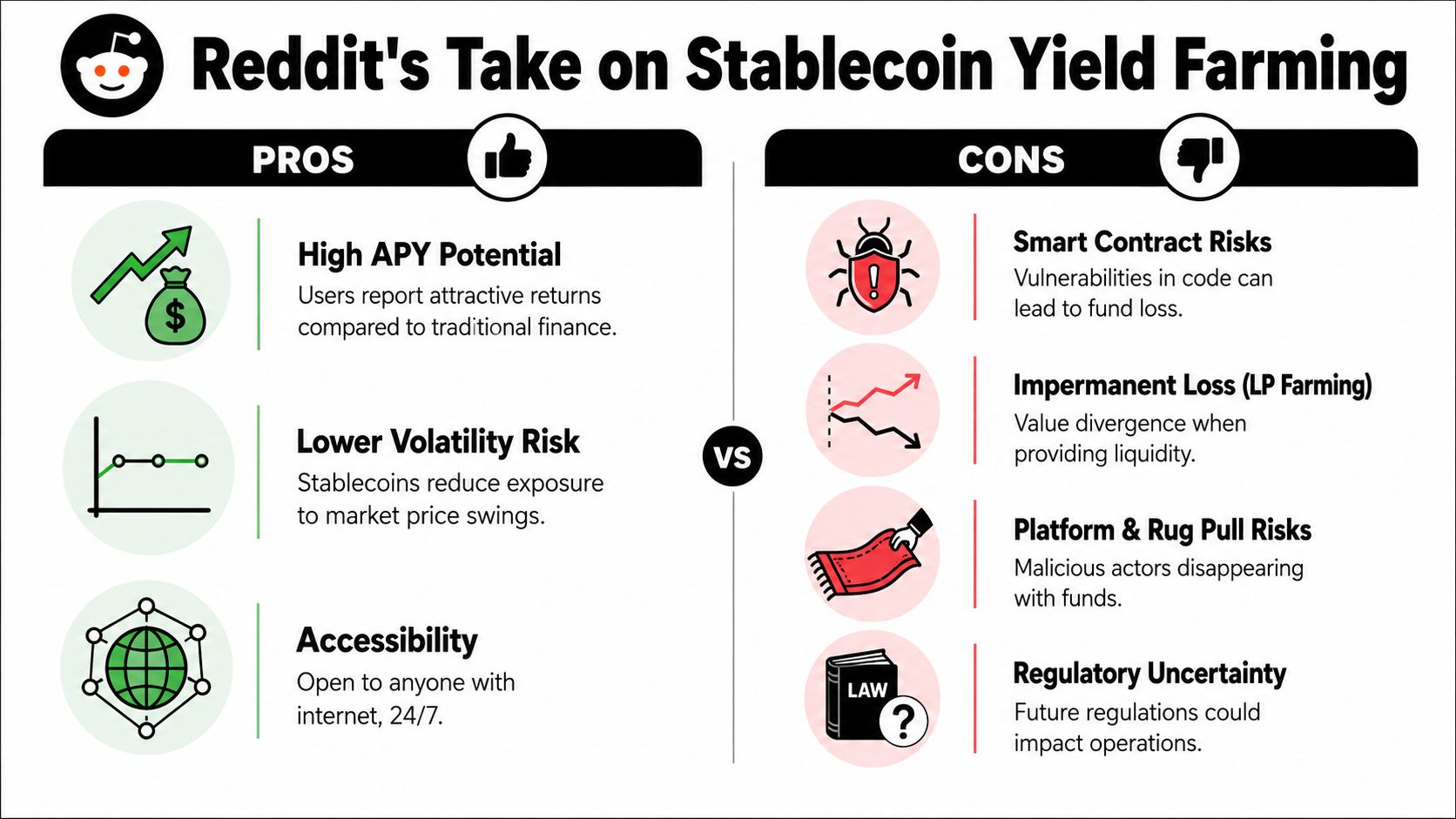
That shift explains why experienced Reddit users often sound skeptical. They've already watched flashy yields compress, incentives disappear, and “passive” strategies turn active the second conditions changed.
What Reddit repeatedly calls the good stuff
Certain names come up constantly because they solve basic needs well. For straightforward lending, users often mention Aave and Compound. For stablecoin-focused liquidity, Curve comes up again and again. The reason isn't mystery alpha. It's familiarity, liquidity depth, and a track record of being widely used.
A rough community distinction tends to look like this:
Parking capital usually means established lending markets.
Improving returns carefully often means stablecoin-centric LPs.
Going degen means layered incentives, thin liquidity, newer contracts, or all three.
That mental model is more useful than any list of “top farms.” Reddit veterans usually don't trust lists. They trust mechanisms and exit options.
What gets flagged as a red alert
The strongest consensus on Reddit isn't about where to earn. It's about what to avoid. Across threads, the same warnings keep returning:
Anonymous or unclear teams. If nobody can explain who built it or who maintains it, users get wary fast.
Unaudited contracts. Reddit doesn't treat an audit as a guarantee, but lack of one gets noticed immediately.
Impossible-looking APYs. Huge rates can come from token emissions, thin liquidity, or outright scams.
Complicated paths to yield. The more wrappers, bridges, or side contracts involved, the harder it is to know what can fail.
Exit friction. If it's easy to deposit and oddly complicated to withdraw, Reddit usually assumes there's a reason.
Most bad farms don't fail because the interface looks bad. They fail because the yield story doesn't hold up under basic questioning.
That's also why community management matters more than many DeFi teams realize. Projects that communicate clearly during stress usually retain more trust than projects that disappear into silence. If you're interested in how teams structure that relationship with users, this enterprise community management guide is a useful complement to what you see playing out in crypto forums.
What the best Reddit comments actually teach
The most valuable advice on stablecoin yield farming Reddit threads is rarely dramatic. It's boring in the right way:
Start small. Use your first deposit to learn the system, not to maximize income.
Read the yield components. If a pool mixes fees, lending income, and token rewards, know which part is likely to vanish first.
Check user behavior during stress. Search for older complaint threads, not just new promotional ones.
Prefer understandable strategies. A plain Aave deposit may outperform a confusing farm because you can stick with it.
For anyone trying to verify what a protocol is doing onchain instead of relying on comments alone, browsing guides on reading DeFi activity onchain is one of the better habits you can build.
How Stablecoin Yield Farming Works
Open a stablecoin farm from a Reddit thread and the interface usually looks simple. Deposit USDC, click approve, collect yield. The underlying complexity sits underneath that button. Stablecoin yield farming is just a stack of mechanisms. If you can identify which mechanism is paying you, you can judge whether the return is durable or promotional.

Reddit discussions get messy because people often compare headline APY without separating where it comes from. In practice, stablecoin yield usually comes from one of three places: borrowers paying interest, traders paying swap fees, or protocols handing out incentives to attract deposits. Those are not interchangeable income streams.
Lending is the simplest starting point
Lending is the cleanest model to inspect. You deposit a stablecoin into a market like Aave or Compound, borrowers post collateral and take loans, and the protocol routes part of that interest back to depositors.
Reddit often treats lending as the safer default for a reason:
The source of yield is easier to trace
You are not managing a paired position
Returns usually depend less on short-term trading activity
The position is easier to exit and explain
That does not make it safe by default. Rates can fall fast when borrowing demand drops, and a market with weak collateral rules can still create losses. But the logic is visible. For a lot of beginners, that matters more than chasing a few extra points of APY.
Liquidity provision pays for a different job
LP farming is not just "higher yield lending." You are supplying assets to a pool so traders can swap against it. Your income comes from trading fees, and sometimes from extra token rewards layered on top.
Stablecoin pools reduce some of the volatility you get with unrelated token pairs, but they introduce different moving parts. Pool design matters. So does the peg behavior of each stablecoin in the pool. A USDC-USDT pool behaves differently from a pool that includes a newer synthetic or overcollateralized stablecoin with weaker secondary market liquidity.
A quick comparison helps:
Strategy type | Primary return driver | Main complication |
|---|---|---|
Lending | Borrow interest | Rates change with utilization |
Stablecoin LP | Trading fees | Pool design, peg behavior, reward sustainability |
Incentive farming | Protocol rewards | Emissions can drop or dilute quickly |
APY only matters after you break it into parts
This is the mistake that shows up in Reddit threads every week. A farm advertises a strong APY, and the comments treat that number like a single thing. It is usually a blend.
A displayed APY can include:
Base lending income
Trading fee income
Protocol token incentives
Each component has a different shelf life. Borrow demand can persist for months. Trading fees can disappear when volume rotates elsewhere. Incentive tokens can lose value while you are still "earning" them.
If most of the yield comes from a token you would not hold on its own, treat that part as temporary. That one filter cuts out a lot of bad farms.
Chain choice changes the economics
Chain selection is not just a gas fee discussion. It changes what position size makes sense, how often you can rebalance, and how painful it is to exit during stress. Ethereum still has the deepest liquidity and many of the oldest protocols. Arbitrum and Base are popular in Reddit threads because smaller accounts can move without burning too much yield on transaction costs.
That trade-off matters. Lower fees help, but the chain only improves the strategy if the protocol quality and liquidity are still there. A cheap deposit into a weak farm is still a weak farm. If you want a practical framework for checking those trade-offs before depositing, this guide to DeFi risk management frameworks is a good companion.
This explainer is worth watching if you want a visual walk-through of the process before moving funds:
The useful Reddit lesson here is simple. Ignore the label on the app and identify the cash flow. Lending, LP fees, and token incentives each pay you for a different kind of exposure. Once you see that clearly, the farm stops looking like a black box.
Managing Risks and Farming Safely in 2026
Stablecoin farming only works if your downside discipline is stronger than your curiosity. Reddit tends to teach this the hard way. Most losses don't come from misunderstanding the yield number. They come from underestimating what can break around it.
The three risks that matter most are easy to name and easy to neglect.
Smart contract risk
If the code has a bug, your position can be affected even if your market view was right. Audits help, but they don't make code invulnerable. What you want is a stack of evidence: widely used contracts, active maintenance, clear documentation, and a history of surviving stress.
Check practical signals, not just branding:
Audit visibility. Can you find clear audit references from the protocol itself?
Contract simplicity. Is this one core product, or a maze of wrappers and vault logic?
Upgrade clarity. Do users understand who can change contract behavior?
Protocol and operator risk
Some failures come from bad code. Others come from bad incentives or bad actors. A protocol can become dangerous even if the interface looks polished and the Discord is active.
Use a pre-deposit checklist:
Read the docs like a skeptic. If the docs avoid explaining where yield comes from, that's a warning.
Search for complaint threads. Product pages show best cases. Reddit shows stress cases.
Look for concentration risk. If one token, one chain, or one mechanism drives everything, that fragility matters.
Test withdrawals early. A tiny test exit tells you more than a large theoretical APY.
The best time to discover a problem is before your full position is in the contract.
Stablecoin risk
People often say “stablecoins” as if they're interchangeable. They aren't. Every stablecoin carries its own issuer, reserve, governance, or mechanism risk. A strategy can look conservative at the protocol layer while still taking meaningful asset risk if the stablecoin itself comes under pressure.
That's why strong risk management isn't only about protocols. It's also about asset selection, chain exposure, and position sizing. If you want a more structured framework, this guide to DeFi risk management practices is a helpful starting point for building a repeatable process.
What disciplined users do differently
Experienced users tend to act in ways that look less exciting on Reddit but hold up better over time:
They prefer explainable yield. Lower but understandable often beats higher but fragile.
They separate testing from investing. The first deposit is for learning workflows and exits.
They watch behavior, not slogans. Fast support, clear incident updates, and honest communication count.
They avoid FOMO rotations. If a farm only makes sense when you're rushing, it probably doesn't make sense.
The safest posture in 2026 is still the oldest one in DeFi. Stay liquid. Stay skeptical. Keep your strategy simple enough that you can explain every risk without looking at the app.
Your Action Plan for Getting Started
Most stablecoin yield farming Reddit advice becomes useful only after you turn it into a personal process. Without that, you're just borrowing someone else's risk tolerance.
A practical first move
Start by deciding what kind of user you are. If you want the cleanest learning curve, focus on lending markets with simple deposit and withdrawal flows. If you're already comfortable reading pool mechanics, stablecoin LPs can make sense, but only if you know exactly what drives the return.
Then narrow the field fast. Don't review twenty protocols. Review two or three and compare them on clarity, liquidity, withdrawal experience, and how easy it is to explain the yield source.
A simple checklist you can actually use
Set your risk boundary. Decide in advance what would make a strategy too complex or too fragile for you.
Research before depositing. Read the docs, search Reddit for stress-case discussions, and inspect the mechanism behind the APY.
Use a test amount first. Your first transaction should teach you how approvals, deposits, and withdrawals work.
Track yield by source. Separate base income from bonus rewards so you know what may vanish.
Review regularly. A stablecoin strategy isn't “set and forget” if the protocol changes, incentives shrink, or community sentiment deteriorates.
Good farming feels a little boring. That's usually a good sign.
If you're still getting comfortable with wallets, approvals, and protocol selection, a beginner-focused walkthrough on getting started with DeFi safely can help remove a lot of the friction.
The core lesson from stablecoin yield farming Reddit threads is simple. Don't copy posts. Extract principles. The winning habit isn't finding the loudest farm. It's building a repeatable process for judging whether a yield opportunity makes sense before your capital touches it.
If you want a simpler way to put stablecoins to work without manually chasing every new opportunity, Yield Seeker offers an AI-powered approach to automated, risk-aware stablecoin yield management. It's built for people who want onchain yield without living inside dashboards all day.