
You open a few tabs to check the market. One dashboard shows a breakout list. Another shows wallet flows. A Telegram channel is shouting about a fresh narrative. A DEX pair looks active, but the liquidity is thin. Meanwhile, your stablecoins are still idle because moving them without a process feels riskier than doing nothing.
This is the primary problem individuals confront. It isn't lack of data. It's too much unranked, unverified data arriving all at once.
An AI crypto screener helps because it compresses the search. It can surface candidates faster than any manual workflow. But speed alone doesn't create an edge. Plenty of traders lose money faster with better tooling.
The edge comes from verification. A smart investor doesn't ask only, “What did the model find?” They ask, “Why did it flag this, what would disprove it, and does this signal fit my actual goal?” That matters even more if your goal isn't chasing volatile trades, but automating stablecoin yield with tighter risk control.
Cutting Through the Crypto Market Noise
Most crypto users start with the same bad workflow. They scan social feeds, bounce between TradingView, exchange watchlists, and DeFi dashboards, then make a decision from a pile of half-confirmed signals. The process feels active, but it's mostly reactive.
That gets worse when the market fragments. A breakout trader might care about momentum and volume. A DeFi allocator cares more about where capital is moving, whether liquidity is durable, and whether a yield opportunity is real or just briefly juiced. Those are different jobs. Yet many people use the same generic dashboard for both.
Why manual screening breaks down
Manual screening fails for two reasons.
First, there's too much coverage required. You can't reliably watch thousands of assets, multiple timeframes, and on-chain activity with a browser full of tabs. Second, context gets lost. A clean chart can still hide bad execution conditions, weak liquidity, or temporary incentive distortion.
A lot of users sense this before they can explain it. They know they're spending time, but they don't trust the output.
Most bad crypto decisions don't come from missing information. They come from acting on unranked information.
That's why many investors start looking for systems that can reduce the search space. A solid workflow begins with a tool that narrows the field, then moves into validation. If you already track broad conditions, this guide on how to analyze market trends pairs well with a screener-based process.
What a useful tool changes
A useful AI crypto screener acts like a triage layer. It doesn't replace judgment. It decides what deserves your attention first.
That sounds simple, but it changes behavior in practice:
Less random browsing: You stop hunting for ideas and start reviewing ranked candidates.
Faster rejection: Weak setups get discarded early instead of absorbing an hour of chart checking.
Better fit by goal: You can separate momentum ideas from capital-preservation tasks like stablecoin deployment.
More consistent process: You can review the same types of evidence each time, which matters more than having a flashy prediction score.
The best users treat the screener like an analyst on first pass, not like an autopilot on final pass. That mindset avoids a lot of expensive mistakes.
What Is an AI Crypto Screener
A basic screener is a filter. It sorts coins by rules you set, such as price, market cap, or volume. That's useful, but it's still just a query engine.
An AI crypto screener goes further. It combines indicators, pattern recognition, and ranking logic so the output isn't just “assets matching criteria,” but “assets that look meaningful under a defined model.”
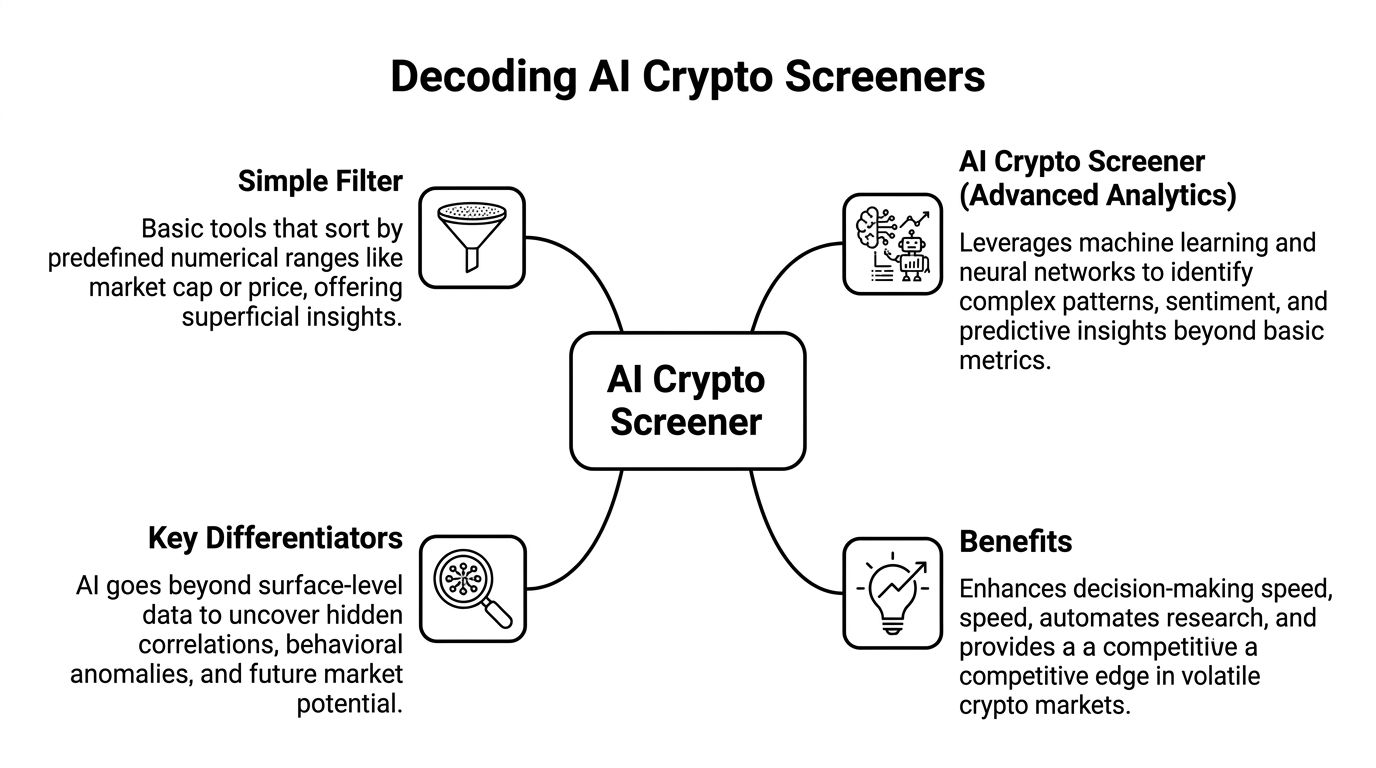
Simple filters versus model-driven screening
Think of a simple filter like searching a spreadsheet. You ask for coins above a threshold, below a threshold, or inside a category. The tool gives back rows.
An AI screener behaves more like an analyst team that never sleeps. It reviews multiple conditions together, detects combinations that tend to matter, and ranks what passes. Modern systems can scan over 3,000 cryptocurrencies in real time and recognize about 26 technical patterns simultaneously, including setups like EMA alignment and RSI divergence, according to altFINS' explanation of AI in crypto trading.
That matters because crypto opportunities often don't announce themselves through one metric. A coin might look strong only when momentum, structure, and participation line up at the same time.
What the AI part actually adds
The useful part isn't the label. It's the combination logic.
A stronger screener can do things a basic filter won't:
Tool type | What it does well | Where it falls short |
|---|---|---|
Basic screener | Finds assets that match explicit numeric rules | Misses context and pattern interaction |
AI crypto screener | Combines signals, ranks setups, and reduces noise | Can become a black box if it doesn't explain itself |
That distinction matters more than marketing language. Many products call themselves AI because they attach a score to a chart. That alone means nothing. What matters is whether the model is combining independent evidence in a way you can inspect.
Practical rule: If a screener can't tell you what kind of evidence pushed a setup to the top, treat its score as a prompt for research, not a reason to deploy capital.
For yield-focused users, this difference is even sharper. A basic filter might show pools with high rates. A stronger AI system should help identify whether those rates are supported by durable conditions or inflated by short-lived behavior that disappears once capital rotates.
How AI Crypto Screeners Actually Work
An AI crypto screener usually has three moving parts. It gathers inputs, processes them through a model, then turns the output into a ranked signal or alert. Once you understand that chain, the tool stops feeling magical and starts feeling auditable.
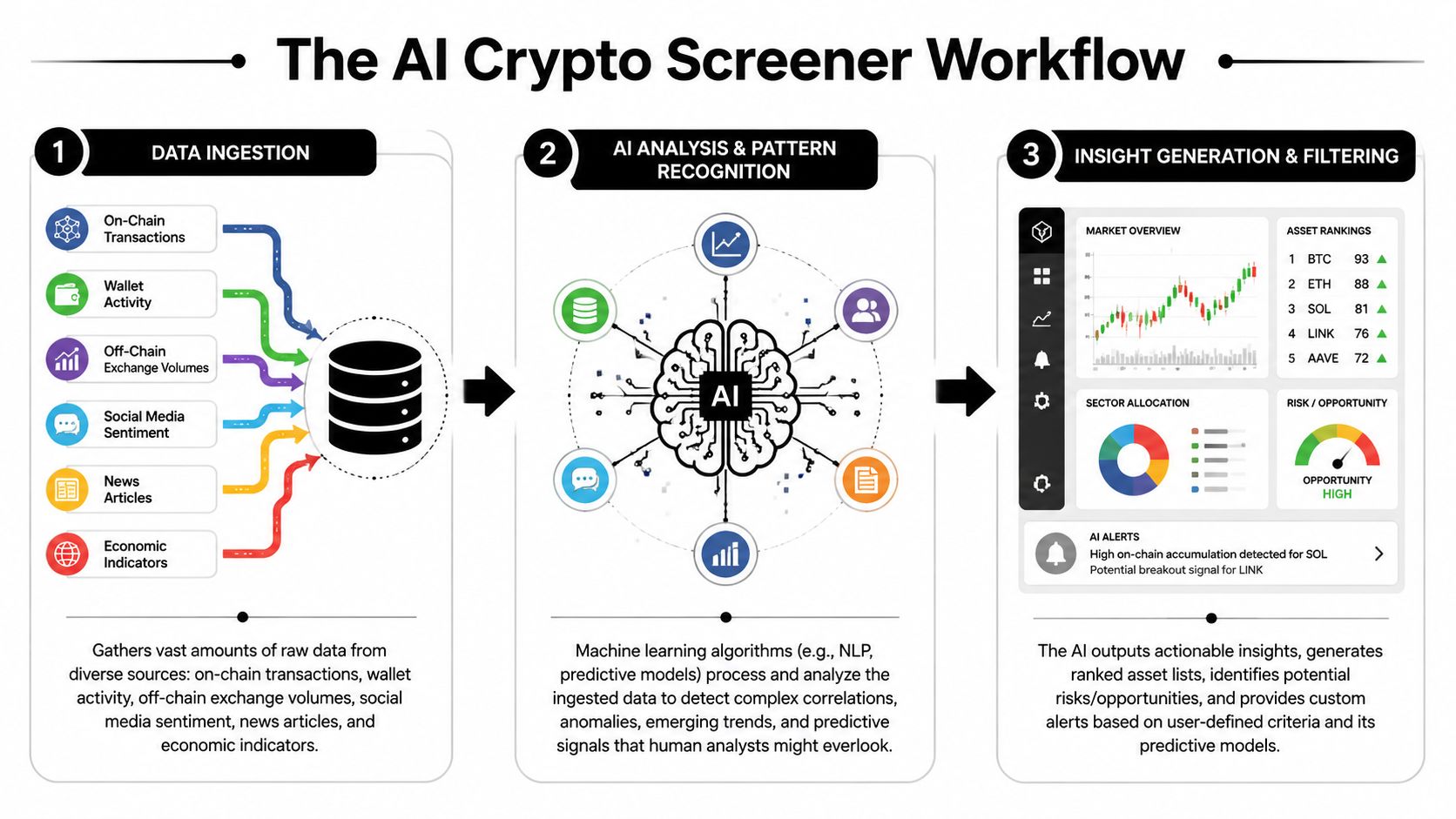
Data comes in from more than one lane
Good screeners don't rely on a single chart feed. They pull in market data, technical indicators, and often on-chain or venue-specific context. Some teams building their own data pipelines start by exploring web scraping API basics because collection quality affects everything downstream.
Professional platforms have expanded well beyond simple price screens. According to altFINS' comparison of crypto screeners, advanced systems can scan 3,000+ cryptocurrencies, use over 150 pre-computed technical indicators, and provide 130+ pre-built trading signals while correlating multiple timeframes and on-chain inputs.
That's the important point. The screener isn't looking for one trigger. It's looking for alignment.
The model scores agreement, not just excitement
Here's where many users get confused. They think the model predicts price. Most of the time, it's doing something more practical. It scores whether multiple independent signs agree on the same directional story.
Some platforms make that logic more explicit. DYOR describes a composite scoring approach that generates a normalized confidence range from -100 to +100, and a stronger signal only appears when at least three independent filters agree across timeframes such as 15m, 1H, and 4H, as explained on DYOR's platform site.
That structure is healthier than a single-indicator alert because it reduces noise. If volume is rising but trend structure is broken, the setup may not pass. If momentum is strong but broader alignment is missing, the model can hold back.
For a deeper look at where this fits in DeFi systems, this piece on machine learning in DeFi is useful background.
A short visual helps if you want to see the concept in action.
What the output should look like to a user
A strong output is not “buy now.” It's closer to this:
A ranked candidate: Something moved to the top because several conditions aligned.
A reason set: You can see which elements mattered, such as momentum, trend, or participation.
A timeframe context: The signal tells you whether it's tactical, swing-oriented, or part of a broader regime.
A next action: Review liquidity, venue quality, and whether the setup fits your mandate.
That last step matters most. An AI crypto screener is good at compression. You still have to decide whether the compressed idea is investable.
Practical Workflows for Stablecoin Yield
Most articles about screeners stop at long and short setups. That leaves out one of the most useful applications: using AI to manage stablecoins with less manual protocol hopping.
If your goal is yield, you need a different workflow from a momentum trader. You're not asking, “Which token might run?” You're asking, “Which opportunity offers competitive yield, acceptable protocol risk, clean liquidity conditions, and flexibility if I need to exit?”
Start with opportunity discovery, not commitment
The first pass should be broad and conservative. Use the system to gather candidates across lending markets, vaults, and other stablecoin venues. Don't chase the highest displayed rate first.
What matters at this stage:
Source of yield: Is it lending demand, incentives, trading fees, or some mixed mechanism?
Capital mobility: Can you exit cleanly if conditions worsen?
Consistency: Does the opportunity look durable, or does it appear to spike briefly and fade?
Operational complexity: More moving parts usually means more things can break.
AI provides its greatest assistance. It watches fragmented venues continuously and surfaces changes faster than a manual routine.
Move from signal to verification
Once a candidate appears, verification matters more than ranking. The workflow should look like this:
Read the signal type clearly
A yield spike means something different from a trend confirmation. Don't mix them.Check protocol context
Ask why the yield is high. New incentives, sudden borrowing demand, and thin liquidity all create very different risk profiles.Review liquidity and exit conditions
A great quoted yield is less useful if size can't move without friction or if unwind paths are messy.Look for confirmation from independent context
On-chain activity, capital persistence, and venue depth all matter more than a headline number.Set a re-check cadence
Yield allocation isn't a one-time choice. Conditions change, so your system should review and re-rank opportunities continuously.
For stablecoin strategies, the best AI signal is often not “enter now.” It's “conditions changed, verify whether this venue still deserves capital.”
What works and what usually fails
The workable setup is an AI-assisted loop where the machine handles monitoring and prioritization, while you control constraints. That's especially effective for treasury managers, busy operators, and users who hold idle stablecoins but don't want to babysit every protocol.
What usually fails is copying a trading screener workflow into yield management. Token momentum logic doesn't translate cleanly into stablecoin allocation. A chart can be bullish while a DeFi venue is operationally unattractive. In yield strategies, plumbing matters as much as price.
A practical user ends up with a simple rule. Let the model search constantly. Let human judgment approve capital movement only after checking why the opportunity exists and how easily it can be exited.
How to Evaluate and Choose a Screener
The selection of a screener is often approached incorrectly. Users compare homepage claims, then sign up for the platform with the busiest interface. That's how you end up paying for noise.
A better approach is to inspect the product the way you'd inspect a strategy. You want to know what goes in, how it ranks, and whether the output matches your use case.
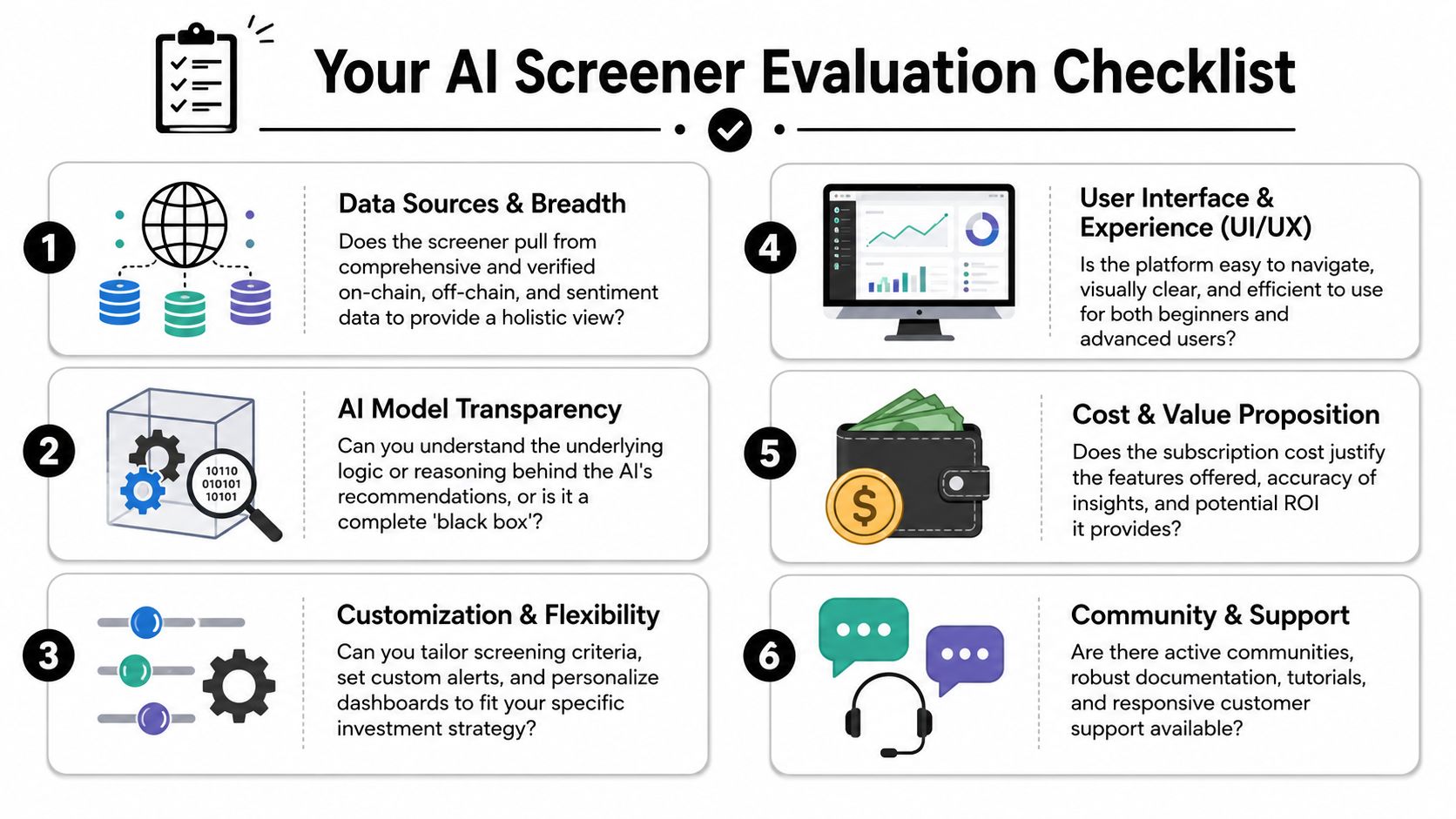
Ask how the score is built
If a platform shows scores but doesn't explain weighting, be careful. Some professional screeners explicitly rank assets using weighted factors such as 50% volume activity, 30% 24-hour price change, and 20% 1-hour price change, as discussed in this YouTube walkthrough on professional crypto screener logic.
That doesn't make one weighting scheme universally correct. It does show the right question to ask: what does this model reward, and does that fit my goal?
A breakout trader may want a screener that emphasizes participation and short-term movement. A stablecoin allocator may care more about risk controls, protocol signals, and capital stability than raw momentum.
Use a practical checklist
Here's the shortlist I'd use before trusting any AI crypto screener:
Method visibility: Can you tell which factors drove the alert?
Coverage fit: Does it cover the venues and asset types you use?
Alert quality: Are notifications specific enough to act on, or are they just noisy pings?
Custom rules: Can you shape the output around your own constraints?
Workflow match: Is it built for trading, allocation, research, or a mix?
Product maturity: Does the interface help you decide quickly, or slow you down?
A useful comparison is whether you need a dashboard or an agent. This breakdown of DeFi dashboards vs AI agents is helpful because many users buy a dashboard when what they really want is monitored decision support.
Specialization matters more than feature count
A general screener can be excellent and still be wrong for you. If your day is spent trading breakouts, broad market coverage and chart pattern logic may be enough. If you're allocating stablecoins, you need a system that respects different constraints.
That's why “best screener” is usually the wrong question. The better question is, “Best screener for what decision?”
Risks and the Black Box Problem
The biggest failure mode with AI tools isn't bad math. It's misplaced trust.
A platform gives a high-confidence signal, the interface looks polished, and the user assumes the hard part is done. In crypto, that's dangerous. Models can overfit. Data can be incomplete. A setup can score well and still be unusable in live conditions.
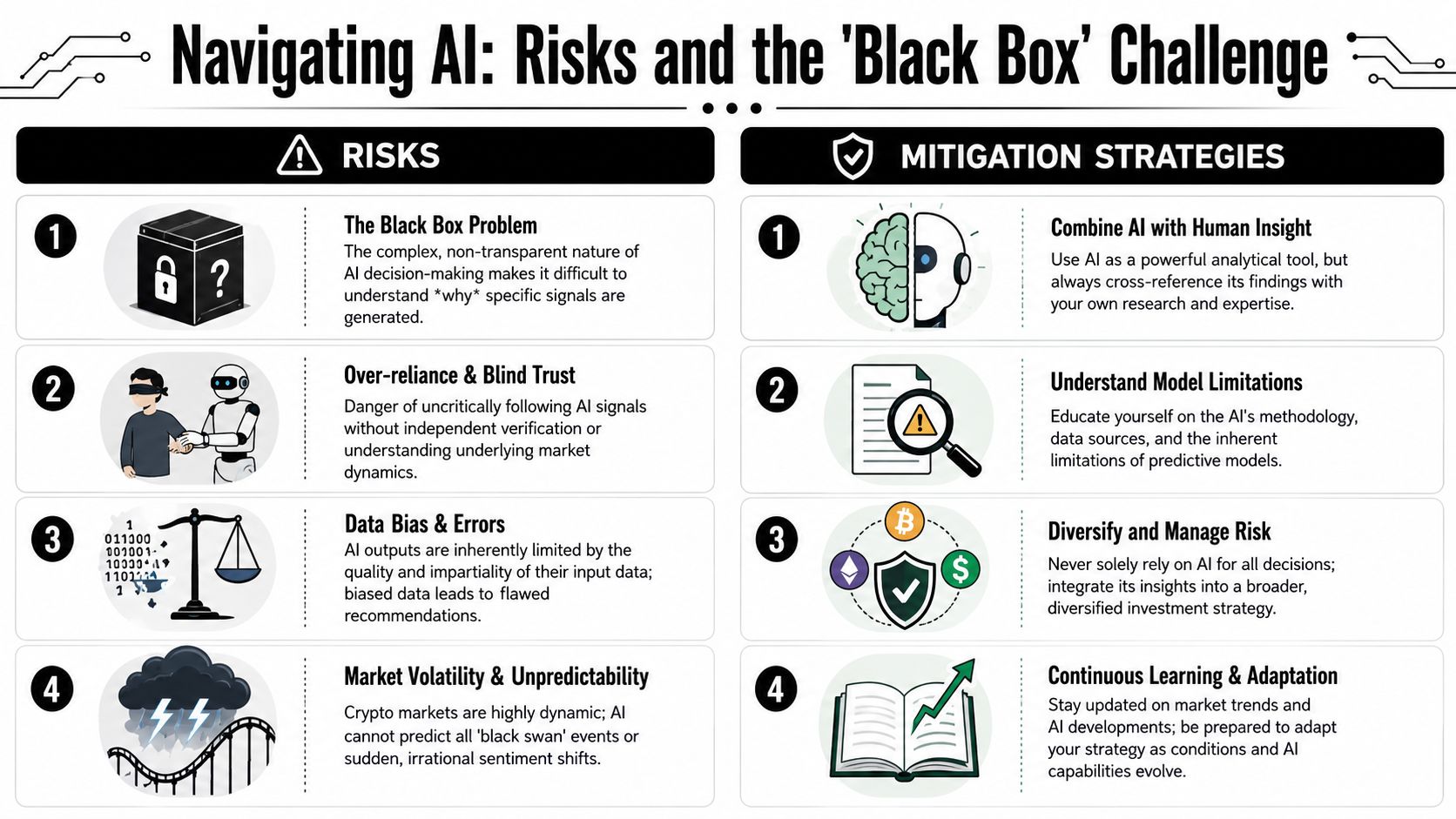
Why users hesitate to trust AI signals
This trust problem is common enough that it shows up directly in user concerns. One recurring issue is the black box gap: not knowing whether a flagged signal reflects a genuine anomaly or a hallucinated pattern. The concern gets worse when models expose confidence scores without visible validation logic, as described in this summary of the black box trust gap around AI crypto signals.
That concern is valid. A score isn't evidence. It's a compression of evidence.
If you can't inspect the path from raw input to final alert, you shouldn't treat the output as authoritative.
How to audit an AI signal before acting
This is the part most guides skip. A good audit process is simple enough to repeat.
Check signal composition: Don't act until you know whether the alert came from trend, momentum, volume, or a mixture.
Cross-reference market structure: Review venue liquidity, recent participation, and whether the setup survives outside the platform's own chart.
Test the path to exit: For DeFi and smaller assets, a signal is only as good as your ability to unwind.
Use small initial allocations: Let real market behavior confirm the thesis before sizing up.
Track false positives: If a screener keeps surfacing setups that look strong but fail quickly, the problem may be the model fit, not your execution.
For teams automating around AI, security matters too. If a platform connects signals to execution, reviewing an AI agent security assessment can help frame the operational risks around autonomous actions, permissions, and failure handling.
What works in practice
The healthiest approach is to treat AI as a decision support layer. Let it search broadly, rank quickly, and alert continuously. Then apply your own rules before capital moves.
That hybrid approach does two things. It preserves the machine's advantage in scale and speed, and it preserves the human advantage in skepticism, context, and mandate fit.
Blind trust fails. Blind rejection also fails. The workable middle ground is verification.
If you want that verification mindset applied to stablecoin yield, Yield Seeker is built for exactly that workflow. It helps users deploy stablecoins with an AI agent that monitors DeFi opportunities in real time, while keeping the experience simple, flexible, and focused on risk-aware yield rather than random signal chasing.